HCPCS Code G0163: Skilled nursing observation and assessment
What is HCPCS Code G0163? HCPCS Code G0163 is a deleted Level II code for skille...

Last Updated: Oct 15, 2026
33249 is the CPT code for insertion or replacement of a permanent implantable defibrillator system, with transvenous lead(s), single or dual chamber. The code covers the pulse generator and the transvenous lead or leads placed in the same session.
Three problems account for most denials on this code. They are a missing or undated LVEF study, an ICD-10 pairing that fails Medicare NCD 20.4, and a skipped prior authorization.
Let Pabau's smart automation suggest the right codes, reduce claim denials, and keep your practice compliant—effortlessly.
Automate repetitive tasks and focus on what matters most—your patients.
Reduce coding errors and ensure compliance with the latest regulations.
Clean claims, fewer denials, and faster reimbursements.
Powerful insights and reporting to help your practice thrive.
HIPAA compliant SOC 2 certified GDPR-compliant Trusted by 4,000+ clinics worldwide

CPT code 33249 covers a new or replacement transvenous ICD system. Subcutaneous systems take 33270, and a generator-only swap takes 33262, 33263 or 33264.
Primary-prevention coverage under NCD 20.4 needs a documented LVEF of 35% or below, plus a recorded shared decision-making encounter.
33249 carries 23.89 total RVUs under the CY2026 Medicare Physician Fee Schedule, the same in facility and non-facility settings.
Missing LVEF documentation and ICD-10 pairing mismatches are the two leading denial causes. A pre-submission checklist prevents both.
Pabau’s claims management software supports structured billing workflows for high-complexity cardiac codes, including pre-authorization tracking and claim status visibility.
CPT code 33249 reports insertion or replacement of a permanent transvenous implantable defibrillator system, single or dual chamber. The generator and the transvenous lead or leads are both paid under this one code.
The American Medical Association’s CPT code set gives 33249 one official descriptor. It reads: Insertion or replacement of permanent implantable defibrillator system, with transvenous lead(s), single or dual chamber.
Pocket creation and intraoperative device programming are included in the code and cannot be billed separately. Defibrillation threshold testing performed at implant is the exception, and it is reported with CPT 93641.
Understanding the surgical steps matters because operative note documentation must map directly to what CPT code 33249 covers. An electrophysiologist performs the procedure under fluoroscopic guidance, typically under conscious sedation or general anesthesia.
The operative note must reflect each of these steps. A note that simply states “ICD implanted without complication” lacks the procedural detail payers expect to confirm that all bundled components were performed.
Medicare coverage for CPT code 33249 is governed by National Coverage Determination 20.4, administered by the Centers for Medicare and Medicaid Services. Claims that do not satisfy NCD 20.4 are denied for medical necessity regardless of diagnosis code accuracy. The criteria differ by clinical indication.
The LVEF measurement must be dated. CMS expects the echo or nuclear study to have been performed within a reasonable timeframe before the procedure. A value greater than 35% or an undated study will trigger a medical necessity denial.
NCD 20.4 also requires a shared decision-making encounter before a primary-prevention implant, using an evidence-based decision aid. Record it as its own dated note rather than a line inside the consultation letter.
Every CPT code 33249 claim requires at least one ICD-10-CM diagnosis code that supports the clinical indication. Payers cross-reference the diagnosis against NCD 20.4 criteria automatically. Mismatches cause immediate rejection.
I47.2 has not been billable since 1 October 2022, so a claim carrying it will reject on the code itself. Use I47.29 for documented ventricular tachycardia, or I47.20 where the type is not specified.
Use the most specific available code. For an ischemic primary-prevention implant, I25.10 is the usual pairing, supported by the catheterization or imaging report. Do not use I42.9 when a documented etiology is in the record, because unspecified codes trigger additional documentation requests from Medicare Administrative Contractors.
The defibrillator family spans new implants, generator-only exchanges, subcutaneous systems and pacing devices. Selecting the wrong code among these is the most common technical billing error on these procedures.
The most consequential distinction is 33249 against a generator-only exchange. If the surgeon removed the existing generator and reused the leads already in place, the correct code is 33262, 33263 or 33264. Which one depends on how many leads the system carries. Billing 33249 for that case claims lead work nobody performed.
One add-on code attaches to 33249, and one further code covers a separate service performed in the same session. Both depend on what the operative note actually records.
Fluoroscopic guidance is bundled into the implant and is not separately reportable, so 76000 does not belong on the claim. The ICD pulse generator and the leads are not billed on the physician claim either. The facility is paid for the device through its own claim, under the inpatient DRG or the outpatient OPPS rate.
Medicare fee-for-service does not require prior authorization for CPT code 33249 as a standalone requirement. However, prior authorization is commonly required by Medicare Advantage plans, commercial insurers, and managed Medicaid programs. Skipping this step accounts for a disproportionate share of preventable denials.
For emergency ICD implants, document the emergent nature in the record and submit retroactive authorization where required. Most payers accept retrospective review for life-threatening indications. Reviewing medical billing compliance standards for your payer mix keeps the authorization step from being skipped on urgent cases.
Incomplete documentation is the root cause of most 33249 denials that survive the initial edit scrub. The medical record must contain all of the following before the claim is submitted. Pabau, the practice management platform we build, includes software for billing teams that holds a claim in the queue until every item is attached.
Several of these items carry a deadline that predates the procedure, so the order they are gathered in matters as much as the list itself.
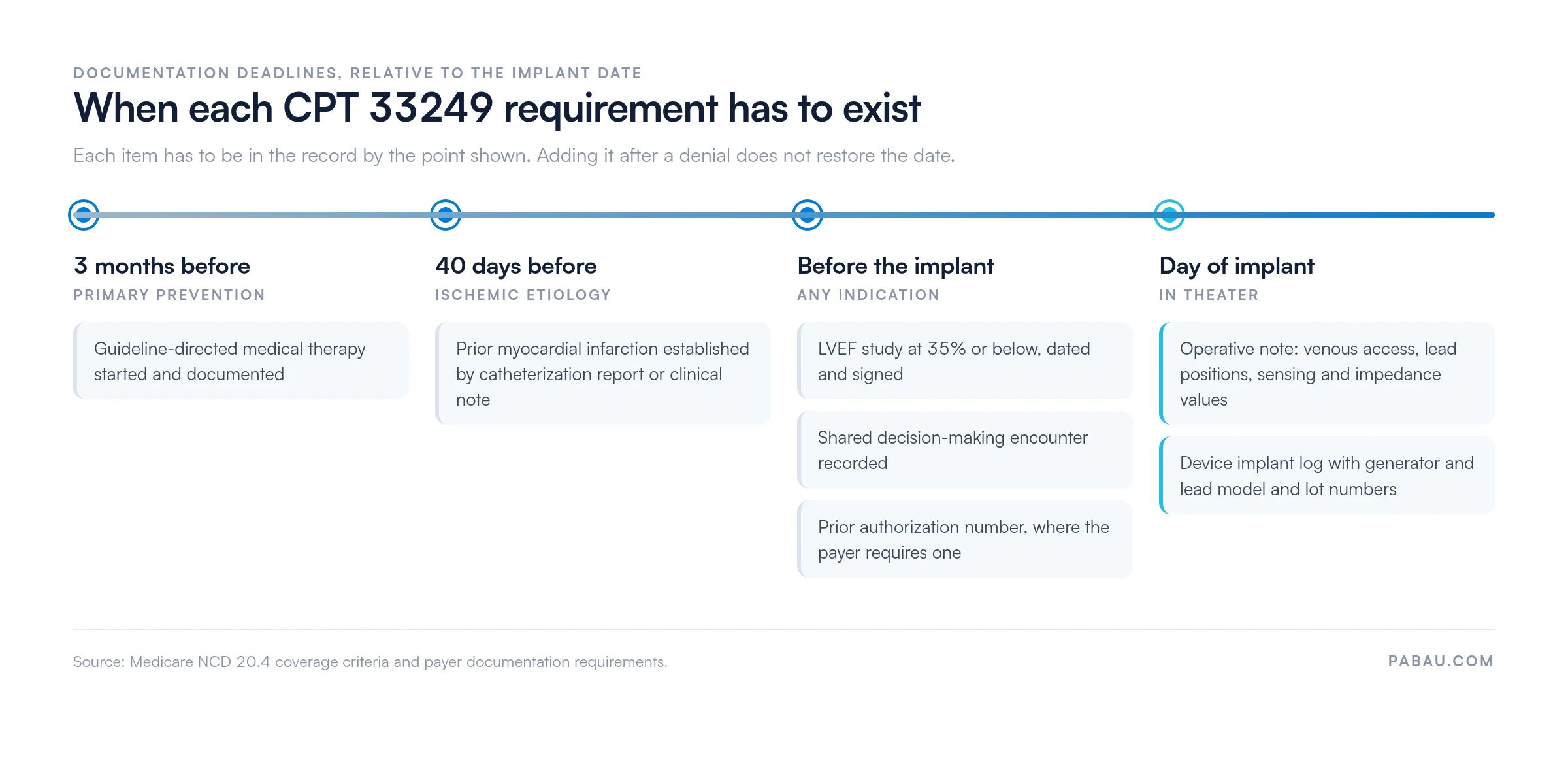
Run a pre-claim checklist against this list for every 33249 case before it leaves the billing queue. A single missing item is enough to trigger a medical necessity denial. The LVEF date and the GDMT documentation are the usual culprits, and the appeal then takes 60 to 90 days.
Medicare reimbursement for CPT code 33249 is calculated from the Medicare Physician Fee Schedule (MPFS), which the Centers for Medicare and Medicaid Services updates annually. The CMS Physician Fee Schedule lookup tool provides current payment amounts by locality.
RVU values change with each annual MPFS rule. Use the FastRVU lookup tool or the CMS fee schedule download to confirm current values, then apply your geographic practice cost index (GPCI) adjustment. The device itself is not inside this professional fee. The facility is paid for it on its own claim.
The electronic remittance advice (ERA/835) returned after payment posts will show the allowed amount, any contractual adjustment, and the patient responsibility. Reconciling ERAs against expected MPFS rates for 33249 is a straightforward way to catch underpayments.
Most denials on CPT code 33249 fall into five categories. Each is avoidable with pre-claim checks rather than post-denial appeals. Understanding denial management workflows reduces the 60 to 90-day lag that unresolved cardiac code denials typically create.
Building a clean claim for 33249 means all five issues are resolved before submission. Post-denial correction on a cardiac device implant averages more rework than almost any other inpatient procedure code.
Modifier selection decides whether 33249 is paid at full value, at a reduced rate, or split between two surgeons. On a code this large, the wrong modifier costs either revenue or an audit.
Never append modifier -22 without a supporting cover letter. Payers that accept -22 on the claim form without documentation will pay initially, then audit and recoup. Document the complexity in the operative note at the time of surgery, not retrospectively.
In most cardiology practices the evidence for an NCD 20.4 claim is scattered. The echo report sits in the imaging system and the GDMT history in the medication list. The authorization number lives in a spreadsheet, and the implant log in a paper folder.
Pabau holds all of it against the appointment the implant was booked under. Uploaded reports, consent notes, authorization numbers and device details attach to the patient record, so the coder opens one screen instead of four. A pre-submission checklist then keeps the claim in the queue until the dated LVEF value is attached.
Fewer claims leave the practice short of one dated document. Denials that would have taken 60 to 90 days to appeal never get raised in the first place.

Pabau gives cardiology and electrophysiology teams a structured workflow for high-complexity claims. Pre-submission checklists, real-time claim status, and integrated prior authorization tracking keep 33249 and related cardiac codes moving through the revenue cycle without manual follow-up.

CPT code 33249 carries substantial reimbursement and equally substantial documentation requirements. The two most preventable failure modes are undated LVEF studies and missed prior authorizations on commercial plans. A structured pre-claim workflow catches both before the claim is filed.
Decide where in your own workflow each deadline in the timeline above gets checked. A claim held at the scheduling desk costs a phone call, while the same claim held at the clearinghouse costs a quarter of revenue.
Pabau brings pre-authorization tracking, claim status and ERA reconciliation into one platform, which is where accurate medical billing starts for a cardiology team. To see how Pabau handles a 33249 claim end to end, book a demo.

Need to understand how claims move through a clearinghouse? Medical claims clearinghouse overview explains the submission and adjudication process from file validation through ERA posting.
Want to track down a denial’s root cause quickly? Claim.MD clearinghouse guide covers how Pabau’s US clearinghouse partner handles real-time eligibility, claim status, and CARC denial codes.
Looking to reduce claim errors across your revenue cycle? Revenue cycle management explained walks through the end-to-end RCM process and where cardiology billing teams typically lose revenue.
CPT code 33249 covers insertion or replacement of a permanent transvenous implantable cardioverter-defibrillator (ICD) system, single or dual chamber. The pulse generator and all transvenous leads are included, along with pocket creation and intraoperative programming. Defibrillation threshold testing at implant is the exception, and it is reported separately with CPT 93641.
The Medicare physician fee for CPT 33249 is based on 23.89 total RVUs under the CY2026 Physician Fee Schedule. That figure is multiplied by the annual conversion factor and adjusted for your locality. Use the CMS Physician Fee Schedule lookup for the current amount. The device is not inside this professional fee, because the facility is paid for it on its own claim.
CPT 33249 covers transvenous ICD systems, where the leads run through a vein into the heart chambers. CPT 33270 covers the subcutaneous ICD, whose electrode sits under the skin and never enters the vasculature. They are not interchangeable and cannot be billed together on the same claim.
Yes. CPT 33225, which covers left ventricular lead placement for cardiac resynchronization therapy, is a designated add-on code to CPT 33249. When a CRT-D system is implanted in a single session and an LV lead is placed, bill both 33249 and 33225 together. CPT 33225 cannot be reported as a standalone code.
The required ICD-10-CM diagnosis codes depend on the clinical indication. Common pairings include I25.10 for ischemic primary prevention, I42.0 for dilated cardiomyopathy, I49.01 for ventricular fibrillation, and I47.29 for other ventricular tachycardia. I47.2 was split on 1 October 2022 and is no longer billable. The selected code must map to a covered NCD 20.4 indication or the claim will be denied for medical necessity.
The most common denials are NCD 20.4 medical necessity not met and a missing or undated LVEF study. An incorrect ICD-10 pairing and a missing prior authorization follow. NCCI bundling edits are the fifth, triggered by billing 33249 with a mutually exclusive code such as 33262 or 33270.
Prior authorization is not required by original Medicare fee-for-service, but it is commonly required by Medicare Advantage plans, BCBS affiliates, and Carelon-managed commercial plans. Verify PA requirements with the specific payer before scheduling an elective implant. For emergent cases, document the emergent indication and submit retroactive authorization as the payer’s policy allows.