

CCSD code G5100: Bypass of duodenum billing guide
CCSD code G5100 bills a bypass that leaves the duodenum in place CCSD code G5100...

Last Updated: Oct 16, 2026
93288 is the CPT code for an in-person interrogation of a single, dual, multiple lead or leadless pacemaker, with analysis, review and report. The clinician connects to the device, records its data, disconnects and signs an interpretation.
The check looks routine, yet the code turns on two questions. What is implanted, and did anyone change a setting? An ICD goes to 93289, and a loop recorder goes to 93291. Reprogramming moves the visit to 93279-93281, which are not reported with 93288 on the same date. Get both answers from the device record before you code, and the rest of the claim follows.
Let Pabau's smart automation suggest the right codes, reduce claim denials, and keep your practice compliant—effortlessly.
Automate repetitive tasks and focus on what matters most—your patients.
Reduce coding errors and ensure compliance with the latest regulations.
Clean claims, fewer denials, and faster reimbursements.
Powerful insights and reporting to help your practice thrive.
HIPAA compliant SOC 2 certified GDPR-compliant Trusted by 4,000+ clinics worldwide

CPT code 93288 covers an in-person interrogation of a single, dual, multiple lead or leadless pacemaker, with analysis, review and report.
ICDs go to 93289 and subcutaneous loop recorders go to 93291, so confirm the device from the implant record before you code.
Programming is never bundled into 93288. When settings change, bill 93279-93281 and leave 93288 off that date.
In 2026, 93288 carries 0.42 work RVUs and pays about $55 nationally before locality adjustment.
Remote pacemaker monitoring is billed with 93294 and 93296, and each covers a period of up to 90 days.
CPT code 93288 reports an in-person interrogation of an implanted pacemaker. The clinician reads the device, reviews the data and signs a report. The American Medical Association descriptor packs four elements into one line, so here it is in parts.
Leadless pacemakers joined the descriptor in CPT 2019. Programming is not part of the code. If settings change, the visit becomes a programming evaluation, which has its own codes.
The device in the chest decides the code. Check it against this table before you build the claim.
An in-person pacemaker check follows a steady sequence. Here is how a routine visit runs from start to finish.
Those six steps are the whole service. Notice what the list leaves out, which is any change to a setting.
Suppose the clinician adjusts output, rate or mode to find better values. That work is a programming evaluation, reported with 93279, 93280 or 93281 by lead configuration. In that case, 93288 is not reported for the same date.
The word “iterative” separates the two code sets. The programming descriptors describe iterative adjustment of the device to test its function and select the best permanent values. Interrogation only reads the device and reports on it.
Here is a quick example. A patient with a dual-chamber pacemaker arrives for a routine check. The atrial capture threshold has risen, so the clinician raises the output and retests until capture is stable. That visit is a dual-lead programming evaluation, 93280, and 93288 stays off the claim.
Both questions fit on one chart. Work through it in order, and each answer points to a single in-person code.
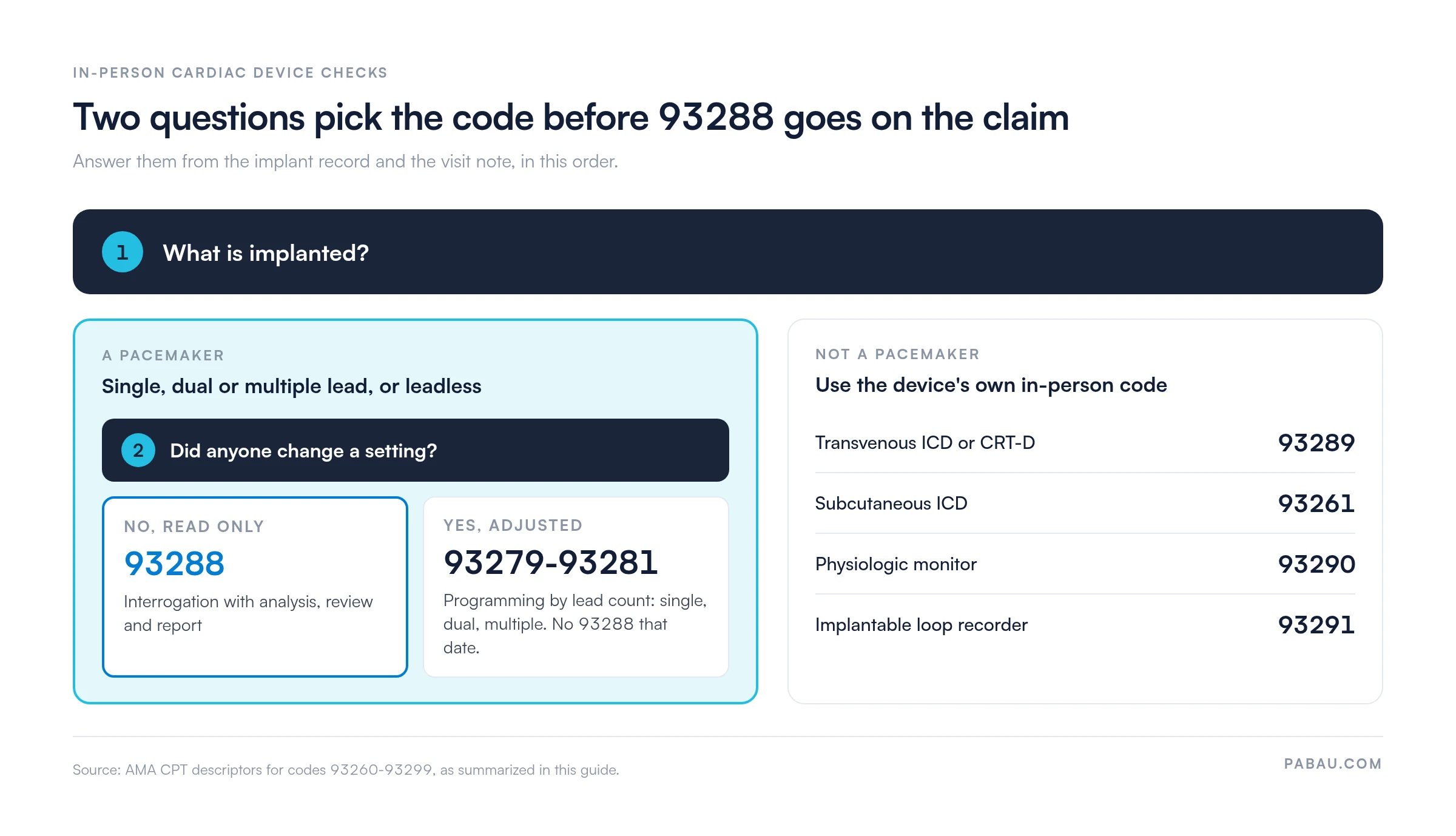
93288 is for pacemakers. 93289 is for transvenous defibrillators, CRT-D included, and it adds analysis of heart rhythm derived data. A device that can deliver a shock goes to 93289, however many leads it has.
The fix is the same each time. Take the device type from the implant record or the manufacturer card, not from memory or the visit reason.
93288 belongs to the CPT range for implantable, insertable and wearable cardiac device evaluations, 93260-93299. These are the neighbors you will meet on pacemaker claims and the devices around them.
Run through this list before you release the claim. Each line answers a question a reviewer is likely to ask.
A superbill that captures device details at the visit saves a round of chart requests later. It also gives your clean claim review something concrete to check against.
Frequency limits come from your Medicare Administrative Contractor and each commercial plan, not from the CPT descriptor. Check the active policy before an extra check, and record the clinical reason. Good medical billing compliance habits make that note routine.
93288 has a professional and a technical component on the Medicare fee schedule. Who supplies the equipment and staff decides how you bill it.
Never append 26 and TC to the same line. If one provider does both parts, the global code is the right claim.
Medicare pays 93288 under the CMS Physician Fee Schedule. The figures below use the 2026 national RVUs and the $33.4009 conversion factor. Your locality adjustment moves them up or down.
RVUs are from the CMS 2026 national relative value file, as listed by FastRVU. Confirm your locality rate in the CMS look-up tool before you load expected payments. Commercial plans set their own rates, so compare each contract separately.
Load the 2026 rate for your own locality, not the national figure. Geographic adjustment can move the 93288 allowable well away from $55, and payment posting is only as good as that baseline.
The diagnosis should say why the pacemaker was checked. These ICD-10-CM codes fit common routine and problem-focused visits.
These errors come up again and again on pacemaker check claims. Each one has a simple guard.
Log each rejection by reason as part of your denial management routine. Repeat patterns then surface early, while they are still cheap to fix.
Many pacemaker patients also send transmissions from home. Those checks are billed with remote codes, never with 93288.
Report each 90-day code once per period. CPT also bars 93294 when the monitoring period is shorter than 30 days.
An in-person check can fall inside an open remote period. Before you bill both, check the CPT parenthetical notes and current NCCI edits for those dates. Your electronic remittance advice then shows how each payer handled the pair.
Once the visit is coded, the work shifts to getting paid. That means sending the claim, watching its status and matching what the payer returns.
Pabau, our practice and billing software, handles that stretch for US practices through its Claim.MD integration. You submit 93288 claims electronically from the patient record. Claim status and remittances then come back to the same place.
Your billing team sees which claims were accepted, which were paid and which need follow-up. Nobody has to log in to a separate portal to chase each one. See how claims management in Pabau works.
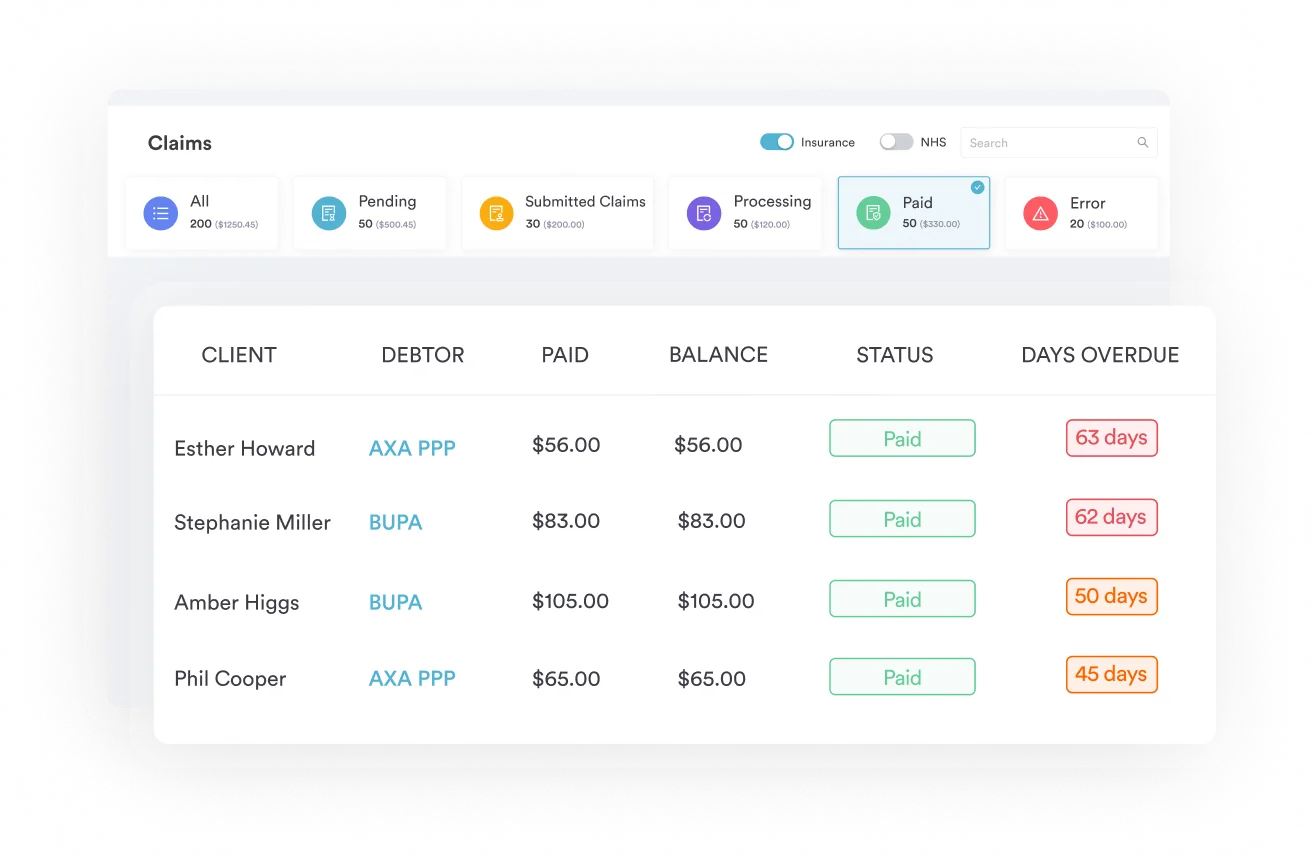

Pabau submits 93288 and related device claims electronically through Claim.MD. Claim status and remittances come back to one place, so your team spends less time chasing payers.

Two questions settle the code on a pacemaker check. Is the device a pacemaker, and did anyone change a setting? Answer both from the implant record and the visit note, and 93288 either fits or it does not.
Build those two checks into intake instead of leaving them to the coder. It costs a minute at check-in and spares you a rejected claim and a chart request later. Book a demo to see how Pabau submits and tracks your cardiac device claims.

Need to understand clearinghouse claim submission for cardiac codes? Pabau’s Claim.MD clearinghouse guide explains how electronic claim submission works for cardiology and specialty practices.
Seeing denial codes on your remittance you don’t recognize? Denial codes in medical billing covers the most common CARC and RARC codes returned on cardiac device claim rejections.
Want to build a cleaner billing process across your practice? Revenue cycle management fundamentals walks through the end-to-end workflow from charge capture to payment posting.
Changing settings at the check instead? CPT code 93280 covers the programming evaluation of a dual-lead pacemaker, the code that replaces 93288 on that date.
Billing remote loop recorder transmissions? CPT code 93298 explains remote monitoring of subcutaneous rhythm monitors and its 30-day period.
Per visit. The descriptor reports the service per patient encounter, including connection, recording and disconnection. One in-person pacemaker check is one unit of 93288.
Use 93291 for an in-person interrogation of a subcutaneous cardiac rhythm monitor. Programming that device uses 93285.
Yes, when the check is medically necessary and documented. The interpreting clinician bills the professional component with modifier 26, because the hospital supplies the equipment and staff.
A physician or other qualified health care professional. Trained staff can help with connection and recording under your supervision rules, but the signed interpretation must come from the billing clinician.
Yes, when the visit treats a separate problem beyond the device check. Document that work on its own and append modifier 25 to the E/M code. Check payer policy first, because some plans bundle the two.



