HCPCS code P9058: Red blood cells, leukocytes reduced, CMV-negative, irradiated
HCPCS code P9058: Official descriptor and key attributes HCPCS code P9058 report...

Last Updated: Oct 26, 2026
33216 is the CPT code for insertion of a single transvenous electrode for a permanent pacemaker or implantable defibrillator. It covers the lead only, so the pulse generator is coded separately and a second new lead moves the claim to 33217.
Most 33216 denials trace back to four causes: Wrong code selection, missing prior authorization, thin medical necessity documentation, and bundling errors. Repositioning an existing lead is a different code, 33215.
Let Pabau's smart automation suggest the right codes, reduce claim denials, and keep your practice compliant—effortlessly.
Automate repetitive tasks and focus on what matters most—your patients.
Reduce coding errors and ensure compliance with the latest regulations.
Clean claims, fewer denials, and faster reimbursements.
Powerful insights and reporting to help your practice thrive.
HIPAA compliant SOC 2 certified GDPR-compliant Trusted by 4,000+ clinics worldwide

CPT code 33216 covers insertion of one new transvenous electrode only, and a second new lead in the same session calls for 33217 instead.
Repositioning an existing lead is a separate code, 33215, so it never goes on the claim as 33216.
Medicare assigns 33216 a 90-day global period, so related care in that window needs the correct modifier to be paid separately.
Modifier 52 (reduced services) belongs on a procedure that was curtailed before completion, and leaving it off invites a denial.
The pulse generator and device hardware are billed under separate codes and are never included in 33216.
CPT code 33216 describes the insertion of a single transvenous electrode for a permanent pacemaker or implantable defibrillator system. That wording comes from the American Medical Association’s CPT code set. It sits in the Pacemaker or Implantable Defibrillator subsection (33202-33249) of the cardiovascular surgery codes. Its neighbors cover dual-lead, complete-system, repositioning and replacement procedures.
The key clinical distinction is electrode count. CPT code 33216 applies when exactly one new transvenous lead is inserted, whether for a system upgrade or a lead replacement. Coders regularly confuse it with 33217 (two leads) or mix up the lead-insertion code with a generator code. The operative report must make single-lead insertion explicit.
CPT code 33216 covers the transvenous placement of one new pacing or sensing electrode, for either a pacemaker or an ICD system. It’s reported on its own when a lead is added or replaced independently of the generator. It can also sit alongside a generator-only code when a new lead goes in during the same session.
Repositioning a lead that’s already implanted is a different code, 33215. Several other services also fall outside the 33216 scope, and bundling them incorrectly is among the most common reasons claims are rejected.
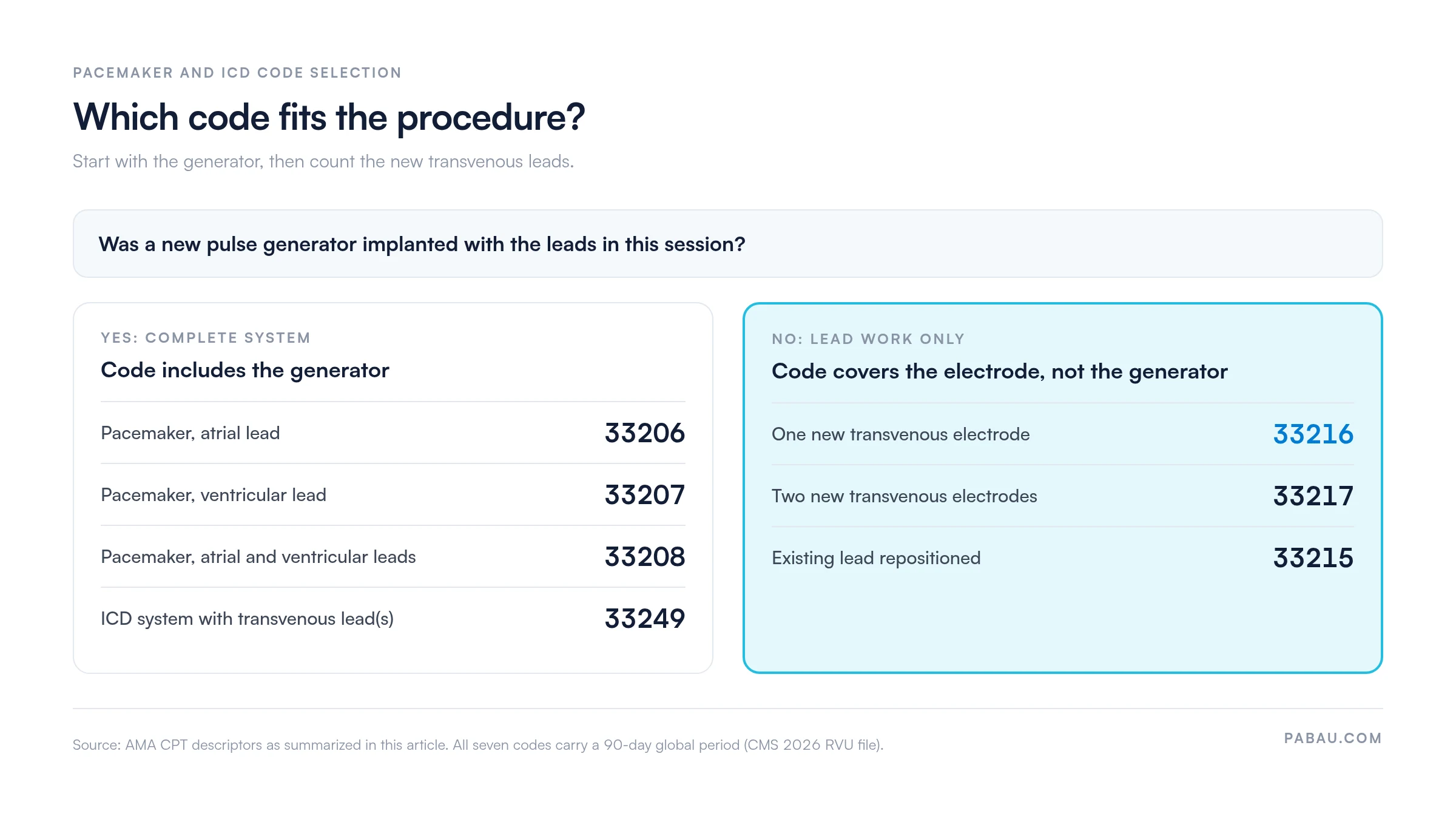
Selecting the wrong code from the pacemaker and ICD family is the single largest source of 33216 claim errors. Three variables separate the codes: Electrode count, whether the generator is included, and whether the system is a pacemaker or an ICD.
Review the AAPC CPT code lookup to confirm descriptor language for any code in this range before billing.
Common confusion point: 33208 is often chosen by mistake when a coder sees “dual chamber” in the operative report. But 33208 includes the generator. If the report describes lead insertion only, 33216 (or 33217 for two leads) is correct. 33249 trips up ICD claims the same way, because it already includes the generator and the lead(s). The diagram below sorts the whole family with two questions.
Documentation decides whether a 33216 claim survives medical necessity review. The operative report must do more than confirm that a lead was placed. It must establish medical necessity, identify the device system, and justify a single lead over a dual-lead alternative. Capture these details in line with medical billing compliance rules, so the record holds up when a payer audits it.
Flag missing threshold testing values before claim submission. Payers routinely request operative records for cardiac implant procedures. A report lacking impedance and threshold data at implant is a fast path to a medical necessity denial.
Applying the right modifier to CPT code 33216 prevents underpayment and compliance risk in equal measure. The most consequential is modifier 52, but several others apply depending on the clinical scenario and billing arrangement.
Use modifier 52 whenever the procedure is curtailed. Billing an incomplete 33216 at the full rate overstates the service and creates false claims exposure. The modifier tells the payer what happened, and the operative note explains why.
Medicare pays for CPT code 33216 under the Physician Fee Schedule (MPFS), with rates set annually by CMS and adjusted by geographic locality. In the CMS 2026 RVU file, 33216 carries 5.48 work RVUs, 3.15 practice expense RVUs, and 1.29 malpractice RVUs. That’s 9.92 in total, or about $331 nationally at the file’s $33.4009 conversion factor.
Your MAC locality moves that figure up or down. Use the CMS Physician Fee Schedule lookup tool to retrieve the rate for your locality. For a quick RVU-based calculation by location, FastRVU’s 2026 RVU lookup pulls the work, PE, and MP values alongside the conversion factor.
Medicare does not require prior authorization for CPT 33216, but the procedure must meet National Coverage Determination (NCD) criteria. NCD 20.4 governs Medicare coverage of implantable cardioverter defibrillators. NCD 20.8 covers cardiac pacemakers, and its section 20.8.3 covers permanent pacemakers. The ICD criteria include LVEF thresholds, while the pacemaker criteria turn on documented symptoms. A claim that passes technical billing checks but fails medical necessity review will still be denied.
Commercial payers are a different matter. Most major carriers require prior authorization for cardiac device procedures. Run insurance eligibility verification and check authorization status well before the scheduled procedure date. The payer may also require ACC/AHA guideline-aligned documentation of the underlying indication. A Level I or IIA indication is generally required for reimbursement.
Most CPT code 33216 denials trace back to four root causes: Wrong code selection, missing authorization, thin medical necessity documentation, and bundling errors. Modifier and place-of-service slips complete the list below. Denial management workflows that catch these before submission spare you a long appeal on a high-value cardiac claim.
The CMS National Correct Coding Initiative (NCCI) bundles certain component services into CPT code 33216. They can’t be billed separately unless an NCCI-associated modifier permits it. Coders who know the code but not its edits make two mistakes. They skip separately payable services, or they split out bundled ones. The second one is what auditors look for.
Your electronic remittance advice (ERA) shows the CARC and RARC codes that point to an NCCI violation on a submitted claim.
NCCI edits update quarterly, so check the current CMS tables before you submit. A clean claim also needs the technical and coding details payers audit on cardiac device procedures.
Run a quarterly audit of 33216 claims against the current CMS NCCI PTP edit table. Pull every claim where a modifier 59 or X-modifier was appended and confirm the operative note supports a distinct service. Auditors flag modifier overuse on cardiac implant codes as a compliance risk.
A 33216 claim usually gets assembled from three places, and each handoff can drop something. The lead count lives in the operative note, the authorization lives in a payer portal, and the claim goes out through a separate clearinghouse.
Pabau, the practice management and billing platform we build, keeps those steps on one patient record. Through its Claim.MD integration, your team checks coverage and benefits in real time before the procedure date. Pabau then turns the invoice into an electronic CMS-1500 claim and sends it to thousands of US payers.
Electronic remittance advice comes back into Pabau and lands against the claim it settles. With claims software for cardiology practices, a 33216 denial shows up next to the note that explains it. So your team can correct and resubmit without hunting across systems.
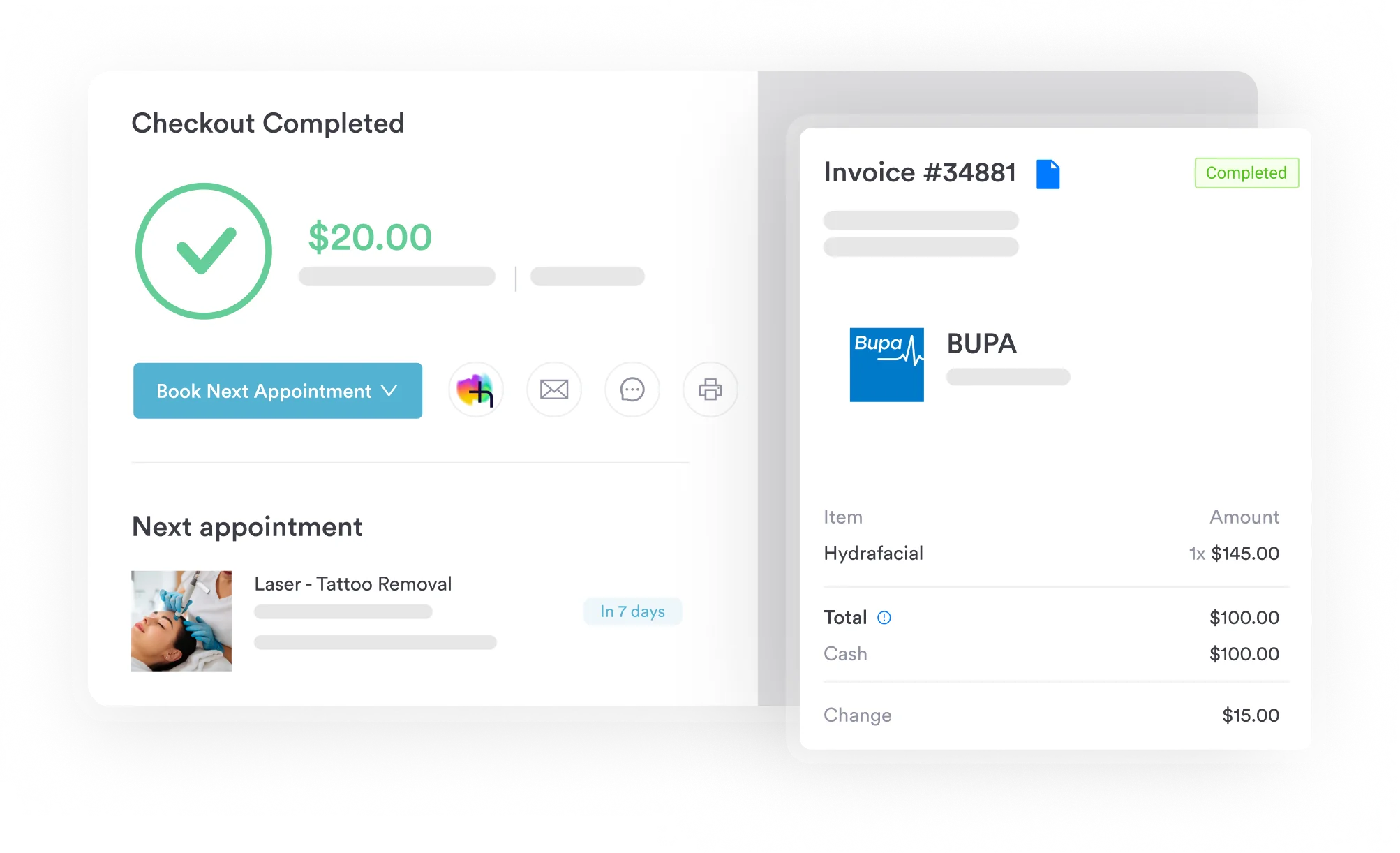

Pabau checks coverage before the procedure, turns the invoice into an electronic claim through Claim.MD, and posts the remittance back against it. Your team spends less time chasing 33216 denials.

CPT code 33216 rewards the coder who reads the operative note before choosing a code. Confirm that one new lead went in and that no generator code already includes it. Then check the 90-day global window before anything else goes on the claim.
The trade-off is a few minutes up front against weeks of appeals later. Matching the note to the code, the NCD, and the NCCI edits costs far less than reworking a denied cardiac claim.
Book a demo to see how Pabau links the operative note, the eligibility check, and the claim for every 33216 your practice bills.

Need to understand how clearinghouse submission works? Medical claims clearinghouse explained walks through how 837P claims move from practice to payer.
Want to reduce claim rejection rates across your practice? Revenue cycle management fundamentals covers the end-to-end process from eligibility through payment posting.
Wondering how to handle insurance credentialing for new cardiologists? Getting credentialed with insurance companies covers the enrollment steps that determine whether claims like 33216 are even payable.
Billing a complete dual chamber pacemaker instead? CPT code 33208 covers the code that bundles the generator with atrial and ventricular leads.
Placing a temporary pacing lead during the procedure? CPT code 33210 explains when temporary transvenous pacing is billed and when it bundles.
CPT code 33216 is the procedure code for insertion of a single transvenous electrode for a permanent pacemaker or implantable cardioverter-defibrillator (ICD) system. It covers the lead component only. The pulse generator is billed separately under a different CPT or HCPCS code, and dual-lead procedures use CPT 33217 instead.
Modifier 52 (reduced services) applies when the procedure is curtailed before completion. Modifier 22 applies when the procedure requires substantially increased effort, supported by documentation. Modifiers 54 and 55 split the 90-day global fee between the operating surgeon and the physician managing post-operative care. Modifier 79 allows separate billing for an unrelated procedure during the global period.
CPT 33208 covers insertion of a complete dual-chamber pacemaker system, including the generator and two leads. CPT 33249 covers insertion or replacement of a permanent ICD system with transvenous lead(s), single or dual chamber. It includes the generator and the leads. CPT 33216 covers a single lead only, with no generator. It is used when the lead is placed independently of a generator, or alongside a generator that is coded separately.
Medicare pays about $331 nationally for CPT code 33216 in 2026. That figure comes from 9.92 total RVUs and the $33.4009 conversion factor in the CMS RVU file. Your MAC locality adjusts that figure, so check the CMS Physician Fee Schedule lookup tool for your rate. The 90-day global period means routine post-op care is included in that payment.
The most common triggers are wrong code selection, such as 33217 billed when a single lead was placed, and missing commercial prior authorization. Claims also fail when medical necessity documentation doesn’t meet NCD 20.4 for ICDs or NCD 20.8 and 20.8.3 for pacemakers. Omitting modifier 52 on a curtailed procedure and separately billing bundled services, such as fluoroscopic guidance, round out the list.
Medicare fee-for-service does not require prior authorization for CPT code 33216. The procedure must still meet NCD 20.4 criteria for ICDs, or NCD 20.8 and 20.8.3 criteria for pacemakers. Most commercial payers and Medicare Advantage plans do require prior authorization, with clinical documentation aligned to ACC/AHA guidelines. Always confirm authorization requirements with the specific payer before scheduling the procedure.