





CCSD Code 25100: Coeliac plexus, splanchnic and hypogastric diagnostic block billing
What is CCSD Code 25100? CCSD Code 25100 is the Clinical Coding and Schedule Dev...

Last Updated: Sep 24, 2026

Billable Code Specific Code
S63.004D is the billable ICD-10-CM code for unspecified dislocation of right wrist and hand, subsequent encounter.
Coders lose money on this code in two directions. They leave the character on A after active treatment ends, or they jump to S before a late effect exists. Both come back denied.
Let Pabau's smart automation suggest the right codes, reduce claim denials, and keep your practice compliant—effortlessly.
Automate repetitive tasks and focus on what matters most—your patients.
Reduce coding errors and ensure compliance with the latest regulations.
Clean claims, fewer denials, and faster reimbursements.
Powerful insights and reporting to help your practice thrive.
HIPAA compliant SOC 2 certified GDPR-compliant Trusted by 4,000+ clinics worldwide

ICD-10 code S63.004D reports an unspecified dislocation of the right wrist and hand at a subsequent encounter, and it is billable.
The 7th character D means the patient is in the healing phase and receiving routine follow-up care.
Active treatment always takes A, even when the surgery happens weeks after the original injury.
S is reserved for a documented late effect, and no amount of elapsed time triggers it on its own.
Practice management software like Pabau carries the code from the patient record onto the claim, then returns claim status and remittances.
The full descriptor is unspecified dislocation of right wrist and hand, subsequent encounter. The 2026 edition took effect on October 1, 2025 and runs through September 30, 2026.
In medical billing terms, billable means the code is complete on its own and valid for HIPAA-covered electronic transactions.
“Unspecified” here describes the dislocation, not the patient’s side. The note does not identify which joint gave way, whether that is the radiocarpal, midcarpal, or carpometacarpal joint.
The ICD-10-CM Official Guidelines accept an unspecified code when the documentation genuinely does not support a more precise one.
D is not a counter for return visits. It reports that active treatment is finished and the patient is in the healing or recovery phase. The CMS ICD-10-CM coding guidelines set out what that covers.
Dislocation codes keep the choice to three characters. Fracture codes in the same chapter carry a longer list, which is how a malunion earns a character of its own in S52.001P. Three options sounds easy. It is still where most S63.004 denials start.
Ask one question at every encounter: what is the provider treating today? The answer picks the character, and the three answers never overlap.
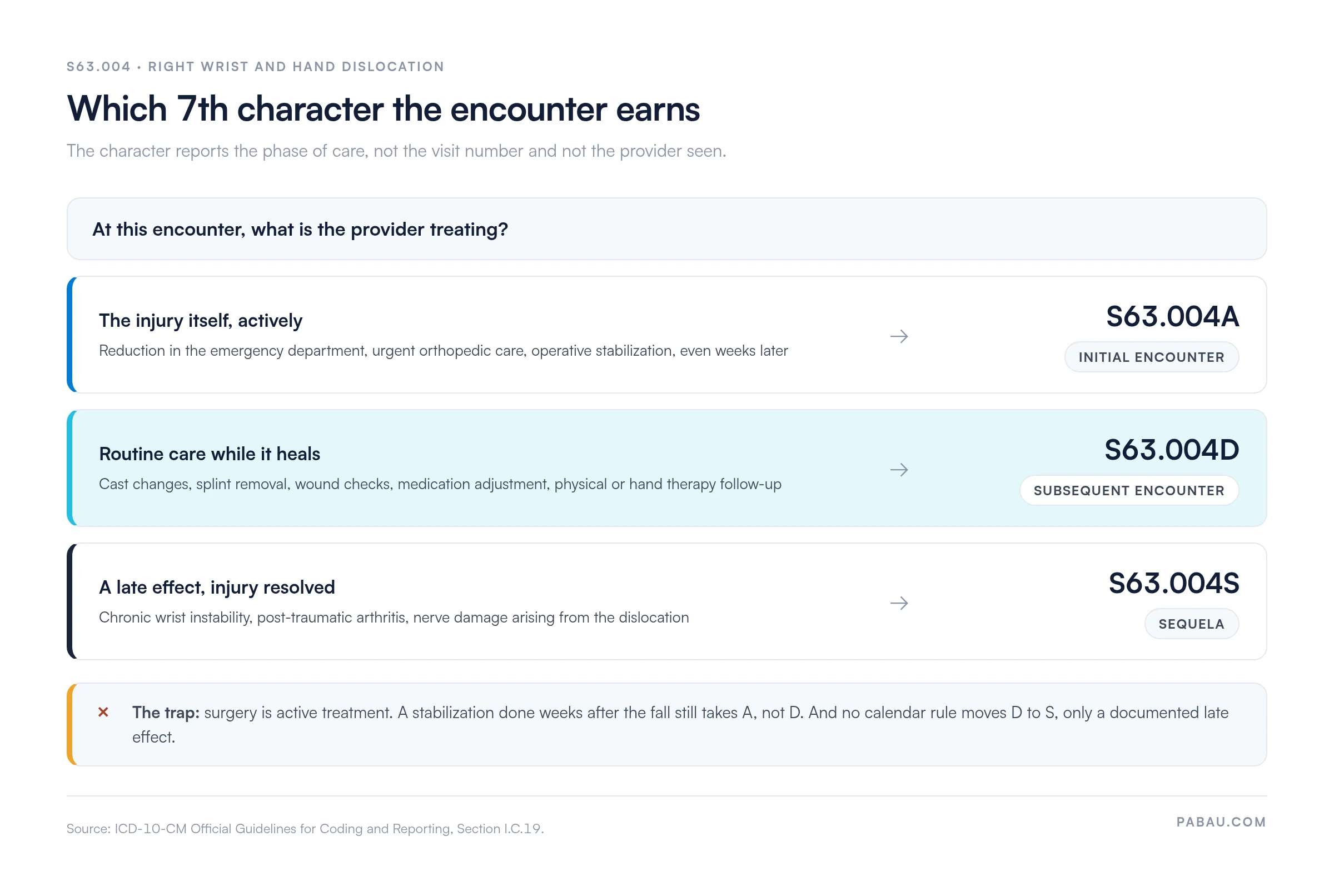
D applies for as long as the patient receives routine care during healing and recovery. The move to S waits for a documented late effect once the original injury has resolved.
No clock forces the change, so a patient in a long rehabilitation program after wrist surgery can sit on D for months.
A worked example makes it concrete. A patient falls, dislocates the right wrist, then gets reduced and splinted in the emergency department. Code that visit for active treatment.
Four weeks later an orthopedic office removes the splint and checks range of motion, so that visit takes the D character. Two years on, chronic instability from the same injury becomes S63.004S.
S63.004 is a parent code, so it is not billable and a claim carrying it gets rejected. Only the complete seven-character code reimburses.
Knowing where it sits also helps you find the neighbors, and the CDC ICD-10-CM web tool confirms the hierarchy below.
The side is fixed in this code and only the dislocation type is open. A wrist dislocation happens when the carpal bones shift against the radius and ulna, the metacarpal bases, or each other.
ICD-10-CM demands laterality on wrist and hand injuries wherever the record supports it, and S63.004D carries the right side.
Referrals are where the joint detail usually disappears. The physician’s initial unspecified diagnosis travels onward, and hand therapy practices then code from whatever the referral says.
Three patterns account for most of these encounters.
Sometimes the follow-up exam does name the joint. A positive Watson test pointing at scapholunate instability is that kind of finding.
Documented specificity like that moves the encounter off the unspecified code, so read the note before you default to S63.004D.
These terms all index to S63.004D, so you can code from them without a query:
When a physician writes “right wrist dislocation” and stops there, S63.004D is the correct subsequent encounter code.
Do not reach for a radiocarpal or midcarpal code the note never names. That restraint is standard practice in sports medicine, where follow-up notes rarely repeat sub-joint detail.
Section I.C.19 of the ICD-10-CM Official Guidelines governs 7th characters on injury codes. Four of its rules do the work on every follow-up claim, and they matter most to practices keeping physical therapy records.
Audit your S63.004 claim history quarterly. A high volume of S63.004A claims running past four weeks post-injury usually means coders are defaulting to the initial encounter character. Pull those claims for rework, then write a short team note explaining what triggers D.
Most wrong-code claims in this family land on a sibling rather than a stranger. Learn the five below and you stop the two expensive mistakes: submitting a non-billable parent, and submitting the wrong side.
The AAPC ICD-10-CM lookup lists the full S63.0 family.
One failure pattern repeats. The initial note says “right wrist dislocation,” then the therapy referral drops the side entirely.
Read the chart as a whole and code S63.004D, because the record does support the right side. Laterality mismatches are a routine denial management item, and far cheaper to catch before submission.
Run these three before you submit. Miss one and the claim comes back as a records request or a medical necessity denial, which costs your team a week either way.
Those checks sit inside a longer path, and knowing the path tells you where a claim tends to stall. Here is how a subsequent encounter claim actually moves.
S63.004D never travels alone on the claim. It commonly pairs with evaluation and management codes 99211 through 99215 for orthopedic follow-up.
A therapeutic procedure code takes its place when therapy is billed the same day. It is a diagnosis code, so it explains the service rather than standing in for one.
Compare your S63.004D volume against S63.004A every month. A rising share of D claims usually means coders are switching characters on time. A flat or falling share is the warning sign, because it suggests the 7th character never gets updated after the first visit.
The switch happens when the provider documents a late effect and the original injury is done healing. No other signal triggers it.
Coders get this wrong in both directions, moving to S during active rehabilitation, or holding D for years on a plainly chronic condition. The rest of the wrist and hand block behaves the same way, which is what the sequela character does in S69.91XS.
Some notes describe healing and an emerging late effect in the same paragraph. Query the physician before you pick a character.
A payer’s clinical editor can spot sequela language sitting under a D claim, and the denial that follows costs more than the query would have. Route ambiguous injury notes back rather than guessing.
Today that follow-up claim usually gets rebuilt by hand. A coder reads the note, looks S63.004D up in a reference tab, then retypes it into a separate billing screen.
Meanwhile the front desk may or may not have checked coverage before the visit. Every retype is another chance to leave the character on A.
Practice management software like Pabau closes that loop. The ICD-10 code recorded against the visit lands on the claim form itself, so your coder edits one record instead of copying between two systems.
A built-in ICD-10-CM lookup library sits behind a search icon, and our claims management software holds the claim until the required fields are complete.
US practices submit from that same screen through our Claim.MD integration, which routes claims to thousands of US payers.
Real-time eligibility runs before the appointment, claim status comes back into the patient record, and remittances post against the charge. Your team works denials from the patient’s own timeline rather than a spreadsheet.

Pabau carries the ICD-10 code from the patient record onto the claim. Submit through Claim.MD to thousands of US payers, then get claim status and remittances back in one place. See how subsequent encounter follow-ups fit your workflow.

S63.004D rewards one habit above all others. Before you code any follow-up, ask what the provider treated at that encounter, then let the answer pick the character. Healing gets D. Active treatment gets A, surgery included. A documented late effect gets S.
Build that question into your review step and the S63.004 family stops generating rework. The trade-off worth remembering is that specificity you cannot support costs more than an unspecified code ever will. Want the code to travel from the note to the payer without a retype? Book a demo, and we will walk it through with your billing team.

Coding another 7th character on the same forearm? S52.136N walks through the nonunion character and how it differs from a routine follow-up.
Need the sequela version of an upper-limb injury? S51.029S shows how the S character reads once the wound itself has healed.
Billing a wrist procedure alongside the diagnosis? 25031 covers incision and drainage in the forearm and wrist, including the documentation payers expect.
Working on a hand case instead? 26170 sets out the billing rules for excising a tendon in the palm.
Want the follow-up note to carry the phase of care every time? Progress note template gives you a structure that records it in the same place at every visit.
No. The 7th character reports the phase of care, so a video follow-up during healing is still S63.004D. Place of service and any telehealth modifier belong on the procedure line, not on the diagnosis code.
A second dislocation is a new injury, so that encounter starts over at S63.004A. Document the new event and its date clearly, because the note is what separates a re-injury from a late effect.
Not automatically. That date closes the current code set, and ICD-10-CM updates take effect every October 1. Check the new tabular list before coding dates of service on or after October 1, 2026.
On the date of that visit, not the date of the original injury. Each follow-up encounter is its own claim with its own deadline, so a long rehabilitation course never shortens the window.
No. Pain that comes with the healing dislocation is part of the injury, so it does not earn its own code. Add a separate pain diagnosis only where the provider documents a distinct, unrelated cause.