CPT code 93503: Swan-Ganz catheter billing and modifiers
CPT code 93503: Official descriptor and procedure overview In the AMA CPT code s...

Last Updated: Oct 23, 2026

CPT code 25031 describes incision and drainage of a bursa in the forearm and/or wrist. It applies when the bursa becomes infected or inflamed and needs surgical drainage.
CMS assigns CPT 25031 a 090-day global period, which makes it a major surgery for billing purposes. Routine follow-up care for 90 days after the procedure is bundled into the base payment.
CMS values 25031 at about 11.47 total RVUs, or roughly $364, and that payment does not change between office and facility settings.
Missing the laterality modifier (LT or RT) and billing a same-day E/M visit without modifier 57 are the two most common denial triggers.
Practice management software like Pabau flags NCCI edits, prompts for the required modifiers, and submits CPT 25031 claims through the Claim.MD clearinghouse.
CPT code 25031 is maintained by the AMA and carries the official descriptor: Incision and drainage, forearm and/or wrist; bursa. It sits within the Musculoskeletal System section of the CPT codebook, specifically under Incision Procedures on the Forearm and Wrist (codes 25000-25040).
The procedure involves a surgical incision into an inflamed or infected bursal sac in the forearm or wrist. The surgeon then drains the accumulated fluid or purulent material and irrigates the space.
The bursa is a fluid-filled sac that cushions tendons, bones, and skin. When it becomes infected or acutely inflamed, conservative treatment often fails and surgical drainage becomes necessary.
Key code facts at a glance:
Not every case of bursitis warrants 25031. Payers require documented medical necessity before approving the claim, and that means the clinical record must show conservative treatment either failed or was contraindicated. Surgical drainage claims are reviewed on that evidence, so the note has to name the non-surgical options that were tried or ruled out.
The three primary indications for 25031 are:
The operative note must document the specific anatomical site, forearm or wrist. It must confirm the bursal origin of the collection, ruling out an abscess, hematoma, or tendon sheath. It must also state why non-surgical management was insufficient.
Where the conservative care happened at a primary care practice, pull that history into the note instead of referring to it. A payer reviewing the claim sees your record, not the referring one.
Pairing the wrong diagnosis code with CPT 25031 is a fast track to a medical necessity denial. The ICD-10-CM codes below are the most commonly used pairings, verified against current coding guidelines. Laterality is built into many of these codes, which ties directly to the laterality modifier requirement on the CPT side of the claim.
Cross-referencing these against the CDC/NCHS ICD-10-CM web tool before submission confirms you are using a billable, non-excluded code.
One distinction matters more than the rest. The L02.5xx codes describe cutaneous or subcutaneous abscesses of the hand, not bursitis. If the collection is bursal in origin, the M70.1x series is more accurate.
Document that the collection arose from the bursal sac rather than the skin or soft tissue. That single line supports the diagnosis code and defends against downcoding to a soft-tissue abscess code.
Modifiers tell the payer about special circumstances that affect how the procedure was performed or billed. Applying the wrong modifier, or omitting a required one, is among the most common reasons CPT 25031 claims are delayed or denied. Laterality modifiers matter most, because 25031 describes a unilateral procedure that could have been performed on either side.
Because 25031 is a major surgery, the decision-for-surgery visit takes modifier 57, not modifier 25. Modifier 25 belongs on E/M services billed with minor procedures that carry a 000-day or 010-day global period. Sending a 25031 claim with modifier 25 on the same-day E/M is a routine denial.
Modifier 59 carries compliance risk if misapplied. CMS NCCI guidance holds that modifier 59 belongs only on a documented distinct service. The documentation has to separate it from the procedure it is being unbundled from, and overuse is an audit trigger.
Reimbursement for CPT 25031 varies by payer and by geographic location. The Medicare Physician Fee Schedule, maintained by CMS, is the standard reference for RVU values and baseline payment rates. These figures are revised annually, so verify them against the CMS look-up tool before using them in contract negotiations.
One quirk sets 25031 apart from most surgical codes. CMS assigns it a single practice expense value, so the office rate and the facility rate come out the same. Place of service still decides who bills the overhead, but it does not move the physician payment.
Note: These figures follow the CMS physician fee schedule relative value file for January 2025 and are subject to annual revision. Geographic adjustment factors will shift the actual payment by location.
CPT 25031 carries a 090-day global period, which CMS classifies as major surgery. The global package covers the day before the procedure, the day of the procedure itself, and the 90 days that follow. Routine postoperative care from the operating surgeon during that window is already paid for in the surgical fee.
A 90-day window is longer than most incision and drainage codes carry, so it is worth verifying at the source. The CMS national physician fee schedule relative value file lists 25031 with GLOB DAYS = 090. The sibling forearm and wrist codes 25000, 25020, 25028, and 25035 carry the same 090 assignment.
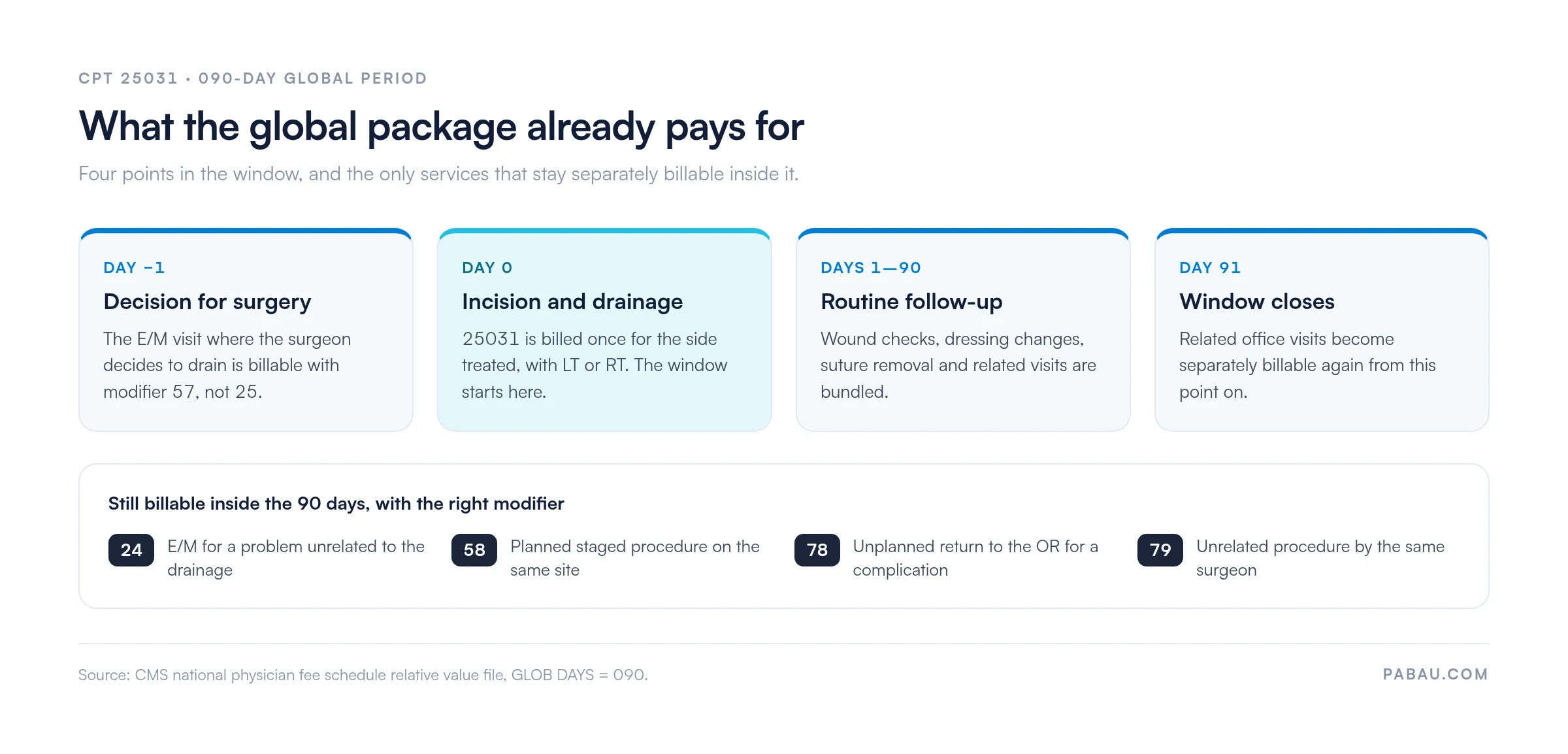
Mapping that window onto the calendar changes front-desk behavior as much as billing. Every follow-up booked in the next three months needs checking against the surgery date before it is coded as a separate visit.
CPT 25031 is payable in three settings, and the physician payment is the same in each:
Bill the POS code that matches where the service was actually performed. Mismatching POS on the claim is a fraud and abuse risk, not just a billing error.
Track your CPT 25031 denial patterns by place of service separately. Office-based claims tend to deny on documentation grounds (missing medical necessity); hospital-based claims more often deny on bundling grounds. Separating the two helps you target the right corrective action for each setting.
The National Correct Coding Initiative (NCCI) publishes bundling edits that tell payers which code combinations are considered redundant when billed together. For CPT 25031, the key bundling rule covers evaluation and management (E/M) codes on the same date of service. Those E/M visits are bundled when they relate directly to the decision to perform the procedure.
Among the common denial codes, NCCI-related edits rank in the top five reasons surgical claims fail on first submission.
Bundling principles for 25031:
Every element below needs to appear in the operative note before the claim is submitted. Payers audit musculoskeletal surgical claims closely. A note that is vague about anatomical site, collection type, or medical necessity will trigger a denial or a documentation request.
A superbill template built for forearm I&D procedures stops your billing team from chasing the chart for missing details. A structured progress-note format, such as a PIE note, does the same job for the follow-up visits inside the global window.
Practices using clean claim protocols catch these omissions before the claim goes out, rather than after the denial comes back. Consistent templating is the most reliable fix for recurring documentation-related denials.
Electronic remittance advice data shows billing teams which documentation element payers are flagging on denied claims. The team can then correct that element across every future submission.
Selecting the wrong code from the forearm incision family is a common upcoding or downcoding error. The table below maps the sibling codes to 25031 and defines the key differentiator for each. When the operative note clearly describes a bursal collection in the forearm or wrist, 25031 is correct. A deeper collection, a different structure, or a different anatomical level points to a different code.
All five codes in this table carry a 090-day global period, so switching codes within the family does not change the postoperative window. The differentiator is always the anatomical structure named in the operative note. Move outside the forearm and wrist range and the region decides the code, from 26170 in the palm to 25441 at the distal radius.
The confusion between 25031 and 25035 is understandable, because both involve incision procedures in the forearm and/or wrist. The defining distinction is the target tissue. CPT 25031 drains a bursal sac. CPT 25035 involves an incision into the bone cortex, and it is used for periosteal or osseous infections such as osteomyelitis.
In practice: If the operative report mentions “bursa,” “bursal sac,” or “bursectomy,” use 25031. If it mentions “cortex,” “periosteum,” “osteomyelitis,” or “bone,” 25035 may be appropriate. Billing 25035 for a bursal drainage procedure constitutes upcoding.
Both codes carry a 090-day global period, so the post-op billing window is identical and offers no help in telling them apart. Only the operative note’s description of the target tissue separates them.
Four denial patterns account for most rejected CPT 25031 claims. Each one has a specific fix that can be built into your pre-submission workflow.
Billing forearm I&D procedures by hand, across payer contracts with different modifier requirements and NCCI edit tables, creates a predictable failure rate. Practices that connect clinical documentation to the billing workflow catch errors at the point of coding, not after the denial lands.
Pabau’s claims management software connects clinical notes to the billing workflow. CPT and ICD-10 code selection then happens in context, rather than as a separate manual step.
The Claim.MD integration handles electronic claim submission to thousands of US payers and runs real-time eligibility verification. It also returns electronic remittance advice, the ERA or 835 file. The billing team then sees denial reasons as coded CARC explanations rather than generic rejection notices.
For CPT 25031, a missing laterality modifier or an NCCI edit conflict surfaces before the claim reaches the payer. The alternative is finding out 30 days later, as a denial.
The practical workflow runs in a few steps. The clinician completes the operative note. The billing team selects CPT 25031 and the matched ICD-10 code within Pabau. The system checks the claim against payer-specific modifier requirements and NCCI edits, then routes the clean claim through Claim.MD.
Denials that do occur come back with machine-readable CARC codes, which is faster to work than an unstructured EOB letter. Practices comparing medical billing software gain the most from an integrated clearinghouse, because integration removes the manual handoff where most CPT 25031 errors originate.
Set up a payer-specific modifier rule in your billing software for CPT 25031: if LT or RT is missing, block the claim from submitting. This single rule prevents the most common denial for this code and requires no coder intervention after initial setup.

Pabau’s claims management tools flag NCCI edits, prompt for laterality modifiers, and submit clean claims through the Claim.MD clearinghouse. Forearm I&D procedures get paid faster, with fewer follow-up calls.

One line in the operative note settles the coding decision for 25031. It has to name the bursa and the side that was treated. Get that line right and the modifier, the diagnosis code, and the claim all follow from it.
The 90-day window is where the money quietly leaks. A practice that writes the global end date into the schedule on the day of surgery stops billing follow-ups that are already paid. Nothing about the payment rate changes with the setting, so the only variables left are documentation and timing.
That makes 25031 a systems problem more than a coding problem, and systems are worth automating rather than remembering. Book a demo to see how Pabau handles musculoskeletal surgical claims from note to payment.

Examining a painful wrist before you code it? The Watson test covers the technique, interpretation, and accuracy of the scaphoid shift maneuver.
Coding a forearm fracture that failed to heal? ICD-10 code S52.136N covers radial neck fracture nonunion and the documentation it needs.
Billing a follow-up visit for a wrist injury? ICD-10 code S63.004D covers unspecified dislocation of the right wrist and hand at a subsequent encounter.
Working further up the same arm? CPT code 24115 covers excision of a bone cyst of the humerus with autograft.
CPT code 25031 describes incision and drainage of a bursa located in the forearm and/or wrist. The procedure involves surgically opening an inflamed or infected bursal sac, draining the collected fluid or pus, and irrigating the space. It falls under the Musculoskeletal System section of the AMA CPT codebook, specifically within the Incision Procedures on the Forearm and Wrist subsection (25000-25040).
CPT code 25031 has a 090-day global period, which CMS classifies as major surgery. Routine postoperative visits, wound checks, and dressing changes are bundled into the base payment for 90 days after the procedure date. The global package also covers the day before surgery. Unrelated services (modifier 24) and unrelated procedures (modifier 79) remain separately billable. So do returns to the operating room for complications (modifier 78) and planned staged procedures (modifier 58).
The most commonly required modifiers for CPT code 25031 are LT (left side) and RT (right side) to indicate which forearm or wrist was treated. Modifier 50 applies when the procedure is performed bilaterally in the same session. Modifier 59 may be used to override NCCI bundling edits when a genuinely distinct service is documented. Modifiers 22 (increased complexity), 51 (multiple procedures), and 58 (staged procedure) apply in specific circumstances and all require supporting documentation.
CPT code 25031 carries about 11.47 total RVUs: 4.26 work RVUs, 6.34 practice expense RVUs, and 0.87 malpractice RVUs. That works out to roughly $364 in Medicare payment before geographic adjustment. CMS assigns the code one practice expense value, so the total and the payment are the same in an office and in a facility. Verify the current figures against the CMS fee schedule look-up tool each year.
CPT 25031 covers incision and drainage of a bursa in the forearm or wrist. CPT 25035 covers incision into the bone cortex, typically for osseous infections such as osteomyelitis. The target tissue is the distinction that matters, so 25031 needs a documented bursal sac and 25035 needs the bone cortex. Both carry a 090-day global period, so the postoperative window does not help you tell them apart.
Yes, CPT code 25031 can be performed and billed in an office setting (Place of Service 11). CMS assigns the code one practice expense value, so the office rate matches the facility rate. The code is also billable at outpatient hospitals (POS 22) and ambulatory surgery centers (POS 24). Always bill the POS that matches where the service was actually performed.
CPT code 25031 is the correct code for surgically draining septic bursitis of the forearm or wrist. The diagnosis code that pairs with it is typically M70.11 (bursitis, right hand) or M70.12 (bursitis, left hand) from ICD-10-CM. Document bacterial infection, clinical signs (warmth, erythema, fluctuance), and the failure or contraindication of conservative treatment to support medical necessity.