HCPCS Code G0163: Skilled nursing observation and assessment
What is HCPCS Code G0163? HCPCS Code G0163 is a deleted Level II code for skille...

Last Updated: Oct 15, 2026
C7125 is the CCSD code for ultrasound phacoemulsification of cataracts with lens implant in both eyes, including topical or local anesthetic. It applies only when both eyes are treated in the same operative episode.
The code sits in the lens section of Chapter 4 (Eye and orbital contents) of the CCSD schedule used by UK private insurers. The standard intraocular lens and the anesthetic are bundled into the fee, and a single-eye procedure is billed with C7122 instead.
Let Pabau's smart automation suggest the right codes, reduce claim denials, and keep your practice compliant—effortlessly.
Automate repetitive tasks and focus on what matters most—your patients.
Reduce coding errors and ensure compliance with the latest regulations.
Clean claims, fewer denials, and faster reimbursements.
Powerful insights and reporting to help your practice thrive.
HIPAA compliant SOC 2 certified GDPR-compliant Trusted by 4,000+ clinics worldwide

CCSD code C7125 covers ultrasound phacoemulsification with an IOL implant in both eyes during one operative episode, including topical or local anesthetic.
The standard IOL and routine anesthetic are bundled into C7125, so billing either as a separate line gets the claim denied.
C7122 is the unilateral counterpart, and billing two C7122 claims for same-session bilateral surgery is a common cataract coding error.
AXA Health, Bupa, Freedom Health, Vitality, and WPA all recognize C7125, but each sets its own pre-authorization and documentation rules.
Practice management software like Pabau handles CCSD code entry, pre-authorization references, and insurer-ready invoices for C7125 claims.
CCSD code C7125 is the Clinical Coding and Schedule Development (CCSD) code for bilateral ultrasound phacoemulsification of cataracts, with lens implant. It includes topical or local anesthetic.
It sits within Chapter 4: Eye and orbital contents of the CCSD schedule, alongside other ophthalmic surgery codes used across UK private insurance claims. The CCSD group maintains the code. Its schedule is accepted by Bupa, AXA Health, Freedom Health, Vitality, WPA, and most other UK private medical insurers.
Three elements lock in the code’s classification. The technique must be ultrasound phacoemulsification, not extracapsular extraction or a laser-assisted approach. The procedure must include an intraocular lens implant, and both eyes must be treated in the same operative episode.
Change any one of those three and a different code applies, so check all three before you submit a C7125 claim. The decision flow below shows where each “no” sends the claim.
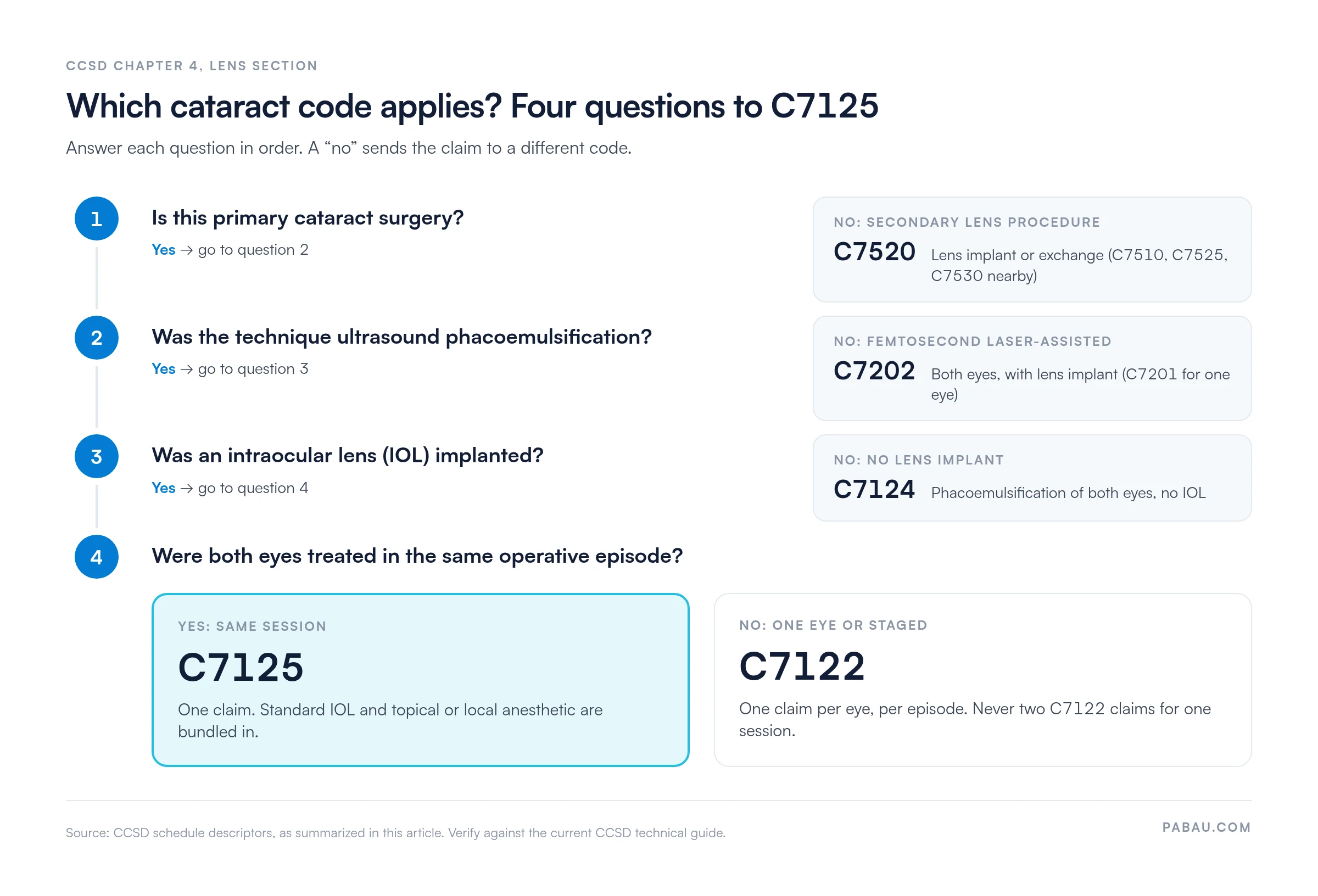
The flow chart covers ultrasound and laser techniques only. A case that converts to extracapsular extraction with no lens implanted is billed as C7110 for one eye. If both eyes convert and receive an implant, the code is C7190.
Bilateral phacoemulsification with IOL implant is the most common elective surgical procedure in UK private ophthalmology. The consultant ophthalmologist removes the clouded crystalline lens from each eye using ultrasonic vibration, then inserts a clear artificial IOL into the capsular bag.
Topical anesthetic drops, or a local anesthetic block (peribulbar or sub-Tenon) where the surgeon prefers, are applied before each eye is treated. Both are bundled within C7125 and must not appear on the invoice as additional lines.
A consultant anesthetist attending on standby is handled differently. The anesthetist claims that attendance under C7181, on a separate submission from the surgeon’s C7125 invoice.
The operative sequence for each eye runs as follows:
The procedure is then repeated for the second eye, either immediately or after a short interval within the same operating session. Posterior capsule integrity is confirmed for each eye before the IOL is seated.
Any intraoperative complication affecting the posterior capsule (rupture, vitreous loss) may need an additional CCSD code alongside C7125. An operative note that documents both eyes in full is what gets the claim accepted.
Misunderstanding the bundling rules for C7125 causes more denials than any other single coding error. The CCSD descriptor explicitly includes three components that must not be billed as additional lines on the same invoice.
Included in C7125 (do not bill separately):
Billed separately (not bundled in C7125):
C7122 is the unilateral counterpart of C7125. It covers ultrasound phacoemulsification of cataract, with lens implant, in one eye, including topical or local anesthetic. The two codes are often confused. Submitting two C7122 claims for surgery on both eyes in one session usually prompts an insurer query or a denial of the second claim.
C7520 is a different procedure altogether. It covers lens implant or exchange, which is a secondary lens procedure rather than primary cataract surgery. Never use it to bill a single-eye phacoemulsification.
Staged bilateral cataract surgery treats each eye in a separate hospital visit, so each episode is billed with C7122. C7125 applies only when both eyes are treated within the same operating session. The Bupa CCSD codes guide lists both codes, so you can check the unilateral and bilateral descriptors side by side while preparing the invoice.
C7125 sits in the lens section of Chapter 4, alongside codes for other cataract techniques, secondary lens procedures, and post-operative laser treatment. Knowing the neighboring codes helps you avoid under-coding complications and over-coding standard procedures. For a Chapter 4 descriptor not listed here, search the full set of CCSD codes.
C7124 in the table covers both eyes with no lens implanted. The single-eye equivalent is C7123, phacoemulsification of cataract without lens implant.
C7520 sits with the other secondary lens codes: C7510 for secondary insertion, C7525 for repositioning, and C7530 for removal of a lens implant. Descriptor wording and fee schedules are updated annually, so verify current values against the CCSD technical guide (October 2025).
Codes for premium IOL types (toric, multifocal) aren’t standardized across payers. Check each insurer’s current schedule before you bill one.
An incomplete operative note is the second most common reason insurers reject C7125 claims. The operative record must confirm each of the following for the claim to reach payer acceptance without a request for further information (RFI).
Consultants leaving NHS employment to build private ophthalmology lists should set up a structured note template from day one. CCSD payers apply stricter invoice-level requirements than NHS episode coding does.
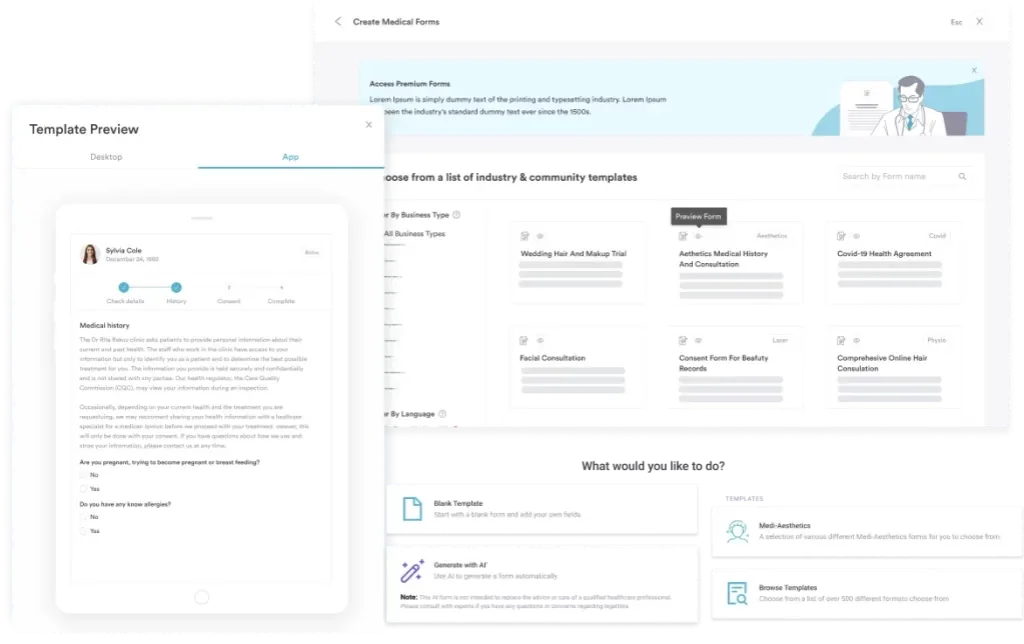
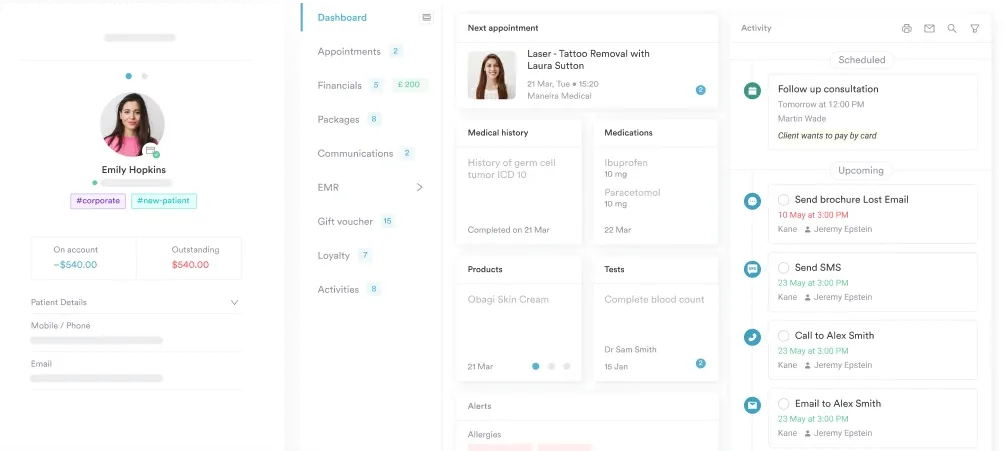
Practice management software like Pabau stores the operative note in the patient record alongside the invoice reference. Each claim then has auditable, insurer-ready documentation behind it from booking to payment.
Build a C7125 operative note template with a bilateral confirmation field and the pre-authorization reference number. Add IOL model and power fields for each eye separately. Completing it at the time of surgery heads off the most common payer requests for further information.
All major UK private medical insurers recognize CCSD code C7125, but each applies different pre-authorization requirements, bilateral policies, and documentation standards. The table below reflects general payer behavior. Rules change each calendar year, so verify current requirements with each insurer before submitting.
Pre-authorization protects both the practice and the patient. If the payer requires pre-authorization, a C7125 claim without a valid reference is denied. Resolving that denial through appeals can take four to six weeks. Each insurer publishes its own fee schedule, and the figures are updated at least annually.
Most C7125 denials fall into six recurring patterns. Identifying which pattern applies lets practices target the correct appeal route rather than resubmitting the same claim unchanged.
Consistent documentation at the point of care stops most of these errors before they reach the claims stage. Standardizing the operative note format and linking it to the invoice at booking also cuts the RFIs that UK insurers send back.
Run a monthly audit of all C7125 claims using your practice management system’s billing reports. Filter for any patient with two C7122 claims on the same date. That pattern flags a likely bilateral miscode before it becomes a formal denial.
Pabau supports CCSD billing workflows for UK private ophthalmology practices, from code entry to insurer-ready invoice generation. The steps below reflect how the platform handles a standard C7125 claim.
Today, many ophthalmology practices re-key the same claim details into a booking tool, a spreadsheet, and an insurer portal. Each re-entry is a chance to drop the pre-authorization number or add a stray IOL line.
Running billing on one platform removes those manual steps between the operating room and payment. Pabau also takes the payment against the same invoice, so your team can see which C7125 claims are paid without switching systems.
Book a demo to see how Pabau handles CCSD code billing from appointment to insurer-ready invoice.

Pabau keeps the operative note, pre-authorization reference, and CCSD-coded invoice on one patient record. Your team submits bilateral cataract claims that insurers can approve without a query.

Decide how each patient will be coded before the cataract list is booked. If both eyes go into one operating session, the invoice carries a single C7125 line and nothing for the standard lens or the anesthetic.
If the second eye is booked for a later visit, bill each episode with C7122 instead. Same-session surgery means one pre-authorization and one claim, but the operative note has to confirm both eyes in full.
Staged surgery doubles the paperwork and gives the insurer two claims to query. Build the bilateral note template and the line-item check into the booking step, and the denial patterns above stop reaching the insurer. Book a demo to see how Pabau links the operative note, pre-authorization reference, and CCSD invoice for your cataract lists.

Need a Bupa CCSD billing reference? Bupa CCSD codes guide covers code structure, common Bupa procedure codes, and how to submit CCSD-coded invoices to Bupa.
Benchmarking your cataract fees? Bupa procedure codes fee schedule explains how Bupa sets and publishes its procedure fees.
Managing multiple payer invoices from one platform? Claims management software in Pabau centralizes CCSD invoicing, pre-auth references, and submission tracking across UK private insurers.
CCSD code C7125 covers ultrasound phacoemulsification of cataracts with intraocular lens implant in both eyes during a single operative episode. It includes topical or local anesthetic. The IOL and anesthetic are bundled within the code and must not be billed as separate invoice lines.
C7125 covers both eyes in one operative episode, while C7122 covers a single eye. Use C7122 for each episode when cataract surgery is staged across separate visits. Billing two C7122 claims for same-session bilateral surgery usually gets the second claim denied as a duplicate. C7520 is a separate code for lens implant or exchange.
Yes. Topical or local anesthetic is explicitly included in the C7125 descriptor and is bundled within the procedure fee. Adding a separate anesthetic line to the invoice will trigger a denial. General anesthetic, where used instead of topical or local, may be separately claimable depending on payer rules. Verify with each insurer.
Yes, provided both eyes are treated within the same operative episode and this is confirmed in the operative note. C7125 is specifically designed for same-episode bilateral surgery. If the two eyes are treated in separate sessions on the same day, check with the payer first. Most treat them as two episodes billed with C7122 per eye.
AXA Health, Bupa, Freedom Health Insurance, Vitality Health, and WPA all recognize CCSD code C7125 under Chapter 4 of their fee schedules. Pre-authorization is required by most of these payers before surgery. Fee amounts and bilateral reimbursement policies differ between insurers, so verify the current schedule with each payer before quoting the patient.
Yes, a standard monofocal IOL is bundled within the C7125 descriptor. Billing it as a separate line item will result in a denial. Premium IOL upgrades (toric, multifocal, or extended depth-of-focus lenses) are not automatically included. They need separate coding and payer approval before they can be invoiced.