ICD-10 Code V09.01XS: Pedestrian injured in nontraffic accident involving military vehicle, sequela
ICD-10 Code V09.01XS: Code description and clinical meaning ICD-10 code V09.01XS...

Last Updated: Oct 26, 2026
Billable Code Specific Code
S52.001P is the billable ICD-10-CM code for unspecified fracture of upper end of right ulna, subsequent encounter for closed fracture with malunion.
Two errors send these claims back more often than any others. Coders reach for the radius instead of the ulna, or they pick the wrong 7th character. Either one costs a rebill and a documentation query.
This page takes the code apart character by character, then follows it through to the remittance advice.
Let Pabau's smart automation suggest the right codes, reduce claim denials, and keep your practice compliant—effortlessly.
Automate repetitive tasks and focus on what matters most—your patients.
Reduce coding errors and ensure compliance with the latest regulations.
Clean claims, fewer denials, and faster reimbursements.
Powerful insights and reporting to help your practice thrive.
HIPAA compliant SOC 2 certified GDPR-compliant Trusted by 4,000+ clinics worldwide

S52.001P is the billable ICD-10-CM code for an unspecified fracture of the upper end of the right ulna, healed with malunion. It has been in the code set since FY2016, so it is not a new FY2026 addition.
The 7th character P marks a subsequent encounter where the closed fracture healed in an abnormal position. That is distinct from nonunion (character K) and routine healing (character D).
S52.0 is the ulna branch of the S52 forearm family. The upper end of the radius sits in S52.1, which makes S52.101P the radius equivalent of this code.
Documentation must confirm the site, the right side, closed fracture status, and malunion on imaging or in the notes. The record also has to show a follow-up visit.
Practice management software like Pabau submits S52.001P through its Claim.MD integration, which reaches thousands of US payers. The claim is pre-filled from the encounter, with ICD-10 and CPT lookup for the biller.
S52.001P is a billable ICD-10-CM diagnosis code, valid for HIPAA-covered electronic transactions. The full official description is Unspecified fracture of upper end of right ulna, subsequent encounter for closed fracture with malunion.
S52.001P has been in ICD-10-CM since the FY2016 edition, which took effect on October 1, 2015. The wording has not changed since, and the CDC/NCHS ICD-10-CM web tool still lists it in the current FY2026 edition.
Reading the code left to right shows where each digit comes from.
“Unspecified” in the title does not mean the fracture went undocumented. It means the record never confirmed whether the fracture was displaced or nondisplaced.
That is a legitimate choice when the note stays silent on displacement. Fracture categories across the injury chapter use the same convention.
The 7th character is the most consequential digit in any S52 code. It tells the payer which phase of care you are billing and how the fracture healed.
Choose the wrong one and the claim comes back for an appeal, a rebill, or a records request. P gets confused with D for routine healing and K for nonunion more than any other pairing.
Category S52 uses the full 16-character set, covering closed and open fractures alike. Only the closed-fracture characters can ever apply to S52.001P itself.
The same character logic runs through the whole injury chapter, from S00 to T88. Learn it on the forearm and it transfers straight to a femur code such as S72.91XG.
Two questions settle the character faster than reading the table does. Ask what kind of encounter this is, then ask what the record says about healing.
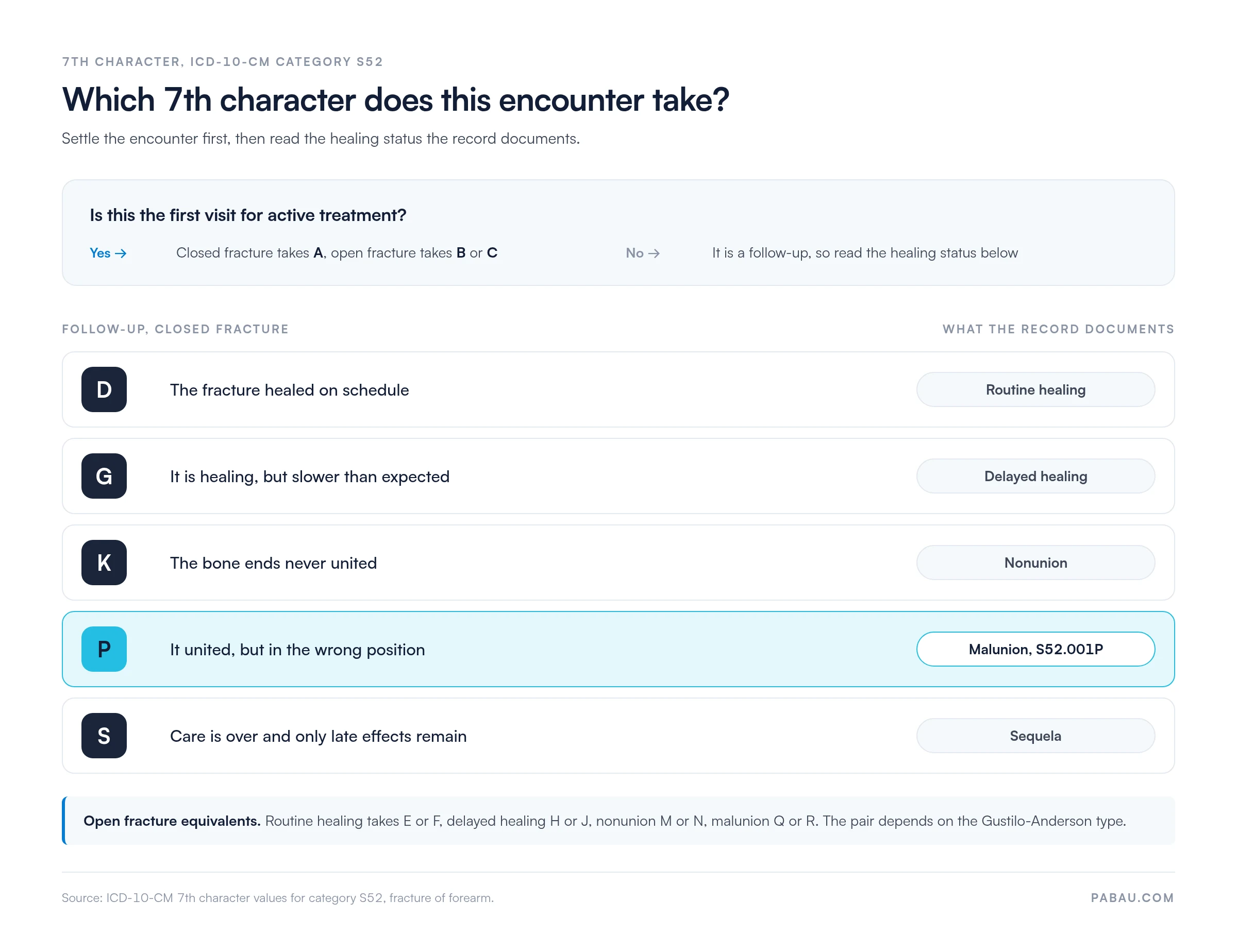
Malunion means the fracture healed, but the bone ends united out of position. The acute phase is over, which is why P is a subsequent-encounter character.
Nonunion is the opposite outcome, because there the bone never united at all. Both cause symptoms and both may need surgery, and each one has its own character.
A worked example makes the choice concrete. A patient fractures the upper end of the right ulna in March and wears a cast for six weeks. In June she comes back with a visible bump and pain on rotating the forearm.
Imaging shows the fracture united at an angle, and the note records a closed injury with no named structure. That visit codes to S52.001P.
Following the code up its own branch confirms you have the most specific option available. The AAPC Codify ICD-10-CM lookup lays out the same hierarchy for checking.
The S52 subcategories pair off by site and by bone. S52.0 is the upper end of the ulna, and S52.1 is the upper end of the radius. A radial neck nonunion, for instance, lands in S52.136N. So read the branch before you read the character.
S52.001 is not billable on its own, because it needs a 7th character to be complete. Send it without one and the clearinghouse rejects it as an invalid code.
Laterality is settled one level up, at S52.001. The sixth digit separates right (1), left (2), and unspecified (9). A coder cannot fall back on unspecified once the record names a side.
Payers read a missing side as a documentation problem, and they deny or downcode accordingly.
Practices that run a physical therapy EMR track rehab after fracture repair by limb, so the laterality digit and the exercise log have to agree.
The same holds in sports medicine software, where a return-to-play note names one arm. When the chart and the claim disagree on the side, an auditor will find it before you do.
Submitting S52.001P without support in the chart creates audit exposure. The ICD-10-CM Official Guidelines are maintained jointly by CMS and NCHS, and they expect every element of a code to rest on the record.
So medical billing teams should confirm each of the following before the claim goes out.
The principle is straightforward. Every digit in S52.001P needs a documentation anchor somewhere in the chart. Where one is missing, query the provider before you submit rather than after the denial.
Flag malunion documentation at the point of imaging. When a radiologist or an orthopedic surgeon writes ‘healed in malposition’ or ‘malunion present’, capture that language and attach it to the claim. Doing it up front gives the payer an audit trail from the image to the code. That is what keeps a medical necessity review short.
Choosing the character is one step of several. From there the claim travels a fixed route, and each stop can send it back.
Two things trip up that route on malunion claims. The first is timing, because a malunion often surfaces months after the injury. Check the payer’s timely filing limits against the date of service, not the date of the fracture.
The second is the record itself. When imaging names malunion and the office note does not, the claim can clear every automated edit and still fail an audit later.
Three subsequent-encounter characters cover the same bone and the same side. D, K, and P differ only on how the fracture healed. Submit P where D belongs and the claim no longer matches the record, which is how post-payment audits start.
A clearinghouse edit will not catch that, because a completeness check confirms the fields are filled and the code exists. No part of it reads the imaging report.
The practical rule tracks the bone. While it is still healing, G covers slow progress and K covers no union at all.
Once healing has finished, D is the normal result and P is the malunion. After treatment ends and only late effects remain, S applies.
Providers rarely write in ICD-10-CM phrasing. These are the phrases that should send a coder to S52.001P, assuming the rest of the documentation holds up.
Two families of terms need care here. An olecranon fracture and a coronoid process fracture both sit at the upper end of the ulna.
Each carries its own code in S52.02x through S52.04x. S52.001 applies only where the record leaves the structure unnamed. A radial head fracture points at the radius, so it belongs in S52.1.
The code itself is simple enough. A short list of mistakes accounts for most of the denials in this family. Each row below pairs the error with its consequence and the fix.
Denials in this family repay a second look. Pabau pre-fills the claim from the encounter and gives the biller an ICD-10 and CPT lookup.
The code on the form then matches the code in the chart. No automated edit reads the imaging report, though, so the choice between P and K stays with a person. When a denial does land, the denial codes on the remittance point straight at the character that caused it.
S52.001P sits inside a large family of forearm fracture codes. Coders working across sites, sides, and encounter types need to move around S52 quickly.
The ICD List lookup tool covers the complete set with parent-code navigation. For the shaft one subcategory down, see S52.209K.
S52.101P covers an unspecified fracture of the upper end of the right radius with malunion. On the page it looks almost identical, and it is the substitution that causes the most trouble in this part of the tabular list. If the imaging names the radial head or the radial neck, the claim belongs in S52.1.
After submission, the remittance advice shows how the payer handled each S52 code, with an adjustment reason code attached.
A clearinghouse sits in front of that and checks the claim’s fields are complete before it goes on. It cannot confirm that the character you chose matches the imaging, so that review has to happen inside the practice.
Most S52 denials start in the notes rather than on the billing screen. If the imaging report records malunion and the treatment note does not, the coder has no documentation to anchor character P to. Laterality has the same problem, and it often sits in one system while the claim gets built in another.
Pabau keeps the clinical record and the claim in one place. Our claims management software builds each claim from the encounter itself.
The treatment note, the attached imaging, and the visit history all stay one click away. Nobody has to move between an EMR and a separate billing tool to confirm the bone, the side, or the healing status.
Claims then go out electronically through our Claim.MD integration, and the remittance lands back on the same record. When a payer rejects an S52 code, the practice sees the claim, the code, and the reason code together.
The fix becomes a documentation query instead of a hunt through the ledger, so fewer fracture claims get billed twice.

Pabau integrates with Claim.MD to submit ICD-10-CM codes like S52.001P to thousands of US payers. ICD-10 and CPT lookup, eligibility checks, and electronic remittance advice keep your orthopedic billing on one record.

Fracture claims in the S52 family fail for a small number of reasons. The wrong bone, the wrong encounter type, the wrong healing status, and an open fracture coded as closed cover most of them. S52.001P packs six clinical facts into seven characters, and each one has to trace back to a line in the record.
The judgment worth keeping is simple. Read the imaging before you read the code book. Character P is a clinical finding rather than a billing choice, so the note has to say malunion before the claim can.
Pabau’s Claim.MD integration submits codes like S52.001P to thousands of US payers, then brings the remittance back onto the same patient record. Book a demo to see how orthopedic and musculoskeletal billing runs end to end.

Need the delayed-healing character on another bone? S82.226G works the same 7th character logic through a tibial shaft fracture.
Wondering when the sequela character takes over? S69.91XS shows how a wrist injury is reported once active care is finished.
Billing the surgery as well as the diagnosis? CPT code 25441 covers distal radius arthroplasty, including its documentation and payer rules.
Coding a laceration at the same joint? S51.029S walks through an elbow laceration reported as a sequela.
Treating the fracture with traction? CPT code 20650 sets out how skeletal traction is billed alongside the fracture diagnosis.
Not as a rule. ICD-10-CM carries no national mandate for external cause reporting, so most payers do not ask for one on a malunion follow-up. Where a payer or a state does require it, report the cause with its own subsequent-encounter character rather than an initial-encounter one.
Yes. When the malunion is the reason for the visit, S52.001P goes first on the claim. Other conditions treated at the same encounter follow it. The order should match what the note says the visit was for.
No. ICD-10-CM guidelines keep aftercare Z codes away from traumatic fractures. Follow-up care, including surgery on the malunion, still reports the injury code with a subsequent-encounter character. So S52.001P stays on the claim while the malunion is being treated.
Report it for as long as the malunion is under active management at follow-up visits. Once treatment ends and only residual effects remain, the sequela character applies instead, giving S52.001S. The code set puts no cap on how many subsequent encounters you can bill.