HCPCS code E0372: Powered air mattress overlay billing guide
HCPCS code E0372 covers a powered overlay, not a bed HCPCS code E0372 pays for a...

Last Updated: Oct 15, 2026
Billable Code
E4030 is the CCSD code for tracheoplasty, the open surgical reconstruction of the trachea to widen, reshape, or repair a narrowed or weakened airway. UK private medical insurers accept it on the surgeon's claim. It sits under Larynx and trachea in Chapter 5 (Ear, nose and throat) of the CCSD schedule.
Tracheoplasty for congenital conditions has its own code, E4032. Tracheostomy, partial excision of the trachea with reconstruction, and tracheal stricture dilatation are coded separately. The operative note decides which code applies.
Let Pabau's smart automation suggest the right codes, reduce claim denials, and keep your practice compliant—effortlessly.
Automate repetitive tasks and focus on what matters most—your patients.
Reduce coding errors and ensure compliance with the latest regulations.
Clean claims, fewer denials, and faster reimbursements.
Powerful insights and reporting to help your practice thrive.
HIPAA compliant SOC 2 certified GDPR-compliant Trusted by 4,000+ clinics worldwide

CCSD code E4030 covers tracheoplasty: Open surgical reconstruction of the trachea, billed to UK private medical insurers.
Most UK PMI payers require prior authorisation before E4030 surgery, and a missing authorisation number is the leading denial cause.
E4030 is often confused with tracheostomy (E4210) and partial excision of the trachea (E3900), and the wrong adjacent code gets the claim rejected.
Operative notes must document the surgical approach, the structural repair, and any grafts or implants used to support the claim.
Pabau supports CCSD billing workflows with structured clinical records, digital documentation tools, and claims management features.
CCSD code E4030 is the designated code for tracheoplasty in the schedule of CCSD codes, the procedure coding system UK private medical insurers use. Tracheoplasty is plastic or reconstructive surgery of the trachea: Reshaping, widening, or repairing an airway lumen that has become narrowed, damaged, or structurally weak.
It is distinct from simply creating an airway opening (tracheotomy) or removing a tracheal segment and rejoining the ends (resection and anastomosis).
CCSD operates separately from the NHS coding system. NHS trusts use OPCS-4 for procedure classification. CCSD codes are recognised only in the private sector, where insurers including Bupa, AXA Health, Aviva, Vitality, and Allianz Care require them. A code that is valid in OPCS-4 has no standing in a private insurance claim, and vice versa.
E4030 sits under Larynx and trachea in Chapter 5 (Ear, nose and throat) of the CCSD schedule. ENT surgeons treating subglottic or upper tracheal stenosis may use it, and so may thoracic surgeons managing mid or lower tracheal pathology. Either way, the documented procedure must match the tracheoplasty descriptor. The procedure name, surgeon specialty, and operative technique all need to align with E4030 before submission.
The same alignment test applies to other Chapter 5 codes. CCSD code E1260 covers image-guided endoscopic sinus surgery. A note that omits the navigation system reads as standard endoscopic sinus surgery, and the claim is recoded to E1432 at a lower fee.
Tracheoplasty is performed when the trachea cannot maintain adequate airway patency through conservative management or endoscopic intervention alone. The primary indications coders will encounter on operative notes include:
This list reflects the billing context for E4030 rather than clinical guidance. Coders should confirm the documented indication matches one of these categories before assigning the code. Tracheoplasty for a congenital condition has its own code, E4032, so a congenital indication points away from E4030. If the operative notes describe simple or bronchoscopic balloon dilation without open reconstruction, E4030 does not apply either.
Understanding what E4030 bundles into its fee is essential for avoiding unbundling errors. The CCSD Technical Guide (October 2025 edition) sets out the bundling principles that apply across surgical codes. E4030 follows those general rules for major reconstructive procedures.
Bundling rules are insurer-specific. Never assume a component is separately billable without verifying with the relevant payer’s coding team before submission.
When graft material is used during tracheoplasty, document the source, type, and dimensions in the operative note. Bupa and AXA Health may request this detail to confirm the procedure complexity matches E4030 rather than a simpler repair code. A vague note that mentions ‘reconstruction’ without specifying graft use often prompts a clinical query letter.
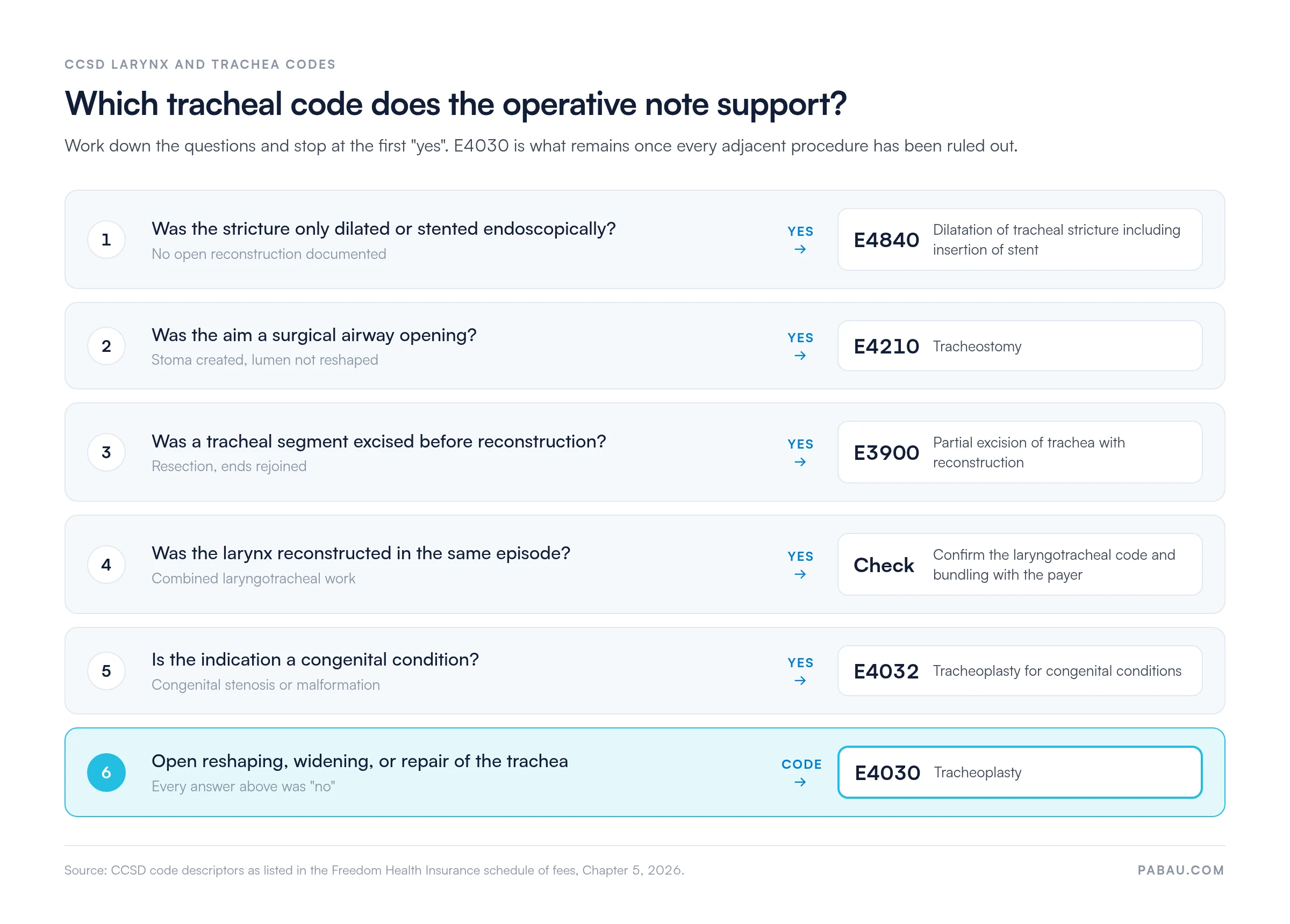
Tracheoplasty is one of several tracheal procedure codes in the CCSD schedule. Choosing the wrong one is a frequent denial trigger for this code group. The table below shows the codes most often confused with E4030 and the decision rule for each.
If the operative note describes a combined laryngotracheal and tracheal procedure, consult the CCSD schedule for the laryngotracheal reconstruction code. Then verify with the payer whether E4030 can be billed alongside it, or whether the laryngotracheal code covers the full episode.
Procedures above the trachea carry their own CCSD codes. CCSD code E2300 covers pharyngeal myotomy, so check it when the operative note describes work on the pharynx rather than the trachea.
Ruling the adjacent codes out in a fixed order stops a coder from settling on E4030 before the more specific options have been checked.
An E4030 claim will not process without a complete operative record. UK private insurers apply strict documentation standards to high-value surgical codes, and tracheal reconstruction sits firmly in that category. The documentation must satisfy the insurer’s administrative requirements and the clinical evidence standards that justify medical necessity.
The following elements must appear in or accompany the operative note before submission:
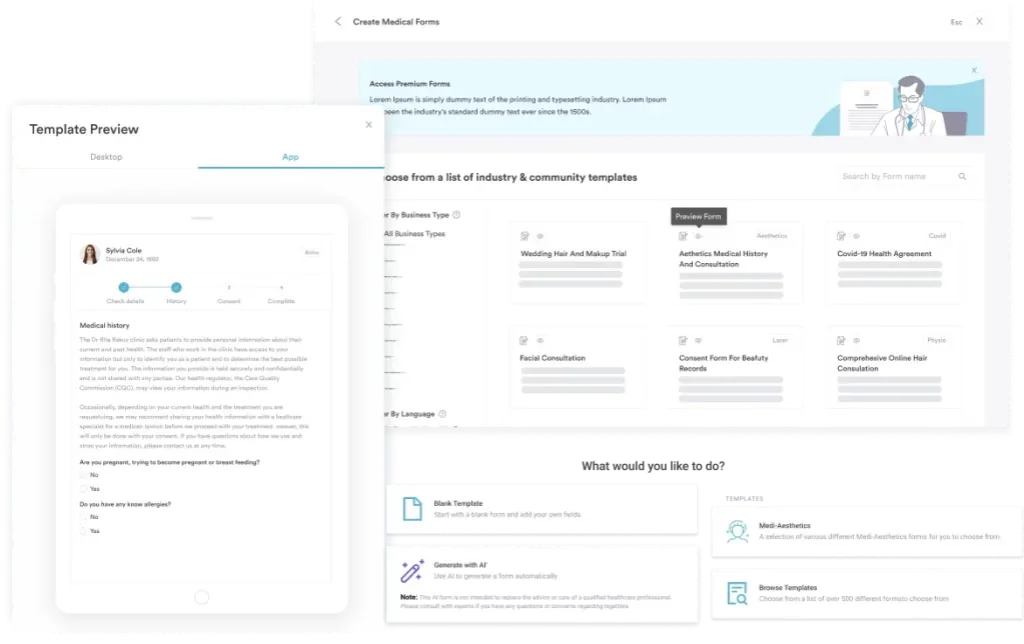
Practice management software like Pabau offers digital forms with structured fields that capture each required element at the point of care. Nobody has to reconstruct the note from memory afterwards. With the operative report stored in the patient record beside the pre-authorisation correspondence, billing staff work from the same file the surgeon signed.
Prior authorisation is the most critical step in the E4030 billing workflow. Most UK private medical insurers treat tracheal surgery as a high-cost episode requiring pre-approval before the procedure is carried out. Billing without a valid authorisation number is the most common reason E4030 claims are denied outright. Clinical necessity alone is not grounds for appeal once the operation has gone ahead.
General pre-authorisation principles across UK PMI payers include:
Requirements differ by payer and policy type. The Bupa CCSD billing guide outlines Bupa-specific authorisation pathways. Always verify current pre-auth criteria with each insurer’s provider services team, because thresholds and evidence requirements change with annual schedule reviews.
Each UK private medical insurer publishes its own recognition fee schedule and applies its own clinical governance rules to high-value surgical codes. Specific fee amounts for E4030 are not reproduced here because they change with each annual schedule update. Verify current figures through each insurer’s provider portal before billing.
For insurers not listed in your practice’s billing system, contact their provider services team before requesting authorisation. Ask them to confirm whether the patient’s policy covers E4030.
Denial patterns for CCSD code E4030 follow the same categories seen across other high-value surgical codes, and a handful of triggers account for most rejections. Checking for each one before submission is far quicker than managing appeals afterwards.
Appeals are time-limited under most payer contracts. Log the denial date and the appeal deadline immediately on receipt of any rejection notice.
Build a pre-submission checklist for E4030 claims: Authorisation number confirmed, surgeon recognition verified, and reconstructive technique documented. Check any add-on codes against the payer’s unbundling policy too. Running this check before every submission catches the most common E4030 denial triggers while they can still be fixed.
A tracheoplasty episode generates claims from three distinct parties: The operating surgeon, the anaesthetist, and the hospital or private facility. Each submits a separate claim to the insurer, and each uses different CCSD code categories. Understanding how these claims interact prevents duplicate billing errors and unbundling disputes.
Each of these claim streams should reference the same authorisation number and the same episode date. Inconsistencies across claims from the same surgical episode are a common audit trigger.
A structured submission workflow for CCSD code E4030 reduces the administrative error rate and gives billing coordinators a repeatable process for high-value surgical claims. The steps below apply to most UK PMI payers, but verify payer-specific variations before submitting.
Surgeons moving from NHS settings into private practice often underestimate how much documentation private insurers require for surgical codes of this complexity. The NHS OPCS-4 system and the CCSD schedule have fundamentally different administrative cultures around evidence submission.
Accurate E4030 billing depends on two habits. The first is complete clinical documentation at the point of care. The second is a claims workflow that tracks authorisation status, submission dates, and query responses. Both break down when the practice relies on paper or disconnected systems.
Pabau’s claims management software gives UK private practices a centralised workflow for tracking surgical claims from pre-authorisation through to payment confirmation. Billing coordinators attach operative notes and supporting documents to the patient record, which cuts the manual file assembly that slows complex claim submissions.
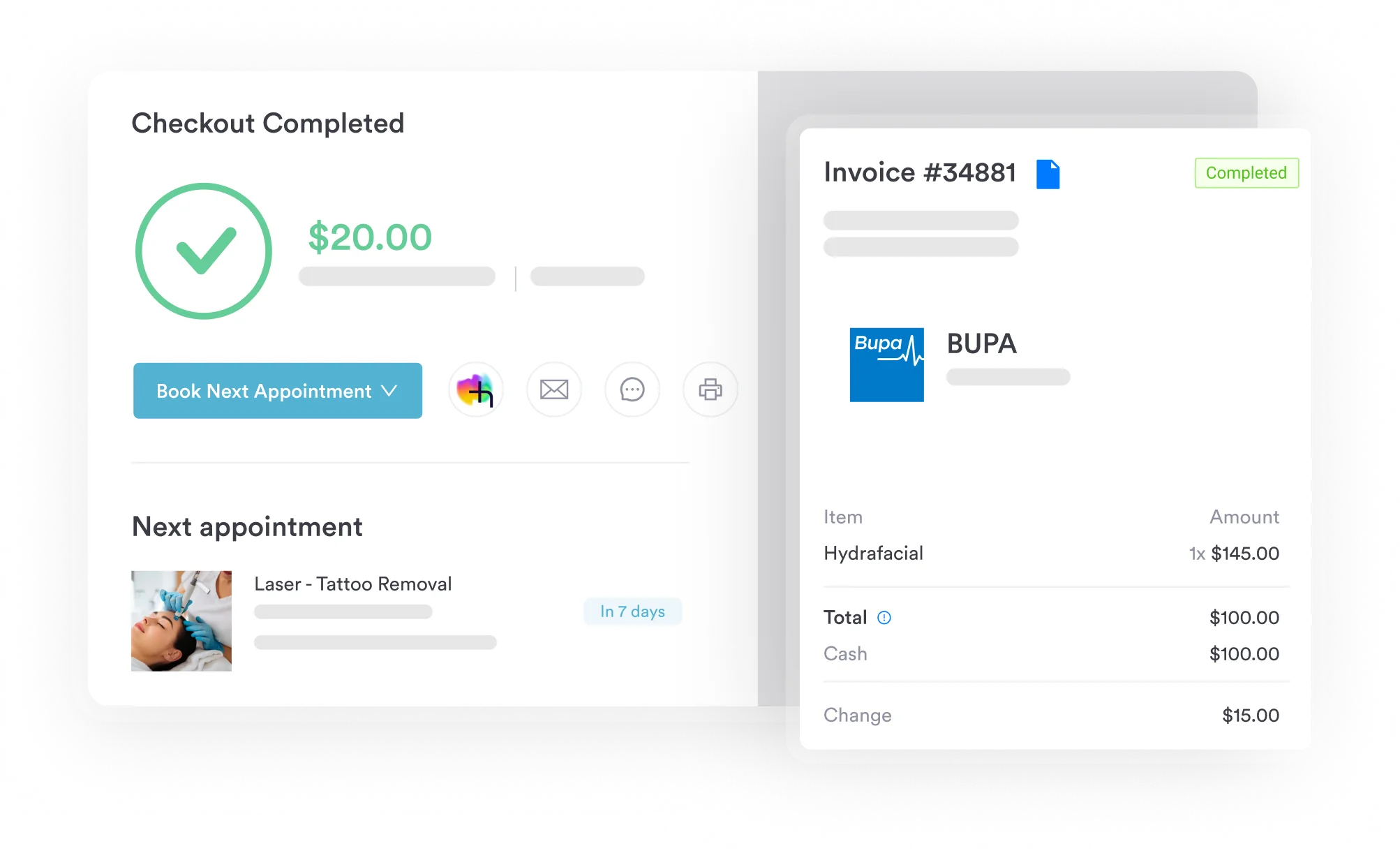
Pabau also keeps an audit trail of every document version, authorisation reference, and claim status update. E4030 claims are routinely subject to clinical review, and that trail lets the practice answer a query letter with one complete reply.
Features that support the tracheoplasty billing workflow include:
Surgical billing accuracy improves most when clinical documentation and claims administration share one platform. Theatre notes, authorisation letters, and claim forms then sit in the same patient record. The billing team stops chasing missing documents between theatre and submission.

Pabau gives private practices the clinical records, digital forms, and claims management tools needed to keep surgical billing accurate and audit-ready. See how it works for UK private healthcare teams.

An E4030 claim is won or lost before the patient reaches theatre. Secure the pre-authorisation number and confirm the surgeon’s recognition first. Then rule out E4840, E4210, E3900, and E4032 before settling on tracheoplasty.
The trade-off is time spent up front. A pre-submission check adds minutes to each case, while a returned claim or clinical query can add 4 to 6 weeks to payment.
Book a demo to see how Pabau keeps operative notes, authorisation references, and insurer claims together for surgical practices billing CCSD codes.

Need a complete overview of CCSD codes for Bupa billing? Bupa CCSD billing guide covers how to look up, verify, and submit procedure codes for the UK’s largest private insurer.
Billing another airway procedure from the same schedule section? CCSD code E4100 covers insertion of a voice prosthesis and its documentation requirements.
Coding a diagnostic look at the larynx before surgery? CCSD code E3680 explains when endoscopic laryngopharyngoscopy is billed as a sole outpatient procedure.
Want to see how Bupa sets recognition fees? Bupa procedure codes fee schedule explains how Bupa structures its fees across the CCSD schedule.
CCSD code E4030 covers tracheoplasty: Open surgical reconstruction of the trachea to restore airway patency. It applies where the windpipe is narrowed, structurally damaged, or otherwise functionally compromised. It does not cover tracheotomy (stoma creation), tracheal resection and anastomosis, or bronchoscopic dilation procedures.
A tracheoplasty reconstructs the structure of the trachea to widen or repair it. A tracheotomy creates a surgical opening in the trachea to provide an airway without altering its structure. They are billed under different CCSD codes, E4030 and E4210, and must not be used interchangeably. Confusing them is one of the most common coding errors for tracheal procedures.
Yes, prior authorisation is typically required by Bupa, AXA Health, and most other UK private medical insurers for major tracheal surgery, including tracheoplasty. Authorisation should be obtained before the procedure is carried out. Claims submitted without a valid authorisation reference number are routinely returned unprocessed. Verify current requirements with each insurer, as policy-level variations apply.
The most frequent denial triggers for E4030 are a missing pre-authorisation number and a mismatch between the operative note and the code submitted. Surgeon recognition problems and unbundled add-on codes without payer agreement follow close behind. Each of these is preventable with a structured pre-submission review.
The codes most often compared with CCSD code E4030 are E4210 (tracheostomy), E3900 (partial excision of trachea with reconstruction), and E4840 (dilatation of tracheal stricture). Congenital cases use E4032, and combined larynx and trachea repair needs the laryngotracheal code confirmed with the payer. Each describes a different technique, so the code must match the documented operative approach.
Yes, anaesthesia codes are always billed separately from the surgical code for the same episode. The anaesthetist submits their own CCSD-coded claim under the anaesthesia schedule, independent of the surgeon’s E4030 claim. Both claims reference the same authorisation number and episode date. The hospital or private facility also submits a separate facility claim for theatre time and consumables.