

CCSD code G5100: Bypass of duodenum billing guide
CCSD code G5100 bills a bypass that leaves the duodenum in place CCSD code G5100...

Last Updated: Oct 16, 2026
25100 is the CCSD code for a diagnostic coeliac plexus block, splanchnic nerve block, or hypogastric block, with or without image guidance. It covers test blocks that use local anaesthetic to check whether sympathetic nerve interruption relieves visceral or pelvic pain.
Image guidance is bundled into the single 25100 fee and is never billed as a separate line. Neurolytic blocks of the same structures, using alcohol, phenol, or radiofrequency, are billed under a separate CCSD code.
Let Pabau's smart automation suggest the right codes, reduce claim denials, and keep your practice compliant—effortlessly.
Automate repetitive tasks and focus on what matters most—your patients.
Reduce coding errors and ensure compliance with the latest regulations.
Clean claims, fewer denials, and faster reimbursements.
Powerful insights and reporting to help your practice thrive.
HIPAA compliant SOC 2 certified GDPR-compliant Trusted by 4,000+ clinics worldwide

CCSD Code 25100 covers diagnostic coeliac plexus, splanchnic nerve, and hypogastric blocks that use local anaesthetic to test a patient’s pain response.
Neurolytic blocks using alcohol, phenol, or radiofrequency are billed under a separate CCSD code, and mixing up the two is the most common denial trigger.
Image guidance is bundled into the 25100 fee, so the claim carries one line and no separate guidance code.
Procedure notes must record diagnostic intent, the guidance modality, the agent and volume injected, and the post-block pain assessment.
Claims management software like Pabau checks membership numbers and authorisation codes before Healthcode submission, then tracks each claim’s status.
CCSD Code 25100 is the Clinical Coding and Schedule Development code for a diagnostic coeliac plexus block, splanchnic nerve block, or hypogastric block. The CCSD Group publishes and updates the procedure schedule used by UK private medical insurers, including Bupa, AXA Health, Aviva, Vitality, WPA, and Cigna.
Three anatomically distinct procedures share the code because they answer the same diagnostic question. Does the patient’s visceral or pelvic pain respond to sympathetic nerve interruption before anyone commits to a therapeutic or neurolytic intervention?
Specifically, the word “diagnostic” in the descriptor limits the code to prognostic or test blocks. Instead, a block performed with chemical neurolysis (alcohol or phenol), or intended as a definitive treatment, is billed under a different CCSD code. Submitting a therapeutic block under 25100, or a diagnostic block under the neurolytic code, is the most frequent coding error in this procedure class.
All three procedures grouped under CCSD Code 25100 target ganglia or nerve trunks in the sympathetic nervous system that relay visceral pain signals. However, each has its own anatomical target and clinical indication. What they share is diagnostic intent. Local anaesthetic temporarily interrupts the pain pathway, so the clinician can assess how the patient responds.
Pain specialists and anaesthetists should confirm in the procedure note which of the three blocks was performed and which anatomy was targeted. As a result, insurers may query a claim that carries only the code number, with no matching procedure description in the notes.
The most consequential distinction in this procedure class is whether the block is diagnostic or therapeutic. CCSD Code 25100 covers diagnostic blocks only. In contrast, neurolytic blocks on the same structures use alcohol, phenol, or radiofrequency as a definitive treatment. As a result, they fall under a separate CCSD code, with different clinical criteria, documentation requirements, and insurer coverage rules.
Document the agent name, concentration, and volume in every procedure note. For example, a note that records only “nerve block performed” gives the insurer no way to confirm diagnostic or neurolytic intent. Consequently, that usually leads to a request for further information, or an outright rejection.
Each procedural step maps to something the billing note must capture. In an insurer audit, the procedure note is the primary evidence that the correct code was applied. Below is the typical clinical sequence for a diagnostic coeliac plexus or splanchnic nerve block under image guidance.
Image guidance is standard practice for sympathetic nerve blocks at these anatomical depths and is almost universally used in UK private practice. Consequently, it is never billed separately under CCSD Code 25100.
The official schedule descriptor reads “Coeliac plexus block, splanchnic nerve block, hypogastric block – diagnostic +/- image guidance”. That “+/- image guidance” wording means one bundled fee applies whether or not fluoroscopy, CT, or ultrasound guidance was used.
There is no separate add-on code for image guidance in this procedure family. The bundling is written into the schedule itself, so it holds for every insurer that uses CCSD.
The same “+/- image guidance” wording appears across other CCSD pain-block codes, such as 25022, 25030, A5743 to A5766, and A7300. Where guidance is mandatory, CCSD writes it into the descriptor instead, using wording like “under image guidance” or “under X-ray control”. CCSD 25012 carries that mandatory wording, placing the sacral root block under X-ray control.
CCSD A7352 follows the same pattern, with image guidance built into the descriptor for a named major nerve or plexus block. A coeliac plexus block stays on 25100 even under imaging, because A7352 excludes it.
Insurers that use CCSD can set different fee amounts for 25100, but none of them unbundle the guidance from it. In practice, that means:
Any guidance code submitted alongside 25100 is an unbundled line and will be declined by Bupa, AXA Health, and other CCSD insurers. Documenting the modality still matters for clinical governance and audit, even though it does not change the code or the fee.
Some diagnostic protocols involve bilateral needle placement in one session. Examples include bilateral anterocrural coeliac plexus blocks and bilateral splanchnic nerve blocks. Whether 25100 can be billed once per side on the same date is governed by the current CCSD technical guide and each insurer’s policy. Therefore, check both before claiming bilaterally.
Where bilateral billing is supported, the procedure note must state that bilateral injection was performed. It should document needle placement and agent injection for each side separately, and confirm that each side was guided independently. A note describing only one side’s technique, submitted with two 25100 codes, will typically be queried or reduced to a single unit.
Multiple procedures on the same date raise a similar question. A coeliac plexus block and a hypogastric block in one session target anatomically distinct structures and answer distinct diagnostic questions. Check the CCSD schedule and the insurer’s multiple-procedure policy to see whether both can be billed as separate 25100 lines.
In practice, most UK insurers apply a percentage reduction to the lesser procedure when several interventional pain procedures are performed in one session.
Planning to bill 25100 bilaterally, or alongside a second sympathetic block on the same date? Check the current CCSD technical guide and your insurer’s multiple-procedure reduction policy first. Document each side or each structure as a separate entry in the procedure note, so the claim is supported if it is queried.
CCSD Code 25100 sits within a family of interventional pain codes covering sympathetic nervous system procedures. Using the wrong code from this family is among the most common billing errors in pain management practices. In short, two facts from the procedure note settle the choice, as the diagram below shows. The table after it maps the key neighbouring codes and when each applies.
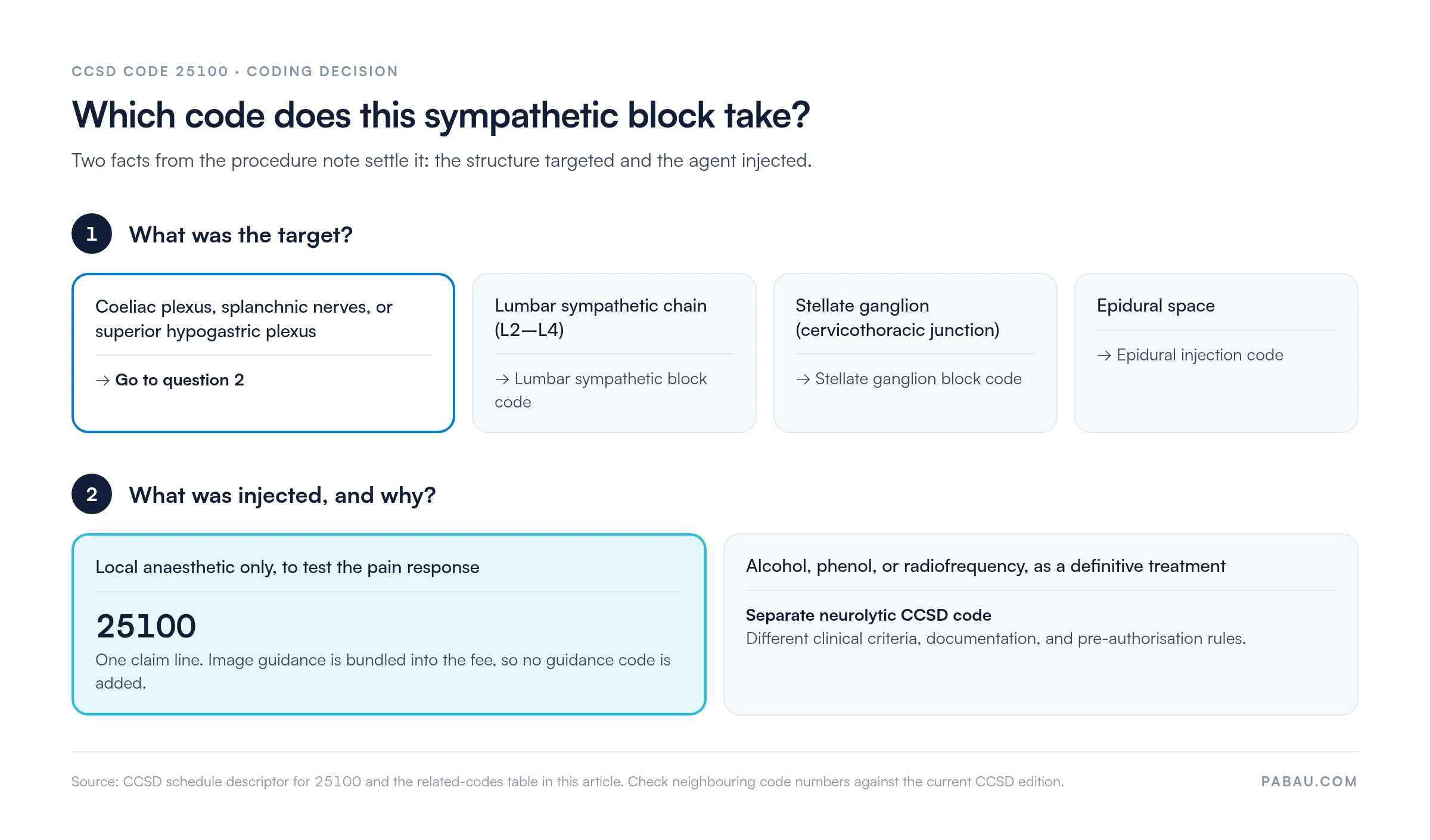
Code numbers in this class can change between annual editions of the schedule. Check the neurolytic, lumbar sympathetic, and stellate ganglion codes against the current edition before you submit. For other procedures billed under the same schedule, browse Pabau’s library of CCSD codes.
Most UK private medical insurers require pre-authorisation for interventional pain procedures in this category. Pre-authorisation (also called prior approval or pre-auth) confirms that the insurer will fund the procedure before it is performed. A claim submitted without a required pre-authorisation is typically declined, however accurate the coding.
Build the pre-auth request into the booking process for every elective pain intervention, so it is settled before the appointment.
Pre-authorisation requirements can change with each insurer’s annual policy update. The table above reflects general practice for interventional pain procedures, so check each insurer’s current provider guide before the patient attends. For Bupa specifically, the Bupa CCSD coding guide covers submission conventions across Bupa-recognised procedures.
Denial patterns for CCSD Code 25100 follow predictable categories. In fact, denials for CCSD Code 25100 are often preventable with correct coding, complete documentation, and timely pre-authorisation.
When a CCSD Code 25100 claim is denied, the appeal should attach the complete procedure note and the pre-authorisation confirmation, if one was obtained. Add a short clinical letter from the treating clinician explaining why the diagnostic block was indicated at that point in the patient’s pathway. Most insurers run a formal appeal process with a 30-day resolution window.
Submitting a CCSD Code 25100 claim to a UK private insurer follows a consistent workflow across most payers. In brief, the seven steps below outline the standard submission pathway.
Many pain practices still type membership numbers and pre-authorisation references into each claim by hand. One transposed digit sends a correctly coded 25100 claim back from the insurer, and the fee waits while someone fixes it.
Pabau’s claims management software checks the membership number and authorisation code on each claim before it goes to Healthcode. After submission, each claim’s status is tracked in Pabau, so your team can see where every 25100 claim stands.
As a result, fewer claims bounce back for missing details. When an insurer does ask for more information, your team can reply inside its response window, before the claim lapses.

Pabau checks membership numbers and authorisation codes before each Healthcode submission, then tracks every claim’s status in one place.

Treat the agent in the procedure note as the coding decision. Local anaesthetic only, a test purpose, and a recorded post-block pain score point to 25100. Alcohol, phenol, or radiofrequency move the claim to the neurolytic code.
From there, two habits remove the most avoidable rejections. Get the pre-authorisation reference before the procedure date, and submit 25100 as a single line with no guidance add-on. Ultimately, both cost a few minutes at booking, which is far cheaper than an appeal after a denial.
Book a demo to see how Pabau checks membership numbers and authorisation codes before your CCSD claims reach Healthcode.

Need Bupa’s submission conventions in one place? Bupa CCSD codes covers the Bupa procedure code schedule and how claims are submitted against it.
Billing a block at the nerve root instead? CCSD code 25120 is the billing guide for dorsal root ganglion blocks.
Moving from a test block to radiofrequency treatment? CCSD code 25130 is the billing guide for dorsal root ganglion radiofrequency blocks.
Billing a paravertebral block instead? CCSD code 25010 is the billing guide for paravertebral blocks.
CCSD Code 25100 is the UK private healthcare procedure code for a diagnostic coeliac plexus block, splanchnic nerve block, or hypogastric block. In particular, all three use local anaesthetic to test whether sympathetic nerve interruption relieves the patient’s pain before any therapeutic intervention is considered.
CCSD Code 25100 covers diagnostic blocks only. Therapeutic or neurolytic blocks of the same structures, performed with alcohol, phenol, or radiofrequency energy, are billed under a separate CCSD code. Miscoding a neurolytic procedure as 25100 is the most common claim error in this category.
The defining difference is the agent used and the clinical purpose. CCSD Code 25100 covers a temporary prognostic test with local anaesthetic. The neurolytic code covers long-term or permanent destruction of the nerve pathway using alcohol, phenol, or radiofrequency. They carry different pre-authorisation requirements and different fee levels with most UK insurers.
Yes. Most UK private insurers require pre-authorisation for interventional pain procedures including diagnostic sympathetic nerve blocks. A claim submitted without a valid authorisation reference is typically declined regardless of coding and documentation accuracy. Obtain pre-auth before the procedure date and retain the reference number with the claim record.



