ICD-10 Code V09.01XS: Pedestrian injured in nontraffic accident involving military vehicle, sequela
ICD-10 Code V09.01XS: Code description and clinical meaning ICD-10 code V09.01XS...

Last Updated: Oct 26, 2026
Billable Code Specific Code
S52.136N is the billable ICD-10-CM code for nondisplaced fracture of neck of unspecified radius, subsequent encounter for open fracture type IIIA, IIIB, or IIIC with nonunion.
N marks nonunion, and it fits only a Gustilo type III injury. Reach for M or R instead and the claim describes a different fracture, which is what payers and auditors pick up.
The reference below runs through all 16 seventh characters, the Gustilo criteria, the documentation a payer expects, and the ICD-9-CM mapping.
Let Pabau's smart automation suggest the right codes, reduce claim denials, and keep your practice compliant—effortlessly.
Automate repetitive tasks and focus on what matters most—your patients.
Reduce coding errors and ensure compliance with the latest regulations.
Clean claims, fewer denials, and faster reimbursements.
Powerful insights and reporting to help your practice thrive.
HIPAA compliant SOC 2 certified GDPR-compliant Trusted by 4,000+ clinics worldwide

S52.136N covers a nondisplaced fracture of the neck of an unspecified radius, seen again after an open type III injury failed to unite.
The 7th character N fits one situation only, a subsequent encounter for a Gustilo type IIIA, IIIB or IIIC fracture with documented nonunion.
Laterality is unspecified here, so use S52.134N for the right radius and S52.135N for the left.
Subcategory S52.136 has 16 valid 7th characters, and swapping N for M, R or J is the usual error.
Practice management software like Pabau checks the fields an insurer needs before you send, then files the claim through Claim.MD.
The long description reads nondisplaced fracture of neck of unspecified radius, subsequent encounter for open fracture type IIIA, IIIB, or IIIC with nonunion. It is a billable, specific code, valid for every HIPAA-covered transaction. The 2026 edition took effect October 1, 2025.
Billable is not the same as payable. Payer policy, medical necessity, and prior authorization rules all apply on top of a valid code.
Every level narrows the code, and skipping one is how coders end up under the wrong parent.
Here is the full path.
That 6th character, the digit 6, is the only reason laterality is unspecified. Swap it for 4 and you have the right radius. Swap it for 5 and you have the left.
Every code in subcategory S52.13 needs a 7th character, and 16 are valid, per the CMS ICD-10-CM guidelines.
Three questions decide which one you use. Is this the first visit for the injury, or a later one? Was the fracture closed, or open and graded? And how is it healing now?
Laid out as a grid, the whole set is easier to hold onto than a list of letters.
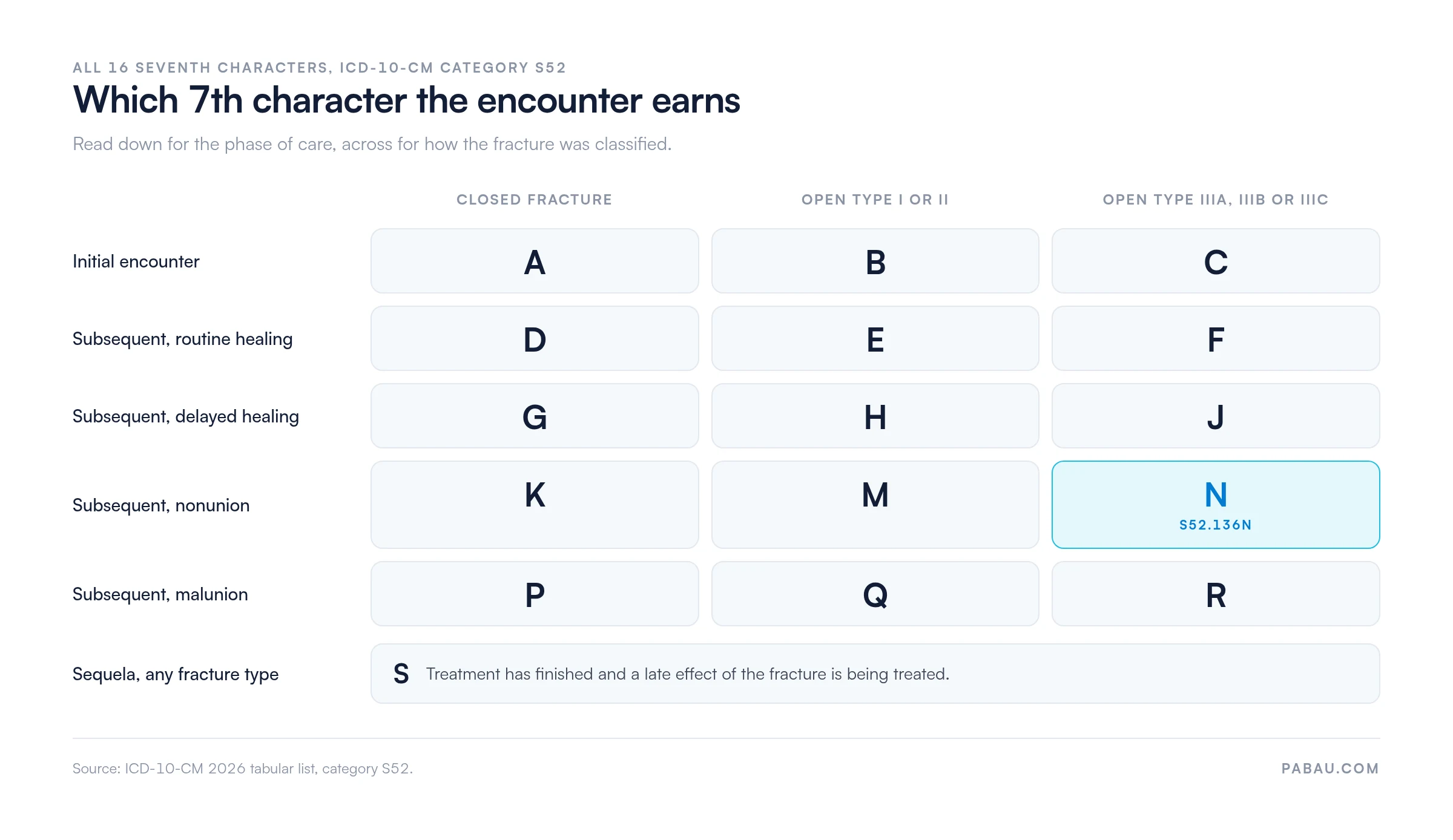
N is correct only when all three answers line up. The encounter is subsequent, the original fracture was graded IIIA, IIIB or IIIC, and the bone has not united. If the original injury was type I or II, the nonunion character is M instead.
Delayed healing and nonunion are also separate characters, not two words for the same finding. A fracture that is healing slowly takes J, and the same split runs through the humerus codes like S42.332G.
Type III splits into IIIA, IIIB and IIIC, and what separates them is soft-tissue coverage and blood supply.
The grading comes from Gustilo and Anderson’s 1976 paper in the Journal of Bone and Joint Surgery. For S52.136N, the surgeon has to have named the subtype at the time of the injury.
Coders do not assign a Gustilo type. It has to come from the operative report, the emergency note, or an orthopedic consult. When the record says only “open fracture”, query the clinician before you reach for a type III character.
The word has to be in the record. Nonunion means the fracture has stopped progressing toward healing, and only the treating physician can make that call.
No single timeframe defines it. Orthopedic literature generally treats 6 to 9 months without healing as nonunion, and the threshold shifts with the bone, the patient, and the surgery.
Expected healing time is bone-specific, so the same characters on a tibial shaft code like S82.226G cover a different span of months.
None of those subtypes changes the code. S52.136N needs the word nonunion, or a clear equivalent such as “failure of fracture healing”, in the note for the visit you are coding.
Read the imaging report as well as the clinical note. Radiologists often document nonunion on X-ray or CT before the surgeon writes it in the office note. Both documents support the code, but imaging alone does not, so you still need the clinical interpretation.
Work down the list in order. Each line is a separate question, and one wrong answer sends you to a different code.
All six have to hold at the same time. Miss one and a different code applies, which is how a straightforward follow-up visit turns into denial management work.
Take a patient who broke the radial neck in a bike crash in February, and who now sees a sports medicine practice for follow-up. The operative note from February grades the injury IIIB.
Eight months on, imaging shows no union, and the surgeon writes nonunion in the office note. That visit codes to S52.136N.
From there the claim moves in a straight line. The coder assigns the diagnosis, the biller ties it to the service performed that day, and the claim leaves as an electronic CMS-1500. The payer adjudicates it and sends back a remittance.
Three failures break that line, and none of them is the code itself:
Payers rarely spell out which of the three it was. The remittance carries a reason code instead, so reading denial codes against your own rejections is faster than guessing.
A billable code carries no weight on its own. Every condition on the checklist needs a source document behind it, and an auditor will ask for each one by name.
Judging whether that record is strong enough stays a human review. What software checks is the claim form. Practice management software like Pabau runs a validation pass when you hit send.
A missing membership number or authorization code holds the claim back, rather than the payer doing it later. That is the difference between a clean claim and a resubmission three weeks later.
Submission itself runs through the Claim.MD integration, which files electronically to thousands of US payers and brings the remittance back.
Pabau’s claims management software also carries a searchable ICD-10 library of more than 20,000 codes. Treat that as a lookup for finding S52.136N quickly, not as a check on whether the chart supports it.
Subcategory S52.136 has 16 valid versions, one per 7th character. Four of them describe an open type III fracture at a later visit, and that is where errors cluster. F is routine healing, J is delayed healing, N is nonunion, and R is malunion.
Two mistakes account for most of the rework. The first uses N when the original fracture was type I or II, where M is correct. The second uses N for a malunion, where R is correct.
Malunion characters behave the same way elsewhere in category S52, as S52.001P shows.
Notes use clinical shorthand instead. All of these phrasings point to S52.136N when the rest of the record backs them up.
A matching phrase does not make the code safe. Wording is what most medical billing compliance reviews turn on, so all six documentation elements still have to be in the chart.
No single ICD-9-CM code matches S52.136N. ICD-9 never carried Gustilo type or healing status, so the closest reading pairs a fracture code with a nonunion code. Legacy audits and historical reconciliation are the only places you need it.
Watch the last digit. The radial head codes, 813.05 and 813.15, sit one digit away and cover a different part of the bone.
Treat any mapping as approximate rather than equivalent. CMS keeps its General Equivalence Mappings in the CMS GEM archive, and that is the reference to check a legacy conversion against.
ICD-10-CM has been required since October 1, 2015, and S52.136N applies to any date of service in the 2026 coding year.
Run the crosswalk against the CMS General Equivalence Mappings when you convert legacy ICD-9 claims for an audit or a quality report. Check any commercial crosswalk tool against them first, because complex fracture codes are where those tools disagree most.
In a lot of practices the diagnosis and the claim live in two systems. A coder picks S52.136N in the chart, and someone re-keys it into a billing tool. Nobody spots the missing authorization number until a rejection arrives weeks later.
Pabau keeps both in one record. The invoice, the diagnosis code, and the insurer details all come off the patient file, so nothing gets typed twice. Validation runs at the point of sending, and the claim waits until the fields the insurer needs are filled in.
From there it goes out electronically through the Claim.MD clearinghouse, with eligibility checks, claim status, and remittances in the same dashboard. For a practice billing a run of fracture follow-ups, that turns a week of chasing into a status you can read on a Monday morning.

Pabau turns the invoice into an electronic claim, checks the fields the insurer needs, and files it through Claim.MD. You get fewer rejections on subsequent-encounter visits and a remittance you can track in one place.

N is not a severity upgrade. It states two separate facts, the Gustilo grade from the original injury and the healing status today. Read both in the record before you type the character, and the rest of the code follows.
The trade-off worth remembering is specificity against speed. Unspecified laterality keeps a claim moving, but it also tells the payer that nobody checked. One query usually turns S52.136N into S52.134N or S52.135N, and that version survives review.
When the coding is right and the claim still comes back, the problem is usually the submission. Book a demo to see how Pabau moves a subsequent-encounter claim from invoice to remittance without a second system.

Coding a sequela visit instead? S51.029S shows how the S character works once active treatment has finished.
Need the procedure side of a forearm claim? 25441 covers arthroplasty with prosthetic replacement of the distal radius.
Still on the initial encounter? S42.452A walks through the A character on a displaced humeral condyle fracture.
Billing a follow-up for a sprain rather than a fracture? S63.004D applies the same subsequent-encounter logic to the wrist.
No. External cause codes are reported at the initial encounter only, so a subsequent-encounter code like S52.136N goes out without one. The cause of the original injury is already on the record from that first visit.
No. The 7th character tracks the phase of healing, not the months since the injury. Keep using a subsequent-encounter character while the fracture is still under aftercare. Move to S only once treatment has ended and a late effect is being treated.
No. The nonunion characters K, M and N exist only in the subsequent-encounter range. A first visit for the injury takes A, B or C, depending on whether the fracture was closed or open.
No. Encounter type follows the phase of care, not the provider. A surgeon seeing the patient for the first time still codes a subsequent encounter if active treatment finished elsewhere.