CPT code 93503: Swan-Ganz catheter billing and modifiers
CPT code 93503: Official descriptor and procedure overview In the AMA CPT code s...

Last Updated: Oct 23, 2026

CPT code 26170 describes excision of tendon, palm, flexor or extensor, each tendon, in the AMA’s Musculoskeletal System section.
The code is reported per tendon excised. Multiple tendons removed in the same session each require a separate unit of 26170.
Anatomy decides between 26170 and 26180. The operative note has to state whether the excision happened in the palm or within a finger.
Modifier 51 and the finger-specific F modifiers are the ones that come up most. A wrong or missing modifier is a frequent cause of NCCI edit denials.
Pabau’s claims management software checks each claim for the fields payers require, then submits it electronically through Claim.MD.
CPT code 26170 is a billable code for excision of tendon, palm, flexor or extensor, each tendon. It covers complete removal of a tendon from the palmar region of the hand, and it is reported once for every tendon excised.
Denials on this code usually trace back to the operative note rather than to the surgery itself. Payers need to see which tendon came out, whether it was flexor or extensor, and how many were excised. Medical billing for hand surgery codes starts with getting those details on the page.
The American Medical Association places 26170 in Surgery > Musculoskeletal System > Hand and Fingers > Excision Procedures, within CPT range 26100-26262. That sets it apart from tendon repair and tendon transfer, which describe reconstruction rather than removal.
Surgeons use 26170 when the clinical indication requires complete tendon removal from the palm. Common indications include:
The code covers both flexor and extensor tendons in the palm. Flexor tendons run along the palmar surface, while extensor tendons course along the dorsal aspect. Both sit inside the region the code describes, so tendon layer alone never changes the code.
Quantity is what changes the claim. Each tendon excised in the same operative session is reported separately with 26170.
The modifiers that come up on 26170 are 51, 50, 59, LT, RT, F1 through F9, and 22. Which one applies depends on the clinical scenario. A wrong modifier, or a missing one, is the most common route to a denial on this code.
Modifier 51 reduces payment on the secondary procedure to 50% of the allowed amount for most payers. Some carriers keep modifier 51-exempt lists, so verify before appending it. Medicare’s rules on modifier 51 differ from commercial policies. Confirm the guidelines with your Medicare Administrative Contractor (MAC).
Reimbursement for 26170 varies by payer, geographic location, and whether the procedure happens in a facility or non-facility setting. The figures below reflect 2025 Medicare Physician Fee Schedule (MPFS) national averages. Actual payment depends on the Geographic Practice Cost Index (GPCI) adjustment for each MAC jurisdiction. Always verify current rates with the CMS fee schedule lookup tool.
The FastRVU lookup tool pulls current values directly from CMS data, including the most recent MPFS final rule. RVU values for 26170 change with every annual rule, so cite the data year whenever you document expected reimbursement internally.
Medicare pays the lower of the submitted charge or the MPFS allowed amount. For hand surgery practices, accurate superbill documentation captures the tendon count and the operative site. It also records any secondary procedures performed in the same session. Incomplete superbill data delays payment and creates compliance exposure.
After adjudication, Medicare returns a remittance advice showing the allowed amount, the patient’s liability, and any adjustment reason codes. Reviewing those promptly on 26170 claims catches underpayments before the appeal window closes. Practices submitting through the Claim.MD integration can run eligibility checks and code validation before a claim leaves the practice.
Re-check RVU values when CMS publishes the proposed MPFS rule each summer, then again when the final rule lands in the fall. Rate changes affecting 26170 often arrive alongside broader musculoskeletal surgery adjustments.
The National Correct Coding Initiative (NCCI) maintains bundling edit pairs. Each pair governs which two codes may be billed together for the same patient on the same date. Billing two codes that form an NCCI edit pair without an appropriate modifier results in automatic denial of the secondary code.
For 26170, the bundling considerations that matter involve adjacent excision and repair codes covering overlapping anatomical work. When a tendon excision and a second tendon procedure are both performed, the note carries the burden. It must place each at a distinct anatomical site, or describe each as a separately identifiable service. A clearinghouse edit check before submission catches most of these pairs while the claim can still be fixed.
The AMA CPT coding resources portal carries CPT Assistant references, which give official guidance on specific procedure scenarios. CMS publishes the NCCI Policy Manual and the quarterly edit files on its own site.
Several adjacent codes in the hand and finger range are routinely cross-referenced with 26170. Choosing one off an imprecise operative note is a frequent billing error, alongside modifier mistakes. The table below maps each of them to its clinical indication.
The 26170 and 26180 pair causes the most confusion. Anatomy settles it. The palm means 26170, and a finger means 26180. A note that says only “hand tendon excision” leaves the coder guessing between them.
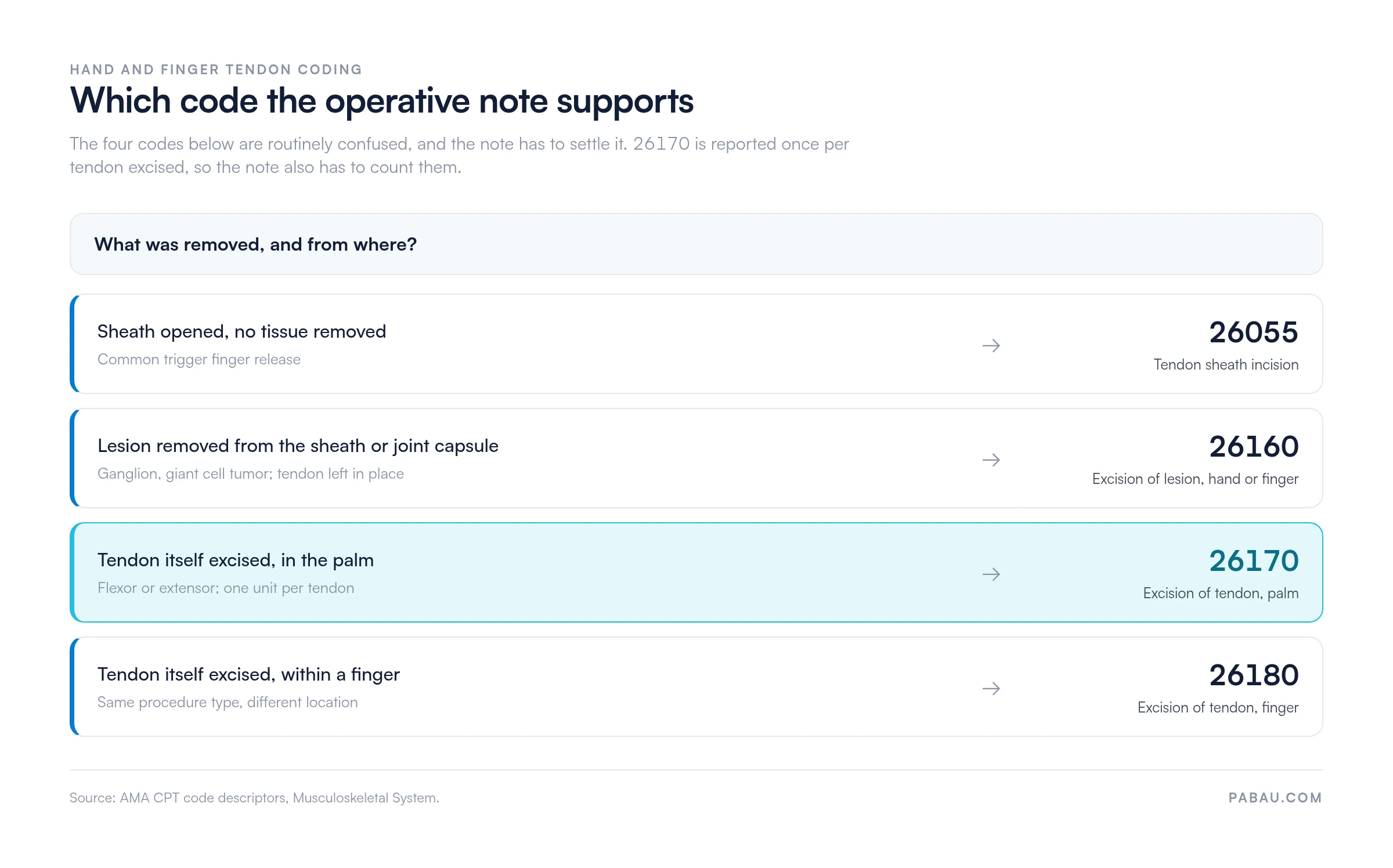
Hand tendon excision turns up in orthopedic and plastic surgery practices alike, and both bill the same descriptor. The one document that decides the code is the operative note, so hold every surgeon in the group to the same wording.
Denials on 26170 cluster around three root causes. Documentation is too thin, the modifier is wrong, or the code itself was the wrong pick. Systematic pre-submission checks remove most of the avoidable rejections.
Denial management for hand surgery codes should include a quarterly claims audit, comparing billed units of 26170 against the operative notes. A clean claim the first time is far faster than working a denial through the appeals cycle.
Track your average units of 26170 per claim. If it drifts above 1.5 across your case mix, check the notes. Each extra unit needs its own documented tendon excision.
In most hand surgery practices, the operative note lives in one system and the claim gets built in another. Someone reads the note, counts the tendons, picks the modifier, and types it all again into a billing tool. Every retype is a chance to lose the detail a payer needs.
Practice management software like Pabau keeps the note, the charge, and the claim inside one patient record. Its claims management software checks each claim for the fields payers require, such as membership numbers and authorization codes. Claims then go out electronically through the Claim.MD integration.
After submission, each claim’s status sits in the same place as the record it came from. When a 26170 claim stalls, the coder can see where it is without opening a separate portal, so the practice gets paid sooner.

Pabau checks each claim for the fields payers require, then submits it through Claim.MD and tracks its status in the patient record. Fewer resubmissions, and faster payment.

26170 rewards a practice that fixes the note rather than the claim. Get the tendon, the layer, and the count into the operative report, and both modifier selection and unit counts follow from what is written. Audit defense follows too.
Pabau’s claims management software checks each claim for the fields payers require before it leaves the practice. It then routes the claim through Claim.MD for electronic submission to thousands of US payers. Book a demo to see how Pabau handles hand surgery billing from note to payment.

Coding a wrist dislocation on a follow-up visit? ICD-10 code S63.004D walks through laterality and the encounter suffixes payers check.
Billing a distal radius replacement in the same practice? CPT code 25441 sets out the descriptor, the documentation, and the modifiers that apply.
Need the incision counterpart to an excision code? CPT code 25031 covers incision and drainage in the forearm and wrist.
Standardizing how clinicians write up a visit? The PIE note template shows the problem, intervention, and evaluation format with worked examples.
Assessing a wrist before you schedule surgery? The Watson test guide covers the scaphoid shift technique, how to interpret it, and its accuracy.
CPT code 26170 is the excision of tendon, palm, flexor or extensor, each tendon. The code sits in the AMA’s Musculoskeletal System section. It covers complete removal of a tendon from the palmar region of the hand, and it is reported once per tendon excised.
The modifiers that come up most are 51, 59, 50, LT, RT, and F1 through F9. Modifier 22 applies when the procedure takes substantially more work than usual, with documentation to support it. Verify each payer’s modifier policy before submitting, because Medicare and commercial rules differ.
Medicare pays roughly $425-$475 in a non-facility setting and $290-$330 in a facility setting. Those are 2025 MPFS national averages, before geographic adjustment, and they are updated with each annual final rule. Use the CMS fee schedule lookup tool or FastRVU to confirm the rate for your MAC jurisdiction.
CPT 26170 carries approximately 4.0-5.0 work RVUs under the MPFS, though exact values change with each annual rule update. Total RVUs include the work RVU, the practice expense RVU, and the malpractice RVU. The practice expense RVU differs between facility and non-facility settings. Verify the current year’s figures using the FastRVU lookup tool or the CMS fee schedule data files.
CPT 26170 covers excision of a tendon from the palm. CPT 26180 covers excision of a tendon from the finger. Both describe the same type of procedure, flexor or extensor, each tendon, in a different anatomical location. The operative note must specify whether the surgery happened in the palmar region or within a finger.
CPT 26170 and CPT 26160 may be billed together when they are genuinely distinct procedures at separate sites. NCCI edit review comes first. If an edit pair exists, modifier 59 or an X-modifier has to be appended with supporting documentation. Check the current quarter’s NCCI tables before submitting both codes on the same date of service.