Nursing narrative note template
A nursing narrative note template is a structured PDF that guides you through re...

3
Last Updated: Oct 21, 2026

A progress note template records what happened in one encounter, so every clinician who opens the file reads the same structure.
SOAP, DAP, and BIRP are the three dominant formats, and each one suits a different clinical setting.
Nine elements belong in every note, from the session date and presenting concerns through to risk assessment and the plan.
Specialty templates keep those nine and add their own fields, such as a mental status exam or range of motion scores.
Pabau’s customizable clinical records let teams build specialty templates whose fields save straight into the patient’s file.
A ready-to-use form with fields for patient details, presenting concerns, clinical observations, interventions, assessment, and the treatment plan. It suits mental health, physical therapy, nursing, and general medical practice.
Download templateStructured documentation is what keeps care continuous when the next appointment lands with a different clinician. A progress note template makes sure every encounter is recorded the same way, in enough detail to guide the next treatment decision.
This guide covers the nine elements that belong in every note, the three formats clinicians actually use, and free templates for six specialties. Each one is ready to print, or to rebuild inside the system you already run.
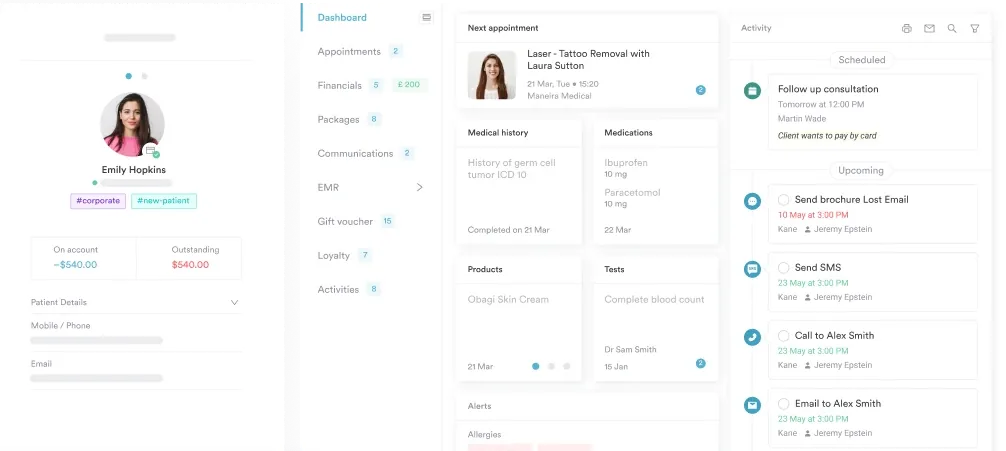
A progress note template is a structured form that standardizes how clinicians document patient encounters. It captures the session date, presenting concerns, clinical observations, interventions, patient response, and the plan for ongoing treatment. Every specialty needs one, from mental health and physical therapy through to nursing and primary care.
Intake forms capture background history. Treatment plans set out therapy goals. A progress note does a narrower job, recording what happened in one session, how the patient responded, and what comes next.
Templates cut the time each note takes and reduce omissions. They also make the record straightforward to review when someone audits it.
Whatever the specialty or format, every note carries the same nine foundational elements.
Cover all nine and the record is audit-ready. Digital intake forms can pre-fill the identifier and the presenting concerns before the session starts, which leaves you writing only the clinical content.
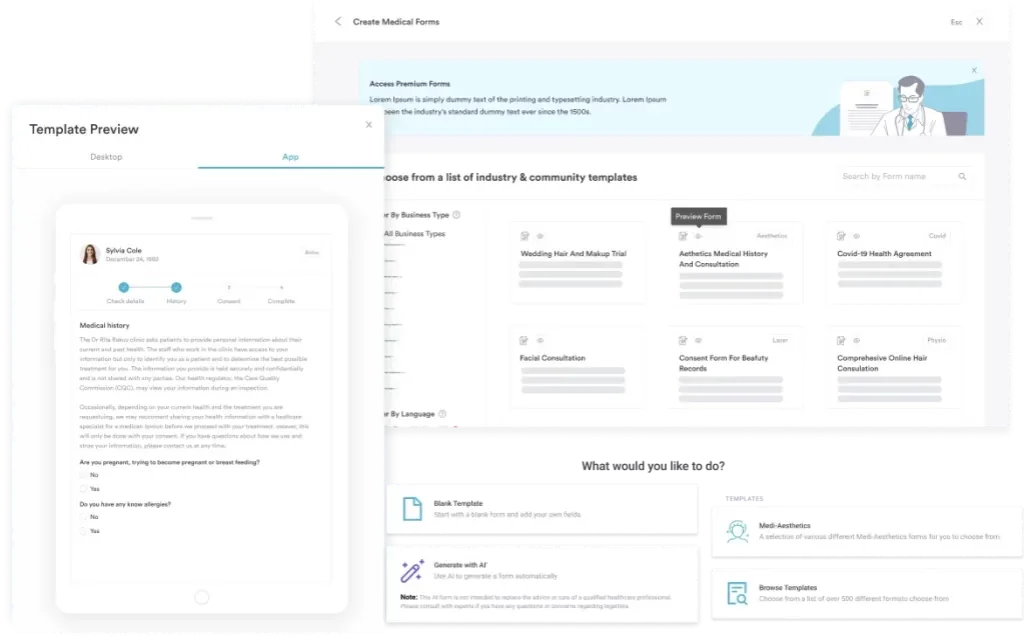
Three structured formats dominate clinical note-writing. Each one organizes the same information differently, so the right choice comes down to your specialty and workflow.
SOAP is the most widely recognized of the three. Its structure mirrors medical assessment logic and slots neatly into compliance documentation requirements. DAP and BIRP speed up note-writing for clinicians who rarely take objective measurements, and neither leaves anything out. Nursing units often add a fourth format, F-DAR charting, which pairs each focus with data, action, and response.
Every specialty keeps the nine core elements and then adds its own fields on top. The grid below shows what those additions look like, and which format each setting tends to reach for.
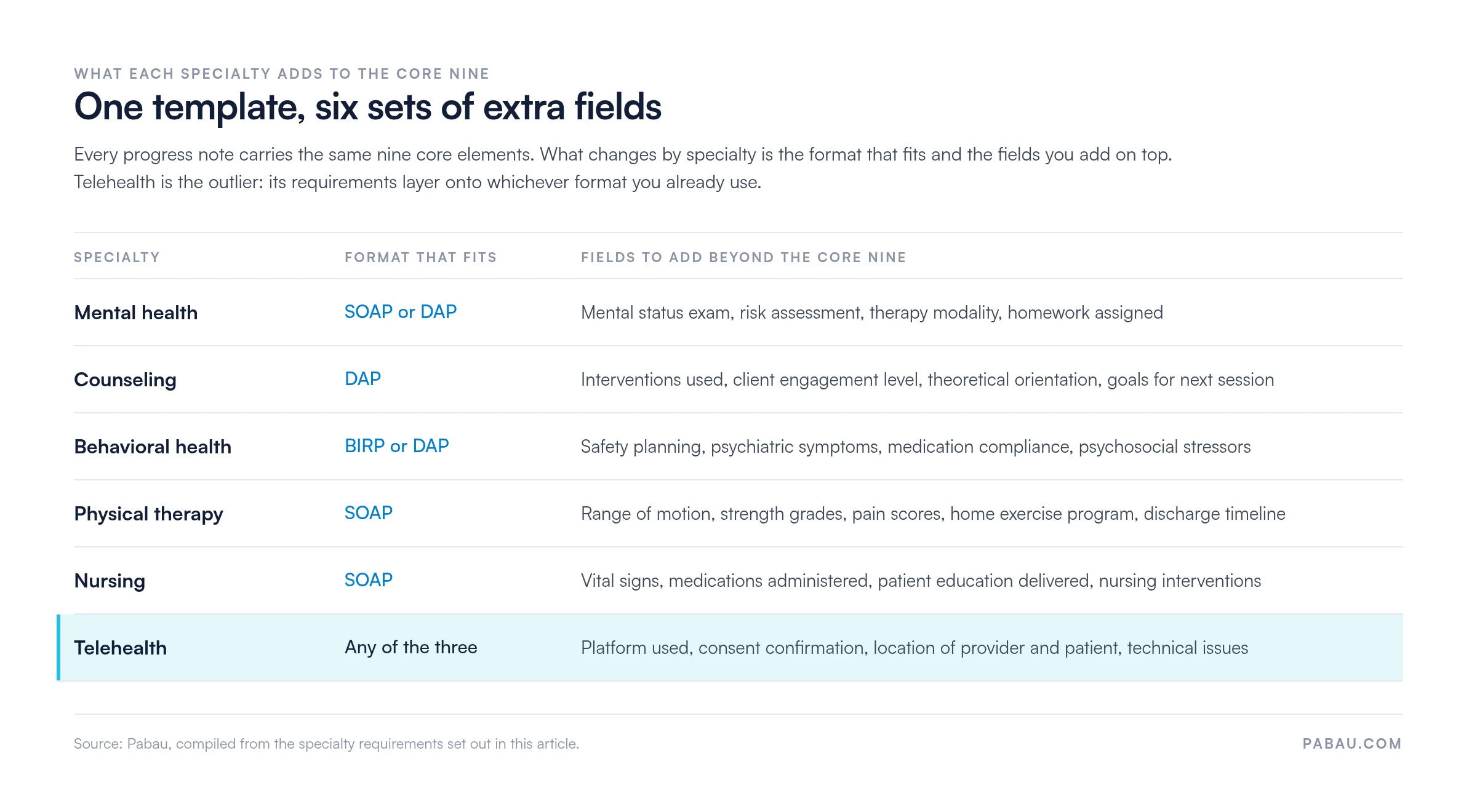
Mental health notes must include a mental status exam covering mood, affect, thought content, and orientation. Risk assessment is mandatory at every session. Most therapists work in DAP or SOAP, with extra fields for presenting symptoms, therapy modality, homework assigned, and the plan for next time.
A psychiatric evaluation template covers the initial assessment. Practices running mental health EMR software can then carry those baseline findings into every note that follows.
Counseling notes focus on the therapeutic relationship and on updates to the presenting concern. Record the interventions you used, whether that was cognitive behavioral therapy (CBT), mindfulness work, or psychoeducation. Note any between-session assignment and how engaged the client was.
Leave space for two things the format itself does not prompt for. Those are the theoretical orientation you applied, and the goal the client stated for the next session.
Notes in substance use and psychiatric settings need detailed sections for safety planning, psychiatric symptoms, medication compliance, and risk of harm to self or others. Psychosocial stressors belong there too. BIRP and DAP both work well here, because they keep documentation fast without losing clinical rigor.
A PIRP note is a close variant worth knowing. It swaps behavior for the presenting problem, which suits caseloads organized around a treatment plan goal.
Objective measurements lead a physical therapy note. Record range of motion, strength grades, functional test results, pain scores, and exercise tolerance. The form also needs fields for current functional status, exercises performed in session, the home exercise program provided, and the expected discharge timeline.
SOAP is the standard across allied health. Practices on physical therapy EMR software can pull the previous session’s measurements forward. Progress becomes visible at a glance instead of buried in a stack of notes.
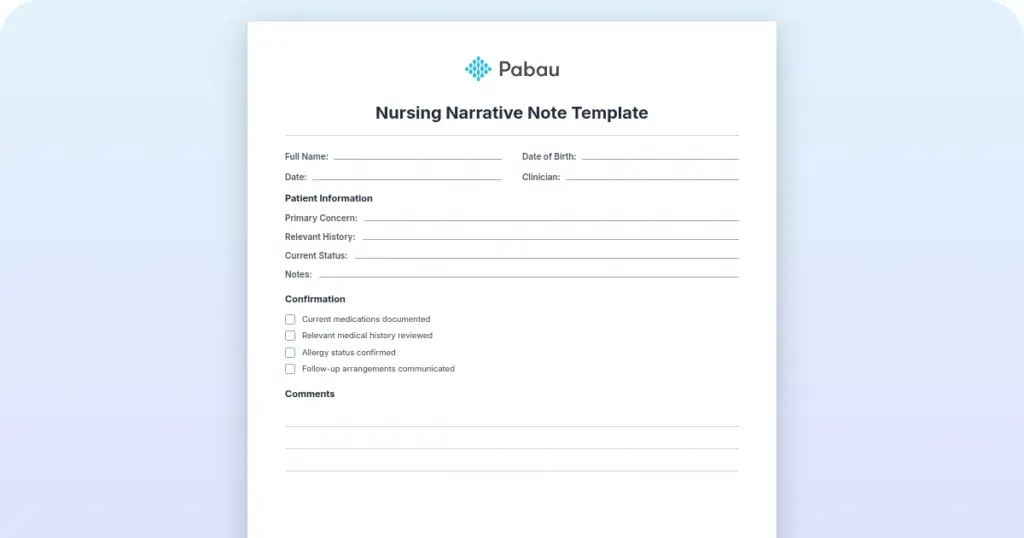
Nursing notes document vital signs, medications administered, patient education delivered, and interventions such as wound care or catheter management. The template needs room for chief complaints, the nursing assessment, the care delivered, and the patient’s response.
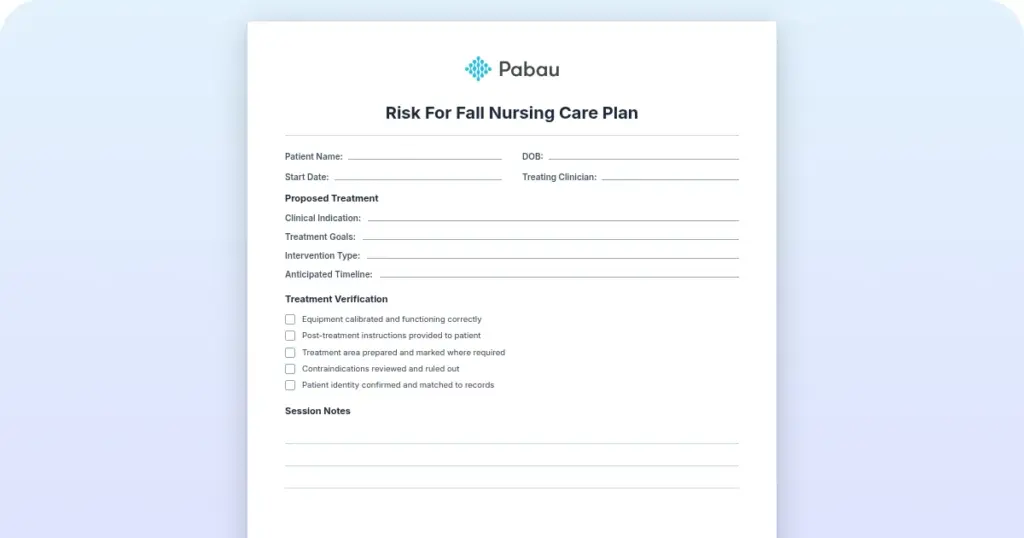
Where the note sits alongside a nursing care plan, every entry can be tied back to a stated goal. That turns a run of shift notes into evidence of progress. Those goals start from a nursing diagnosis, and a standardized outcomes list gives you a scale to score them against.
On an inpatient unit, two working documents sit either side of the note. A shift brain sheet keeps vital signs and medication times to hand during the shift. A structured handoff report then carries that detail to the nurse taking over.
Telehealth notes carry everything an in-person note does, plus four details specific to the medium. Document the platform used, the consent confirmation, the location of both provider and patient, and any technical problems that came up.
Those four fields matter most when care moves between settings. Capture them and an in-person follow-up starts with the full picture of what was and was not possible remotely.
A template is only as good as what gets written into it. These habits improve clarity, compliance, and usefulness to whoever reads the note next.
Running the template inside automated clinical workflows handles the mechanical part for you. Timestamps save themselves, and every edit lands in an audit trail you did not have to maintain.
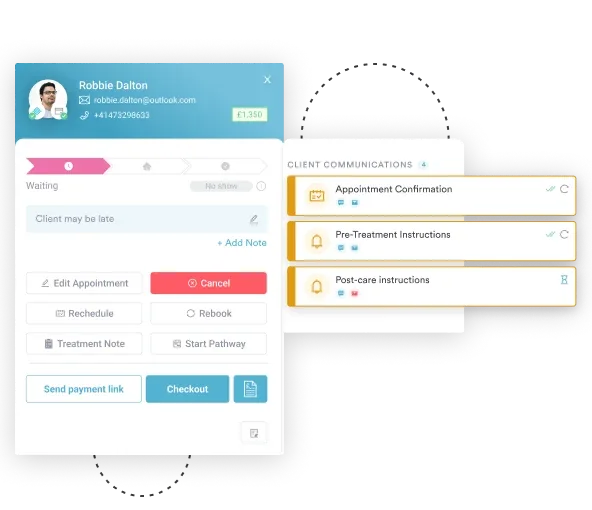
Progress notes are part of the patient’s medical record, so in the United States they fall under HIPAA. That means secure storage, with access limited to the clinicians who are authorized to see them.
Psychotherapy notes get an extra layer of protection. These are the detailed session notes kept in mental health treatment, and they cannot be disclosed without explicit patient authorization.
Compliance comes down to five practical measures.
A HIPAA-compliant records system handles all five in the background. That takes the liability off your practice and off the clinician writing the note.
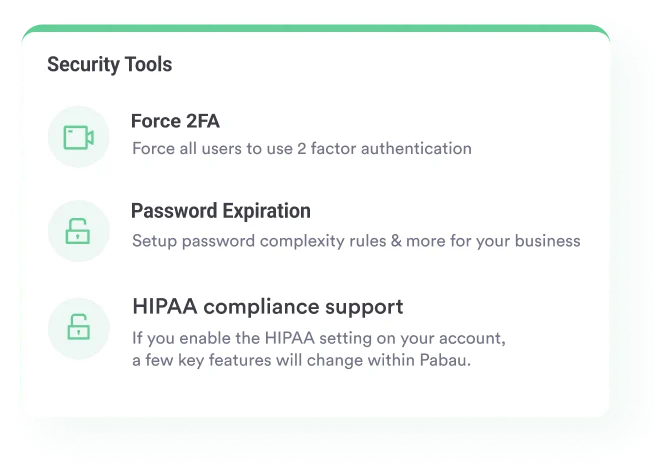
Paper charts and shared spreadsheets make every one of those habits a manual effort. Practice management software like Pabau holds the clinical record in one place instead. The note, the appointment, and the treatment plan all sit on the same file.
Teams build their own progress note templates to match their specialty and workflow. Fields, dropdown options, and required sections are configured once, then reused at every encounter. Every subscription includes the full template builder, so nothing you need sits behind a higher tier.
Because notes live next to patient history, appointments, and prescriptions, the next clinician opens the file with the context already there. Pabau Scribe, our AI scribe, can draft the note from the session itself. That gives your team the evening back instead of a documentation backlog.

Build customizable progress note templates that save straight into the patient record, with role-based access and automated audit trails behind them. Your team documents faster and the record stands up to review.

The format matters less than the discipline. Pick SOAP, DAP, or BIRP based on how much objective data your setting actually produces, then hold to that structure at every session.
The template is what makes that consistency survive a busy week. Fill it in while the session is still fresh and the record does two jobs at once. It briefs the next clinician, and it satisfies whoever audits you.
Book a demo to see how Pabau’s clinical records and template builder cut the time your team spends writing notes.

Need a fuller patient intake form? Medical needs form template covers contact details, medical history, medications, allergies, insurance, and consent.
Treating a minor without a parent present? Medical release form for minors authorizes a caregiver to consent to treatment when a parent is unavailable.
Planning patient education sessions? Nursing teaching plan template sets learning objectives, teaching methods, and ways to evaluate patient understanding.
Writing a quick SOAP note? SOAP progress notes template gives one page with Subjective, Objective, Assessment, and Plan fields.
Wondering why SOAP notes matter? SOAP notes meaning guide explains how the format closes gaps that lead to failed audits and care lapses.
Every progress note needs nine elements. Those are the session date, the patient identifier, presenting concerns, clinical observations, interventions provided, patient response, your assessment, the plan, and a risk assessment. A template keeps all nine in front of you, so none of them gets skipped.
SOAP notes cover Subjective, Objective, Assessment, and Plan, and are used across medicine and allied health. DAP notes drop to Data, Assessment, and Plan, which suits behavioral health. BIRP notes cover Behavior, Intervention, Response, and Plan, and are common in psychiatric and substance use treatment. All three capture the same clinical information in a different order.
Yes. Healthcare regulations require clinicians to keep written documentation of patient encounters, in the US and internationally. The notes are the evidence of care delivered and of clinical decision-making. Missing notes create legal liability and can lead to licensing board sanctions.
Yes, and it is encouraged. A template standardizes documentation, reduces errors, and makes compliance easier to prove. Customize it to your specialty and workflow, but keep the core structure of date, presenting concerns, assessment, and plan.
Yes, in the United States. Progress notes are part of the patient medical record, so HIPAA applies to them. They must be stored securely, with access limited to authorized staff and no disclosure without consent, except where the law requires it. Psychotherapy notes get stricter protection still.
There is no fixed word count. A note needs enough detail to support your clinical decisions and survive an audit, and no more than that. Most run between 200 and 500 words, depending on how complex the session was.