

CCSD code G5100: Bypass of duodenum billing guide
CCSD code G5100 bills a bypass that leaves the duodenum in place CCSD code G5100...

Last Updated: Oct 16, 2026
D1440 is the CCSD code for combined approach tympanoplasty with an intact canal wall. In one operation, the surgeon clears disease from the mastoid and the middle ear and repairs the eardrum where needed. The posterior bony ear canal wall stays in place.
Cholesteatoma is the usual indication. Insurer fee schedules grade D1440 as a major procedure, and most UK private medical insurers require prior authorization before surgery. If the canal wall is taken down, the operation is coded D1020 instead.
Let Pabau's smart automation suggest the right codes, reduce claim denials, and keep your practice compliant—effortlessly.
Automate repetitive tasks and focus on what matters most—your patients.
Reduce coding errors and ensure compliance with the latest regulations.
Clean claims, fewer denials, and faster reimbursements.
Powerful insights and reporting to help your practice thrive.
HIPAA compliant SOC 2 certified GDPR-compliant Trusted by 4,000+ clinics worldwide

CCSD code D1440 covers combined approach tympanoplasty where the bony ear canal wall is left intact throughout surgery.
Cholesteatoma is the primary indication, and the diagnosis in the operative note must align with the procedure code submitted.
Intact canal wall and canal wall down techniques carry different CCSD codes, D1440 and D1020. Billing one when the other was performed leads to denial.
Most UK private insurers, including Bupa and AXA Health, require prior authorization before D1440 is performed. Claims submitted without it are rejected.
CCSD code D1440 is the procedure code for combined approach tympanoplasty with an intact canal wall. It covers mastoid and middle ear surgery in one operation, with the posterior bony ear canal wall left in place. Its official descriptor is: Combined approach tympanoplasty with intact canal wall tympanoplasty.
The code sits in Chapter 5 (Ear, nose and throat) of the CCSD schedule, within the D-series subgroup for middle ear and mastoid surgery. The Clinical Coding and Schedule Development Group maintains the schedule, and all major UK private medical insurers use it.
ENT surgeons and practice managers in CQC-registered private hospitals and independent sector treatment centers submit D1440 after one specific operation. The surgeon uses a combined posterior tympanotomy approach, clears the mastoid and middle ear cleft, and closes without removing the posterior bony canal wall. The code applies whether or not the eardrum needed grafting, provided the canal wall stayed intact.
The CCSD schedule groups procedures by surgical complexity and anatomical site. Insurer fee schedules, including Freedom Health’s and National Friendly’s, grade D1440 as a major procedure. It attracts a higher fee than a myringoplasty (D1420) because it involves two anatomical compartments: The middle ear and the mastoid.
Confirm the current fee on your insurer’s portal rather than relying on historic schedule values, because fees are updated periodically.
Combined approach tympanoplasty (CAT) with intact canal wall describes a two-compartment middle ear procedure performed under general anesthesia. The surgeon approaches the mastoid from behind the ear (a post-auricular incision) and drills into the mastoid air cells. At the same time, the middle ear is reached through the ear canal. The posterior bony wall of the ear canal is preserved throughout, so the anatomy stays recognizable and the ear canal self-cleans after surgery.
The operative steps relevant to D1440 are:
Cholesteatoma is the most common indication. The technique also treats chronic suppurative otitis media with extensive middle ear granulation. Surgeons use it for selected cases of ossicular chain erosion that need reconstruction, too. Surgeons choose the intact canal wall approach when they expect to clear the disease without sacrificing the canal wall. That is typically a contained cholesteatoma without significant mastoid involvement or complications.
The distinction between intact canal wall (ICW) and canal wall down (CWD) is the single most consequential clinical decision for coding this episode. Private insurers treat these as procedurally distinct operations with separate codes and, in some cases, separate pre-authorization pathways. Submitting D1440 when a CWD procedure was performed, or the reverse, is a technique mismatch and typically leads to automatic denial.
The operative note is the primary document insurers use to adjudicate this distinction. If the note does not state that the canal wall was preserved, the insurer’s medical reviewer has no basis for accepting D1440 over D1020. Coders must not make this call themselves. The operating surgeon has to state it clearly in the written record.
Several D-series codes sit next to D1440. The right one depends on whether mastoid work was performed, which technique was used, and whether the procedure is a revision or second-stage operation. Two questions settle most cases:
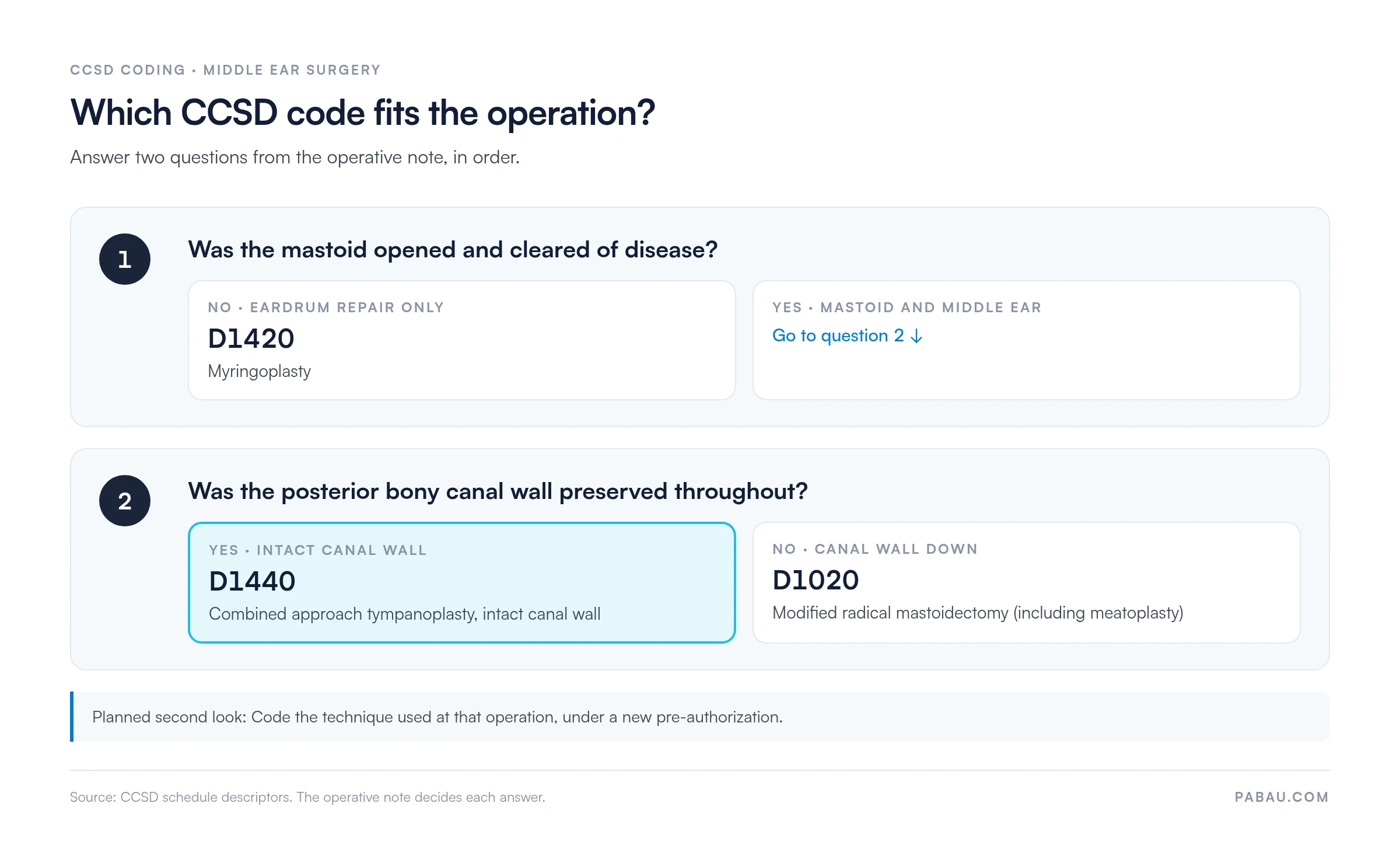
Always verify code numbers and descriptors in the live CCSD schedule before submission. The second-stage row carries no single code, because the right one depends on the technique used at re-exploration.
Mastoid-only surgery has its own code. When the operation stops at the mastoid and leaves the middle ear and eardrum untouched, that simple mastoidectomy is coded D1040, not D1440.
For other procedures in the schedule, including neighboring ENT codes, see our CCSD code guides.
Ossicular chain reconstruction may be separately billable alongside D1440 when the surgeon performed a distinct ossiculoplasty procedure using a prosthesis. However, bundling rules vary by payer. Bupa, AXA Health, and other UK private medical insurers each publish their own fee schedule notes. These specify which add-on codes are included in the primary procedure fee and which attract an extra payment.
Before billing ossiculoplasty as an add-on, check the schedule notes for D1440 in the relevant insurer’s portal. Submitting an add-on code that the insurer considers bundled into D1440 produces a partial denial. Cartilage graft harvesting is generally included rather than separately billable. Ossicular prostheses may be reimbursed separately as materials costs, depending on the insurer.
Private insurers adjudicate CCSD code D1440 almost entirely on the basis of the operative note. A note that lacks specific anatomical detail gives the insurer grounds to query, downcode, or deny the claim without any fault in the surgery itself. A complete note is the most direct protection against that outcome.
The operative note for a D1440 claim must include all of the following:
A digital operative note template standardizes these fields and makes it harder to miss one under time pressure. Surgical records also fall under UK data protection law. Insurers may request the full note during an audit, so store it securely and keep it easy to retrieve.
Most major UK private medical insurers require prior authorization (pre-auth) before elective ENT surgery, including D1440 procedures. Surgery performed without pre-auth is one of the most common causes of outright rejection on this code. Check your insurer’s current portal before booking the operating date, because pre-auth rules can change between annual policy renewals.
Our guide to Bupa CCSD codes covers Bupa’s procedure codes, including ENT surgery. Here is how each major insurer typically handles pre-auth:
Second-stage procedures need their own pre-authorization. These are planned re-explorations nine to 18 months after an ICW cholesteatoma operation. Do not assume the original pre-auth covers the second look. Request it as a new procedure, citing the original authorization reference and the clinical rationale for re-exploration.
D1440 claims tend to fail on one of three fronts: Technique precision, pre-auth compliance, or documentation completeness. Good claims management software can flag many of these issues before submission. The underlying cause is almost always one of the following.
The fix depends on the cause:
The intact canal wall approach for cholesteatoma carries a higher risk of residual disease than the canal wall down technique. The preserved wall limits the surgeon’s view of parts of the middle ear. That is why a planned second-look operation at nine to 18 months is an accepted part of treatment for many ICW cholesteatoma cases. This is established ENT surgical practice, documented in guidance from the British Association of Otorhinolaryngology (ENT UK).
For billing purposes, the second-stage operation requires separate pre-authorization. Key points for practice managers:
A clean D1440 claim follows a consistent workflow. Each insurer’s portal has its own submission fields, and the steps below cover the requirements shared across UK PMI claims.
Practice managers handling ENT surgical billing can cut rework by turning the six steps into a pre-submission checklist. Confirm each one before the claim leaves the practice.
Check four points on every D1440 claim before it leaves the practice. Is the pre-auth reference recorded, and does the operative note confirm the intact canal wall explicitly? Does the diagnosis code match the operative findings, and are add-on codes verified against the insurer’s schedule notes? Five minutes of checking is far cheaper than a denial and an appeal.
Without one system, a D1440 claim is spread across three places. The pre-auth reference sits in an insurer portal, the operative note in a shared drive, and the claim status in someone’s inbox.
Practice management software like Pabau links each patient to their insurer and raises the invoice to the right third party. Claims go to Healthcode from inside Pabau with the invoice details pre-filled, so nobody re-keys the procedure code.
Before a claim is sent, Pabau checks that membership numbers and authorization codes are filled in. If one is missing, the claim can’t be sent, so a D1440 claim without its pre-auth reference is caught before the insurer sees it. Each claim then moves through clear stages, from Submitted to Paid, in one dashboard.

Pabau checks authorization codes before a claim leaves, sends it through Healthcode, and tracks it to payment. See how that fits your ENT billing workflow.

Code D1440 only when the operative note says, in the surgeon’s own words, that the posterior canal wall stayed intact. If the note is silent, hold the claim and ask the surgeon. Fixing a note before submission is faster than appealing a denial.
The trade-off to remember is the second look. The ICW approach often means a planned second operation. Flag it in the patient record at the first surgery, and request its pre-auth as a new procedure.
Book a demo to see how Pabau checks pre-auth codes and tracks every CCSD claim for your ENT practice.

Billing other CCSD ENT codes alongside D1440? Pabau’s Bupa CCSD billing guide covers the D-series and how to submit ENT procedure codes to Bupa correctly.
Preparing a pre-auth request for ENT surgery? The prior authorization process walks through each step from request to approval.
Appealing a D1440 denial? Denial management in healthcare covers why claims get denied and how to stop repeat denials.
Coding another ear procedure? CCSD code D0610 covers billing for a biopsy of a lesion of the pinna.
CCSD code D1440 is the procedure code for combined approach tympanoplasty with intact canal wall. In this middle ear operation, the surgeon works in both the mastoid and the middle ear while preserving the posterior bony ear canal wall. It covers the mastoidectomy component, posterior tympanotomy, middle ear disease clearance, and tympanic membrane repair performed in the same surgical episode.
In intact canal wall (ICW) tympanoplasty, the surgeon preserves the posterior bony ear canal wall, maintaining normal ear canal anatomy and self-cleaning function. In canal wall down (CWD) surgery, that wall is removed, creating a single mastoid-middle ear cavity that requires lifelong monitoring and regular microsuction. The two techniques carry separate CCSD codes, D1440 and D1020. The operative note must document the distinction explicitly for the correct code to be accepted.
Yes, cholesteatoma is the primary clinical indication for D1440 when it is treated using the combined approach with intact canal wall technique. The diagnosis must be documented in the operative note and must correspond to an appropriate diagnostic code on the claim form. Cholesteatoma treated using a canal wall down technique is billed under D1020 instead.
Yes, both Bupa and AXA Health typically require prior authorization before elective inpatient ENT surgery including combined approach tympanoplasty. The authorization must be obtained before the operating date. Retrospective requests for elective procedures are generally not accepted. Always verify current requirements via each insurer’s provider portal, as pre-auth rules change between policy years.
If the second-look operation uses the same combined approach with intact canal wall technique, D1440 may be the appropriate code again. However, the second stage needs its own pre-authorization request and a new operative note documenting findings and technique. The claim must also show clearly that this is a planned staged procedure. If the surgeon converts to a canal wall down technique at the second stage, D1020 applies instead. Confirm with the operating surgeon before submitting.
The most common denial reasons are missing prior authorization and an operative note that does not explicitly confirm canal wall preservation. Technique mismatches between the code and the documented procedure are also common. So are diagnosis codes that do not support a combined approach mastoidectomy. Bundling errors on add-on codes (such as ossiculoplasty) submitted separately when the insurer treats them as included are also a frequent cause of partial denials.



