ICD-10 Code Y76.0: Diagnostic obstetric and gynecological devices
ICD-10 Code Y76.0: Definition and billable status ICD-10 Code Y76.0 is a valid, ...

Last Updated: Oct 23, 2026
Billable Code Specific Code
S69.91XS is the billable ICD-10-CM code for unspecified injury of right wrist, hand and finger(s), sequela.
Let Pabau's smart automation suggest the right codes, reduce claim denials, and keep your practice compliant—effortlessly.
Automate repetitive tasks and focus on what matters most—your patients.
Reduce coding errors and ensure compliance with the latest regulations.
Clean claims, fewer denials, and faster reimbursements.
Powerful insights and reporting to help your practice thrive.
HIPAA compliant SOC 2 certified GDPR-compliant Trusted by 4,000+ clinics worldwide

S69.91XS is a billable ICD-10-CM code for an unspecified right wrist, hand or finger injury treated as a sequela.
The 7th character S marks a sequela. Using A or D instead is one of the top denial triggers on these claims.
The provider note has to link the current condition to the original injury, or the payer rejects the claim.
Code the sequela condition first as the principal diagnosis, then S69.91XS as an additional code.
Practice management software like Pabau keeps ICD-10 entry, sequela documentation, and claim submission through Claim.MD in one record.
S69.91XS is a billable, specific ICD-10-CM code, so it can go on a claim without further specification. Here is the core reference data you need before submitting.
S69.91XS means an unspecified injury of the right wrist, hand and finger(s), treated as a sequela of that injury. Every character carries a clinical meaning, and misreading one position lands you on the wrong code. The table below decodes each one.
The 6th position holds a placeholder “X” whenever a code has no subcategory value there but still needs a 7th character. Omitting it produces an invalid code that payers reject. This convention sits in the CMS ICD-10-CM coding guidelines, Section I.A.5.
The 7th character is the most consequential part of this code. It tells the payer you are treating a late effect rather than the original injury. The CDC/NCHS ICD-10-CM official guidelines, Section I.B.10, apply sequela coding whenever the condition follows directly from an earlier injury. No time limit runs after that injury.
Three 7th character options exist in this family. Picking the wrong one is a leading cause of rejection for orthopedic and physical therapy practices.
Key distinction: “D” is for ongoing care of the original injury while it is still healing. “S” covers a new or persistent condition caused by that injury, once it is no longer the treatment focus.
A patient in therapy for a wrist fracture that is still healing takes “D.” A patient returning six months later with post-traumatic arthritis in the same wrist takes “S.”
When in doubt between D and S, ask: Is the original injury still healing, or has a new condition emerged from it? If the provider note says the fracture has healed but the patient now has limited range of motion, that is a sequela. The note must say so explicitly.
S69.91XS sits in a family of closely related codes. The right pick turns on laterality and encounter type. Selection errors usually happen when neither is checked against the provider note.
A note on S69.90XS: Payers flag claims where the note documented the side but the unspecified code was submitted. Confirm the side before you reach for it. The AAPC Codify ICD-10-CM lookup lists the full S69.91 family for cross-reference.
The same laterality discipline applies to neighboring sequela codes, including S51.029S. Read the side off the note every time, rather than off the referral.
The hierarchy shows where to go when the note carries more detail. It also confirms that S69.91XS is the right stop when the injury type is genuinely undocumented.
If the note names a sprain, fracture, or contusion, use the more precise code from S60-S69 instead. The unspecified designation applies only when the injury type is not documented or not classifiable. Other upper-limb sequela codes such as S42.399S sit in their own subcategory and follow the same drill-down.
Sequela coding asks more of the note than initial or subsequent encounter coding does. A missing causal link is the most common reason payers deny these claims, so denial management in healthcare starts with one line in the chart.
The ICD-10-CM Official Guidelines, Section I.B.10, require the note to establish a clear causal relationship between the current condition and the prior injury. Here is what that means in practice:
Those five elements are easier to recognize inside a note than as a checklist. The visual below maps each one onto the line that carries it.
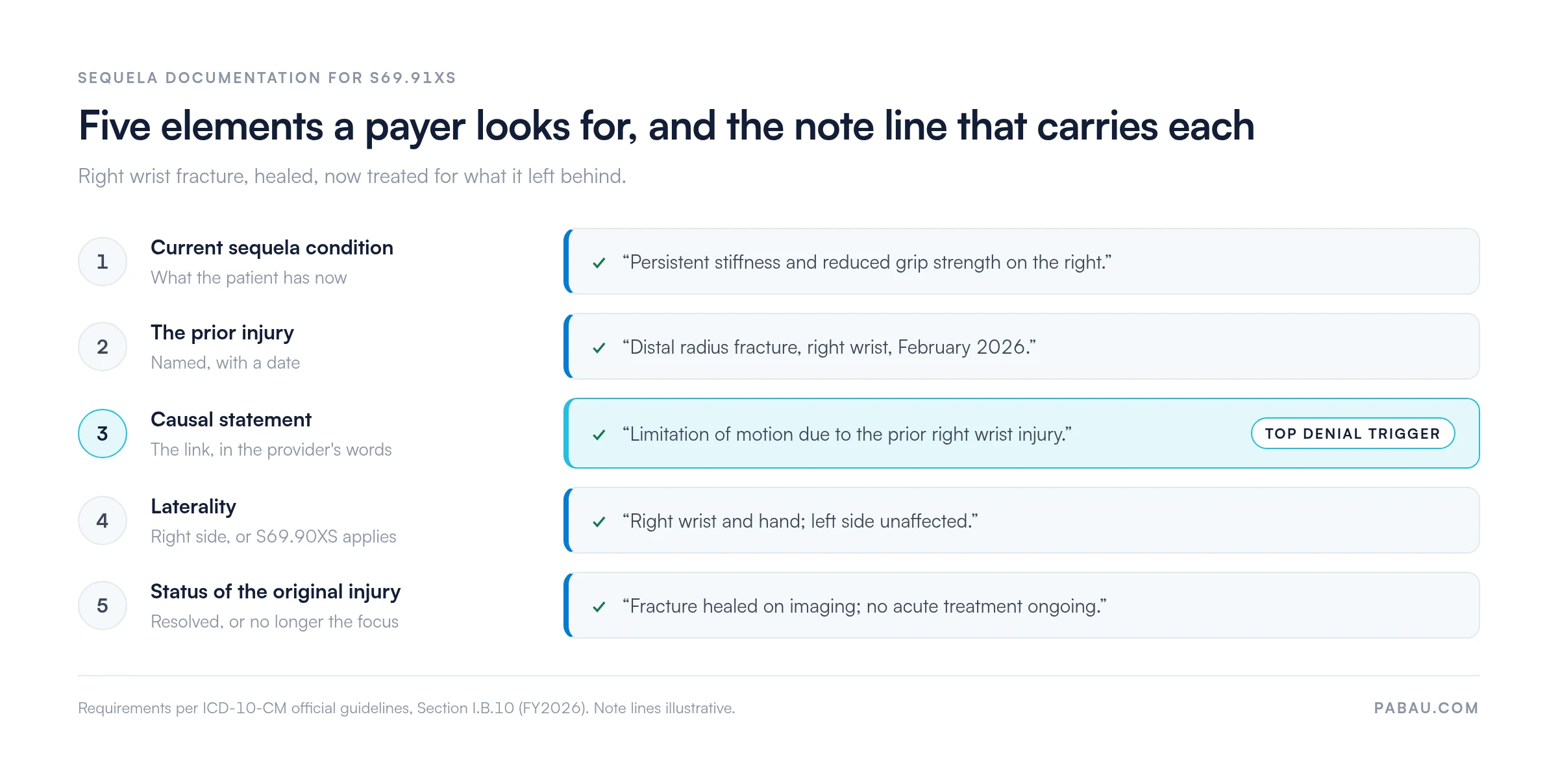
On a sequela claim, code the nature of the sequela as the principal diagnosis. S69.91XS then sequences as an additional code, per CMS sequencing guidelines. A clean claim carries that documentation with it, and the same causal-link standard governs every sequela code, including every sequela code, including S14.118S.
S69.91XS applies when the original injury is settled and a condition it left behind is the reason for today’s visit. The scenarios below separate appropriate use from the misuse payers flag.
Orthopedic, occupational therapy, and physical therapy practice management teams meet these transitions from acute care to sequela care every week.
For workers’ compensation cases, state jurisdictions differ in how they treat sequela codes, so verify payer policy before you submit one. Athlete follow-up produces the same pattern, and sports medicine software that keeps the original injury date on file makes the causal link easy to state.
Getting the documentation right is only half the job. How the claim is structured decides whether it pays, and medical billing workflows for sequela codes have their own quirks. The denial codes that come back will name the reason precisely.
Practices that keep sequela coding inside the system that holds the note can submit through the Claim.MD integration. Claim.MD is the clearinghouse that practice management software like Pabau submits US claims through, and it carries ICD-10 catalogs plus real-time eligibility checks.
Key billing considerations for sequela code S69.91XS:
Pabau’s claims management software takes the ICD-10 code straight from the patient record. Fewer hands retype it, so fewer sequela claims fail on a mistyped 7th character. Feeding those claims into a steady revenue cycle management routine keeps late-effect encounters from sitting unbilled.
In many practices the sequela link stays in the provider’s head and never reaches the note. The coder reads the chart days later, finds a healed fracture and a stiff wrist, then has to guess what the provider meant. The claim goes out with S69.91XS and no causal sentence behind it.
Pabau keeps the diagnosis with the note. Clinicians chart the encounter in structured patient records, enter the ICD-10 code at the point of documentation, and the code travels with the claim. All five elements above sit in one place, so a coder can see the causal statement without hunting for it.
From there the claim routes to Claim.MD without a re-keying step, so nobody retypes the 7th character. Denials that do come back land next to the record that produced them. Every Pabau subscription includes claims, records, and reporting, so none of this sits behind a higher tier.

Pabau holds the note, the ICD-10 code, and the claim in one record, then submits through Claim.MD. Orthopedic and physical therapy practices use it to cut sequela denials.

S69.91XS earns its place on a claim only when three facts hold together. The original right wrist, hand, or finger injury has resolved. The condition in front of you today came from it, and the note says so in plain language.
If one of them is missing, the fix sits upstream. Ask the provider for the causal sentence before the claim leaves the building. A minute now saves an appeal later, and that is the trade worth remembering.
Sequenced correctly, with the sequela condition first, S69.91XS pays like any other billable code. Book a demo to see how Pabau keeps the code, the note, and the claim in one record.

Coding another sequela in the upper limb? S51.029S runs through the same 7th character and causal-link checks.
Need the burn-injury version? T22.342S shows how sequela rules work outside fracture care.
Coding a total knee replacement? Total knee arthroplasty billing guide CPT code 27447 covers total knee arthroplasty, replacing both the medial and lateral compartments of the joint.
Billing knee manipulation under anesthesia? Knee manipulation billing guide CPT code 27570 covers knee manipulation under anesthesia to break up scar tissue limiting joint mobility after surgery.
Checking laterality on a hand code? S60.152S is the left-side counterpart, and it runs the same documentation checks.
S69.91XS is a billable ICD-10-CM diagnosis code for unspecified injury of the right wrist, hand and finger(s), sequela. The 7th character S marks a sequela. The current condition is a late effect of an earlier right wrist or hand injury. The code is valid for FY2026, effective October 1, 2025.
Yes. S69.91XS is a billable, specific ICD-10-CM code valid for direct use on insurance claims. It needs no further specification or additional subcategory code to be submitted for reimbursement.
S69.91XD is a subsequent encounter code, used while the original right wrist or hand injury is still healing. S69.91XS is the sequela code. Use it when the injury has healed but left chronic pain, stiffness, or grip weakness. Use D while the injury heals, and S for lasting effects once it has.
Use a sequela code, 7th character S, when the original injury has resolved. The visit then treats a condition that developed because of that earlier injury. Use a subsequent encounter code, 7th character D, while the original injury is still healing and care for it continues.
The note must describe the current sequela condition and identify the prior right wrist or hand injury. It must also state the causal link between them, confirm the right side, and show that the original injury has resolved. Missing any of these elements is grounds for denial.
Generally yes, but workers’ compensation ICD-10 requirements vary by state jurisdiction. Sequela codes are commonly accepted for long-term follow-up care of occupational right wrist and hand injuries. Individual state rules and payer policies still apply, so verify them before submitting.
S69.91XS specifies the right wrist, hand and finger(s). S69.90XS covers the unspecified side, meaning laterality was not documented. Use S69.91XS whenever the provider note confirms the right side, and reserve S69.90XS for notes that never name a side.