EHR ROI: How to calculate and maximize your return
EHR ROI is the financial return a practice earns on its electronic health record...

Last Updated: Oct 15, 2026

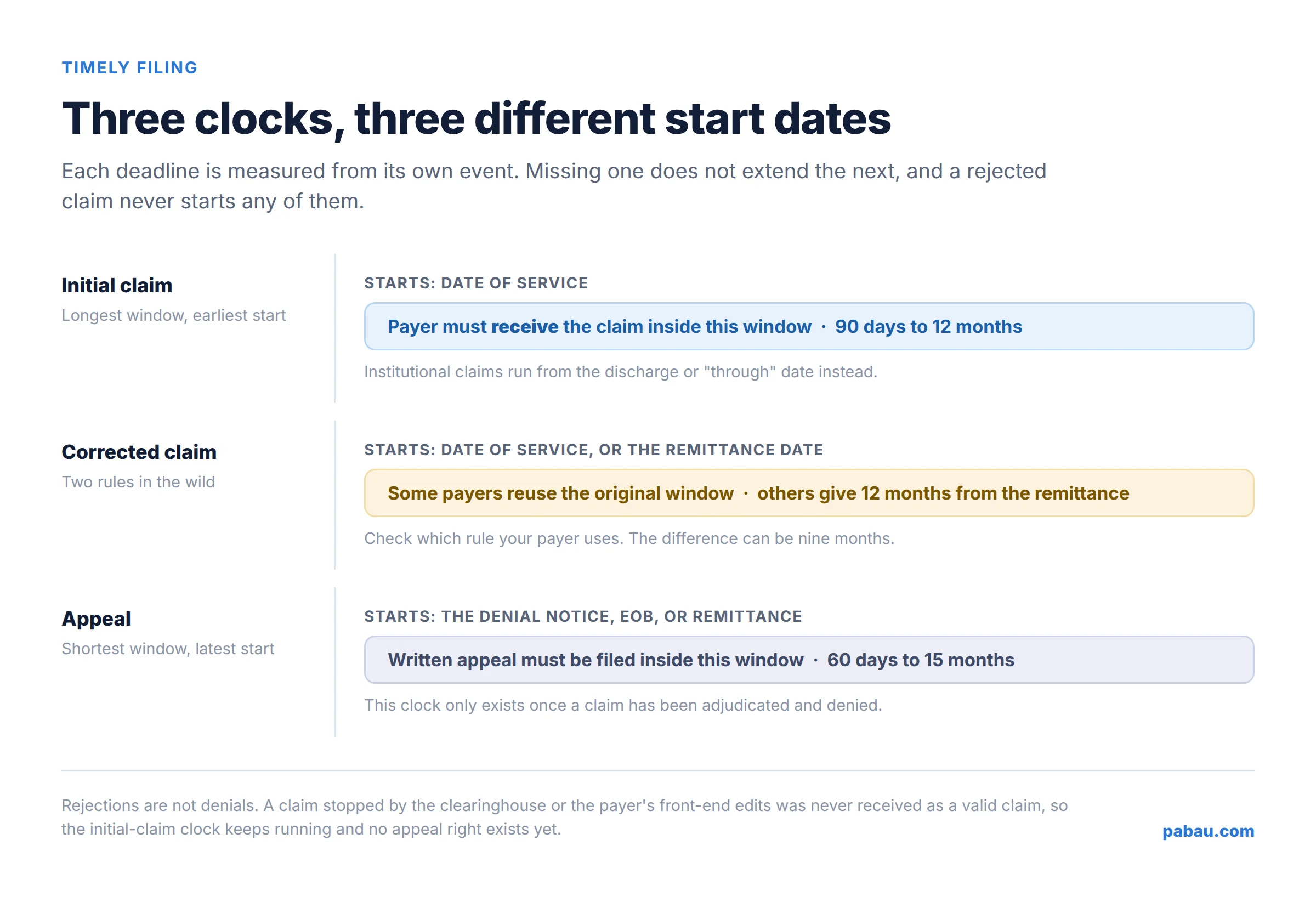
A timely filing limit is the deadline by which a payer has to receive your claim, counted from the date of service.
Medicare allows one calendar year. Commercial plans commonly land between 90 and 365 days, and many set the number in your contract instead.
The clock stops when the payer receives a valid claim. A rejection is not a receipt, so the clock keeps running.
Corrected claims and appeals carry their own deadlines, and the appeal window usually starts from the remittance date rather than the date of service.
A CO-29 denial can be overturned, but only with dated proof that the payer received your claim on time.
A timely filing limit is the deadline by which a payer has to receive your claim. Miss it and the claim is finished. Cosmetic visits skip this deadline since they are paid at checkout, which is the side of the business our best med spa software comparison covers. The payer returns adjustment code CO-29, “the time limit for filing has expired“.
The CO group code makes that balance a contractual obligation your practice absorbs. Most network contracts also bar you from billing the patient for it, so a late claim is a pure write-off in your revenue cycle.
The table below carries three deadlines for each payer: initial claims, corrected claims, and appeals. Every figure was checked against the payer’s own published policy in August 2026, with the source named in each row. Where a payer sets its limit by contract or by state, the cell says so rather than inventing a single number.
There is no single timely filing limit. Medicare allows one calendar year from the date of service. Medicaid programs run from 90 days to 12 months depending on the state. Those short windows bite hardest in specialties that bill Medicaid heavily, such as ADHD practices.
Commercial plans commonly land between 90 and 365 days, and Blue Cross Blue Shield, known as BCBS, sets its limits plan by plan. Several large payers publish no national figure at all, because the number lives in your participation agreement.
| Payer | Initial claim | Corrected claim | Appeal | Source |
|---|---|---|---|---|
| Medicare Part B, fee-for-service | One calendar year after the date of service | Reopening within one year of the initial determination, for any reason | Redetermination within 120 days of receiving the initial determination | 42 CFR 424.44, 405.942 |
| Medicaid federal ceiling | 12 months from the date of service. Every state must impose this limit, and many set a shorter one | Not set federally. Each state program publishes its own rule | Not set federally. Check your state’s provider manual | 42 CFR 447.45(d) |
| Medicaid, Texas | 95 days from each date of service. Inpatient claims run from the discharge date | Filed as an appeal to TMHP, inside the same 120-day window | 120 days from the disposition date on the Remittance and Status Report | TMHP manual |
| Medicaid, New York | 90 days from the date of service | 60 days from the date of notification, for claims returned with errors | No separate window published. Everything must be finally submitted within two years | eMedNY guide |
| BCBS of Texas Blue Choice PPO | 365 days from the date of service | Same 365-day deadline as the original claim | Claim review within 180 days of the payment date or provider claim summary | BCBSTX PPO manual |
| BCBS of Texas HMO Blue Texas | 180 days from the date of service | Same 180-day deadline as the original claim | Claim review within 180 days of the payment date or provider claim summary | BCBSTX HMO manual |
| Anthem BCBS Virginia | 365 days from the date of service | 12 months from the date on the original explanation of payment | Reconsideration within 12 months of that payment notice, then appeal within 180 days of the outcome | Anthem provider news |
| UnitedHealthcare | Set by your participation agreement and state rules. UnitedHealthcare’s own worked example uses 90 days | The same number of days as the initial claim, counted from the date of service | Reconsideration and appeal together within 12 months of the remittance date | 2026 UHC guide |
| Cigna | 90 days after the date of service in network. 180 days out of network | The original deadline applies, unless Cigna asked for the extra information | 180 calendar days from the initial payment or denial decision | Cigna claim filing |
| Aetna | Set by your contract. Aetna publishes no national figure in its provider manual | Not published separately. Your contract’s filing window applies | Reconsideration within 180 calendar days of the claim decision, then appeal within 60 days | Aetna disputes |
| Humana | Commercial, 90 days from the date of service unless state law or your contract says otherwise. Medicare Advantage, one year | Not published nationally. Varies by plan and state | Commercial follows the policy or state law. Medicare Advantage out of network, 65 days from the denial | Humana claims |
| TRICARE | One year after the services are provided | A returned claim is due back the later of one year after service, or 90 days from the return | Reconsideration mailed within 90 days of the initial determination notice | 32 CFR 199.7, 199.10 |
Two patterns are worth noticing. BCBS is not one payer, and the three Blue plans above range from 180 to 365 days. The number also moves inside a single payer. UnitedHealthcare’s Empire Plan supplement gives 120 days after the end of the year of service, while its main guide sends you to your agreement.
The clock starts on the date of service and stops when the payer receives a valid claim. The words that matter are receives and valid. Sending a claim is not the event that counts, and payers measure the days between the service date and their own date stamp on receipt. That is unforgiving on long courses of care, where a burn coded T31.70 generates claims for months.
Institutional claims are the exception. Medicare, BCBS of Texas, and Texas Medicaid all run the window from the discharge date instead. Device codes such as C1893 travel on those institutional claims, so their clock starts at discharge too. For a span of care, that means the “through” date of the statement period, not the first day of the stay.
A rejected claim keeps the clock running. A claim stopped by your clearinghouse or by the payer’s front-end edits was never accepted for adjudication, so nothing has been filed. Those edits usually catch demographic errors and missed eligibility checks.
UnitedHealthcare states the point plainly. Rejected claims are not proof of timely filing. Fix the data and resubmit the same week, because a clean claim is the only kind that stops the clock.
Secondary claims get their own start date. Most payers run the window from the primary insurer’s remittance instead of the date of service. Transplant drugs show this often, since J7525 is usually billed to Medicare first and a supplement second. Practices that bill Medicare plus a supplement see this constantly, including pelvic health practices.
Cigna measures from the processing date on the primary’s explanation of benefits. BCBS of Texas allows its full 180 or 365 days from the date the other carrier responds. UnitedHealthcare gives at least 90 days from the primary’s payment or denial.
One more override sits on top of all of it. Your participation agreement can shorten any commercial deadline, and state law can lengthen it. Skin substitutes sit under their own payer policies again, and Q4170 is priced product by product. Aetna and UnitedHealthcare both decline to publish a national number for exactly that reason. For those two, the authoritative answer is the contract in your filing cabinet.
Check whether the denial is correct before you write anything off, then appeal inside the payer’s appeal window with dated proof of receipt. Payers do get this wrong, usually when a claim was received on time but reprocessed later under a new claim number.
Be realistic about the odds. Without dated proof of receipt, these appeals almost never succeed, and the money is gone. The CO group code also means the write-off belongs to your practice. A custom orthosis such as L2126 is an expensive one to absorb. Cigna, UnitedHealthcare, and BCBS of Texas all state in writing that you cannot bill the patient for a late-filing denial.
So CO-29 is one of the most expensive codes on the denial code list. It is also the best argument for a denial management process that catches aging claims early.
Payers want dated confirmation that they received and accepted the claim. Proof that you sent it does not carry the same weight. Supply lines need the same trail, and a dialysis tubing set billed as A4755 is no exception. Anthem asks specifically for the payer’s own response to the submission, or a positive acceptance message.
| How you submitted | Proof it generates | How well it holds up |
|---|---|---|
| Electronically, through a clearinghouse | Dated 999 and 277CA acceptance reports carrying the batch ID and claim number | Strongest, because it shows the payer accepting the claim |
| Payer portal | An on-screen submission confirmation, saved or printed | Accepted, if it carries a date and the claim number |
| Paper, by mail | A certified mail receipt with an itemized list of the claims enclosed | Accepted, but you have to remember to create it |
| Billing software only | A computer-generated transaction history naming the payer | Weakest, because it shows sending rather than receipt |
Submission method decides whether you have proof at all. Send an electronic 837 claim file and the acceptance trail builds itself, sitting in your in your clearinghouse reports reports whether you ever need it or not. Use portals or paper and you are the archive, which works right up until the person who kept the folder leaves.
Timely filing denials usually come down to workflow. Nobody forgets that Cigna wants 90 days. Claims age out because they sit in a spreadsheet, or because a rejection came back in week two and nobody read it until week 14. A repeat inhalation drug such as J7614 can raise a fresh claim every month while that happens.
Practice management software like Pabau fixes both by keeping the claim on the record it came from. Claims are validated and submitted straight from the invoice through our Claim.MD integration.
That means the filing clock starts running the day of the visit rather than at month end. Every claim then carries its own status and full activity history, so you can see how long it has been unpaid.
When something bounces, it comes back with a reason attached, including the CARC code that explains it. So you can fix a rejection while the filing window is still open. Corrected claims, voids, and appeals all go out from the claim record itself. That history also doubles as your billing compliance trail if a payer audits the claim. A clean claim needs the code, the modifiers and the diagnosis to agree, which is the check claim submission software runs.
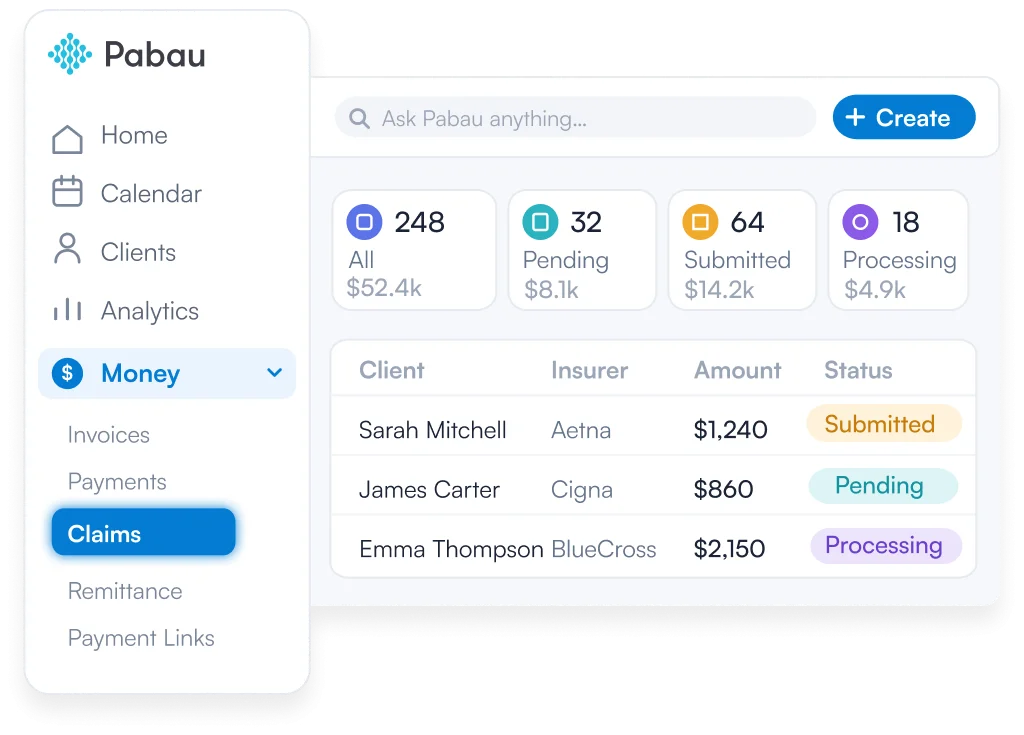

Pabau validates and submits claims from the invoice through Claim.MD, then tracks every one on its own record with full activity history. Rejections come back with their CARC codes, so you can correct and resubmit while the filing window is still open.

Timely filing is the one denial category you can make structurally unlikely. Every other denial needs a judgment call about coding, coverage, or medical necessity. This one only needs the claim to leave the building.
So the table above matters less than the two habits underneath it. Submit at the point of service, so even a 90-day payer never gets close. And read your acceptance reports weekly, because a rejection you have not opened is a claim that has not been filed.
Then look up the number that binds you, which is the one in your participation agreement rather than any table online. Bookmark this page for the payer policies, and check your contract for the rest. Book a demo to see how Pabau submits and tracks claims so filing deadlines stop being something you have to remember.

Coding a discoid lupus diagnosis? Discoid lupus coding guide explains why this subcode is billable while the parent L93 code is not.
Denials piling up faster than you can work them? Denial management in healthcare sets out a five-step process and the corrected claim versus appeal decision.
Coding an unspecified crystal arthropathy? Crystal arthropathy coding guide covers where this billable code sits in the musculoskeletal chapter for the 2026 code year.
Not sure where the acceptance reports come from? What is a medical claims clearinghouse? follows the route your claim takes and the confirmations it sends back.
Reading remittances to spot aging claims? What is electronic remittance advice (ERA)? shows how to find a denial and its date inside the file.
It is the deadline by which a payer has to receive your claim, counted from the date of service. Limits range from 90 days to 12 months. Miss it and the claim is denied with code CO-29, which you usually cannot bill to the patient.
Medicare claims must be filed no later than one calendar year after the date of service, under 42 CFR 424.44. Corrections go through a reopening within one year of the initial determination. A first-level appeal, called a redetermination, is due within 120 days of receiving that determination.
Cigna allows 90 days after the date of service for participating providers. Humana applies 90 days to commercial claims, unless state law or your contract says otherwise. UnitedHealthcare uses 90 days in its own worked example, but the binding number is in your agreement.
Yes, but not one shared limit. Each Blue plan sets its own, and the limits differ between products inside the same plan. Blue Choice PPO in Texas allows 365 days from the date of service, while HMO Blue Texas allows 180. Check your local plan’s provider manual.
Yes, and payers publish a route for it. You need dated proof that the payer received and accepted the claim inside the filing window, such as a clearinghouse acceptance report. Without that proof, the appeal rarely succeeds. File it within the appeal window, which runs from the remittance date.