HIPAA compliant texting: What you can send patients & how to communicate securely
HIPAA compliant texting is possible when a text holds no protected health inform...

Last Updated: Oct 16, 2026

Software covered: 1. Pabau, 2. CoverMyMeds, 3. Surescripts, 4. Availity, 5. Waystar, 6. Infinx, 7. Myndshft, 8. Rhyme, 9. Silna Health.
Prior authorization software splits into drug benefit networks and medical benefit automation, and a tool built for one side will not cover the other.
The CMS prior authorization rule excludes drugs, so its 2026 deadlines tighten procedure approvals and leave prescription approvals exactly where they are.
Pabau is the only platform here that publishes a price, at $104 a month for one user with every feature included.
CoverMyMeds and Availity Essentials cost providers nothing, because health plans and pharmacy benefit managers fund the network instead.
Winning the approval is half the job. Check that the authorization number reaches the appointment and the claim, or the write-off lands anyway.
The best prior authorization software for your practice comes down to one question. Are you authorizing prescriptions, or procedures and services? Those two jobs run on different networks, and a tool built for one rarely touches the other.
The burden itself is not in dispute. Practices complete 39 prior authorization requests per physician each week, and staff spend 13 hours on them. Those figures come from the AMA’s 2025 prior authorization physician survey.
This guide reviews nine platforms for private practices, med spas, therapy practices, and larger provider groups. Every price below came off the vendor’s own site in August 2026, never a review aggregator. Only one of the nine publishes a figure at all.
Pabau, our own platform, tops the list; the other eight run drug benefit networks first, then medical benefit automation. Read the “what it authorizes” column first, because it rules most of the list out for you.
Prior authorization software asks the payer for approval before you deliver care, then tracks the answer. It automates the prior authorization process your staff runs by phone and fax today. Most of those calls name one procedure and one diagnosis, such as S62.252S. The good ones do four separate jobs, and most tools are strong at two of them.
That last job is where money leaks. An approval that never reaches the claim form produces the same denial as no approval at all. A hand repair approved against S62.211B is worth nothing if the number never reaches the claim. The payer books that denial as a contractual write-off rather than a patient balance.
Those rejections come back under specific denial codes, and the authorization ones are easy to spot once you know them. The diagnosis on the claim has to match the one authorized, down to S62.396B.
Prior authorization tools fall into three groups: drug benefit networks, medical benefit automation, and approvals held inside your practice management system. The category decides what the tool can authorize, so it matters more than any feature list.
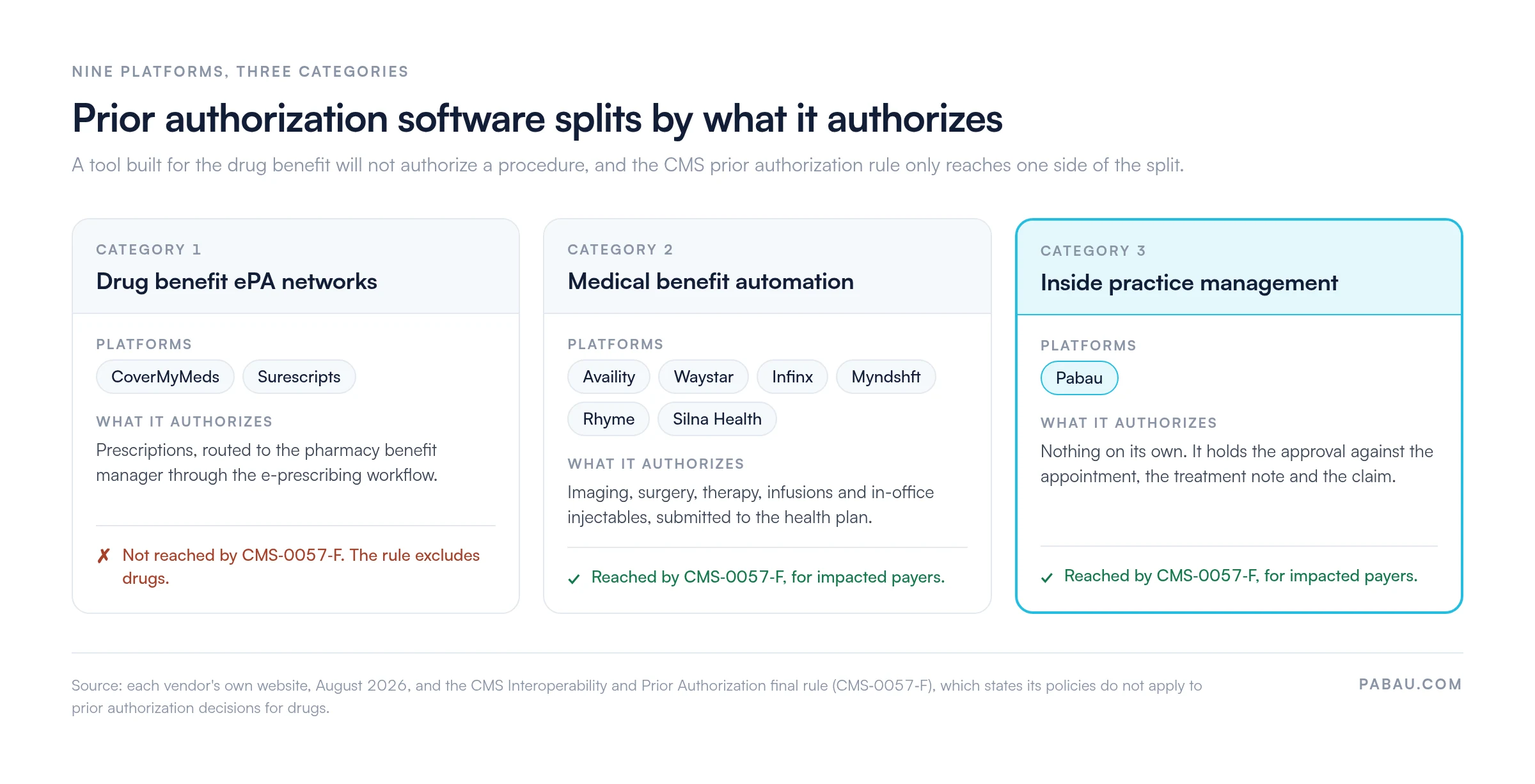
Drug benefit networks live in the e-prescribing workflow. CoverMyMeds and Surescripts move a request to the pharmacy benefit manager and bring back a decision, often in minutes. Neither one will authorize an infusion, a course of therapy, or a surgical procedure.
Medical benefit automation handles the rest. Availity, Waystar, Infinx, Myndshft, Rhyme, and Silna Health submit to the health plan for imaging, surgery, therapy, and in-office drugs billed under the medical benefit. Hand surgery sits squarely there, whether the request names S62.211B or a later encounter. Most of them are sold to health systems and large groups.
Practice management platforms authorize nothing themselves. Practice management software like Pabau instead keeps the result. The approved number, dates, and unit count sit on the client record, the appointment, and the insurance claim. So does the diagnosis the request was built on, S63.289D included. So the approval you won gets used before it expires.
There is a fourth group worth naming, because listicles keep putting it in the buyer’s column. Cohere Health sells to health plans, not to practices. Your staff may submit through it, but no practice can purchase it.
Before you take a single demo, run the PA mix test on last month’s authorizations. The test takes about 20 minutes and eliminates most of the shortlist above. Sort them by diagnosis as well, because a run of S62.357B requests points at one referral source. Pull the requests from your submission log, or from a stack of completed prior authorization forms if you still work on paper.
Practices with a genuinely mixed authorization load often end up running two tools, and that is a defensible answer rather than a failure. A dermatology practice prescribing biologics and also selling cosmetic injectables needs a drug benefit network for the biologics. It still needs one system that holds the approval next to the appointment and the invoice. Price both, not one.
Each platform below was assessed on what it can authorize, how it reaches your existing systems, published pricing, verified review data, and best-fit practice size. Ratings come from Capterra and G2 where a public profile exists, and five of the nine have none.
Pabau, our own platform, leads the list; the rest follow in the order they request and win approvals from a payer.
Pabau keeps the approval on the appointment and the claim, so the number you won gets used before it expires.
Pabau is an all-in-one practice management system built for medical aesthetics, wellness, and private healthcare. It leads this list because of what happens after the approval: the eight platforms below request and win approvals from payers, and Pabau is where that result gets used.
Pabau holds the result instead: insurer, policy details, and authorization code live on the client record, and Pabau’s claims management software validates those fields before a claim can go out. A sequela code such as S62.612S is checked the same way before submission.
That step matters because of how authorizations fail: the approval is won, the visit gets rescheduled past the approved date range, and nobody notices until remittance. Pabau ties the authorization to the appointment instead. A staged repair for S63.004D is where that window slips most often.
Pabau scores 4.7 out of 5 from 647 reviews on Capterra, the highest verified rating here. Reviewers praise the all-in-one scope; criticism covers the learning curve and slow loading.
| Plan / Tier | Price | Details |
|---|---|---|
| Starter and Solo | From $62/month | One user, unlimited patients, full platform access |
| Team, Medium and Group | Scales by user count | Two to 15 users, unlimited patients |
| Enterprise | Custom quote | 16+ users with multi-location support |
Pricing depends on location and user count, and annual billing saves up to 20%. Every plan carries claims, clinical records, and scheduling, so no feature sits behind a higher tier.
CoverMyMeds is the electronic prior authorization network most US practices already touch, owned by McKesson, handling prescription authorizations across most health plans and pharmacy benefit managers.
It stays free for providers and pharmacists, funded by plans, PBMs, and manufacturers, with a network naming more than a million providers, 50,000 pharmacies, and 350 EHR systems.
A pharmacy can also start a request and route it to you, removing the initial phone call. CoverMyMeds will not authorize a procedure, a course of therapy, or an in-office infusion billed on the medical benefit.
CoverMyMeds Platform holds 3.7 out of 5 from 16 reviews on G2, a thin sample for a network this large, and no Capterra or Trustpilot profile exists.
| Plan / Tier | Price | Details |
|---|---|---|
| Provider access | Free | Electronic prior authorization for prescriptions, no per-request fee |
| Pharmacy access | Free | Request initiation and routing to the prescriber |
| Payer and manufacturer programs | Not published | Network and access services sold to payers and manufacturers |
CoverMyMeds states on its own support pages that provider and pharmacist access is free, funded by health plans, PBMs, and manufacturers. There is no published price list, because a practice is not the customer.
Surescripts is the network layer behind electronic prescribing in the US, reaching prescribers through EHR vendors. It reports that 84% of prescribers use an EHR equipped with electronic prior authorization.
Electronic Prior Authorization delivers the plan-specific question set into the prescribing screen, with under four minutes to return the average approval. Prior Authorization Automation goes further, pulling clinical answers straight from the record.
Surescripts reports a median approval time of 18 seconds on that automated path, with 11% fewer denials for missing information. The practical question is whether your EHR vendor has switched it on.
Surescripts Prior Authorization carries no verified aggregate rating on Capterra or G2, normal for infrastructure sold to EHR vendors rather than practices. Ask your own EHR vendor which Surescripts products your license includes.
| Plan / Tier | Price | Details |
|---|---|---|
| Through your EHR vendor | Not published | Electronic Prior Authorization inside the prescribing workflow |
| Prior Authorization Automation | Not published | Automated question set completion from the clinical record |
| Prior Authorization Portal | Not published | Web access where the EHR lacks it |
Surescripts publishes no pricing and directs every enquiry to sales. Ask your EHR vendor, since that is where the cost, if any, sits.
Availity is the multi-payer portal a US billing team most often lives in, and its site describes Essentials as a free portal, reporting 95% direct payer connectivity and 3 million connected providers.
Instead of logging into six plan portals, staff request and track medical authorizations in one place, alongside eligibility and claim status. Participating plans vary by region, so check yours first.
Availity also sells Essentials Pro and an AI-assisted utilization management product, AuthAI, sold to health plans, not practices.
Availity averages 4.0 out of 5 from 41 reviews on G2. Reviewers value one portal for many payers; complaints cluster on payer coverage and a dated feel.
| Plan / Tier | Price | Details |
|---|---|---|
| Availity Essentials | Free | Multi-payer portal for eligibility, claims, and authorizations |
| Availity Essentials Pro | Custom quote | Denial management, financial clearance, EHR-based authorization |
| Availity AuthAI | Not sold to practices | Utilization management, purchased by health plans |
Availity’s own login page calls Essentials a free portal, and no price is published for Essentials Pro.
Waystar sells authorization automation as part of a revenue cycle platform, the right shape when authorizations are one team’s full-time job, reporting 70 million authorization transactions a year and coverage across 35 or more service lines.
Authorization Manager runs the workflow, Auth Initiate opens requests for scheduled services, Auth Status chases updates, and Medical Necessity checks the order against payer policy.
Waystar also markets Auth Accelerate for end-to-end automation, reporting a 70% cut in submission time and 85% auto-approval from implemented clients — vendor figures, so treat them as a target, not a guarantee. Our Pabau versus Waystar comparison covers the claims side.
Waystar scores 4.4 out of 5 from 207 reviews on Capterra and 4.4 from 117 on G2. Reviewers rate the platform’s breadth highly; value for money scores lowest, at 4.2.
| Plan / Tier | Price | Details |
|---|---|---|
| Authorization Manager | Custom quote | Determination, submission, and status tracking |
| Auth Accelerate | Custom quote | End-to-end authorization automation with real-time approvals |
| Full platform | Custom quote | Authorizations plus claims, denials, and patient payments |
Waystar publishes no prices. Expect the quote to scale with transaction volume and the modules you take.
Infinx pairs authorization automation with a staffed service, the honest answer to why full automation stalls: complex cases and payers who refuse electronic submission still need a person, and Infinx supplies one.
The determination step is strongest. Infinx quotes over 98% accuracy deciding whether an authorization is needed, judged against payer guidelines and the CPT code, flagging requests needing none instantly.
Infinx lists 2,800 or more payer connections and integrations with Epic, Cerner, ModMed, and NextGen. Its case studies are health systems and imaging networks — the intended buyer.
Infinx Prior Authorization has no verified aggregate rating on G2 or Capterra. Ask for references in your own specialty and volume.
| Plan / Tier | Price | Details |
|---|---|---|
| Patient Access Plus | Custom quote | Authorizations, eligibility, benefit checks, and patient estimates |
| Prior authorization module | Custom quote | Determination, initiation, and follow-up agents |
| Specialist services | Custom quote | Infinx staff working assigned cases alongside your team |
Infinx publishes no prices and quotes after a consultation. The site offers a prior authorization ROI calculator.
Myndshft solves the awkward middle of the split: a drug given in your treatment room is usually billed on the medical benefit, not the drug benefit. CoverMyMeds cannot help there, and a general medical tool often lacks the drug detail.
Myndshft covers both sides, reporting real-time benefit verification for 94% of covered lives, and also handles coordination of benefits, insurance discovery, and patient out-of-pocket calculation. DrFirst acquired Myndshft in April 2024, and the product now sits inside that company.
For an IV therapy, weight loss, or hormone practice billing insurers, this is the most relevant category here: the authorization and benefit check land together, so you know the patient’s balance before treatment.
Myndshft carries no verified aggregate rating on Capterra or G2. Ask DrFirst for references from practices your size, and confirm payers live in your region.
| Plan / Tier | Price | Details |
|---|---|---|
| Prior authorization | Custom quote | Medical and pharmacy benefit authorization automation |
| Eligibility and benefits | Custom quote | Real-time verification, coordination of benefits, insurance discovery |
| Full platform | Custom quote | Authorizations, benefits, and patient financial responsibility together |
Myndshft publishes no pricing. Quotes come through DrFirst, usually depending on transaction volume.
Rhyme, formerly PriorAuthNow, puts payers and providers on one network so approvals return untouched. It reports more than 4 million authorizations a year, 300 or more of the largest payers, and 83 of the largest health systems.
The interesting part is gold carding: Rhyme’s data lets a payer and provider agree to drop the authorization requirement for services the provider consistently gets approved, removing the work rather than automating it.
The catch is structural: Rhyme only delivers a touchless decision when the payer has installed it. Check your top five payers against the network before this goes on a shortlist.
Rhyme carries no verified aggregate rating on Capterra or G2. Named references include Norton Hospital, and it has publicized a partnership with the Ohio Hospital Association.
| Plan / Tier | Price | Details |
|---|---|---|
| Provider network access | Not published | Touchless authorizations inside the EHR for participating payers |
| Gold carding program | Not published | Data and tools to remove authorization requirements with a payer |
| Payer side | Not published | Network participation, purchased by the health plan |
Rhyme publishes no pricing or cost model for either side of the network.
Silna Health targets a specific version of the problem. In therapy and behavioral health, authorizations cover a block of visits and then expire, so the renewal becomes the workload, not the initial request.
Silna handles the full cycle: tracking authorizations, weekly reminders, submissions, and follow-ups. It reports coverage of more than 1,000 payers across all 50 states, and support for over 250,000 patients.
Named customers include autism and physical therapy providers. If your authorizations are recurring blocks rather than one-off procedures, Silna is built for you.
Silna Health carries no verified aggregate rating on Capterra or G2. Named customers include Behavior One Autism Solutions, Elite Alliance Physical Therapy, and Autism Learning Partners.
| Plan / Tier | Price | Details |
|---|---|---|
| Managed authorizations | Custom quote | Tracking, submission, and follow-up handled by Silna |
| Benefits verification | Custom quote | Coverage and patient cost detail alongside the authorization |
| Enterprise | Custom quote | Multi-site therapy and behavioral health groups |
Silna Health publishes no provider pricing. Sample costs on the site describe patient copays, not what your practice would pay.
The table below compares all nine platforms on the five points that decide the purchase. Every entry was checked against the vendor’s own site in August 2026.
Key finding: eight of the nine vendors publish no price for a practice. Pabau is the only one with a figure on its own site. Two are free at the point of use because health plans and pharmacy benefit managers fund the network instead.
The second finding is the last column. Most of these tools finish at the payer’s decision and hand you a number to copy somewhere else. That copy step is where an approved authorization turns into a denied claim.
The CMS Interoperability and Prior Authorization final rule, CMS-0057-F, sets two separate deadlines, and most articles collapse them into one. The operational changes start January 1, 2026. The FHIR Prior Authorization API arrives a year later.
Impacted payers include Medicare Advantage organizations, plus Medicaid and CHIP managed care plans. State Medicaid and CHIP fee-for-service programs are covered too, along with qualified health plan issuers on the federally facilitated exchanges.
Now the part that changes your shortlist. CMS states plainly that the policies in this final rule do not apply to prior authorization decisions for drugs. Every API requirement and every timeframe carries the same exclusion.
So the rule tightens procedure and service authorizations and leaves prescription authorizations exactly as they are. If most of your authorization work is prescriptions, no deadline in 2026 or 2027 is going to help you. That is an argument for tooling, not patience.
There is also a reporting consequence for clinicians. MIPS eligible clinicians report a new Electronic Prior Authorization measure from the 2027 performance period. The attestation needs one request sent through a Prior Authorization API for a medical item or service. Drugs are excluded there too.
Choose by benefit type first, then by who the vendor sells to, then by where the approval ends up. Feature lists come fourth, because they all read the same. Five checks decide it.
In practices we onboard, the authorization is rarely what failed. The approval was granted. It then sat in a portal or a spreadsheet while the visit moved, and the claim went out without it.
Pabau closes that loop by holding the insurer, the policy, and the authorization code on the client record itself. When a claim is raised, background validation checks those fields and holds the submit button until the missing detail is filled in.
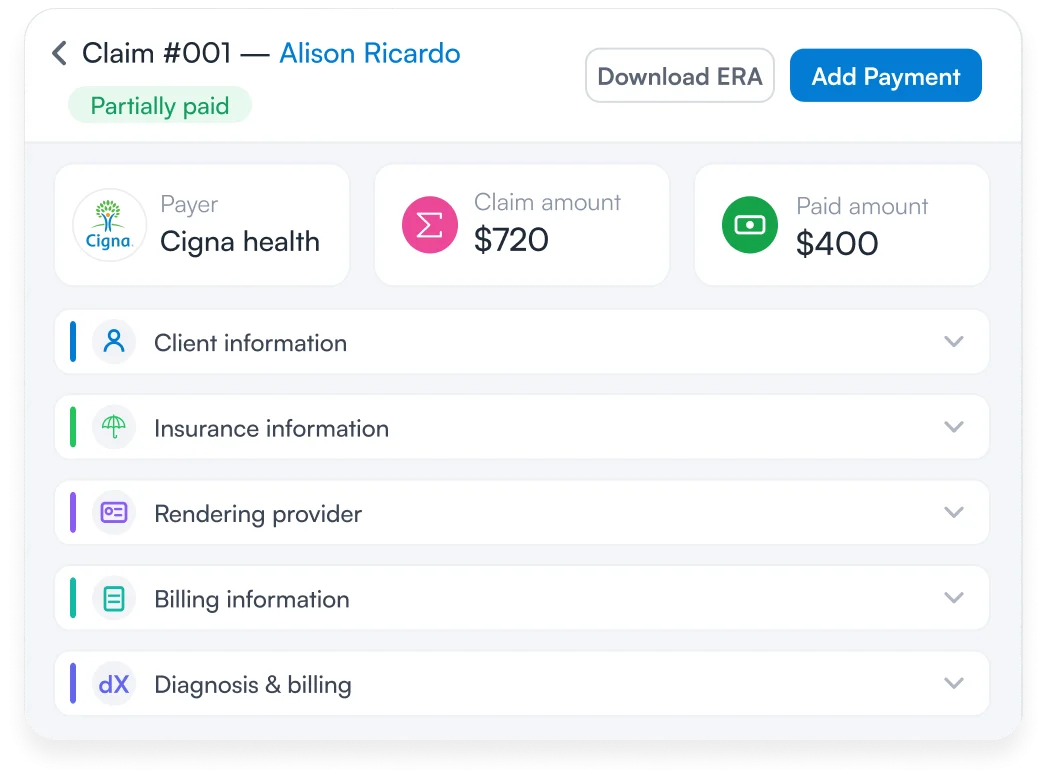
Claims then route out through Claim.MD in the US, with regional claims and billing connections in the UK and Australia. Insurers outside those connections can be reached by email submission from inside Pabau, so a claim never falls back to paper.
The wider benefit is the ledger. Aesthetic and wellness practices bill some patients through insurers and charge others directly. Pabau keeps both streams, the treatment note, and the invoice on one patient timeline. Every subscription includes all of it.

Pabau stores the insurer, policy, and authorization details on the client record, then validates them before a claim leaves your practice. Book a demo to walk through the claims workflow end to end.

Pick the category before you pick the vendor. Almost every disappointing prior authorization purchase is a drug benefit tool bought for procedure work, or the reverse. No amount of automation fixes a network that cannot see your request.
If prescriptions dominate your week, CoverMyMeds costs nothing and there is little reason to delay. If procedures dominate, start with the free Availity Essentials portal and only pay for automation once you know the volume justifies it.
Either way, the approval has to travel. An authorization code stranded in a portal is a write-off waiting for a remittance. That is a scheduling and billing problem rather than an authorization one. Book a demo to see how Pabau keeps the approval, the appointment, and the claim in one record.

Checking coverage before you request the approval? Insurance eligibility verification explains how to confirm benefits before a patient books a treatment.
Approvals still turning into denials? Denial management in healthcare covers how to work a rejection back into a paid claim.
The best prior authorization software depends on what you authorize. For prescriptions, CoverMyMeds is the strongest option and costs providers nothing. For procedures and services, Availity Essentials is a free multi-payer portal, while Waystar and Infinx suit larger organizations with dedicated authorization staff. Pabau fits a practice that wants the approval held against the appointment and the claim. Pabau stores the authorization code, dates, and unit count on the client record, then validates them before a claim goes out.
Prior authorization software asks a payer for approval before care is delivered, then tracks the answer. The software replaces fax and phone chasing with electronic submission and status updates. Good tools do four jobs. First, they determine whether an authorization is needed. Second, they submit the request with clinical documentation. Third, they chase the payer for a decision. Fourth, they carry the approved number and date range to the appointment and the claim. Most platforms are strong on the first three and leave the fourth to your staff.
Two of the nine platforms in this comparison are free to providers. CoverMyMeds says it stays free for providers and pharmacists because health plans, pharmacy benefit managers, and manufacturers fund the network. Availity describes its Essentials account as a free portal, sponsored by the health plans on it. The rest quote privately, and Pabau is the only vendor here publishing a figure, from $104 a month for one user. Free at the point of use is not the same as free overall. A portal still needs a scheduling, records, and billing system beside it.
No. CMS states that the policies in the Interoperability and Prior Authorization final rule, CMS-0057-F, do not apply to prior authorization decisions for drugs. That exclusion covers the API requirements, the 72-hour and seven-day decision timeframes, the specific denial reason, and the new MIPS Electronic Prior Authorization measure. The practical effect is narrow. The rule improves procedure and service authorizations for impacted payers from January 1, 2026. Prescription authorizations keep working exactly as they do today.
Most can, but the depth varies enormously and the word integration hides the difference. Surescripts reaches you only through your EHR vendor, and CoverMyMeds says it is available inside hundreds of EHR systems. Infinx connects through HL7, X12, APIs, and robotic process automation, and Rhyme works inside the EHR where the payer has joined its network. Ask specifically whether the approved authorization number writes back automatically, or whether a staff member copies it across.
No, and that distinction matters when you compare it with the other tools here. Pabau stores the insurer, policy, membership number, and authorization code on the client record, then validates those fields before a claim can be submitted. Claims route out through Claim.MD in the US, with regional claims and billing connections in the UK and Australia. If you need electronic requests fired at hundreds of payers, pair Pabau with a network such as CoverMyMeds or Availity for the submission itself.