ICD-10 Code S66.308A: Extensor muscle injury, other finger
ICD-10 Code S66.308A: Definition and code hierarchy ICD-10 Code S66.308A is the ...

Last Updated: Oct 14, 2026
Billable Code Specific Code
S62.211B is the billable ICD-10-CM code for Bennett's fracture, right hand, initial encounter for open fracture. It is valid for HIPAA-covered transactions in the FY2026 code set, effective October 1, 2025.
A Bennett's fracture is an intra-articular injury at the base of the first metacarpal that involves the carpometacarpal (CMC) joint of the thumb. The 7th character 'B' applies because the fracture is open. Documentation has to support laterality, encounter type, and communication between the fracture and the skin surface.
Let Pabau's smart automation suggest the right codes, reduce claim denials, and keep your practice compliant—effortlessly.
Automate repetitive tasks and focus on what matters most—your patients.
Reduce coding errors and ensure compliance with the latest regulations.
Clean claims, fewer denials, and faster reimbursements.
Powerful insights and reporting to help your practice thrive.
HIPAA compliant SOC 2 certified GDPR-compliant Trusted by 4,000+ clinics worldwide

S62.211B is a billable ICD-10-CM code for Bennett’s fracture, right hand, initial encounter for open fracture, effective FY2026 (Oct 1, 2025).
The 7th character ‘B’ specifically denotes an initial encounter for an open fracture, distinct from ‘A’ (closed) or ‘D’ (subsequent, routine healing).
Provider documentation must confirm laterality (right), encounter type (initial), and that the fracture is open before assigning this code.
CPT 26670 reads “other than thumb”, so it cannot be paired with S62.211B. The thumb CMC procedures are 26645, 26650 and 26665.
Pabau’s claims management software integrates with Claim.MD to validate and submit ICD-10-coded claims electronically to thousands of US payers.
ICD-10 Code S62.211B sits within the S62.2 Bennett’s fracture subcategory, under the broader S62 fractures at the wrist and hand level. The table below captures the key facts coders need at a glance before reviewing documentation.
Verify the current billable status against the CDC/NCHS ICD-10-CM web tool before submission, as billable status may change with annual October 1 updates. The CMS ICD-10 codes page publishes the official update files each fiscal year.
Bennett’s fracture is an intra-articular fracture at the base of the first metacarpal that extends into the carpometacarpal (CMC) joint of the thumb. It produces two fragments. A small volar fragment stays in place, held by the anterior oblique ligament. The metacarpal shaft displaces radially and proximally under the pull of the abductor pollicis longus.
The usual mechanism is an axial force along a partially flexed thumb. That happens in a fall on an outstretched hand, a punching injury, or a sports collision. The injury turns up most often in manual trades, combat sports, and ball-handling sports.
For open fractures coded with S62.211B, the fracture communicates with the skin surface. That raises infection risk and usually calls for surgical debridement alongside fracture management.
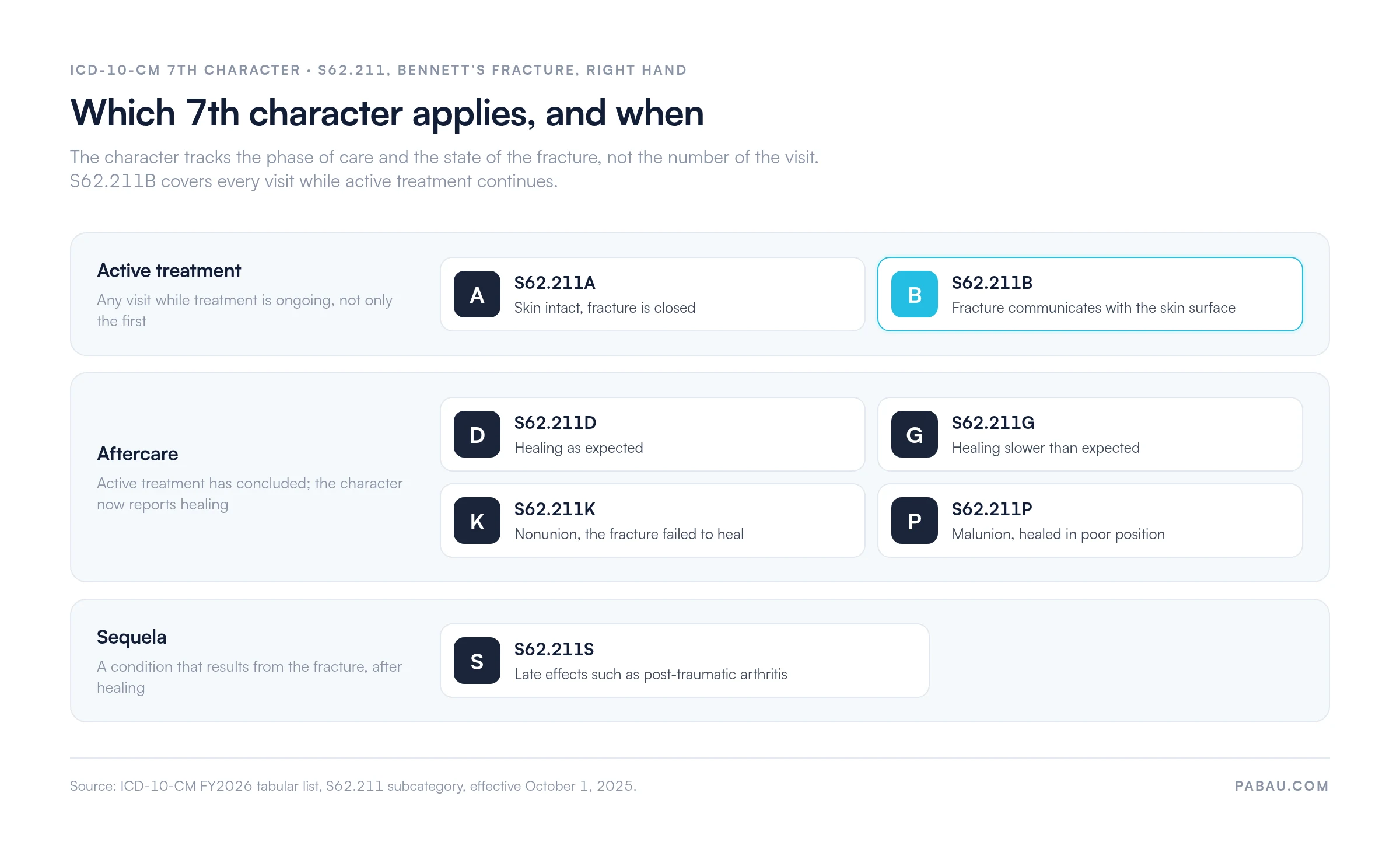
The 7th character ‘B’ denotes an initial encounter for an open fracture. In ICD-10-CM, “initial encounter” means the period during which the patient is receiving active treatment for the fracture, which may cover several visits. It is not limited to the first appointment.
The full 7th character set for S62.211 (Bennett’s fracture, right hand) is as follows:
Read down the column and the pattern is a timeline rather than a visit count. The chart below maps each character to the phase of care it belongs to.
A common coding error is applying 7th character ‘B’ to a fracture that is closed. The documentation must state the wound is open, or indicate that the fracture site communicates with a laceration or puncture wound. According to the AAPC’s ICD-10-CM coding guidance, coders should not infer open fracture status from surgical approach alone.
During the active treatment phase for an open Bennett’s fracture, every visit with the treating provider qualifies for the ‘B’ 7th character. Switch to ‘D’ (routine healing) only after active treatment has concluded and the patient is in the aftercare phase. A mismatch between the 7th character and the clinical status of the fracture is a common reason for claim denial on hand fracture codes.
Selecting the right code from the S62.211 family depends on two variables: laterality and encounter type. The table below maps the sibling codes so coders can confirm the selection against the patient record.
The switch from initial to subsequent encounter is the one that catches practices out. It happens at a clinical milestone rather than on a set date. Once active treatment has concluded and the patient is in aftercare, the claim moves to S62.211D.
S62.211B sits within chapter 19 of ICD-10-CM (Injury, poisoning, and certain other consequences of external causes). The full code tree is:
Only the last row is submittable. S62.21 and S62.211 are structural levels that carry no laterality or 7th character. A claim built on either one is rejected before it reaches adjudication.
Documentation decides whether S62.211B holds up. A claim submitted with this code must be supported by a provider note that addresses all four specificity components the code encodes.
The ICD-10-CM Official Guidelines for Coding and Reporting are published jointly by CMS and NCHS. They require both the fracture description and the encounter type to be clearly supported in the record. Neither one can be inferred from the procedure that was performed.
Missing specificity is a frequent driver of denials on hand fracture claims. A pre-submission check reads the note for those four elements and catches the problem while the chart is still open. That costs a minute instead of a resubmission cycle.
ICD-10 Code S62.211B is a diagnosis code, so it is paired with a procedure CPT code on the claim form. The CPT code depends on the treatment approach. Payer-specific rules and medical necessity criteria still apply, so consult payer policies before assuming coverage.
CPT 26670 is the pairing to watch for, because closed treatment of a carpometacarpal dislocation sounds like a fit. Its descriptor reads “other than thumb”, so it cannot be reported against a thumb CMC injury. S62.211B never pairs with it, and the three codes above are the thumb-specific options. Our CPT code reference lists the surrounding hand and wrist procedures if the operative note describes something different.
The codes above are examples rather than exhaustive billing guidance. Coverage policies, modifier requirements such as -LT and -RT, and prior authorization rules vary between payers. Check the individual contract before submission.
When billing S62.211B with a surgical CPT code such as 26665, add modifier -RT to confirm the right-hand laterality on the claim form. Many payers require explicit laterality modifiers on hand procedure codes even when the ICD-10 diagnosis code already encodes right-hand specificity. Missing the modifier is a common, easily avoidable denial trigger.
A pairing error on a hand fracture claim usually surfaces weeks after the visit, when the remittance advice comes back. By then the coder is reconstructing a decision made from a note they did not write, and the payment sits another cycle away.
Pabau, practice management software built for medical and aesthetic practices, keeps the claim in the same record as the clinical note that supports it. Our claims management software submits electronically through Claim.MD, our US clearinghouse partner, which reaches thousands of US payers.
Claims are validated before they leave the practice, so a diagnosis and procedure mismatch is flagged at the desk instead of on a denial. For an orthopedic or trauma caseload, that moves the correction to the point where the documentation is still fresh.

Pabau’s claims management software integrates with Claim.MD to validate and submit ICD-10-coded claims electronically. Reduce denials on hand fracture and orthopedic codes with payer validation before submission.

ICD-10 Code S62.211B describes a narrow clinical picture: an open Bennett’s fracture of the right hand, still under active treatment. The 7th character carries most of the billing risk. Coding ‘B’ for an intact skin surface, or ‘D’ while treatment continues, produces a denial the note could have prevented.
Treat the note as the control rather than the code lookup. If it names the side, the first metacarpal, the open wound, and the phase of treatment, the code follows from it. The CPT pairing then holds up. Book a demo to see how Pabau validates ICD-10 and CPT pairings before an orthopedic claim reaches the payer.

Treating the same patient after active treatment ends? ICD-10 code S62.211D covers the subsequent encounter with routine healing, including when to make the switch.
Fracture at the first metacarpal but not a Bennett’s pattern? ICD-10 code S62.291B covers other fractures of the first metacarpal bone in the right hand.
Need to understand how ICD-10 coding fits into your billing workflow? What is medical billing walks through the full process from diagnosis code assignment to claim submission and payment posting.
Concerned about claim denials on trauma and orthopedic codes? Denial management in healthcare covers the most common payer rejection reasons and how to address them systematically.
Want fewer resubmissions on orthopedic claims? What is a clean claim in medical billing? sets out what a payer needs on the first pass.
ICD-10 Code S62.211B is the billable ICD-10-CM diagnosis code for Bennett’s fracture of the right hand, initial encounter for open fracture. It reports this injury on HIPAA-covered transactions, including Medicare, Medicaid, and commercial insurance claims. It applies during the active treatment phase, while the fracture is open.
S62.211A is for an initial encounter for a closed fracture, where the skin is intact. S62.211B is for an initial encounter for an open fracture, where the fracture communicates with the skin surface. Both codes apply to Bennett’s fracture of the right hand during the active treatment phase. The fracture type, not the treatment approach, determines which code to use.
Yes. S62.211B is a billable and specific ICD-10-CM code valid for use in HIPAA-covered transactions. It became effective October 1, 2025 under the FY2026 ICD-10-CM edition. Confirm against the current fiscal year’s tabular list, as billable status is subject to annual review.
The 7th character ‘B’ designates an initial encounter for an open fracture in the S62 code category. “Initial encounter” covers any visit during the active treatment phase, not just the first appointment. “Open” means the fracture site communicates with the skin surface through a wound. Both conditions must be supported in the provider documentation.
S62.212B is the equivalent code for Bennett’s fracture of the left hand, initial encounter for open fracture. The digit ‘1’ in position 6 denotes right hand; ‘2’ denotes left hand. All other coding rules, 7th character requirements, and documentation standards that apply to S62.211B apply equally to S62.212B.
Use S62.211D for a subsequent encounter with routine healing (right hand), S62.211G for delayed healing, S62.211K for nonunion, or S62.211P for malunion. Switch from 7th character ‘B’ to the appropriate subsequent-encounter character once active treatment has concluded and the patient enters the aftercare phase. For the left hand, use the S62.212 family with the same 7th character suffixes.