ICD-10 Code S82.242H: Displaced spiral tibial shaft fracture, delayed healing
ICD-10 Code S82.242H: Definition and code details ICD-10 Code S82.242H designate...

Last Updated: Oct 15, 2026
Billable Code Specific Code
S62.252S is the billable ICD-10-CM code for displaced fracture of neck of first metacarpal bone, left hand, sequela.
It is a billable, specific code for FY2026 claims. It applies only after the thumb metacarpal fracture has healed and the patient returns for a lasting effect of that injury.
Two digits decide whether the claim pays. The 7th character has to match the encounter type, and the fifth digit has to match the fracture site. S62.22 is Rolando's fracture at the base of the thumb metacarpal, so it is not interchangeable with S62.25. Either mistake produces a denial.
Let Pabau's smart automation suggest the right codes, reduce claim denials, and keep your practice compliant—effortlessly.
Automate repetitive tasks and focus on what matters most—your patients.
Reduce coding errors and ensure compliance with the latest regulations.
Clean claims, fewer denials, and faster reimbursements.
Powerful insights and reporting to help your practice thrive.
HIPAA compliant SOC 2 certified GDPR-compliant Trusted by 4,000+ clinics worldwide

ICD-10 code S62.252S describes a displaced fracture of the neck of the first metacarpal bone, left hand, sequela. It is billable and specific.
The 7th character S marks a sequela. That means a late effect that persists after the fracture itself has healed.
Do not confuse S62.25 with S62.22. S62.22 is Rolando’s fracture at the base of the thumb metacarpal, not the neck.
Malunion and nonunion take the 7th characters P and K, not S. Keep S for residual conditions of a healed fracture.
Sequence the residual condition code first, then S62.252S. Reporting S62.252S alone as the primary diagnosis triggers payer edits.
Pabau’s claims management software tracks S62.252S encounters and flags 7th character mismatches before the claim reaches the payer.
Code: S62.252S is a billable, specific ICD-10-CM code effective for FY2026 encounters. You can report it directly on a claim without further specification, provided the sequela encounter type is documented.
Verify current billable status against the CDC/NCHS ICD-10-CM web tool before each claim submission. CMS updates the ICD-10-CM tabular list annually. Codes active in FY2025 may be revised, deleted, or carry guideline changes in FY2026.
The first metacarpal is the bone in the palm that connects the wrist to the thumb. Its neck is the narrowed segment just proximal to the metacarpal head, the knuckle joint at the base of the thumb. Fractures here are common in hand trauma. Falls on an outstretched hand, direct impact, and sports compression forces all load the metacarpal neck.
A displaced fracture means the bone fragments have shifted out of anatomical alignment. In a nondisplaced fracture the bone cracks but fragment position holds. Displacement drives the treatment decision between reduction and conservative management. It also decides which half of the S62.25 family you code.
S62.252 takes seven possible 7th characters, not three. Coders who only know the A/D/S pattern from wound and poisoning codes routinely misfile fracture encounters here. The same injury takes a different 7th character depending on the encounter type, not on the severity of the fracture.
ICD-10-CM Official Guidelines section I.C.19.a sets the rule. Character A applies to every encounter where the patient receives active treatment for the fracture, including encounters after surgery.
Character D applies once active treatment ends and the fracture is healing. Character S applies when the fracture has healed and the visit addresses a direct consequence of that prior injury.
A sequela is a condition that arises as a direct late effect of a previous injury, after that injury has itself resolved. It is not the same as aftercare, and it is not the same as a subsequent encounter for a fracture that is still healing.
Malunion and nonunion take the subsequent-encounter characters P and K. The sequela character does not apply to either one. Both describe a fracture that has not achieved normal union, so the fracture is still the active problem. Coding either one as a sequela contradicts the record.
A thumb metacarpal neck fracture that healed in angulation is S62.252P, however long ago the injury happened. A fracture that never united is S62.252K. Reserve S62.252S for a fracture that did heal, where the patient now presents with a lasting effect such as arthritis, contracture, or weakened grip.
The S62.25 sub-subcategory covers fractures of the neck of the first metacarpal across every combination of displacement, laterality, and encounter type. Confusing left (S62.252) with right (S62.251) is a laterality error that chart audits pick up quickly. Use the table below alongside the AAPC ICD-10-CM code lookup.
Avoid S62.253S and S62.256S whenever laterality is documented. Payers routinely query unspecified codes. Using one when the record clearly states left or right hand invites an extra documentation request and delays payment.
The hierarchy confirms that S62.252S sits where you expect it in the ICD-10-CM tabular list, and it supports accurate crosswalk lookups. Injury codes run from chapter down to full code, a structure shared by every entry in our ICD-10-CM code index.
S62.2 divides by fracture site along the thumb metacarpal, and the fifth digit carries that distinction alone. Transposing two digits moves the claim to a different bone segment with a different clinical story. The six sub-subcategories run as follows.
Two consequences follow for coders. S62.225S is a valid code, but it means a nondisplaced Rolando’s fracture of the left hand, sequela, at the base of the bone. It is not a metacarpal neck code, so a claim built on it describes a different injury than the record supports. The map below places each fifth digit against the segment of bone it describes.
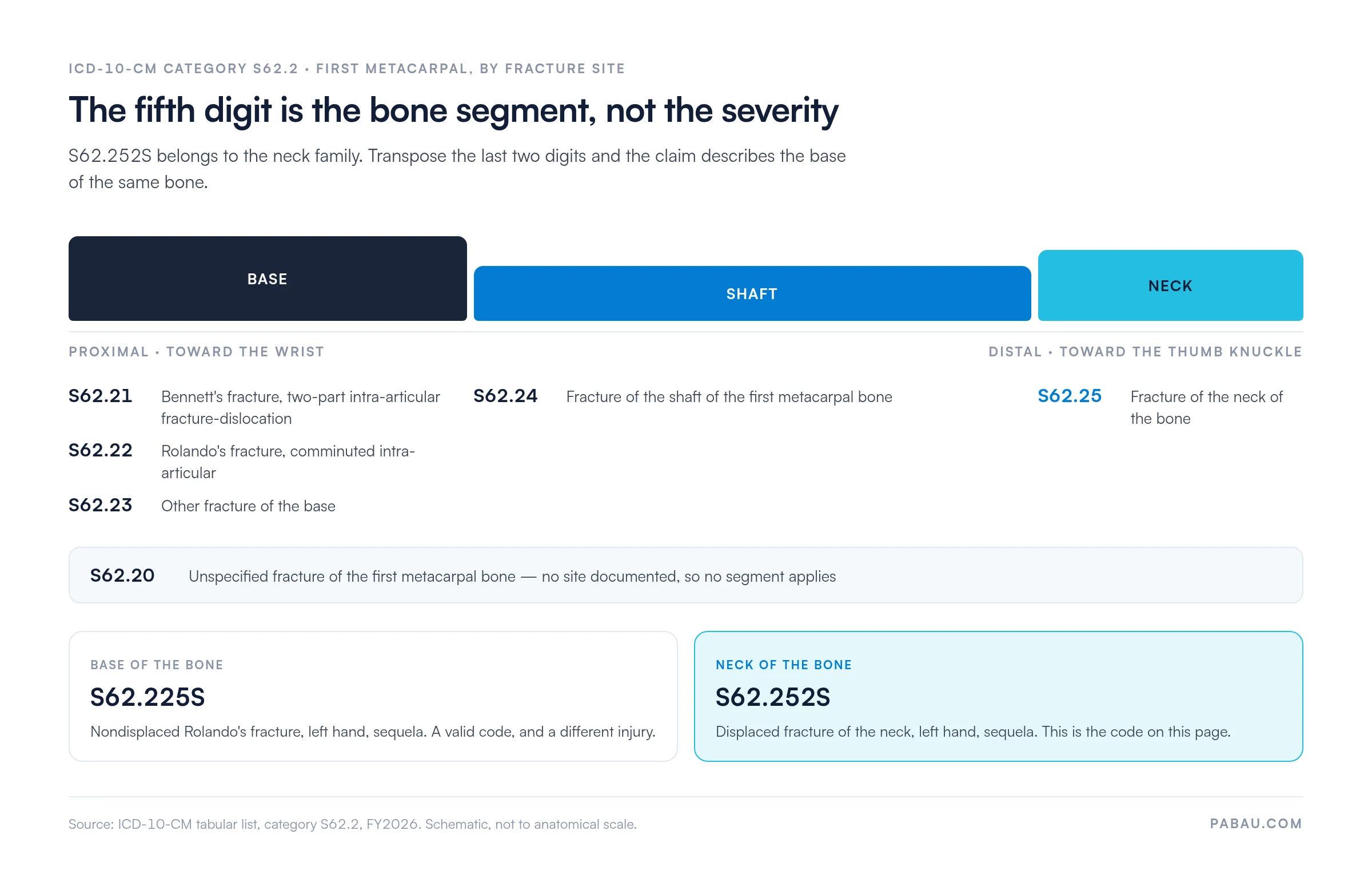
The second consequence is that S62.22 has only six base codes, S62.221 through S62.226. Codes such as S62.227, S62.228 and S62.229 do not exist in ICD-10-CM. If a worklist or template offers one, treat it as a data-entry artifact rather than a code.
Operative notes, ED records, and discharge summaries use varied language for the same injury. The terms below all map to ICD-10 code S62.252S when the record also supports a sequela encounter on the left hand. Check the ICD List code reference for further synonym lookups.
Watch for phrases such as “post-fracture arthritis” or “grip weakness following healed metacarpal fracture.” A note reading “stiffness from prior left thumb metacarpal neck injury” points the same way. In each case S62.252S goes second, after the residual condition.
S62.252S needs five facts on the record before it survives an audit. Missing any one of them turns the code into an assumption, and payers treat assumptions as unsupported coding. Ask the provider for an addendum rather than choosing an unspecified code.
Record the original date of injury as well. Sequela claims often arrive months or years after the fracture, and the payer needs the causal link spelled out. A dated mechanism of injury also supports any external cause code you report with the sequela.
Several ICD-10-CM Official Guidelines govern how these codes get assigned, and misapplying them is a leading cause of failed orthopedic claim edits. Read them alongside CMS ICD-10-CM annual update guidance.
Injury chapters across ICD-10-CM follow the same structural logic, so the habits you build here transfer. The AHA Coding Clinic remains the authoritative resource for complex sequela scenarios that the tabular list does not address.
Audit your sequela claims for two things. First, check that S62.252S is sequenced second rather than first, because a missing residual condition code is a frequent sequela error. Second, search your claim history for S62.225S on metacarpal neck cases. That code means a nondisplaced Rolando’s fracture at the base of the bone, so those claims describe the wrong injury.
Practices reconciling old remittances or appealing historical claims need the ICD-9 predecessors for this injury. GEMs mappings are directional and approximate rather than exact. Cross-reference them against ResDAC ICD coding resources for Medicare claims data research.
One detail catches people out on legacy reconciliation. The published forward GEM for 815.04 lands on the unspecified metacarpal neck codes, S62.339A and S62.369A, rather than on the first metacarpal codes. ICD-9 never distinguished the thumb metacarpal neck, so only the clinical record tells you the injury belongs in S62.25.
Treat every mapping here as approximate. For claims dated before October 2015, reconcile against the original note rather than the crosswalk. ICD-9 captured neither laterality nor displacement nor encounter type at ICD-10-CM’s level of detail.
CPT selection follows the treatment rendered, not the ICD-10 diagnosis. The codes below are common pairings across the S62.252 family, especially the initial-encounter and subsequent-encounter versions.
They are examples only, because payer bundling edits, modifier rules, and prior authorization requirements vary. Confirm against the payer’s fee schedule before you bill.
Note the difference between the two therapy codes, because it is a frequent mislabel. CPT 97110 covers therapeutic exercises for strength, endurance, and range of motion. CPT 97530 covers therapeutic activities, meaning dynamic functional tasks delivered one-on-one. Both can apply to a thumb sequela, but they document different work.
Rehabilitation codes are the usual pairing for S62.252S encounters. Surgical codes 26600 to 26615 belong with initial-encounter claims. Claim denial management on these codes often comes down to matching the 7th character to the procedure category. Billing 26615 with S62.252S will trigger a medical necessity denial.
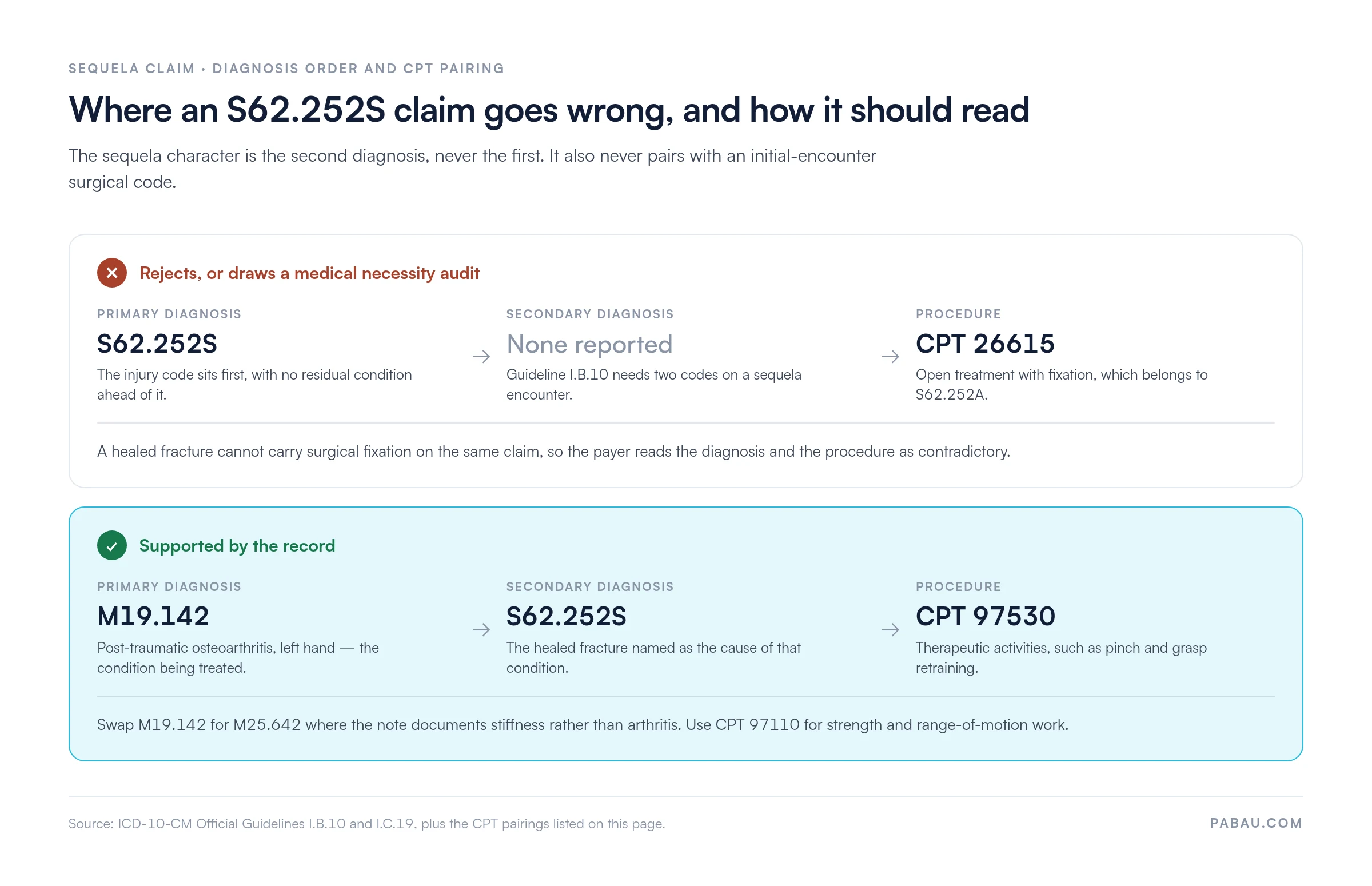
A 7th character error usually surfaces only when the payer sends the claim back. The coder fixes the character, the biller resubmits, and the payment lands weeks later than it should. A sequela claim carries a second failure point, because the residual condition code has to sit ahead of the injury code.
Practice management software like Pabau moves both checks upstream. Our claims management software lets you build claim edits for both errors. One flags a sequela code in the primary position. Another flags a surgical CPT paired with an S character. The coder sees the problem while the chart is still open.
Submission runs through Claim.MD, our clearinghouse partner for US payers. Code combinations get validated against payer-specific rules before the claim goes out. The superbill for these encounters captures the residual condition as the primary diagnosis, with S62.252S behind it. The result is fewer rejections and a shorter path to payment.

Pabau’s claims management tools and Claim.MD integration help hand surgery practices submit clean claims. Catch 7th character mismatches before they reach the payer. Manage the revenue cycle from first encounter through sequela follow-up.

ICD-10 code S62.252S carries three conditions. The displaced fracture of the left thumb metacarpal neck has to be healed. The current visit has to address a direct late effect of it. The residual condition code has to be sequenced first. Miss any one and the claim rejects or draws a medical necessity audit.
Check the digits first. S62.25 is the metacarpal neck, S62.22 is Rolando’s fracture at the base, and S62.227 onward are not codes at all.
Pabau builds those sequencing and 7th character checks into the claim workflow, so coders catch the error before submission. To see how it runs from documentation through clearinghouse validation, book a demo.

Need to manage orthopedic billing denials? Denial management in healthcare covers the root causes of claim rejections and the workflows that resolve them.
Looking for clearinghouse options for US fracture claims? Claim.MD clearinghouse overview explains how electronic claims submission works for orthopedic diagnoses.
Want to understand revenue cycle fundamentals? Revenue cycle management guide covers the full financial workflow from patient encounter to final payment.
ICD-10 code S62.252S is a billable ICD-10-CM diagnosis code for a displaced fracture of the neck of the first metacarpal bone, left hand, sequela. The 7th character S means the original fracture has healed. The current visit treats a residual condition caused by that injury, such as post-traumatic arthritis, chronic stiffness, or reduced grip strength.
No. S62.225S means a nondisplaced Rolando’s fracture of the left hand, sequela, which is a fracture at the base of the thumb metacarpal. S62.252S means a displaced fracture of the neck of the first metacarpal bone, left hand, sequela. The two codes describe different parts of the same bone and different fracture patterns, so they are not interchangeable.
Yes. S62.252S is a billable, specific ICD-10-CM code valid for FY2026 claims. You can report it directly without further specification, as long as the sequela encounter type is documented in the clinical record. Remember that a sequela claim also needs the residual condition code sequenced ahead of it.
S62.252 takes seven 7th characters. A is the initial encounter for a closed fracture and B is the initial encounter for an open fracture. D, G, K and P cover subsequent encounters with routine healing, delayed healing, nonunion and malunion. S is the sequela character. Coders who expect only A, D and S from wound codes often misfile these encounters.
No. Malunion takes the 7th character P, so a left thumb metacarpal neck fracture that healed in a poor position is S62.252P. Nonunion takes K, giving S62.252K. Reserve S62.252S for a fracture that united normally, where the patient now presents with a separate lasting effect such as arthritis or stiffness.
Sequence the residual condition code first, then S62.252S as the injury that caused it. For a left hand, that first code might be M19.142 for post-traumatic osteoarthritis or M25.642 for stiffness. Reporting S62.252S alone as the primary diagnosis is incorrect on a sequela encounter and will trigger payer edits.
Only laterality. S62.251S is a displaced fracture of the neck of the first metacarpal bone, right hand, sequela, and S62.252S is the left-hand equivalent. The fracture pattern and encounter type are identical. Confirm the documented hand against the imaging report before you pick between them, since laterality errors are a common denial source.
Rehabilitation and therapy codes are the usual pairings, notably 97110 for therapeutic exercises and 97530 for therapeutic activities. Surgical codes 26600, 26605 and 26615 belong with S62.252A rather than S62.252S, because the fracture has to be healed for the sequela character to apply. CPT selection remains subject to payer bundling and prior authorization rules.