ICD-10 Code Y76.0: Diagnostic obstetric and gynecological devices
ICD-10 Code Y76.0: Definition and billable status ICD-10 Code Y76.0 is a valid, ...

Last Updated: Oct 23, 2026
Billable Code Specific Code
S62.357B is the billable ICD-10-CM code for nondisplaced fracture of shaft of fifth metacarpal bone, left hand, initial encounter for open fracture.
S62.357 has been part of ICD-10-CM since the code set took effect on October 1, 2015. The FY2026 edition is the current one, and S62.357B remains valid on both CMS-1500 and UB-04 claim forms.
Let Pabau's smart automation suggest the right codes, reduce claim denials, and keep your practice compliant—effortlessly.
Automate repetitive tasks and focus on what matters most—your patients.
Reduce coding errors and ensure compliance with the latest regulations.
Clean claims, fewer denials, and faster reimbursements.
Powerful insights and reporting to help your practice thrive.
HIPAA compliant SOC 2 certified GDPR-compliant Trusted by 4,000+ clinics worldwide

S62.357B is a billable ICD-10-CM code for a nondisplaced fracture of the left fifth metacarpal shaft, initial encounter for open fracture.
The 7th character B marks an open fracture at the initial encounter, while character A covers closed fractures.
Laterality is built into the code. S62.357 covers the left hand and S62.356 covers the right.
The note must show that the wound connects to the fracture site, because ICD-10-CM defaults to closed when it does not.
Practice management software like Pabau carries the selected ICD-10-CM code straight onto the CMS-1500 claim, so nobody rekeys it.
S62.357B is a specific, billable code, so it needs no further character to stand on a claim. The table below summarizes the data points a coder checks before submission.
Knowing where S62.357B sits in the ICD-10-CM tabular list is how coders confirm they have reached the most specific code available. S62.357B is a complete 7-character code, so no more specific option exists.
The parent code S62.357 is non-billable without a 7th character. As a result, coders must append the right one for the claim to clear the payer edits. The CMS ICD-10 codes page publishes the full FY2026 tabular list and the annual update files.
In fact, the 7th character is where most metacarpal fracture claims go wrong. For every S62.357 code, that character sets both the fracture type and the encounter type. Character B means initial encounter for open fracture.
The A/B/D/G/K/P/S set is specific to US ICD-10-CM. The ICD-10-CM Official Guidelines published by CMS and NCHS define the initial encounter as the period of active treatment. That covers emergency department visits, surgical treatment, and the first outpatient visit where treatment actually begins. The WHO version of ICD-10 has no matching 7th character.
The table below lists every valid 7th character for S62.357.
In practice, confusing A and B is the most common coding error on fifth metacarpal fracture claims. Both cover initial encounters, but they describe different wound types with different notes and payment outcomes.
Critical rule: per ICD-10-CM Official Guidelines Section I.C.19, a note that does not specify open or closed defaults to closed. Therefore, select S62.357B only when the record shows an open wound connecting to the fracture site.
Coders and clinicians often use different words for the same injury. These are the accepted synonyms and index entry terms tied to S62.357B. Recognizing them keeps code selection accurate when a note is written in clinical shorthand.
However, in orthopedic literature, boxer fracture refers to the fifth metacarpal neck. When the note names the neck rather than the shaft, a different S62 code applies. Confirm the anatomical location before coding.
A nondisplaced fracture means the bone has cracked but the fragments have not shifted out of alignment. In the fifth metacarpal shaft, that often follows a direct blow, a crush injury, or a punch. The periosteum and surrounding soft tissue often stay intact, so these fractures often respond to conservative treatment.
By contrast, open fractures carry more risk. The wound gives contamination a route to the bone, which changes treatment urgency and the surgical approach. For coders, the open status has to appear in the operative or emergency note before S62.357B can replace S62.357A.
Claims carrying S62.357B draw more scrutiny than closed fractures do, because open status changes both treatment complexity and payment. Consequently, the note has to support every component of the code.
A structured note that captures each of the fields below is much harder for a payer to send back.
Document the mechanism of injury alongside wound status in every open fracture note. When an auditor reviews a claim for S62.357B, the operative or emergency report has to state two things. The first is an open wound connecting to the fracture site. The second is the imaging-confirmed nondisplaced pattern. Otherwise, a note that mentions an open wound without tying it to the fracture site leaves the claim exposed.
The FY2026 ICD-10-CM Official Guidelines, Section I.C.19, govern fracture coding across the whole S00-T88 chapter. Five rules decide whether S62.357B survives a payer review.
The CDC/NCHS ICD-10-CM web tool lets coders check code validity, effective dates, and tabular list notes by fiscal year.
S62.357B is valid on both the CMS-1500 professional claim and the UB-04 institutional claim. Open fracture claims draw more payer review than closed ones, so the notes have to be complete before the claim goes out.
Practices that submit electronically send claims through a clearinghouse rather than to each payer directly. Pabau connects to Claim.MD, which submits and tracks claims across more than 4,000 US payers using the codes the practice has already recorded. Watching which denial codes come back on open fracture claims tells you which note field the payer keeps missing.
On inpatient claims, S62.357B is not POA exempt, so the present-on-admission indicator has to be assigned. A review queue for open fracture codes flags notes where wound detail is thin before the claim is submitted.
First, an ICD-10-CM diagnosis code has to pair with a CPT procedure code on the claim. Instead, the CPT code follows the treatment actually rendered, not the diagnosis. These are the codes most often paired with fifth metacarpal fracture care. Check current payer policy and the CPT 2026 manual before submission.
CPT pairings follow the procedure performed, not the diagnosis alone. Confirm each one against the AAPC Codify ICD-10-CM lookup and your payer’s local coverage determinations. Where debridement is billed at the same encounter, CPT 97597 carries its own documentation rules for wound surface area.
For example, CPT 26615 pairs with S62.357B for open surgical treatment. CPT 26600 and 26605 describe closed fracture treatment, so neither belongs on a claim carrying an open fracture diagnosis. A closed-treatment CPT against an open-fracture ICD-10 code is a clinical inconsistency that payers flag for review. Read the operative report against the ICD-10 selection before the claim is submitted.
The S62.35 subcategory covers nondisplaced shaft fractures of the second through fifth metacarpals, which ICD-10-CM groups as the other metacarpal bones. Each bone has a right-hand code and a left-hand code. The grid below shows which one applies before the 7th character is appended.
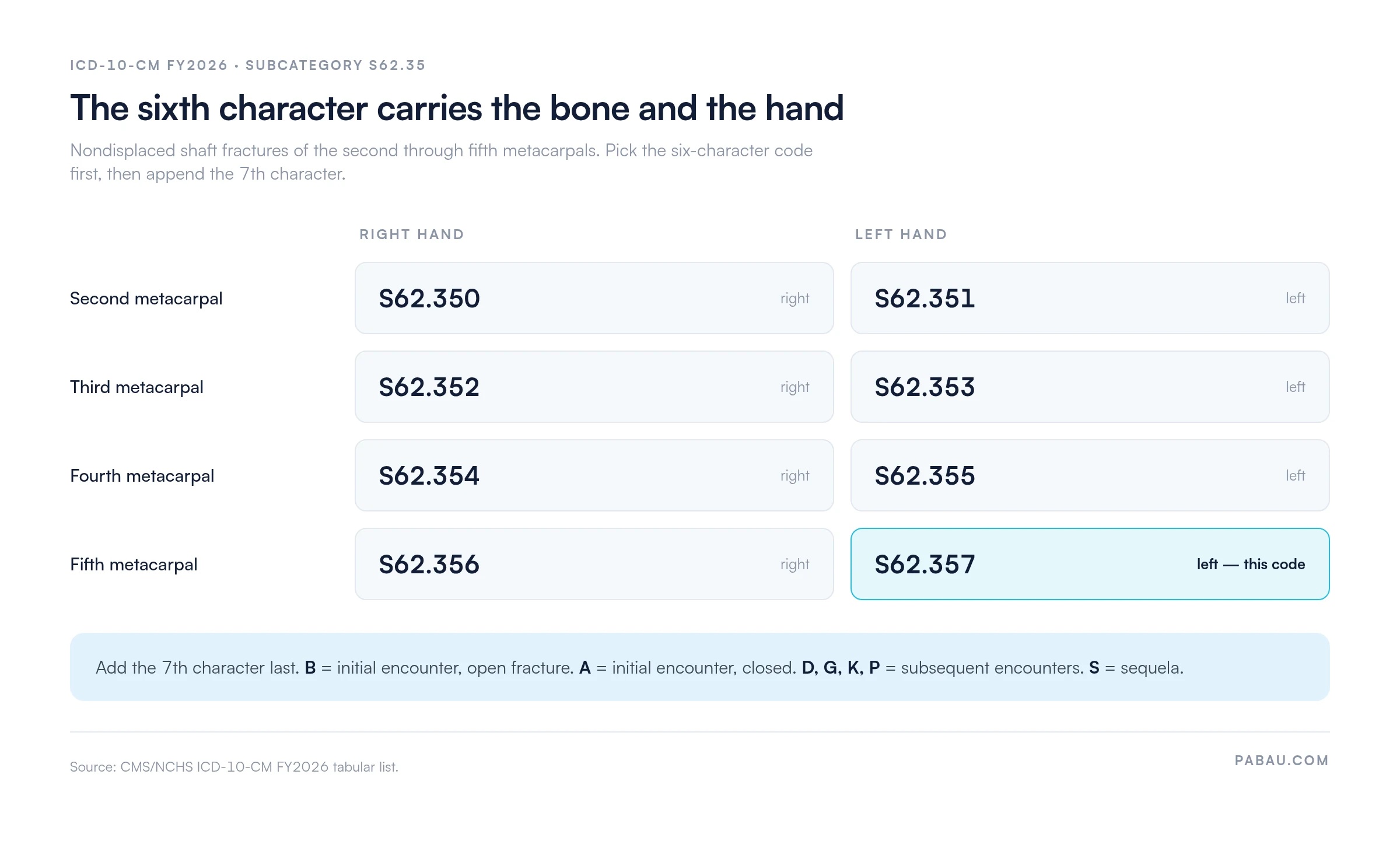
Every one of these codes takes the same 7th character set, so B always means the initial encounter for an open fracture.
In most practices the coder reads the operative note in one system and types the ICD-10 code into another. So, every retype is a chance to drop the B, or to pick S62.356B for a left hand.
Pabau keeps the encounter note, the diagnosis code, and the claim inside one patient record. The code attached in the note is the code that reaches the CMS-1500, and the Claim.MD connection submits and tracks it from there.
That gives hand-injury billing smoother claims management. Fewer claims come back over a mismatch between the operative report and the code on the line. The ones that do are quicker to trace.

Pabau attaches the ICD-10-CM code to the clinical note and carries it through to claim submission via Claim.MD, which reaches more than 4,000 US payers. See how the billing workflow handles orthopedic and hand injury claims end to end.

In short, two facts in the record decide S62.357B. The wound must connect to the fracture site, and the injury must be on the left hand.
If either is missing, the correct code is S62.357A or S62.356B, and a payer will often find the difference before you do. Reading the operative report before the code goes on the claim is the cheapest control available.
Book a demo to see how Pabau keeps the coded diagnosis attached to the claim for hand and orthopedic injuries.

Coding another hand fracture? ICD-10 Code S62.233B covers the first metacarpal, left hand, under the same 7th character rules.
Want to understand how clearinghouse submissions reduce denial risk? Claim.MD clearinghouse overview explains how electronic claims move from the practice to the payer.
Looking for a denial prevention framework for hand and orthopedic claims? Denial management in healthcare outlines the workflows that prevent open fracture claim rejections.
S62.357B is a billable ICD-10-CM code for a nondisplaced fracture of the fifth metacarpal shaft, left hand, initial encounter for open fracture. It has been valid since ICD-10-CM took effect on October 1, 2015, and remains valid in the FY2026 edition. It is accepted on both CMS-1500 and UB-04 claims.
S62.357A indicates a closed fracture at the initial encounter, and S62.357B indicates an open one. Both describe a nondisplaced fracture of the left fifth metacarpal shaft. S62.357B requires clear documentation showing an open wound that connects to the fracture site. When the note does not say open or closed, the default is closed.
The immediate parent is S62.357, nondisplaced fracture of shaft of fifth metacarpal bone, left hand. It is non-billable without a 7th character. Above it the hierarchy runs S62.35, then S62.3, then the S62 category for fractures at wrist and hand level.
Yes. S62.357B is the left hand. The right-hand match is S62.356B, so the note has to name the side before the code is chosen. In other words, a record that names only the fifth metacarpal shaft, with no side, does not support either code.