ICD-10 code S61.201A: Open wound of left index finger without nail damage
ICD-10 code S61.201A covers a left index finger wound of unstated type ICD-10 co...

Last Updated: Oct 16, 2026
Billable Code Specific Code
S63.289D is the billable ICD-10-CM code for dislocation of proximal interphalangeal joint of unspecified finger, subsequent encounter.
Keep the initial-encounter A on that second visit and the payer has an easy reason to deny. Lean on the unspecified sixth character too often, and your documentation starts to look thin in an audit.
Let Pabau's smart automation suggest the right codes, reduce claim denials, and keep your practice compliant—effortlessly.
Automate repetitive tasks and focus on what matters most—your patients.
Reduce coding errors and ensure compliance with the latest regulations.
Clean claims, fewer denials, and faster reimbursements.
Powerful insights and reporting to help your practice thrive.
HIPAA compliant SOC 2 certified GDPR-compliant Trusted by 4,000+ clinics worldwide

S63.289D is a billable ICD-10-CM code for a PIP joint dislocation of an unspecified finger at a subsequent encounter
The 7th character D means the patient is back for routine care during the healing phase
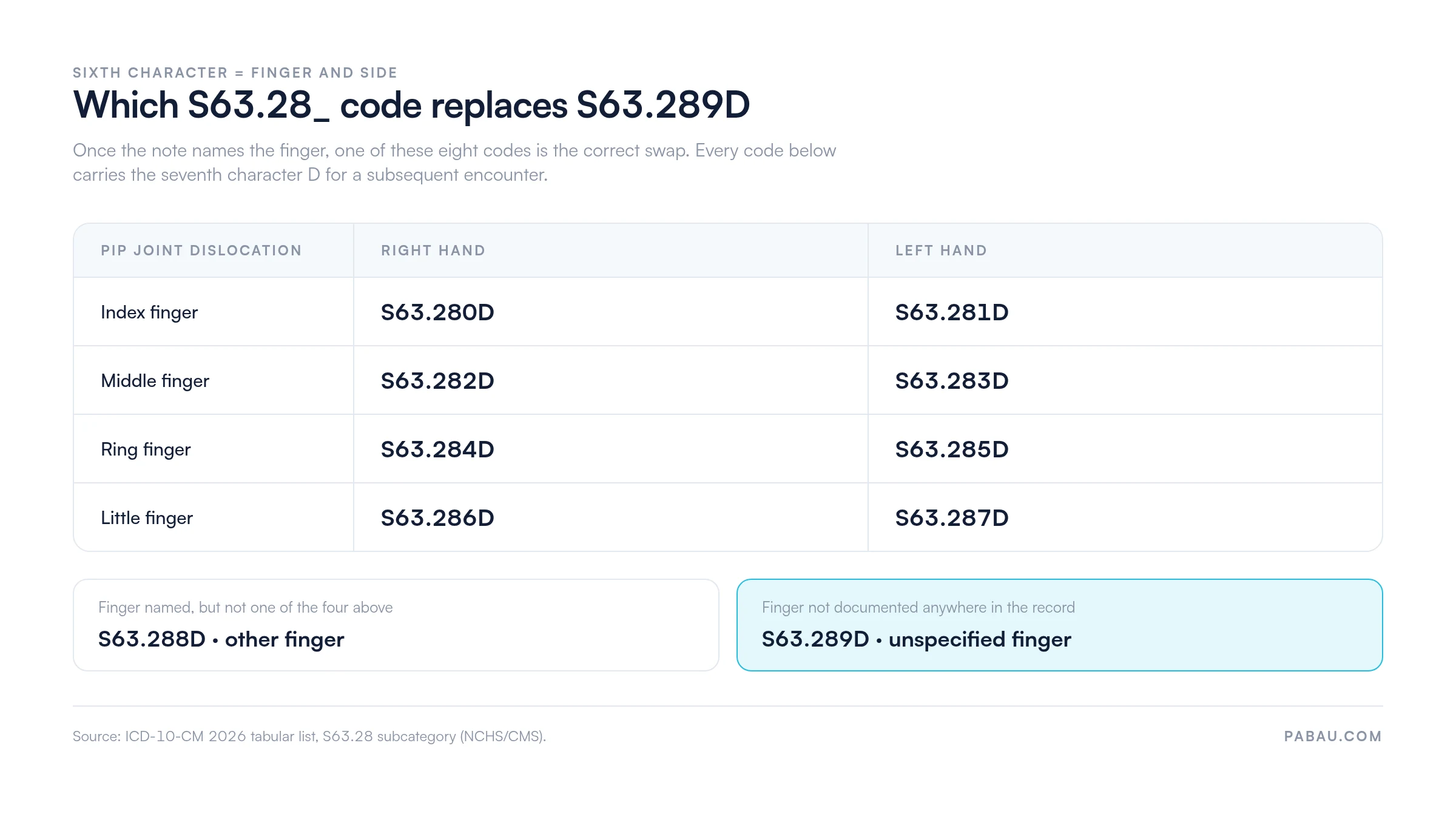
When the note names the finger, swap in a specific sibling code from S63.280D to S63.288D
Claims fail most often when the coder keeps the initial-encounter A after the first active-treatment visit
Practice management software like Pabau carries the code from the clinical note to the claim without re-entry
Two questions bring most coders to this page. Is the code still billable, and does the D character fit today’s visit? The table answers both, and the sections after it explain why.
Read the code left to right and it describes the injury in six steps. Misread one position and the claim can bounce as invalid before a human ever sees it.
The sixth character 9 is what makes this the unspecified version, rather than a digit from 0 to 8. When the clinical note identifies the injured finger, a code in the S63.280 to S63.288 range is always preferred. A partial displacement of the same joint carries its own code, so a right index PIP subluxation at the first active-treatment visit is S63.230A.
The 7th character is where follow-up claims go wrong most often. According to the CMS ICD-10 coding guidance, S63.289 accepts three of them. Each one marks a different point in the life of the injury.
The encounter type follows the purpose of the visit, not the specialty of the provider. Once the dislocation has been reduced and the patient returns for healing-phase care, switch to S63.289D. A physiatrist seeing that patient three weeks after reduction still uses D, even on their own first visit with them.
The ICD-10-CM Official Guidelines for Coding and Reporting are maintained jointly by the NCHS and CMS. They keep the D character in place for the whole healing phase, whichever provider delivers the care.
The proximal interphalangeal joint sits between the proximal and middle phalanges of fingers two through five. Viewed from the side, it is the middle knuckle. It is also the finger joint that dislocates most often, in sport and at work alike.
Dorsal dislocations account for the large majority of these injuries, with the middle phalanx displacing backward, away from the palm. Volar and lateral dislocations show up less often, and they leave more complex instability behind.
S63.289D stays valid whether or not the note records the direction. Even so, the mechanism and the joint should both appear in the record.
Name the mechanism in every note that supports S63.289D. Hyperextension from ball contact, a crush injury, and a fall on an outstretched hand are all worth writing down. A note that reads only ‘finger dislocation, follow-up’ gives an auditor nothing to work with, and it weakens the clinical record.
Every level above S63.289D narrows the anatomy by one step. Reading the ladder is what tells you whether a more specific code exists for this patient. The whole S00-T88 chapter is built this way, so the habit carries over to the other ICD-10 diagnostic codes you bill.
The S63.28 series carries one code per finger, per side. Read the sixth character as a map of the hand and the swap becomes mechanical. Confirm your choice in the CDC/NCHS ICD-10-CM web tool before the claim goes out.
Few providers write “proximal interphalangeal joint dislocation, subsequent encounter” word for word.
The phrases below all land on S63.289D when the finger is unspecified and the visit is a follow-up. Recognizing them saves a query the record does not need.
Subluxation and full dislocation share the same S63.28 range in ICD-10-CM. The classification does not separate partial displacement from complete displacement at this level of specificity.
A healing-phase visit for a PIP dislocation usually bills an office visit, sometimes with a splint or therapy on the same day.
Most of these encounters land on CPT code 99213, with the heavier visits moving up to 99214. Pairings shift by payer and by scenario, so check the AAPC CPT-to-ICD-10 crosswalk before you submit.
Splint application and therapy on the same day as an office visit are a frequent source of edits. Many payers want modifier 25 on the visit code before they pay both lines, so read your contract first.
Picking the code is the first step of a longer trip. Below is the route a follow-up claim takes in a US practice, and the point where it usually stalls.
Step four is the cheap place to fail. A clearinghouse rejection never reaches the payer, so you can correct the 7th character and resend the same day. A denial at step five costs a rework cycle and, on older claims, a fight with the timely filing limit.
Documentation decides whether this claim survives a review. The habits below hold whether the note comes from an orthopedic surgeon, a primary care provider, or a hand therapist.
S63.289D is clinically valid when the provider genuinely cannot identify the finger. That happens in multi-trauma cases, when the earlier treating records are unavailable, or when a patient arrives for follow-up without them. Using the unspecified code there is appropriate and compliant.
Reaching for “unspecified” because nobody asked is a different matter. AHIMA’s query guidance points coders back to the provider when the record supports specificity but stops short of stating it.
One clarification, right index or left ring, turns S63.289D into the code the payer prefers. Payers also read repeated unspecified codes as a documentation quality signal during audits.
The opposite problem shows up too, with the finger named and the joint left out. A left little finger dislocation with no joint documented codes to S63.257A at the initial encounter.
Run a monthly audit on your unspecified finger dislocation claims. If S63.289D appears more than twice in one patient record, the finger was probably identifiable in at least one note. Flag those charts for a provider query before they close.
In most practices the diagnosis gets recorded twice. The provider writes the injury into the note. Someone then re-enters a code in the billing system days later, without that note in front of them. That second entry is where the encounter type quietly slips back to A.
Pabau, our practice management software, keeps the code with the record it came from. Whoever codes the visit picks S63.289D inside the clinical note, and the same code moves onto the claim without re-entry.
Claims then leave for the clearinghouse from the same screen through our Claim.MD integration, which supports CMS-1500 and 837P claims across thousands of US payers.
You get fewer transcription errors and a shorter path from visit to submission. The chart also still reads consistently if a payer asks for it a year later.
Our claims management software also flags codes that are no longer valid, so a retired 7th character does not travel out with the claim.

Pabau embeds ICD-10 diagnosis code selection directly into your clinical notes and billing workflow. Select S63.289D at the point of care and push it straight to the claim, with no manual re-entry and no transcription errors.

S63.289D is an easy code to bill correctly and an easy one to leave stale. Two decisions carry it: the encounter type and the sixth character. Settle both at the first follow-up visit and the rest of the healing phase largely codes itself.
Where the finger is documented, the sibling code is always the stronger claim. Where it genuinely is not, S63.289D holds up, as long as the note explains why.
Book a demo to see how Pabau keeps that code and the note behind it moving together, from the follow-up visit to the remittance.

The note names the finger after all? S63.252D covers an unspecified dislocation of the right middle finger at a subsequent encounter.
Still at the first active-treatment visit? S63.209A sets out the initial-encounter code for an unspecified finger subluxation.
Want this claim to pay on the first pass? Clean claim explains the fields payers reject most and how to fix them before submission.
Curious how the 837P file reaches the payer? Claim.MD clearinghouse guide walks through submission, eligibility checks, and ERA remittance handling.
No national ICD-10-CM rule makes external cause codes mandatory, though some payers and state programs ask for them. If you report one, give the cause code the same 7th character D for the subsequent encounter. Place of occurrence, activity and patient status codes belong on the initial encounter only, so leave them off the follow-up claim.
No. The ICD-10-CM guidelines tell you not to use aftercare Z codes for the aftercare of injuries. Report the injury code with the 7th character for a subsequent encounter instead, which is S63.289D here. Aftercare Z codes fit planned care such as joint replacement follow-up, not a healing dislocation.
For as long as the patient receives routine care while the injury heals. ICD-10-CM sets no day limit and no visit cap on the 7th character. Once healing is complete and only a residual problem remains, such as chronic stiffness, switch to the sequela character S.
No. Thumb dislocations sit in S63.1, a separate subcategory, because the thumb has one interphalangeal joint rather than two. S63.2 covers the other fingers. Coding a thumb injury to S63.289D misstates the anatomy and can contradict the rest of the note.