ICD-10 Code S66.308A: Extensor muscle injury, other finger
ICD-10 Code S66.308A: Definition and code hierarchy ICD-10 Code S66.308A is the ...

Last Updated: Oct 14, 2026
Billable Code Specific Code
S62.211B is the billable ICD-10-CM code for Bennett's fracture, right hand, initial encounter for open fracture.
Open means the fracture site has broken through the skin. The code sits in the injury and trauma chapter of ICD-10-CM. It is valid for fiscal year 2026, which runs from October 1, 2025 through September 30, 2026. Coders apply it at the first visit where the open Bennett's fracture receives active treatment.
Let Pabau's smart automation suggest the right codes, reduce claim denials, and keep your practice compliant—effortlessly.
Automate repetitive tasks and focus on what matters most—your patients.
Reduce coding errors and ensure compliance with the latest regulations.
Clean claims, fewer denials, and faster reimbursements.
Powerful insights and reporting to help your practice thrive.
HIPAA compliant SOC 2 certified GDPR-compliant Trusted by 4,000+ clinics worldwide

ICD-10 Code S62.211B is a billable diagnosis code for Bennett’s fracture of the right hand, initial encounter for open fracture, valid for FY2026.
The 7th character B marks an open fracture at the initial encounter, while A marks a closed one.
From the subsequent encounter onward the 7th character reports healing status only, so D, G, K and P never restate open or closed.
The record has to specify laterality, open fracture status and initial encounter before a coder can apply S62.211B.
Pabau connects claims management to the Claim.MD clearinghouse, with real-time eligibility checks on fracture and trauma diagnoses.
ICD-10 Code S62.211B is the billable ICD-10-CM diagnosis code for Bennett’s fracture, right hand, initial encounter for open fracture. It is valid and specific for fiscal year 2026 under CMS ICD-10-CM guidelines. It applies to adult patients at a first clinical encounter for an open fracture at the base of the right first metacarpal.
The code sits within the S62 block, which covers fractures of the wrist and hand. That block belongs to chapter 19 of ICD-10-CM, injury, poisoning and certain other consequences of external causes. Coders can confirm current validity with the CDC ICD-10-CM web tool or the AAPC Codify lookup.
Bennett’s fracture is a fracture-dislocation at the base of the first metacarpal, the thumb’s long bone. An axial force along the thumb causes it, usually a fall on an outstretched hand or a blow during contact sports. The injury leaves a small triangular volar fragment attached to the deep anterior oblique ligament. The rest of the metacarpal shaft displaces proximally and radially, pulled by the abductor pollicis longus.
Bennett’s fractures are among the most common thumb injuries managed in emergency and orthopedic settings. Laterality has to be documented, and for S62.211B that means the right hand. Without it, a coder falls back on the unspecified code, which carries a higher denial risk.
The 7th character B in ICD-10 Code S62.211B means initial encounter for open fracture. The patient is under active treatment for a Bennett’s fracture where the bone has broken the skin. ICD-10-CM requires a 7th character on every traumatic fracture code. At the first visit, that character carries both the encounter type and the wound status.
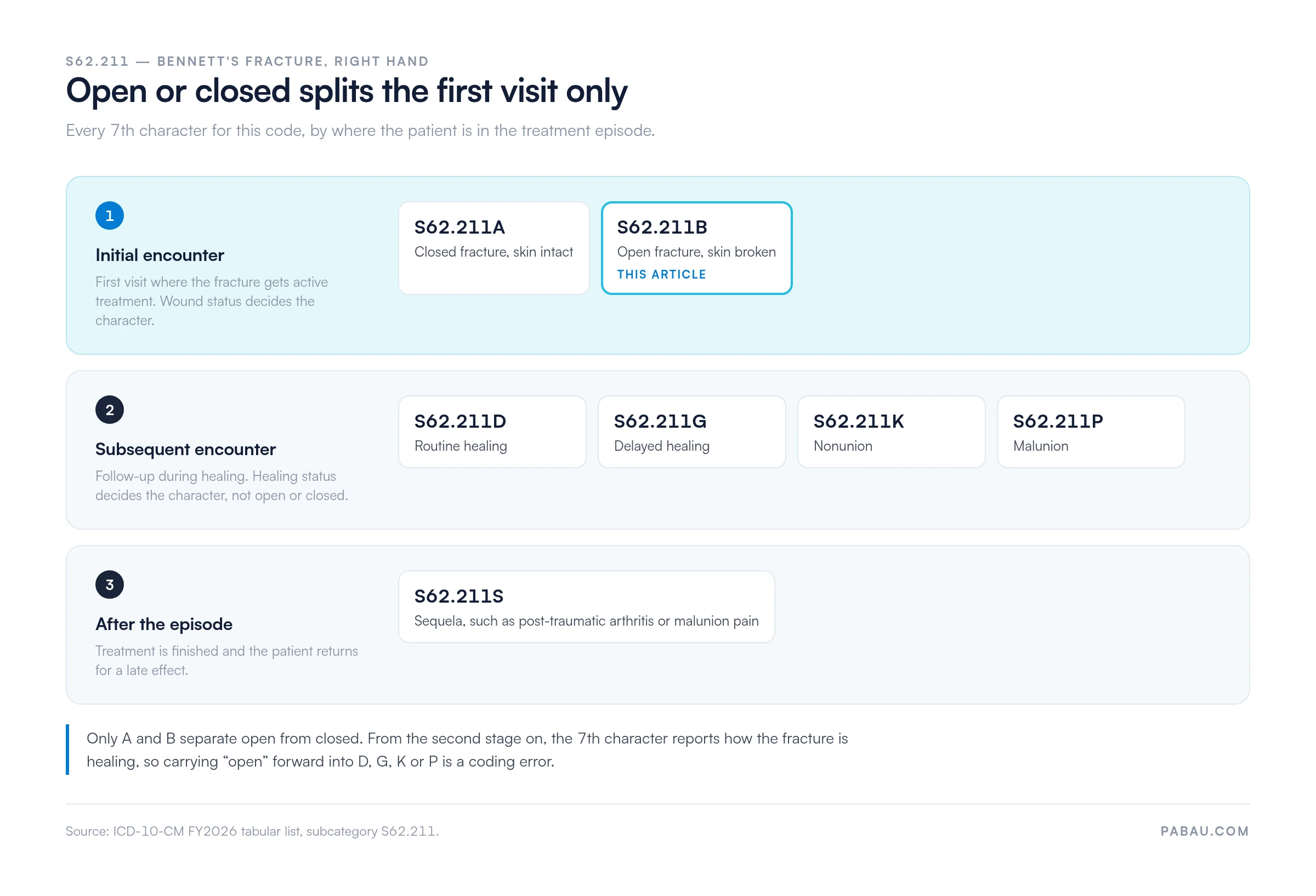
Misapplying the 7th character is one of the most common denial triggers on fracture claims. ICD-10-CM does not subdivide open fractures by Gustilo grade at this code level. A single B covers every open fracture grade at the initial encounter. The full set of options for S62.211 is below.
S62.211B sits at the most specific level of a five-tier ICD-10-CM hierarchy. Reading the parent codes is how a coder confirms that no more specific option exists for the encounter. For S62.211B, the parent-child chain runs as follows:
Coders working with Bennett’s fracture diagnoses meet the sibling and adjacent codes below regularly. Two errors account for most of the avoidable denials here. One is swapping left for right. The other is reporting an open fracture when the record only describes a closed one. Reading the note before the code is chosen settles both.
S62.211A is for a closed fracture with the skin intact, and S62.211B is for an open fracture with the skin broken. Both apply at the initial encounter for a Bennett’s fracture of the right hand. The record has to document wound status at the fracture site to support either one. Open fractures carry greater infection risk and usually require irrigation and debridement, so they can draw different CPT pairings.
Bennett’s fracture procedures vary by fracture stability and by whether surgical reduction is needed. The codes below are the ones most often reported alongside open Bennett’s fracture management. Payer coverage policies differ, so check each pairing against AMA CPT guidelines and the payer’s Local Coverage Determination first. A broader CPT code reference helps when the operative note describes something none of these four cover.
Practices running integrated claims management software can check eligibility against the specific diagnosis before the patient leaves. That beats finding the coverage problem when the remittance arrives three weeks later.
Before pairing any CPT code with S62.211B, confirm the payer’s Local Coverage Determination for metacarpal fracture procedures. Open fracture treatment codes often need extra documentation to pass medical necessity review. Wound classification, irrigation records and debridement notes are what reviewers look for. Run eligibility and benefit checks at the time of service.
Accurate documentation is what separates a clean claim from a denial on S62.211B. The ICD-10-CM Official Guidelines require the medical record to support every element the code encodes. None of the four pillars below can be inferred from context, so the record has to carry all four before the claim is released.
A provider query checklist for open fracture encounters catches missing wound documentation while the chart is still open. That is the cheapest point in the cycle to fix it. Doing it there keeps denial management down to the claims that genuinely warrant an appeal.
ICD-10 Code S62.211B carries no Excludes1 or Excludes2 note that blocks it from being reported with the other codes a fracture encounter usually needs. The tabular instructions that apply to the S62 block, and by inheritance to S62.211B, are listed below.
Capture the companion codes at the encounter rather than adding them retroactively. External cause, place of occurrence and activity codes are far harder to source once the patient has gone home.
Choosing the right ICD-10 code is one step. The claim still has to reach the payer clean, pass eligibility, and clear medical necessity edits before payment is issued.
Practice management software like Pabau connects to the Claim.MD clearinghouse, so the fracture encounter and the claim it produces sit in one system. The clinician documents laterality, encounter type and wound status in the clinical note. Pabau builds the superbill from the verified ICD-10 and CPT codes. The claim then goes out electronically through Claim.MD, which validates it against 4,000+ US payers before it reaches adjudication.

Pabau connects to the Claim.MD clearinghouse, giving your team real-time eligibility checks and clean claim submission on fracture and trauma diagnoses. See how it works for your practice.

ICD-10 Code S62.211B is a specific, billable diagnosis code for a Bennett’s fracture of the right hand at the initial encounter for an open fracture. It is valid for FY2026 and accepted in HIPAA-covered electronic transactions. Reporting it correctly comes down to documentation that captures laterality, wound status and encounter type before the claim leaves the practice.
Treat the 7th character as two separate decisions rather than one. Wound status settles the first visit, and healing status settles every visit after it. Coders who keep those two apart avoid the denial that sends a Bennett’s fracture claim back for correction. Book a demo to see how Pabau carries a verified code from the clinical note to a submitted claim.

Need a full guide to medical claims submission? Medical claims clearinghouse overview explains how clearinghouse validation works end-to-end for injury and trauma diagnoses.
Want to reduce open fracture claim denials? Denial management in healthcare covers the most common denial patterns and how to resolve them before they hit your AR aging.
Looking for the right billing software for orthopedic practices? Best medical billing software in the US compares platforms by claim submission workflow, clearinghouse integration, and ICD-10 code support.
ICD-10 Code S62.211B reports Bennett’s fracture of the right hand at the initial encounter for an open fracture. That is a fracture-dislocation at the base of the first metacarpal where the skin has been broken. Coders apply it on the first visit at which the open fracture receives active treatment. Emergency departments, urgent care centers and orthopedic practices all qualify.
Yes, S62.211B is a billable and specific ICD-10-CM diagnosis code valid for fiscal year 2026. That year runs from October 1, 2025 through September 30, 2026. It meets the specificity requirements for claim submission in HIPAA-covered electronic transactions. Claims submitted with the parent code S62.211, without the 7th character, are rejected.
S62.211A is for a closed fracture with the skin intact, and S62.211B is for an open fracture with the skin broken. Both sit at the initial encounter for Bennett’s fracture of the right hand. The distinction matters clinically, because open fractures carry infection risk, often require irrigation and debridement, and can trigger different CPT pairings. The medical record has to document wound status at the fracture site to support whichever code is used.
The 7th character B means “initial encounter for open fracture” in ICD-10-CM traumatic fracture codes. It signals that the visit is the first episode of active treatment and that the fracture site has broken the skin. In the S62.21 subcategory, B is one of seven 7th character options. Only A and B distinguish open from closed, and the rest report healing status at later visits.
Three CPT codes cover most Bennett’s fracture management. They are 26650 for percutaneous skeletal fixation, 26665 for open treatment with or without fixation, and 26645 for closed treatment requiring manipulation. Open fracture encounters may also carry wound debridement codes such as 97602. Verify specific pairings against AMA CPT guidelines and individual payer coverage policies, since LCD restrictions vary by payer and surgical approach.
Yes, S62.211B is valid for fiscal year 2026, covering October 1, 2025 through September 30, 2026. It is included in the ICD-10-CM 2026 code set maintained by CMS and NCHS. Confirm current validity each year with the CDC ICD-10-CM web tool or the CMS ICD-10 codes page before a new fiscal year begins.