Bear hug test: Procedure, interpretation and free template
The bear hug test is a quick shoulder special test that screens for subscapulari...

2
Last Updated: Oct 23, 2026
The VA knee rating chart is the set of rating tables in 38 CFR 4.71a that turns knee measurements into a disability percentage.
Limited flexion (DC 5260) rates from 0% to 30%, and limited extension (DC 5261) rates from 0% to 50%. Instability, ankylosis, meniscus damage and knee replacement each have their own code. Ankylosis tops out at 60%, and a new total knee replacement is rated 100% for a set period.
Normal knee motion runs from 0° (fully straight) to 140° of flexion, per 38 CFR 4.71 Plate II. VA examiners measure that range with a goniometer at the Compensation and Pension (C&P) exam and match each reading to the tables below. This guide gives the thresholds for every knee code, shows how a reading between two thresholds is rated, and explains the bilateral factor.
A one-page knee evaluation form with fields for the veteran’s details, years of active duty, service connection, symptoms and impact, and the referring physician. It also has rating boxes for 10%, 20% and 30%, plus a notes field for flexion, extension and any other tier.
Download template
The VA knee rating chart is the set of tables in 38 CFR 4.71a that converts goniometer readings and knee conditions into disability percentages.
Limited flexion (DC 5260) rates 0%, 10%, 20% or 30% at 60°, 45°, 30° and 15°, so 30% is the ceiling under that code.
Limited extension (DC 5261) rates 0% to 50% at 5°, 10°, 15°, 20°, 30° and 45°, including a 40% tier at 30°.
The VA can rate flexion and extension separately on the same knee, and painful motion can support at least a 10% rating.
A total knee replacement is rated 100% for 4 months after the 1-month convalescence rating, then never below 30%.
The knee tables sit in 38 CFR 4.71a, the musculoskeletal section of the VA Schedule for Rating Disabilities. The full schedule is Title 38, Part 4 of the Code of Federal Regulations.
At the C&P exam, the examiner measures flexion and extension with a goniometer. The readings go on the Knee and Lower Leg Conditions Disability Benefits Questionnaire (DBQ). A VA rater then matches each reading to the thresholds in the relevant diagnostic code.
The knee and leg codes in the chart are:
One knee can carry ratings under more than one code, as long as each rating covers a different symptom. The VA then merges them with the combined ratings table at 38 CFR 4.25.
Diagnostic Code 5260 rates how far the knee can bend. The examiner measures the furthest point of flexion, and the rating rises as that number falls.
The maximum schedular rating under DC 5260 is 30%. There is no 40% or 50% tier for limited flexion, however little the knee bends. A knee that bends to 40° is rated 10%, because it has reached the 45° threshold but not the 30° one.
Normal flexion is about 140°. A knee that stops at 60° has lost more than half its bend and still rates 0% under this code. Pain and the other knee codes often decide the outcome instead.
Diagnostic Code 5261 rates how close the knee comes to straight. Full extension is 0°, so the reading is the number of degrees the knee stays bent when the patient tries to straighten it.
The maximum under DC 5261 is 50%, and the 40% tier applies once extension is limited to 30°. A knee that stays bent at 20° is rated 30%, and so is one that stays bent at 25°. Where a reading sits close to the next tier, 38 CFR 4.7 lets the VA assign the higher rating. The disability must more nearly approximate those criteria.
When both motions are limited, the VA rates them separately. A VA General Counsel opinion (VAOPGCPREC 9-2004) allows separate ratings under DC 5260 and DC 5261 for the same knee. For example, flexion limited to 30° (20%) and extension limited to 10° (10%) combine to 28%, which rounds to 30%.
Set side by side, the two codes run in opposite directions. Flexion ratings climb as the bend shrinks, while extension ratings climb the longer the knee stays bent.
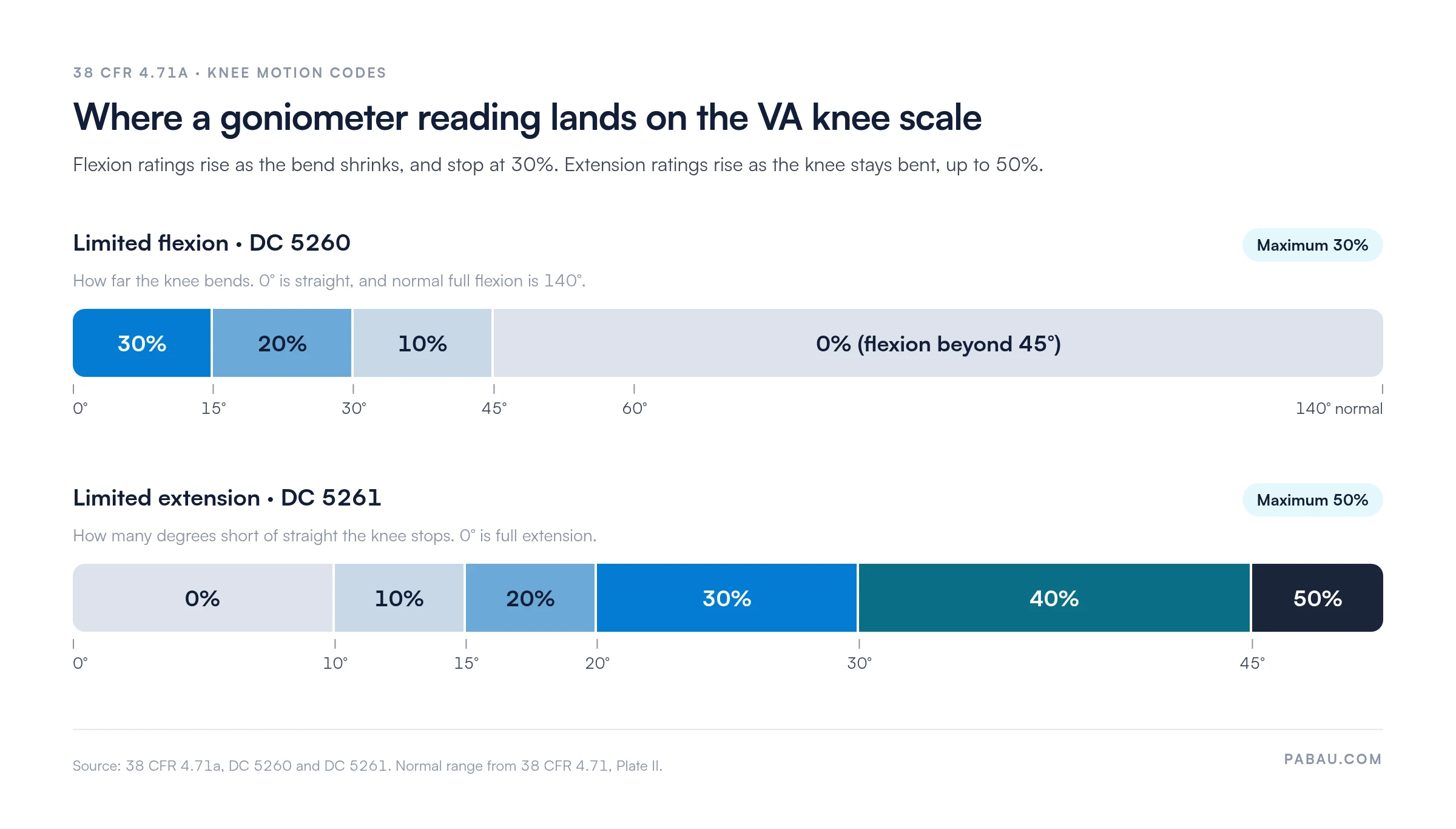
The goniometer reading is where the rating starts. Under 38 CFR 4.40 and 4.45, the VA must also weigh functional loss from pain, weakness and fatigue. A treating clinician can track that loss between exams with a knee outcome survey, which scores how symptoms limit daily activities.
Under 38 CFR 4.59, painful motion of a joint is entitled to at least the minimum compensable rating for that joint. For the knee, that minimum is 10%. The DBQ should therefore record:
A veteran whose knee flares when the weather turns can back that estimate with a daily weather pain log.
If the DBQ lacks these entries, the veteran can cite the omission when asking for a new exam or a review.
Knee conditions beyond limited motion have their own tables in 38 CFR 4.71a.
A knee can carry a motion rating and an instability rating at the same time, because they describe different problems (VAOPGCPREC 23-97). The VA cannot rate the same symptom twice under two codes, which 38 CFR 4.14 calls pyramiding.
A total knee replacement is rated under DC 5055. After surgery, the VA first assigns a 1-month total rating for convalescence under 38 CFR 4.30. DC 5055 then adds a 100% rating for 4 months following implantation, so the total rating runs for about 5 months.
That 4-month period comes from the musculoskeletal rating changes effective February 7, 2021. Older guidance that quotes a 12-month total rating predates that change.
When the 100% period ends, the VA schedules an exam and rates the residuals. Chronic residuals with severe painful motion or weakness rate 60%, and a total replacement never rates below 30%. Knee resurfacing has no minimum and is re-rated under DC 5256 to 5262.
Clinical records that log the surgery date, post-operative protocol and ROM progress give the rater the evidence for that re-rating.
A single knee reaches 30% when it meets one of these criteria under 38 CFR 4.71a:
Separate ratings can also reach 30%, such as 20% for flexion and 10% for extension on the same knee. A combined rating of 30% or more also qualifies the veteran for additional compensation for a spouse, children or dependent parents.
The evidence that supports a knee claim builds in this order:
When both knees are service-connected, 38 CFR 4.26 adds a bilateral factor. The VA combines the two knee ratings, then adds 10% of that combined value before combining the result with other ratings.
Example: If each knee is rated 20%, the combined value is 36%. The bilateral factor adds 3.6, for 39.6%. If the knees are the veteran’s only ratings, that rounds to 40%.
The VA applies the bilateral factor itself, so the veteran doesn’t need to request it. The decision letter should show that it was applied.
The chart is most useful after the exam, when you can check the rating against the recorded readings.
Clinicians treating veterans can follow a standard range of motion assessment at each visit, so readings from different dates compare cleanly with the C&P result.
Between those visits, a low-impact routine such as a four-week cycling plan keeps the knee moving through its regained flexion.
Physical therapy and orthopedic practices that treat veterans often record knee measurements on paper or in notes scattered across visits. Veterans then have to piece together their ROM history before a C&P exam or an appeal.
Practice management software like Pabau stores each goniometer reading, flare-up note and surgery date in the patient’s record, next to every appointment. Digital forms turn the knee rating chart form above into a pre-visit intake, and the patient’s answers flow straight into their file.

Pabau Scribe, our AI scribe, drafts the visit note from the conversation, so the symptoms a patient describes sit alongside the reading. Pabau supports physical therapy practices and sports medicine teams, so the dated ROM history is ready when a veteran asks for records.

Pabau stores goniometer readings, intake forms and clinical notes in one patient record. Veterans get a dated ROM history for their claim without anyone rebuilding it from paper.

Knee ratings turn on fixed thresholds, so the numbers on the DBQ carry most of the weight in a decision. Before the exam, veterans should know that flexion caps at 30% and that pain, repetition and flare-ups belong on the record.
After the decision, compare each reading with the tables and challenge any tier the numbers don’t support. Use a Supplemental Claim if you have new evidence, and a Higher-Level Review if the rater misread the evidence already on file.
For clinicians, the trade-off is a few extra minutes per visit to log readings in a consistent format. Those minutes give a veteran evidence that holds up at review. Book a demo to see how Pabau keeps ROM measurements and intake forms in one record for veterans’ claims.

Standardizing knee measurements? Range of motion assessment: a clinical guide for practitioners explains how to measure and record joint motion consistently.
Recording functional loss? Knee outcome survey (KOS-ADLS) template scores how knee symptoms limit daily activities.
Assessing knee swelling? Sweep test: how to perform, grade, and interpret knee effusion findings shows how to grade the effusion a meniscus claim describes.
Examining a painful knee? Knee examination: 4 stages and which tests to trust sets out the four exam stages and which tests hold up.
Rebuilding knee function? Return to running protocol in physical therapy sets out staged criteria for loading a knee after injury.
The VA knee rating chart is the set of diagnostic code tables in 38 CFR 4.71a that converts knee measurements and conditions into disability percentages. It covers limited flexion and extension, instability, ankylosis, meniscus damage and knee replacement, with ratings from 0% to 100%.
A knee can be rated from 0% to 100%, depending on the diagnostic code. Limited flexion tops out at 30%, limited extension at 50%, instability at 30% and ankylosis at 60%. A total knee replacement is rated 100% for 4 months after the convalescence month, then at least 30%.
The highest schedular rating for limited knee flexion is 30%, for flexion limited to 15° under DC 5260. Higher knee ratings come from other codes, such as limited extension (up to 50%) or ankylosis (up to 60%).
Yes. Each knee is rated on its own under the diagnostic codes, and the two ratings are combined with the table at 38 CFR 4.25. The bilateral factor under 38 CFR 4.26 then adds 10% of the combined value.
The VA measures knee flexion and extension with a goniometer. Normal knee motion runs from 0° of extension (fully straight) to 140° of flexion, per 38 CFR 4.71 Plate II. The examiner also records where pain begins, motion after repeated use and an estimate of flare-up loss.
Yes. Under the Appeals Modernization Act, you can choose a Supplemental Claim, a Higher-Level Review or a Board Appeal. A Higher-Level Review or Board Appeal must be filed within 1 year of the decision. New ROM measurements or clinical evidence belong in a Supplemental Claim, because a Higher-Level Review doesn’t accept new evidence.