

ICD-10 code S61.201A: Open wound of left index finger without nail damage
ICD-10 code S61.201A covers a left index finger wound of unstated type ICD-10 co...

Last Updated: Oct 16, 2026
Billable Code Specific Code
S62.612S is the billable ICD-10-CM code for displaced fracture of proximal phalanx of right middle finger, sequela.
The digit trips coders up more often than the seventh character does. S62.612S is the middle finger, not the little finger. Read the 2 as the fifth digit and you submit a code the chart does not support.
Let Pabau's smart automation suggest the right codes, reduce claim denials, and keep your practice compliant—effortlessly.
Automate repetitive tasks and focus on what matters most—your patients.
Reduce coding errors and ensure compliance with the latest regulations.
Clean claims, fewer denials, and faster reimbursements.
Powerful insights and reporting to help your practice thrive.
HIPAA compliant SOC 2 certified GDPR-compliant Trusted by 4,000+ clinics worldwide

S62.612S is the billable ICD-10-CM code for a displaced fracture of the proximal phalanx of the right middle finger, sequela
The code is valid for FY2026, effective October 1, 2025, and its parent code S62.612 cannot be billed on its own
The digit in S62.61- names the finger, so 612 is the right middle finger and S62.616S is the right little finger
The S seventh character means sequela, so the patient is being treated for a late effect of an earlier injury
S62.61- codes take seven seventh characters (A, B, D, G, K, P and S), so confirm the encounter type before you submit
Practice management software like Pabau links ICD-10 codes to claim creation, so sequela coding errors surface before submission
S62.612S is a billable, specific ICD-10-CM code, so it can carry a diagnosis for reimbursement on its own. It is valid for HIPAA-covered transactions in FY2026, effective October 1, 2025. The full official description is: Displaced fracture of proximal phalanx of right middle finger, sequela.
The CDC/NCHS ICD-10-CM web tool is the official U.S. source for verifying code validity, descriptions and annual updates. Confirm the code against the current fiscal year edition before submission.
The sixth character in S62.61- identifies the finger and the side. The sequence runs index, middle, ring, then little, and each pair takes the right side first. That is why the 2 in S62.612 points to the middle finger rather than the fifth digit.
Each of these needs a seventh character before it becomes billable. For a sequela of a displaced proximal phalanx fracture of the right little finger, use S62.616S. The left little finger is S62.617S. The thumb never appears in this subcategory, because thumb fractures are classified to S62.5-.
The seventh character in an ICD-10-CM fracture code reports the phase of care, and S is the phase after treatment finishes. Codes in the S62 category take seven of them, so A, D and S are only part of the set. The map below shows where each one belongs.
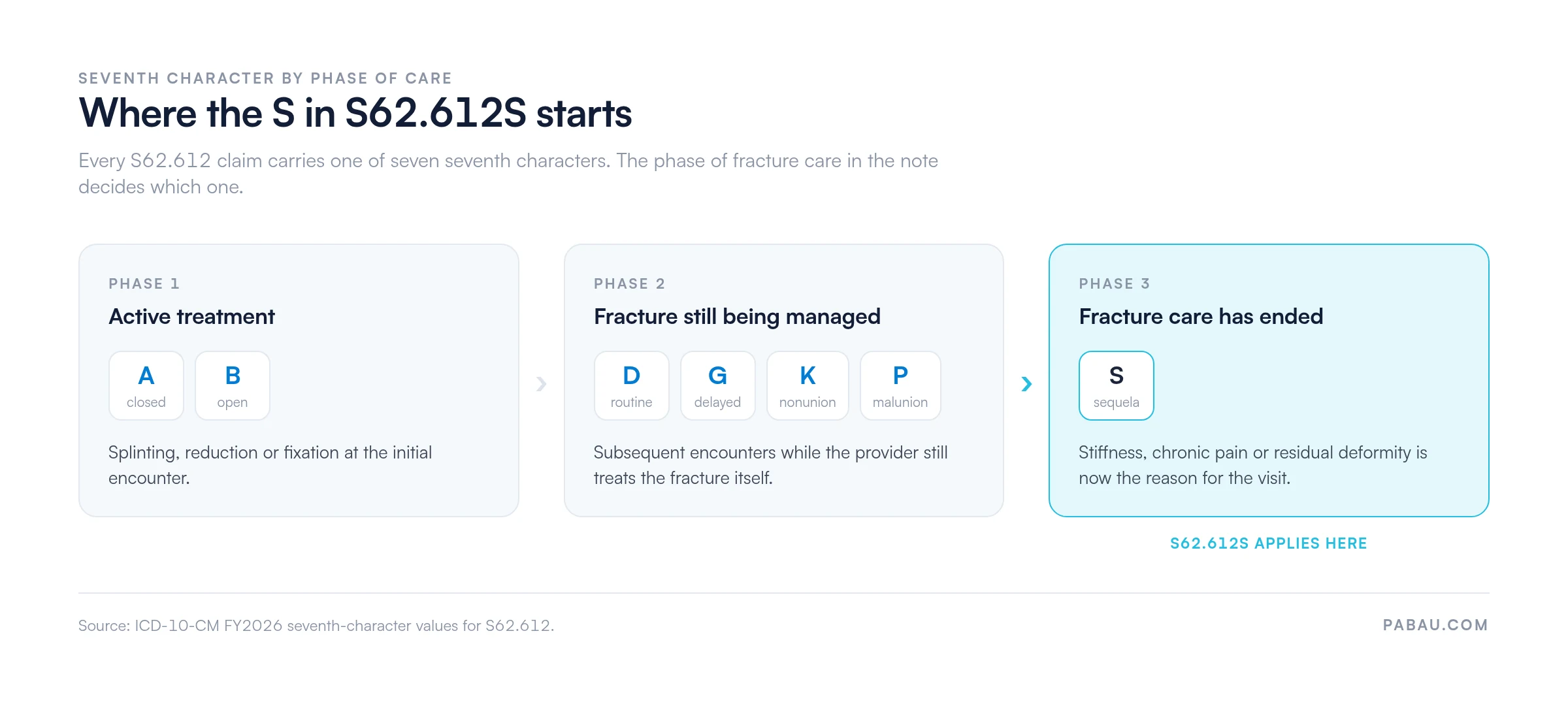
The CMS ICD-10-CM coding guidance sets the test. A sequela code applies when the provider treats a condition that follows directly from a prior injury. The fracture itself has reached its end state, and the late effect is now the reason for the visit.
While the provider still treats the malunion as fracture care, S62.612P is the closer fit. S62.612S covers what remains once fracture care has finished, such as a residual deformity or a stiff joint. A middle phalanx fracture that is still healing slowly takes a G character instead, as S62.628G does for a finger with undocumented laterality.
Sequela coding also pairs two codes. The sequela code identifies where the problem came from, and a second code names the condition being treated now. That pairing rule decides the order of the lines on the claim, which the billing section below covers in detail.
Check the documentation before you pick the seventh character. A note saying the fracture is healed, with the patient in for stiffness or pain from the old injury, points to S62.612S. Where the provider still manages the fracture itself, a D, G, K or P character fits better. The distinction lives in the note, not in the time elapsed since the injury.
S62.612S inherits its rules from the codes above it. Reading the family upward tells you which detail each character carries, and which default applies when the note stays vague.
Only codes carrying a seventh character are billable here. S62.612 may not be submitted for reimbursement on its own, and neither may S62.61 or S62.6. Always take the code to its most specific form, seventh character included.
Two defaults higher up the hierarchy do real work on vague notes. A fracture that is not documented as displaced or nondisplaced is coded to displaced. A fracture that is not documented as open or closed is coded to closed.
Two exclusion notes also sit above this code. S62 carries a Type 1 Excludes note for traumatic amputation of the wrist and hand (S68.-). S62.6 carries a Type 2 Excludes note for fracture of the thumb (S62.5-).
S62.612S has close neighbors in two directions. One set covers the same injury on a different digit, and the other covers a different injury on the same digit. Confirm the phalanx, the displacement status and the side before you settle. A nondisplaced proximal phalanx fracture of the right ring finger, open at the first visit, takes S62.644B. The AAPC Codify ICD-10-CM lookup navigates these sibling codes by keyword or range.
When the note does not name the digit, S62.619S is the fallback, and it costs you specificity. Query the provider instead. Third digit and middle finger both resolve to S62.612S, while fifth digit and little finger point to S62.616S. Pabau’s ICD-10-CM code library lists the wider S62.6 range if you need to compare descriptions side by side.
The proximal phalanx is the base bone of the finger. In the middle finger, the third digit, it connects the third metacarpal at the knuckle to the middle phalanx at the PIP joint. A displaced fracture means the fragments have shifted out of alignment, which separates S62.61- from the nondisplaced codes in S62.64-.
Rotational alignment carries more weight in the middle finger than the code alone suggests. A proximal phalanx that heals with a rotational deformity can make the digit cross over its neighbor in flexion. Notes about scissoring, overlap or grip loss belong in the record, because those findings are the sequela the visit treats.
S62.612S applies only in that final phase. When the patient presents for stiffness or pain following the healed fracture, this code captures where the problem started. The provider’s note has to link the current complaint to the earlier fracture.
Four elements have to be visible in the record before S62.612S holds up under review. Miss one and the claim is auditable.
Chapter 19 of the ICD-10-CM Official Guidelines for Coding and Reporting sets the sequence. Code the sequela condition first, then the injury code carrying the S seventh character. The S belongs on the injury code, never on the code for the late effect itself.
Most denials on this code trace back to five patterns, and four of them are visible before the claim goes out.
Pull your last 90 days of sequela claims and work out the denial rate for S-character codes on their own. Compare that number with your initial and subsequent encounter codes. If the sequela rate runs noticeably higher, look at the note template rather than the coder. One template fix carries through to every claim that follows it.
An S62.612S claim travels like any other diagnosis claim, with one extra rule. The sequela code never sits on the first line by itself. Code the current condition first, then point the service lines at both diagnoses. Which procedure codes ride alongside depends on why the patient came in.
Take a patient six months out from a right middle finger fracture, now in for PIP stiffness. The stiffness diagnosis leads, S62.612S follows it, and the office visit line points at both. Where hand therapy runs the same day, 97110 sits on its own line with the same diagnosis pointers.
Two patterns stall these claims. One is a note that never links the current complaint to the old fracture. That leaves the payer no reason to accept a sequela code. The other is a claim carrying S62.612S alone, with no code for the condition being treated. When either comes back, the electronic remittance advice names the reason.
Five quick reads catch almost every avoidable denial on this code. Work down the list with the note open beside the claim.
Each of those is on screen before you hit submit, which makes the review cheaper than an appeal. Practices that run it as a standing step see fewer sequela claims come back at all.
S62.612S is exempt from present on admission (POA) reporting. A sequela code describes a condition that began with an earlier injury, so a POA indicator would add nothing to an inpatient claim. Inpatient facilities still report the POA field for other diagnoses on the same claim, because the exemption runs code by code.
Practices managing legacy records or answering payer crosswalk queries may need to map S62.612S back to ICD-9-CM. The General Equivalence Mappings published by CMS provide the official crosswalk, and they land on a single broad code.
ICD-9-CM lacked the anatomical granularity of ICD-10-CM. The middle-finger, proximal-phalanx and displacement distinctions inside S62.612S had no separate ICD-9 codes. When mapping historical records, use 905.2 as an approximate equivalent and note that the crosswalk is non-specific.
Sequela coding errors rarely come from not knowing the rule. They come from a note that does not say enough for the coder to confirm the digit or the phase. The coder then either queries the provider or picks the safer unspecified code, and both cost the practice money.
Practice management software like Pabau keeps the clinical note and the claim in one system. Its claims management software puts ICD-10 search inside claim creation. A coder can check S62.612S against the provider’s own wording without switching screens.
Templates carry the rest of the work. Capture the digit, the displacement status and the fracture phase at every visit, and query volume drops at the coding stage. The claim then goes out with the detail a sequela code depends on, first time.

Pabau connects ICD-10 diagnosis codes to billing workflows. Sequela coding mistakes surface before a claim is submitted, not weeks later in a denial report.

Two decisions carry this code. The digit says which finger, and the seventh character says which phase of care. Miss the digit and the claim describes a different finger. A wrong seventh character describes a different phase of the same injury.
The documentation side is steadier work. Capture displacement, digit and side, fracture phase and the current condition at every relevant visit, and the coding follows. Pabau keeps ICD-10 selection and claim submission in one system, which removes the manual transfer step behind many sequela denials. To see how that works for orthopedic and rehabilitation encounters, book a demo.

Want a claim that passes payer edits first time? What a clean claim is explains which checks a payer runs before it pays.
Need to read the reason code on a denied sequela claim? Denial codes in medical billing covers the CARC codes fracture claims come back with.
Capturing the digit and the phase at the visit itself? What a superbill is shows which fields carry the diagnosis and procedure detail.
Tracking what the payer sends back after submission? Electronic remittance advice explains how a payer response reaches your billing queue.
M79.644, pain in right finger(s), when pain is the late effect being treated. Sequence the pain code first and S62.612S second. The sequela code explains where the pain came from, so it never stands alone on the claim.
No. ICD-10-CM guidelines direct you away from aftercare Z codes for injuries, because the seventh character already reports the phase. Use S62.612S for a late effect, or S62.612D for routine healing. An aftercare Z code alongside either one invites a denial.
No. The diagnosis supports medical necessity, but medical decision making or total time sets the level. Two visits for the same sequela can land on different levels, depending on the work documented. Record the history, the findings and the plan, then let the level follow.
Yes. Each digit takes its own code, so a right middle and right ring finger injury needs S62.612S and S62.614S. Report the current condition for each digit as well, and keep the laterality consistent across every line.



