HIPAA compliant texting: What you can send patients & how to communicate securely
HIPAA compliant texting is possible when a text holds no protected health inform...

Last Updated: Oct 16, 2026
An authorized representative form medical practices keep on file names the person a patient trusts to handle their records, insurance inquiries and appeals.
It records who that person is, exactly what they’re allowed to do, and how the patient can take that authority back.
Your practice form covers records and inquiries with your practice. Medicare uses its own document, CMS Form 1696, and each state Medicaid program publishes its own form. The free template below covers the practice side, and this guide shows when you need the others.
A one-page PDF with fields for patient details, the representative’s details and relationship, a scope-of-authority checklist, signature and date blocks, and a revocation clause.
Download template
An authorized representative form names the person a patient trusts to handle their records, insurance inquiries and appeals.
A complete form covers patient identification, representative details, scope of authority, signatures and a revocation clause.
Payers set their own rules, so Medicare uses CMS Form 1696 and each state Medicaid program publishes its own form.
The patient can revoke the designation at any time with written notice to the practice or payer.
Practice management software like Pabau sends the form digitally, captures the e-signature and stores it in the patient record.
A medical authorized representative form is a signed document that lets a patient appoint someone to act for them on healthcare matters. That person might be a family member, a caregiver, an attorney or a legal guardian. The form sets out their authority to handle medical records, insurance claims, benefits inquiries and appeals, and cites HIPAA’s personal representative rule (45 CFR 164.502(g)).
Practices use the form to confirm consent before sharing protected health information, known as PHI, with the representative. It’s narrower than a power of attorney and usually applies only to healthcare and insurance matters with one practice or payer. If the patient only wants records sent to someone, without granting any authority, a HIPAA medical release form is the simpler document.
A patient can name almost any trusted adult. Some practices and payers require the representative to be over 18 and free of conflicts of interest. Common choices include:
A minor cannot name a representative, so a parent delegates that authority instead. A consent form for grandparents sets out what that caregiver may approve. A spouse has no automatic right to the patient’s records, so a spousal consent form states what they may see and when access ends.
The patient keeps the right to revoke the representative’s authority at any time through written notice to the practice or payer.
An authorized representative handles records and insurance matters with one practice or payer. A medical power of attorney reaches further, into treatment and end-of-life decisions, and state law governs it. The table below sets the two side by side.
The form breaks into three parts. Each one answers a question a payer or auditor will ask about the designation.
This section confirms who the patient is and that they’re the one granting authority. Include their full legal name, date of birth, patient ID number (if applicable), current address, phone number and email. Some forms also ask for a government-issued ID number, such as a Social Security or driver’s license number, for verification.
Record the representative’s full legal name, relationship to the patient, contact details and any professional credentials. Then add checkboxes for the authority the patient grants: access to medical records, insurance inquiries, referral requests, appeals, or all four.
Payer forms often split authority into two levels. One lets the representative act for the patient, and the other gives access to information only. Mirror that split on your form, so staff know whether a caller can make requests or only receive updates. Patients can also limit authority to specific conditions, time periods or treatment types.
The signature block needs space for the patient’s signature and date, and the representative’s signature acknowledging the role. Add witness lines if your state law requires them. Some jurisdictions require notarization, while others accept wet or electronic signatures.
E-signatures collected through digital intake forms are generally valid under the federal ESIGN Act. Payers can still set their own signature rules, so check before you submit.

Medicare and Medicaid each publish their own document for representatives, and filing the one the agency expects avoids delays. The guide below matches each task to the document that covers it.
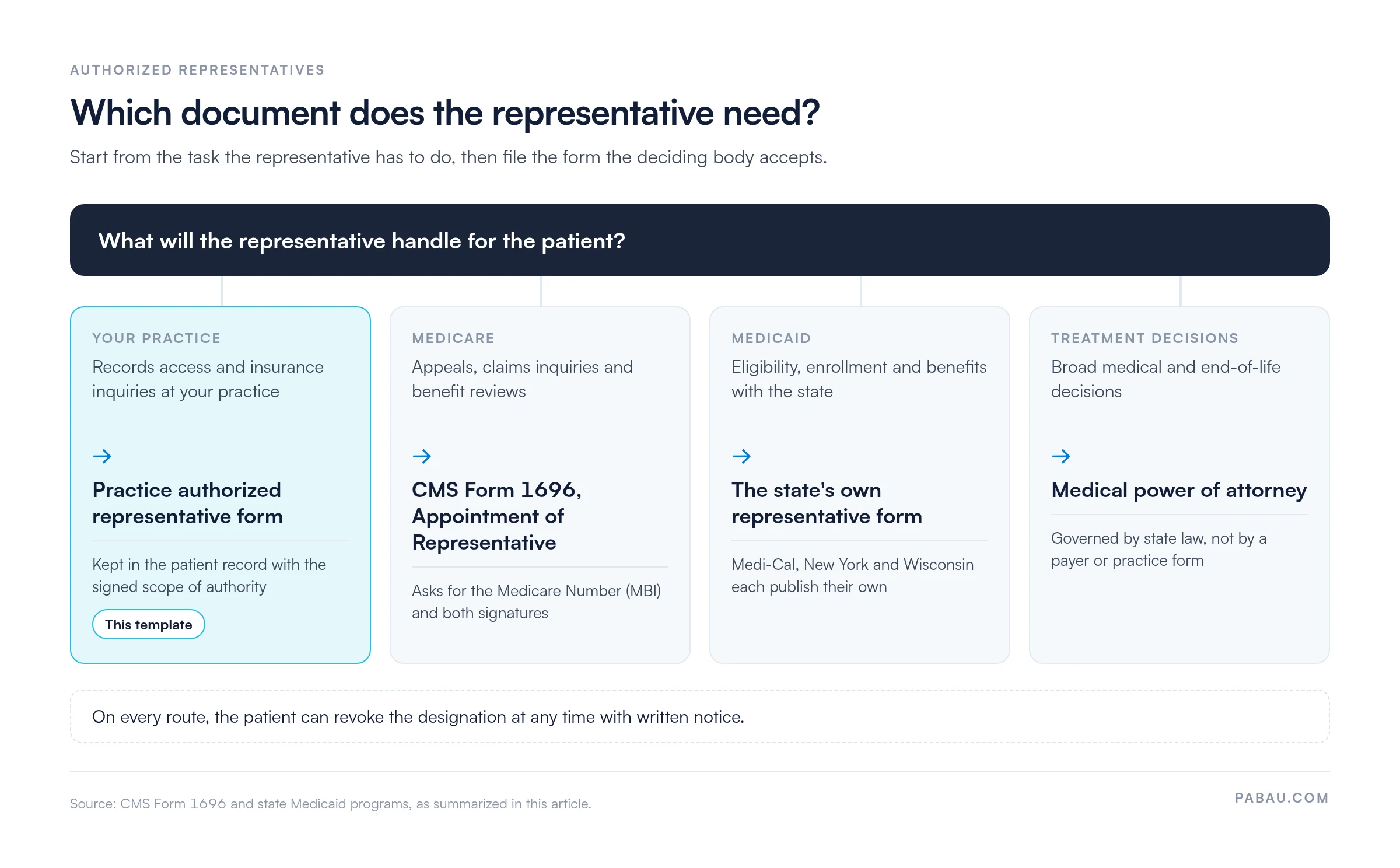
The CMS Form 1696 (Appointment of Representative) is the official Medicare form. Beneficiaries and providers use it to designate representatives for appeals, claims inquiries and benefit reviews. The form asks for the beneficiary’s name and Medicare Number (MBI), the representative’s name and relationship, and both parties’ signatures. Submit it to the Medicare Administrative Contractor (MAC) serving your state, or to CMS directly by mail or secure portal.
Medicaid programs vary by state. California (Medi-Cal) uses a state-specific form, and New York and Wisconsin have their own templates. Each state’s health or social services agency maintains its form and the rules for submitting it.
Compliance management software helps you track which form version each state accepts and when renewals fall due. That cuts errors for practices with patients in more than one state.
HIPAA’s personal representative rule (45 CFR 164.502(g)) treats the representative as a “personal representative” with the same privacy rights as the patient. Your form must clearly document consent under this rule. Keep it in the patient’s medical record for six years, or longer if state law requires it.

A patient may revoke an authorized representative designation at any time, usually by written notice. For Medicaid or Medicare, they send a signed letter to the state agency or Medicare contractor. It should state the patient’s name, ID number and a clear revocation statement.
Update your records as soon as the notice arrives and confirm the revocation with the payer in writing. Note the revocation date in the patient’s file and tell the former representative in writing. If the patient is incapacitated and can’t revoke, a legal guardian may file the revocation for them.
On paper, this form gets printed, signed at the front desk, scanned and filed by hand. Each step risks a missing signature, or a copy nobody can find when the representative calls about a claim.
Practice management software like Pabau turns the template into a digital form. Patients complete and sign it through the patient portal before their visit. The signed copy then lands in their patient record automatically.
When a representative phones, your team opens the record and checks the scope of authority in seconds. If the patient revokes it, the revocation date sits in the same file. That stops staff sharing PHI with someone who has lost the right to it.

Pabau sends the form digitally, captures the e-signature and stores it in the patient record. Your team can confirm a representative’s authority in seconds.

Use the practice form for records and insurance inquiries, and treat Medicare and Medicaid as separate filings with their own paperwork. Getting that split right at intake saves the follow-up call when a payer rejects the wrong document.
The trade-off is upkeep. State forms change, and every revocation has to reach both your file and the payer, so give one person ownership of the process.
Book a demo to see how Pabau collects representative forms digitally and keeps each signed copy in the patient record.

Only need records sent to a third party? Authorization for release of protected health information covers one-off disclosures without granting ongoing authority.
Unsure how long to keep signed forms? How long to keep medical records breaks retention rules down by state.
Checking your wider privacy setup? HIPAA compliance for medical offices walks through the rules, penalties and the steps to comply.
Collecting treatment consent at the same visit? Consent for medical treatment and patient rights gives you a ready-made form to pair with this one.
A Medicare authorized representative is a person the beneficiary designates on CMS Form 1696 to manage their Medicare appeals, claims inquiries, and benefit reviews. The representative has the same access to beneficiary information as the beneficiary themselves.
The form designates a trusted person to access the patient’s medical records, manage insurance claims, request referrals and file appeals. The representative acts only within the scope of authority the patient specifies.
An authorized representative designation covers healthcare records and insurance matters with one practice or payer. A medical power of attorney grants broad authority over medical decisions and end-of-life care under state law.
Notarization requirements vary by state and payer. Most Medicare and Medicaid forms do not require notarization, but some state Medicaid programs or private payers may request it. Check your jurisdiction’s requirements before submitting.
Only if the patient grants full access on the form. Many patients limit representative authority to specific records, conditions, or time periods. The scope of authority must be clearly documented in writing.