Inpatient billing cheat sheet
An inpatient billing cheat sheet is a quick reference for the codes and claim ru...

1
Last Updated: Oct 19, 2026
V5130 is the HCPCS Level II code for a binaural, in-the-ear hearing aid, meaning two ITE devices dispensed together for both ears. It covers the devices only, so the binaural dispensing fee is billed separately with V5160.
A one-ear ITE fitting takes the monaural code V5050 instead, and a binaural behind-the-ear pair takes V5140. Traditional Medicare Part B excludes hearing aids by statute, so V5130 claims go to Medicaid, Medicare Advantage, commercial plans, or the VA.
Let Pabau's smart automation suggest the right codes, reduce claim denials, and keep your practice compliant—effortlessly.
Automate repetitive tasks and focus on what matters most—your patients.
Reduce coding errors and ensure compliance with the latest regulations.
Clean claims, fewer denials, and faster reimbursements.
Powerful insights and reporting to help your practice thrive.
HIPAA compliant SOC 2 certified GDPR-compliant Trusted by 4,000+ clinics worldwide

V5130 covers a binaural ITE fitting, meaning two in-the-ear devices billed as one unit.
A single ITE aid for one ear takes the monaural code V5050, not V5130 or V5120.
Traditional Medicare Part B excludes hearing aids by statute, and Medicaid coverage and rates vary by state.
Pair V5130 with V5160, the binaural dispensing fee, unless the payer bundles it.
Claims management software like Pabau checks each claim for missing details, such as authorization codes, before it goes out.
HCPCS Code V5130 covers a binaural in-the-ear hearing aid, meaning two ITE devices dispensed and billed together in one transaction. The official CMS descriptor is “Binaural, in the ear.”
The code sits in the hearing services range (V5000-V5999) of HCPCS Level II, under the vision, hearing and speech-language pathology services category. CMS maintains Level II for products, supplies, and services that CPT doesn’t cover. Audiologists, hearing aid dispensers, and their billing teams use V5130 when a patient receives two custom or semi-custom ITE shells in one fitting.
The code does not distinguish between technology tiers. A basic analog ITE pair and a premium digital ITE pair both fall under V5130. Payer reimbursement schedules, not the code itself, reflect device-tier differences.
V5130 covers the complete binaural ITE hearing aid supply, meaning both devices and the dispensed unit as a whole. It also covers standard earmold coupling when that is integral to the shell design. It does not cover the professional services surrounding dispensing. Those are captured separately through CPT audiology evaluation codes.
Billing V5130 for any of the following is a coding error:
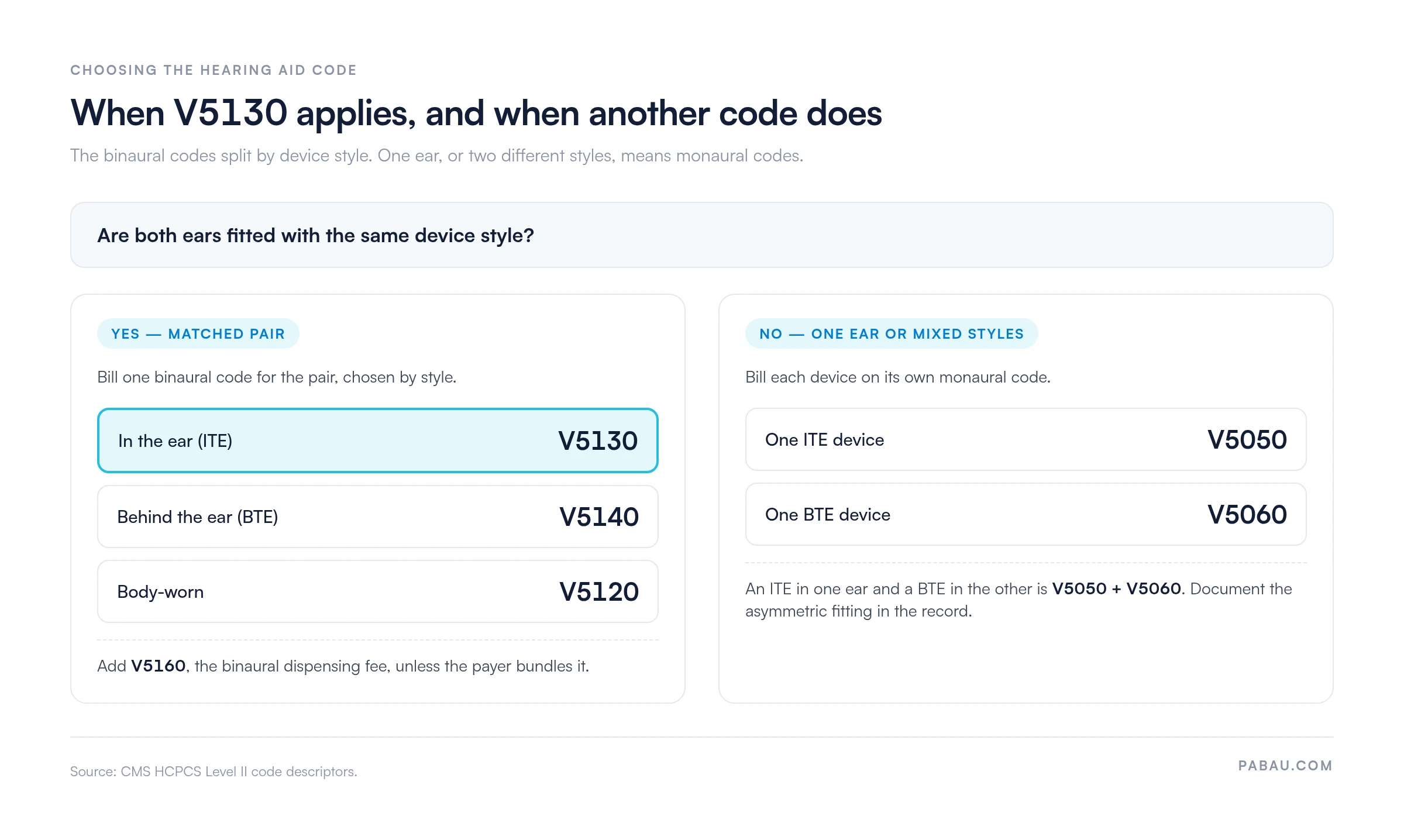
V5130 belongs to a family of binaural codes that split by device style. V5120 covers binaural body-worn aids, V5130 covers binaural in-the-ear aids, and V5140 covers binaural behind-the-ear aids. A single ITE aid for one ear takes the monaural code V5050 instead.
When a patient receives one ITE and one BTE device, neither V5130 nor V5140 applies cleanly. Bill each device on its monaural code (V5050 and V5060 respectively) and document the asymmetric fitting in the record. The decision below maps each fitting to its code.
Incomplete documentation is a leading cause of V5130 denials across commercial and Medicaid payers. Assemble the full file before the date of service, because rebuilding it after a denial takes far longer.
The standard documentation set for V5130 includes:
Medicare Advantage and Medicaid plans often require an additional benefit eligibility check before the fitting date. Running that check before dispensing prevents the most avoidable denial, which is fitting a patient whose benefit was already used this plan year.
Build a V5130 documentation checklist into your intake workflow. Verify the audiogram date, confirm the payer’s lookback window, and collect device serial numbers before the fitting encounter closes. Retroactive documentation requests after a denial can add weeks to the payment cycle.
Traditional Medicare Part B does not cover hearing aids. The exclusion is written into statute. Prior authorization, medical necessity documentation, and appeals can’t produce a Part B payment for V5130. Screening Medicare patients at intake keeps V5130 claims away from traditional Part B, which saves a wasted submission and a confusing statement for the patient.
Coverage by payer type breaks down as follows:
The CMS Physician Fee Schedule lookup tool returns no national Part B allowed amount for V5130, because the code is excluded. Rates that appear in commercial tools for V5130 reflect Medicare Advantage or Medicaid benchmarks, not Part B payment data.
There is no universal CMS fee schedule for V5130 under traditional Medicare, because Part B excludes hearing aids entirely. Reimbursement rates are payer-specific and change annually. The PGM Billing HCPCS lookup tool provides current code descriptions and can surface Medicaid fee data by state where available. Always confirm rates directly with the payer before the plan year begins.
Key variables that affect V5130 reimbursement include:
Electronic remittance advice (ERA) from each payer shows the allowed amount for every V5130 line. Compare it with your billed charges to spot plans that consistently pay less than expected.
Prior authorization requirements for V5130 depend entirely on the payer and the specific plan. No universal rule applies across Medicare Advantage, Medicaid, or commercial carriers. A missing prior authorization is one of the most common V5130 denial reasons, alongside a code that doesn’t match the fitting.
A typical prior authorization request for V5130 includes:
When a prior authorization is denied, most payers allow one level of appeal before requiring a peer-to-peer review. Document the clinical rationale for binaural fitting thoroughly in the original record. Payer reviewers treat documentation added after a denial with suspicion. Checking eligibility at intake confirms PA requirements before the fitting encounter, not after.
V5130 denials cluster around a predictable set of causes, and each one has a check that stops it before the claim leaves the practice.
Checking denial code meanings against each rejected V5130 claim shows where the process breaks down. Repeated CO-4 denials (a modifier missing or inconsistent with the code) point to a modifier workflow problem. Repeated CO-197 denials (missing prior authorization) mean eligibility checks are running too late.
Modifiers tell payers important contextual details about how V5130 was dispensed. Using the wrong modifier, or omitting one that a payer requires, generates a denial even when the device code and documentation are correct. Before submission, check that the 837 electronic claim file carries every modifier the payer expects.
V5130 covers the device cost. V5160 covers the professional dispensing fee for a binaural fitting. Most payers that reimburse hearing aids expect both codes on the same claim. Omitting V5160 leaves professional fees unclaimed, and some payers won’t add it after the claim closes.
V5110 is the dispensing fee for a bilateral body-worn aid, so a binaural ITE fitting takes V5160 instead. Read the device code first and let it select the fee.
On the claim, V5130 and V5160 work together like this:
A minority of payers bundle the dispensing fee into the device code allowance and will not reimburse V5160 separately. Confirm bundling policy annually with each payer before the plan year begins. A payer grid that records which plans pay V5160 separately, and which bundle it, makes that annual check quick.
Run a quarterly audit on V5130 claims: flag any claim submitted without V5160 and cross-check against payer bundling policies. For payers that separately reimburse V5160, each unfiled dispensing fee is direct revenue left on the table. Use your practice management system to set a claim-level alert when V5130 appears without V5160.
Audiology practices billing V5130 juggle several payers, each with its own authorization rules, bundling policy, and modifier demands. Tracked on spreadsheets, a missing detail often surfaces only when the denial arrives.
Pabau’s streamlined claims management runs validation checks every time you send a claim. If a detail like an authorization code or membership number is missing, the claim can’t be sent until it’s fixed. In the US, Pabau connects to Claim.MD for real-time eligibility checks, claim status tracking, and ERA posting.

The result is fewer V5130 rejections and resubmissions, and fewer V5160 fees left unclaimed. Your team spends less time chasing payers and more time fitting patients.

Pabau checks every claim for missing details such as authorization codes before it’s sent, then tracks it through to payment. See how it works for your audiology practice.

Most V5130 denials trace back to checks made too late. Confirm that both ears get matched ITE devices, confirm the payer covers hearing aids, and add V5160 before the claim goes out.
Those checks take minutes at intake. Skipping them costs weeks of resubmissions, and some payers never reopen a closed claim to add a missed dispensing fee.
Book a demo to see how Pabau catches missing authorization codes before your hearing aid claims reach the payer.

Want to understand the broader claim submission process? Medical claims clearinghouse guide explains how claims move from practice to payer and where they fail.
Seeing repeated denials across your HCPCS billing? Revenue cycle management fundamentals covers the end-to-end billing workflow audiologists need to optimize.
Need to verify your billing meets compliance standards? Medical billing compliance checklist walks through documentation and coding requirements that protect your practice.
Fitting behind-the-ear devices instead? HCPCS code V5140 covers billing for a binaural BTE pair.
Only one ear being fitted? HCPCS code V5060 explains the monaural behind-the-ear code.
HCPCS Code V5130 covers a complete binaural, in-the-ear hearing aid fitting: both ITE devices dispensed together in a single transaction. It does not cover monaural fittings, behind-the-ear styles, hearing aid accessories, repairs, or audiological evaluation services.
V5120 is the binaural body-worn code, used when both ears are fitted with body-worn hearing aids. V5130 is the binaural in-the-ear code, used when two ITE hearing aids are dispensed for both ears. Both codes are binaural, so the difference is device style. A single ITE aid for one ear takes the monaural code V5050 instead.
No. Traditional Medicare Part B does not cover hearing aids, a statutory exclusion under Section 1862(a)(7) of the Social Security Act. Medicare Advantage plans may cover binaural ITE hearing aids as a supplemental benefit, but coverage amount and frequency limits vary by plan. Always verify the specific Medicare Advantage plan benefit before dispensing.
Prior authorization requirements for V5130 vary by payer. Many Medicaid programs and Medicare Advantage plans require prior authorization before a binaural ITE fitting is dispensed. Traditional Medicare Part B does not use prior authorization because the code is not covered at all. Check the specific plan’s requirements at eligibility verification before scheduling the fitting.
V5130 covers binaural in-the-ear (ITE) hearing aids, while V5140 covers binaural behind-the-ear (BTE) hearing aids. Both are binaural codes, but they differ by device style. Use V5130 for custom or semi-custom ITE shells worn in the ear canal. Use V5140 for BTE devices that sit behind the ear and couple to the canal via tubing or a dome.
Replacement frequency limits for V5130 are payer-specific. Medicaid programs commonly impose a 3-to-5-year replacement cycle per beneficiary. Medicare Advantage plans set their own frequency limits, often 2 to 4 years. Commercial plans vary by employer benefit design. Verify the plan’s frequency limitation at eligibility verification to avoid a frequency-limitation denial.