ICD-10 code S61.201A: Open wound of left index finger without nail damage
ICD-10 code S61.201A covers a left index finger wound of unstated type ICD-10 co...

Last Updated: Oct 16, 2026
Billable Code Specific Code
S62.396B is the billable ICD-10-CM code for other fracture of fifth metacarpal bone, right hand, initial encounter for open fracture.
In ICD-10-CM, "other" is a residual category. It applies only when the record does not place the break at the base, shaft, or neck. Get that judgment wrong and the claim either denies or pays on a code the chart does not support. Auditors look for exactly that.
Let Pabau's smart automation suggest the right codes, reduce claim denials, and keep your practice compliant—effortlessly.
Automate repetitive tasks and focus on what matters most—your patients.
Reduce coding errors and ensure compliance with the latest regulations.
Clean claims, fewer denials, and faster reimbursements.
Powerful insights and reporting to help your practice thrive.
HIPAA compliant SOC 2 certified GDPR-compliant Trusted by 4,000+ clinics worldwide

S62.396B is the billable ICD-10 code for other fracture of the fifth metacarpal bone, right hand, initial encounter for open fracture.
The 7th character ‘B’ carries both the open wound and the initial encounter, so the parent code S62.396 rejects on its own.
‘Other’ is a residual category, so a note that names the base, shaft, or neck belongs in a different S62.3 series.
The code has been in effect since October 1, 2015, and the left-hand equivalent is S62.397B.
Practice management software like Pabau keeps the note, the invoice, and the claim status in one patient record.
S62.396B is a billable ICD-10-CM diagnosis code. Its full descriptor is other fracture of fifth metacarpal bone, right hand, initial encounter for open fracture. It has been in effect since October 1, 2015, when ICD-10-CM replaced ICD-9-CM in the US. This is not a new or recently added code.
The parent code S62.396 is not billable, and a claim carrying it alone will reject. Payers need the 7th character to know which encounter they are paying for. With that character in place, the code is valid on both the CMS-1500 and the UB-04.
‘B’ means initial encounter for open fracture. The character does two jobs at once. It places the visit at the start of active treatment, and it records that the skin was broken. Fracture codes in the S62 category are invalid without it.
The open and closed distinction only exists on the initial encounter. Once the patient returns, the character describes healing instead, which is why D, G, K and P describe healing rather than the wound.
The CMS ICD-10-CM coding guidelines set out the full character set for each fracture category.
The fifth metacarpal connects the little finger to the wrist, and it breaks more often than any other bone in the hand. A closed-fist impact drives most of those injuries.
ICD-10-CM splits the S62.3 category by site first, then by displacement. Base, shaft and neck each get their own pair of series. S62.39- picks up what is left over, which is a documented fifth metacarpal fracture the record does not place at any of those three sites.
The grid below shows the whole category on one screen.
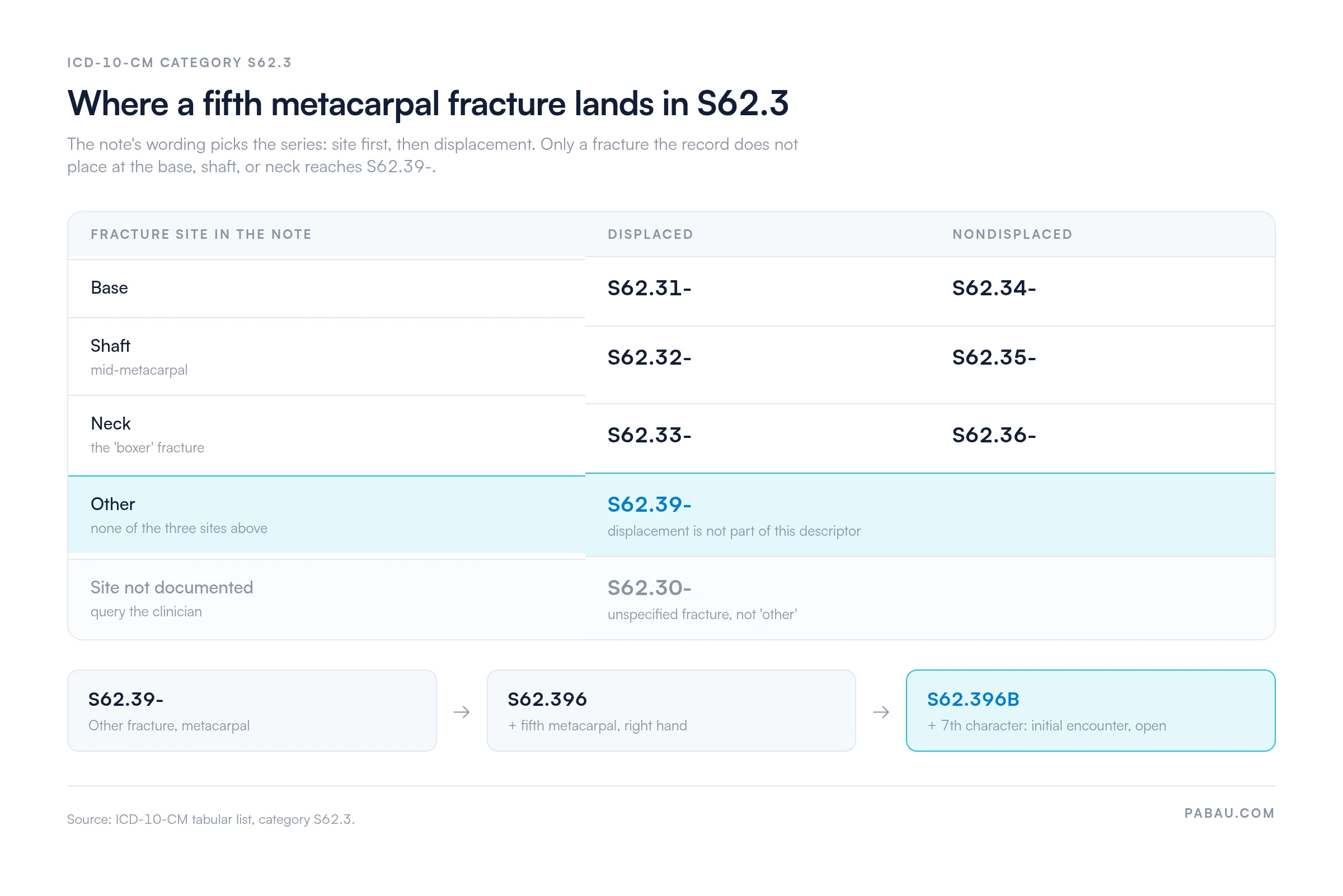
A “boxer fracture” is a neck fracture in clinical shorthand, so it belongs in S62.33- or S62.36-. Read the operative note or the radiology report for the site before you pick a series. That one habit prevents the most expensive error on this family of codes.
An open fracture means a wound communicates with the fracture site, or the bone has broken through the skin. A closed fracture leaves the skin intact. For S62.396B, the record has to describe that wound at the initial encounter, in the clinician’s own words.
If the note documents a closed fracture, the code is S62.396A. Swapping one for the other misstates the injury, and it undercuts the medical necessity of irrigation, debridement or open reduction. Laterality works the same way, with S62.397A and S62.397B covering the left hand.
Each level of the hierarchy adds one piece of detail. Reading it downward is the fastest way to confirm you are in the right part of the tabular list.
The CDC/NCHS ICD-10-CM web tool confirms placement against the official tabular list. Our ICD-10-CM codes hub covers the same 7th character logic across other injury categories.
One parent, seven children, and only one of them fits any given visit. Check this list before a follow-up claim goes out, because most repeat encounters need a character the first claim never used.
The code is only one step in a short chain, and the steps around it are where claims usually stall. Here is the path a single open fifth metacarpal fracture takes.
Two steps break far more often than the rest. Step one produces “metacarpal fracture” with no side and no site, which forces a query. Step three inherits the character from the last visit, which turns a follow-up into a second initial encounter and draws a duplicate denial.
Five details have to appear in the treating clinician’s own documentation, and a coder cannot infer any of them from the procedure billed.
A clean claim on this code depends on all five being present before submission.
Run a five-field check before the claim goes out: side, bone, fracture site, wound status, and encounter type. If one field is missing from the note, query the treating clinician instead of coding around it. A query before submission costs a fraction of the time a denial does after.
Charts rarely use the tabular wording. These are the phrasings that lead to S62.396B in the ICD-10-CM alphabetic index, and each one still has to be checked against the descriptor.
Two phrases look close and land elsewhere. “Boxer fracture” describes the neck, and “shaft” or “mid-metacarpal” sends the claim to S62.32- or S62.35- instead.
An open fracture almost always brings a procedure with it, so this diagnosis rarely appears alone on a claim. The codes below are the ones most often billed alongside it. Confirm the operative note supports whichever you choose.
Surgical debridement is coded by the deepest tissue removed, across the 11042 to 11047 range. Cleaning an open fracture down to bone therefore lands on 11044, with +11047 for each additional 20 sq cm.
Reimbursement varies by payer and locality, so check the local coverage policy before billing debridement alongside fracture care.
S62.396B maps back to the ICD-9-CM 815 category, which handled metacarpal fractures with far less detail.
ICD-9 never isolated the fifth metacarpal, and it never recorded which hand. It also had no residual “other fracture” entry for the metacarpals, so the shaft codes sit closest.
Use these for retrospective chart review and data migration only. An ICD-9 code on a current claim will reject, because payers have run on ICD-10-CM since 2015.
Most trouble on this code comes from five places, and each one is visible in the note before the claim goes out.
Track denial reasons by code and the pattern shows itself quickly. When two of these five account for most of your rejections on hand injuries, the fix belongs at the point of care.
A documentation prompt in the note beats a second review after the money has already been delayed.
In most practices the note lives in one system and the claim in another. A coder reads an exported summary and types a code into a billing tool.
Weeks later the denial arrives, and the side or the wound was never written down. By then the patient has been discharged and the clinician has moved on.
Practice management software like Pabau keeps both in the same place. The clinical note, the invoice and the claim all sit against the same appointment.
Your coder works from the note itself, not from an export. Claims go out electronically through Claim.MD for US practices, and each claim’s status comes back into that same record.
That shortens the loop on a code like S62.396B. When a payer rejects the claim, the status and the note behind it open side by side. The query then reaches the right clinician the same day.
Our claims management software handles submission and status tracking, while the coding judgment stays with your team.
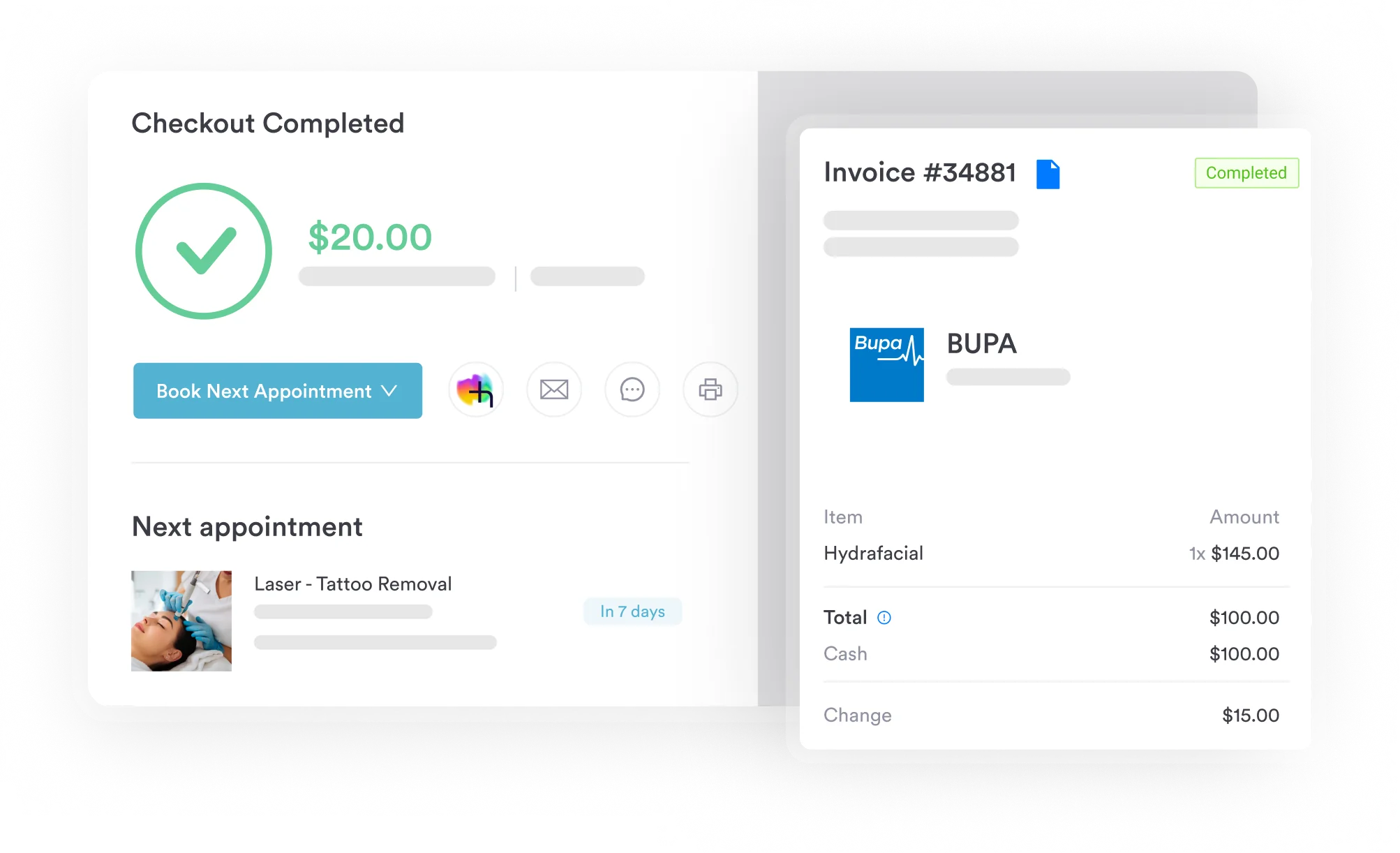

Pabau files every claim against the appointment that produced it, submits electronically, and tracks each claim’s status in the patient record. Your coders work from the note itself.

S62.396B is a narrow code doing a precise job. It says right hand, fifth metacarpal, open at the first visit, and a fracture the record does not place at the base, shaft or neck. When one of those elements is missing from the chart, a query is the answer, not a best guess.
The habit worth building is small. Read the site of the fracture before you reach for a series, then read the wound description before you choose the 7th character. Those two reads prevent most denials across the whole S62.3 family, not just this code.
That check is harder than it needs to be when the note and the claim live in separate systems. Book a demo to see how Pabau keeps hand-injury documentation and claim status in one patient record.

Is the note describing the metacarpal neck instead? S62.337B covers a displaced neck fracture of the fifth metacarpal, which is where most boxer fracture wording belongs.
Coding an open fracture at the base of the bone? S62.349B handles a nondisplaced metacarpal base fracture at the initial encounter.
Billing a late effect of the same injury? S62.367S is the sequela code for a fifth metacarpal fracture, used once active treatment has ended.
Seeing the same rejections month after month? Denial management in healthcare sets out the tracking that shows which errors keep repeating.
Submitting US claims electronically? Claim.MD clearinghouse explains how claims and remittances move between a practice and its payers.
It means other fracture of the fifth metacarpal bone, right hand, initial encounter for open fracture. The code is billable, while the parent code S62.396 is not.
October 1, 2015, the day ICD-10-CM took effect in the US. It is not a new code, so claims from FY2016 onward can carry it.
ICD-10-CM does not require one, but many payers, state mandates and trauma registries expect it. Add the Chapter 20 code for how the injury happened whenever your payer asks for it.
No. The open fracture code already accounts for the wound at that site, so adding an S61- wound code reports the same injury twice. Code a wound separately only when it sits at a different site.
Yes. Compound is the older clinical term for a fracture that communicates with a wound. A note using it supports the B 7th character, as long as the wound itself is described.