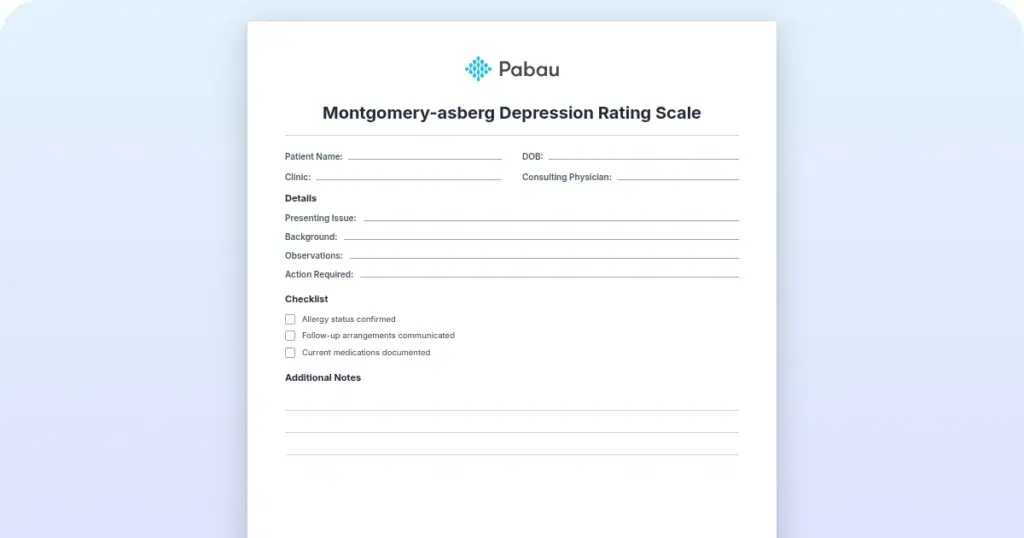
Montgomery-Åsberg Depression Rating Scale (MADRS)
The Montgomery-Åsberg Depression Rating Scale (MADRS) is a clinician-administer...

1
Last Updated: Oct 6, 2026

An anxiety and depression test is a validated screening questionnaire that helps clinicians systematically assess mental health symptoms using standardized scoring.
The PHQ-9, GAD-7, K10, HADS, and DASS-21 are evidence-based tools; all are administered in 5-15 minutes and produce quantifiable scores.
Screening tools identify symptoms, not diagnoses – only licensed mental health professionals can provide a clinical diagnosis following assessment.
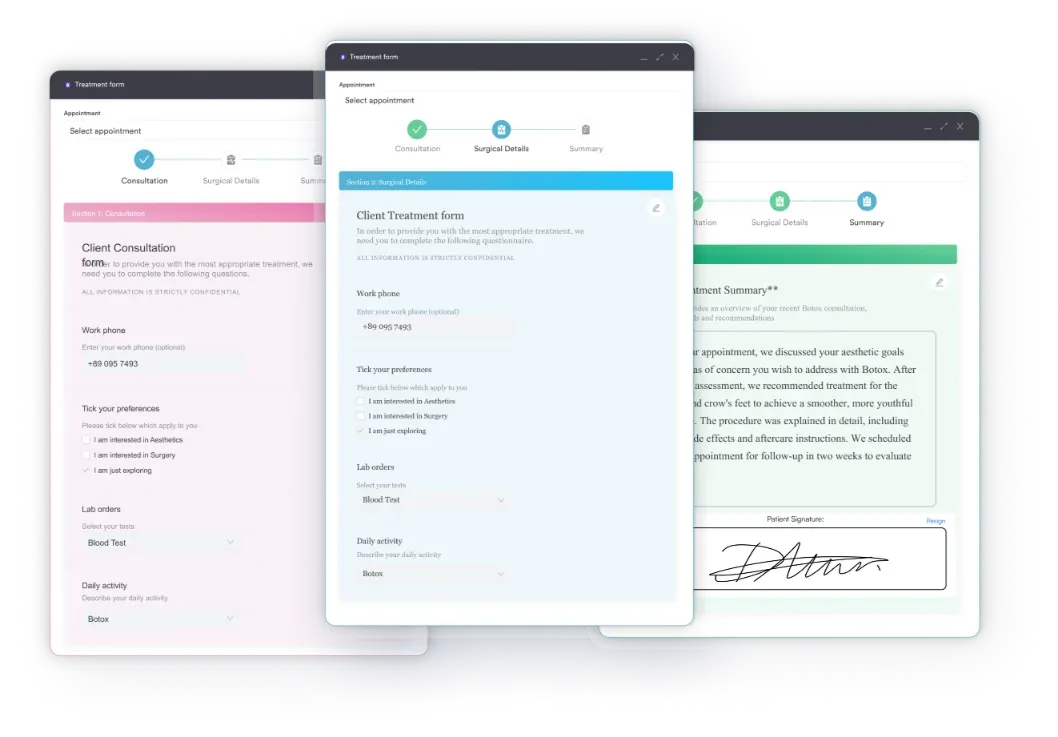
Pabau’s digital forms feature allows practices to administer, score, and store anxiety and depression tests securely within a compliant clinical workflow.
A standardized clinical assessment tool providing structured screening questions and rating scales for mental health professionals to evaluate anxiety and depression symptoms.
Download templateA depression and anxiety screening test gives you a fast, standardized read on symptom severity before you shape a treatment plan. This guide compares the five validated instruments clinicians rely on – the PHQ-9, GAD-7, K10, HADS, and DASS-21 – and shows how to score, document, and store each one.
Practice management software like Pabau lets you administer a depression test as a digital form, score it automatically, and file the result straight to the patient record, so screening adds clinical insight instead of paperwork.
An anxiety and depression test is a validated clinical screening questionnaire that helps mental health professionals systematically assess symptoms of anxiety disorders and depressive conditions. These instruments use standardized questions and rating scales to quantify symptom severity and track changes over time.
Unlike self-diagnosis or informal assessment, validated screening tools are grounded in peer-reviewed psychometric research. They provide reliable baseline measurements and support informed clinical decision-making.
The most widely used instruments – PHQ-9 for depression and GAD-7 for anxiety – are publicly available, cost-free, and can be administered in under 10 minutes. Most instruments ask patients to rate each symptom over the past two weeks, which keeps a depression test anchored to current functioning rather than lifetime history.
A critical distinction: screening tools identify symptoms, not diagnoses. Only a licensed mental health professional can combine test results with clinical interview, medical history, and observed presentation to reach a formal diagnosis. As Mental Health America clarifies, “A screening is not a diagnosis.” The anxiety and depression test serves as a clinical aid, not a standalone diagnostic instrument. A psychology practice running several assessments needs them scored and stored the same way each time.
Each validated tool already specifies the depression questions to ask patients, so mental health practitioners administer a set list and fold it into five key workflow steps:
For psychiatric evaluation templates, screening test administration is typically part of a broader intake battery. Many practices embed anxiety and depression screening into comprehensive mental health assessment workflows alongside risk assessment, substance use screening, and medical history review.
Five validated tools dominate mental health screening. Each differs in length, scoring scale, and clinical application.
PHQ-9 and GAD-7 are public domain – Pfizer released them royalty-free for clinical and research use, so no licensing fees or reproduction restrictions apply. The K10 is also free to use through its developer, Kessler, provided the source is credited. The DASS-21 is distributed free by the UNSW DASS research group.
The HADS works differently. It’s a copyrighted instrument (© Snaith & Zigmond), administered by GL Assessment or the Mapi Research Trust, and practices need a license – often for a fee – before reproducing or administering it.
The Hospital Anxiety and Depression Scale (HADS) and the depression anxiety and stress test (DASS-21) both split their results into separate subscales, which helps when you want anxiety and depression scored side by side. The PHQ-9 depression test stays narrower, giving you one clear depression score to track from session to session.
Other instruments, like the Beck Depression Inventory (BDI), are copyrighted and require licensing to reproduce – a cost barrier for some small practices. Trait-based tools such as the Big Five personality test serve a different purpose: they measure stable personality traits rather than current symptom severity, so they complement rather than replace a depression or anxiety screen.
Platforms differ widely in how they handle clinical worksheets; comparing Carepatron competitors shows the gaps quickly.
Administering and scoring an anxiety and depression test is billable separately from the office visit, using codes for brief standardized assessments. Coverage and reimbursement vary by payer, so confirm current rules with your billing team before submitting claims.
Each depression scale sets its own scoring range and interpretation thresholds, so a raw depression score only carries meaning once you map it to the right cutoffs. Clinicians need to know when a score warrants escalation or safety intervention.
PHQ-9 scores: Range 0-27. A score of 10 or above indicates moderate-to-severe depression and typically warrants treatment. Item 9 screens for suicidal ideation directly; any endorsement (score ≥ 1) requires immediate safety assessment regardless of total score.
GAD-7 scores: Range 0-21. A score of 10 or above indicates moderate anxiety. Scoring 15+ suggests severe anxiety and may warrant pharmacological or intensive psychological intervention.
K10 scores: Range 10-50. Scores 10-15 = low distress; 16-21 = mild; 22-29 = moderate; 30-50 = severe. Used across Australia as a standard outcome measure in mental health services.
HADS scores: Each subscale (anxiety and depression) ranges 0-21. Cutoffs: 0-7 = normal, 8-10 = borderline, 11-21 = clinical range. Useful in medical settings where pure psychiatric diagnosis is not the goal.
DASS-21 scores: Three 7-item subscales cover depression, anxiety, and stress, each item scored 0-3. Multiply each subscale total by 2 to align with the full DASS-42 severity bands published in the UNSW DASS scoring guide.
Screening results inform referral decisions. A positive screen does not mandate referral, but specific clinical situations demand urgent evaluation or specialist care.
Refer immediately if any of the following apply:
Consider referral if any of the following apply:
Framing a higher score as a signal that the case needs specialist expertise, rather than a sign the patient has failed, keeps the relationship on track.
Completed screening questionnaires are protected health information (PHI). Any digital or paper storage must comply with HIPAA-compliant screening data storage requirements.
Best practices for protecting anxiety and depression test data include:
An anxiety and depression test provides a structured, time-efficient baseline of symptom severity. It standardizes communication between clinician and patient, tracks longitudinal change, and flags cases needing urgent intervention. However, the test alone never produces a diagnosis. Clinical judgment, informed consent, safety assessment, and a thorough diagnostic interview remain essential.
Practices that integrate evidence-based screening into intake workflows report faster diagnosis, improved treatment selection, and better patient outcomes.
Book a demo with Pabau to see how digital mental health intake forms and automated scoring streamline screening workflows in your practice.
The best anxiety and depression test depends on your clinical context. The PHQ-9 is most widely adopted for depression screening; the GAD-7 for anxiety. If you need to assess both in one instrument, the K10 or HADS work well. All five are evidence-based, publicly available, and brief.
No. A screening test identifies symptoms but cannot diagnose. Diagnosis requires a licensed mental health professional to conduct a full clinical interview, review medical history, rule out medical causes, assess functional impairment, and integrate the screening score into the full clinical picture.
Administer at intake to establish baseline. Repeat every 4 weeks during active treatment to track response and adjust interventions. If symptoms remain stable, reassess at least annually. More frequent screening is useful when medication or therapy changes occur.
A high score warrants immediate safety assessment, especially checking for suicidal or homicidal ideation. Do not rely on the test score alone; conduct a thorough clinical interview. If the patient is in acute danger, follow your crisis protocol and consider emergency referral.
Most are. The PHQ-9 and GAD-7 are public domain, the K10 is free to use with attribution, and the DASS-21 is distributed free by UNSW. The HADS is copyrighted, though, and requires a license – often for a fee – from GL Assessment or the Mapi Research Trust before you can reproduce or administer it.
Store completed tests in a HIPAA-compliant practice management system with encrypted storage, access logs, and automatic logoff. Use digital forms administered directly in your EHR to avoid paper handling. Never email results without patient consent and secure transmission. Train staff on PHI protection protocols.
Doctors and mental health clinicians rely on validated questionnaires rather than a single lab test. A depression and anxiety screening test such as the PHQ-9, GAD-7, or HADS is scored against published cutoffs, then combined with a clinical interview, patient history, and safety assessment before any diagnosis is confirmed.