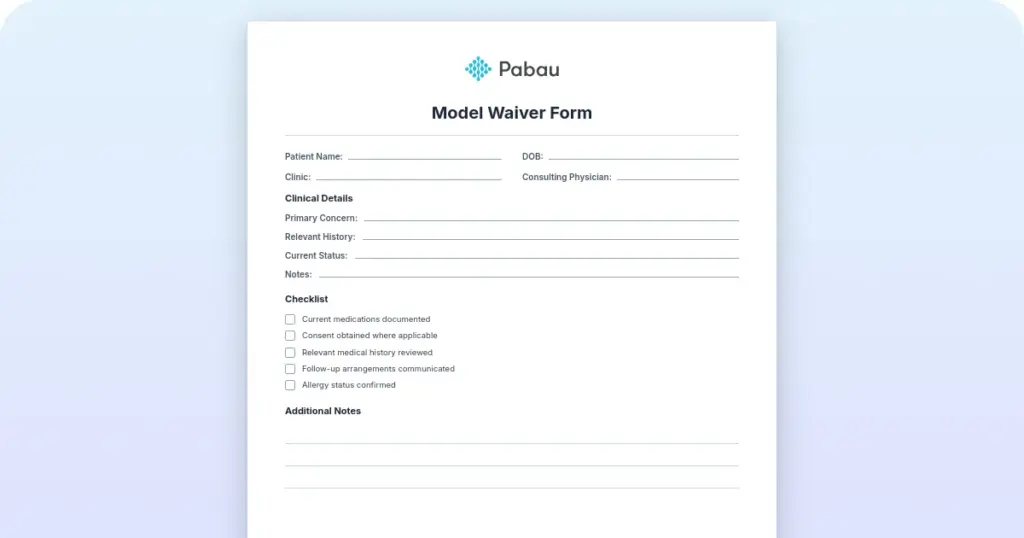
Free model waiver form + what it is and when your practice needs one
A model waiver form is a signed document that lets a healthcare practice use a p...

5
Last Updated: Sep 29, 2026

An advanced treatment consultation form records medical history, contraindications, allergies, medications, and informed consent before aesthetic or medical treatments.
UK data protection guidance, including the NHS Records Management Code of Practice, recommends keeping patient records for at least 8 years to support UK GDPR compliance. Digital forms with e-signatures are legally valid under the Electronic Communications Act 2000.
CQC inspections check for documented evidence of informed consent, treatment suitability assessment, and pre-treatment risk disclosure. This form provides that audit trail.
Practice management software like Pabau lets you send consultation forms through the client portal, collect e-signatures, and store them securely in the patient record within GDPR-compliant systems.
A comprehensive, ready-to-use consultation form covering patient demographics, detailed medical history, contraindication screening, allergies and medications, treatment suitability assessment, risk disclosure, informed consent declarations, and signature blocks. Designed for aesthetic and dermatology practices, medical spas, and advanced treatment centers.
Download templateAn advanced treatment consultation form records a patient’s medical history, contraindications, allergies, and informed consent before procedures like injectables, laser therapy, or IV infusions. One structured document screens for the flags that would delay or rule out treatment, and proves the patient agreed to go ahead knowing the risks. Practices offering injectables, laser, and IV therapy under one roof can compare systems in our guide to software for med spas.
The free template below is ready to use. This guide shows you what to include, how to screen contraindications in tiers, and how to run the form as a pre-appointment workflow inside practice management software like Pabau.
An advanced treatment consultation form is a clinical documentation tool that records a patient’s readiness for aesthetic or medical treatment. It captures medical history, current medications, allergies, previous reactions to treatments, contraindication screening, informed consent language, and practitioner assessment notes. All of this happens before the procedure begins.
The form serves three essential purposes:
For aesthetic treatments like Botox. For medical treatments like IV infusions, phlebotomy.
A structured five-step workflow maximizes the form’s clinical and compliance value.
Patient safety: Contraindication screening prevents serious adverse events. A patient on warfarin needs clinical caution, and often clearance from their prescriber, before fillers or laser therapy, because anticoagulants raise the risk of bruising and bleeding. A patient partway through isotretinoin should defer ablative procedures such as deep peels or laser resurfacing. The form surfaces these risks before they cause harm.
Legal protection: Documented informed consent is your strongest defense against complaints or negligence claims. If a patient claims “I didn’t know about bruising risk,” the signed form showing they acknowledged “bruising and swelling are common for 1-2 weeks” becomes evidence in court.
Regulatory compliance: Inspectors will ask: “Show me the records proving you assessed this patient before treatment.” A completed consultation form is that proof.
UK GDPR compliance requires a lawful basis for capturing patient data. This form fulfills that documentation requirement.
Clinical continuity: Future clinicians reviewing the patient’s record see exactly what was communicated, what was disclosed, and what medical flags were present. This prevents repeat unnecessary testing and accelerates follow-up care.
Aesthetic practices and medical spas delivering injectable treatments (Botox, fillers, PDO threads), laser and light therapies (IPL, HIFU, fractional laser), and topical treatments (chemical peels. Many also structure treatments into med spa packages, which makes fast, consistent screening for suitability and risk even more important.
Dermatology practices performing advanced skin treatments need detailed Fitzpatrick skin type, sun exposure history, and photosensitivity screening to tailor laser settings and predict healing response.
Cosmetic surgery centers require comprehensive pre-operative assessment including bleeding history, medication use, and procedural understanding before surgical intervention.
IV therapy and regenerative medicine practices screening patients for infusions, stem cell therapy, or PRP treatments must assess anticoagulation, vascular access risks, and immune status.
Private GPs and functional medicine practices offering advanced patient consultations benefit from structured forms.
Compliance and audit readiness. Every inspection, whether CQC, ICO, or a malpractice review, hinges on documentation. A completed consultation form proves you obtained informed consent, assessed suitability, and acted safely. Without it, you have nothing to show you assessed the patient before treating.
Reduces liability risk. The form is your documented proof that you disclosed risks. If complications occur, the patient cannot claim ignorance. The form shows they acknowledged potential outcomes.
Workflow efficiency. Digital forms sent pre-appointment mean patients complete them at home, not in the waiting room. Your front desk stops transcribing and chasing paper forms, and data accuracy improves because patients have time to think through their answers.
GDPR-compliant data capture. The form documents what patient data you collected, why you collected it, and how you’ll store it securely.
Divide contraindications into two categories: absolute (delay or refuse treatment entirely for pregnancy, active isotretinoin, recent surgery, or thrombocytopenia) and relative (modify the treatment plan for sensitive skin, recent botulinum toxin use, or concurrent medications). Patients with absolute contraindications cannot proceed. Patients with relative contraindications proceed with documented modifications. This framework protects both safety and clarity.
Beyond the consultation form, integrate these practices to strengthen your compliance posture. First, conducting structured consultations using a consistent template ensures no patient is assessed haphazardly. Standardized assessment reduces missed flags and inconsistent documentation.
Second, photograph or video-record baseline appearance with patient consent. Before-and-after images are essential for monitoring results and documenting complications (e.g., proving that bruising was proportionate to the treatment given, not a complication).
Third, maintain a treatment record card or clinical note in your patient management system (like medical spa software solutions) that links the consultation form, informed consent, treatment plan, procedure notes, and follow-up instructions. A fragmented paper system creates compliance risk.
The UK Care Quality Commission (CQC) assesses practices on five domains: safe, effective, caring, responsive, and well-led. Learn more about CQC’s role in overseeing patient safety. Under “safe,” inspectors specifically look for evidence of risk assessment and informed consent. A consultation form demonstrating that you identified contraindications and disclosed risks directly satisfies this requirement.
The UK Information Commissioner’s Office (ICO) enforces UK GDPR. When processing patient data, you must have a lawful basis. For aesthetic treatment practices, the lawful basis is “contract” (patient agreed to treatment) and “legitimate interest” (assessing suitability). The consultation form documents both: the patient consented to treatment, and you needed their medical history to ensure safety.
Medical liability insurers also require documented consent. JCCP aesthetic standards and Save Face accreditation standards explicitly require practices to retain signed informed consent forms. Practices cannot claim accreditation or insurance coverage without this documentation. Practices offering CQC-regulated treatments, such as IV therapy.
Digital forms (online via patient portal): Patients complete before arrival, e-signatures are legally binding, forms auto-populate the patient record, and retrieval is instant during audits. Requires practice software integration (like skin clinic software) but eliminates paper filing, scanning, and lost documents.
Paper forms (in-person): Simple to implement immediately, no software needed, patients can ask clarification questions during completion. Downsides: takes staff time, handwriting illegibility, storage space, and scanning burden for record-keeping.
Most modern practices run a hybrid model. They send digital forms pre-appointment, and if the patient doesn’t complete it, a paper copy is ready at check-in. This maximizes compliance rates while maintaining flexibility.
The downloadable form is a starting point. Customize it by adding your practice logo, contact details, and specific treatment disclaimers. If you perform laser therapy, emphasize Fitzpatrick skin type and photosensitivity screening. If you inject fillers, highlight filler location history and vascular anatomy risks.
Review the template annually to incorporate new treatment modalities, regulatory updates, or lessons learned from complaints or incidents.
Download the template above and review it with your clinical and legal team to ensure it matches your specific treatments and jurisdiction. Customize the disclaimer language, then implement it immediately in your practice.
If using practice management software, upload the form as a digital template so patients receive it through their portal before their appointment. Train staff to make sure patients complete it, clinicians review it, and it’s filed before treatment begins.

Pabau’s digital forms let you send consultation templates before appointments, collect e-signatures, and auto-file them to patient records, all GDPR-compliant and audit-ready.


Want a deeper guide to informed consent in aesthetics? Performing consultations that convert walks through the full consultation framework, covering assessment techniques and client communication.
Want retail sales to grow alongside treatments? Selling more retail at med spas covers ten ways to turn treatment visits into retail product sales.
Planning to open a med spa in Texas? Owning a med spa in Texas covers ownership rules to check before you sign a lease.
A completed consultation form does three jobs at once. It protects patients by surfacing contraindications before treatment, protects your practice by documenting informed consent and your clinical reasoning, and gives CQC, the ICO, and insurers the evidence they expect to see.
Download the template above and integrate it into your practice workflow, whether digitally through the patient portal or on paper at check-in. Make sure every patient completes and signs it before treatment begins.
Pair the form with strong clinical documentation, and you’ve built the evidence trail that regulators and courts expect to see. Book a demo with Pabau to see how digital forms can streamline this process while keeping every record GDPR-compliant and audit-ready.
An advanced treatment consultation form is a clinical document that captures a patient’s medical history, contraindications, allergies, medications, and informed consent before aesthetic or medical procedures.
Include patient demographics, detailed medical history (surgeries, chronic conditions), current medications and supplements, allergies and sensitivities, previous treatment reactions, contraindication screening (pregnancy, blood disorders, isotretinoin use), informed consent declarations, risk disclosure, and signature/date fields.
Yes, e-signatures are legally valid in the UK under the Electronic Communications Act 2000 and eIDAS regulation. Digital consent forms signed via patient portal carry the same legal weight as handwritten signatures.
UK data protection guidance, including the NHS Records Management Code of Practice, recommends retaining patient records for a minimum of 8 years from the date of last treatment to support UK GDPR compliance. Many insurance providers recommend 10 years. Digital forms stored in secure practice management software meet this standard and simplify retrieval for audits.
Yes. Medical liability insurance requires documented informed consent as a condition of coverage. Insurers will not cover claims if consent documentation is absent or inadequate.
Clinically and legally, treatment should not proceed without documented informed consent. If a patient refuses the form, document their refusal in writing (e.g., “Patient declined to complete consultation form – treatment deferred pending compliance”) and offer to reschedule.