Professional development record
A professional development record is a structured log of a healthcare practition...

8
Last Updated: Oct 8, 2026
Learning how to get CQC registered comes down to five stages: The DBS check, your document pack, the portal application, the assessment, and the decision.
The Care Quality Commission (CQC) regulates health and social care in England. Any provider carrying on a regulated activity must register before treating a single patient.
Expect a few months between a complete application and a decision, which is as precise as CQC’s own guidance gets. Annual fees then start at around £313 (£309 for a diagnostic-only individual) and reach £193,390, depending on service type and size.
This guide walks the whole route, with CQC’s published timings and the current fee bands by service type. The guide also sets out a CQC Registration Readiness Map, tying each of the five key questions to the evidence inspectors ask for.

Anyone carrying on a regulated activity in England must register with CQC, as a provider, a manager, or both.
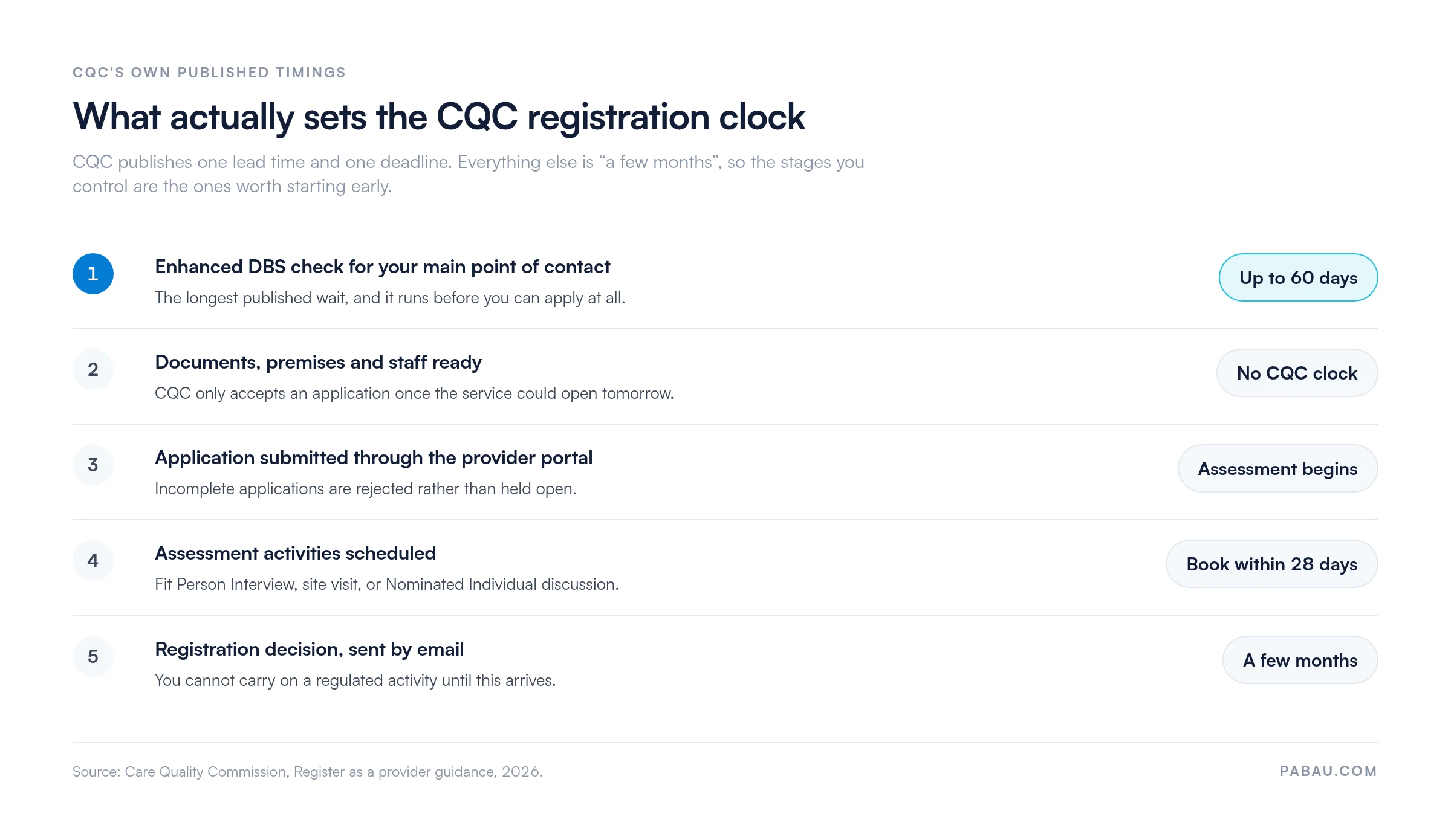
CQC registration runs through five stages, and the enhanced DBS check alone can take up to 60 days.
A registration decision takes a few months, and CQC can refuse an application if assessment dates are not agreed within 28 days.
For most services, annual fees run from £313 for the smallest care service to £193,390 for a hospital provider with more than 15 locations.
The CQC Registration Readiness Map ties each of the five key questions to the evidence inspectors expect, and to the record that produces it.
Any individual, partnership, or organization carrying on a regulated activity in England must register with CQC before that activity starts.
Registration with CQC covers a wide span of services. GP practices, dental practices, care homes, domiciliary care agencies, independent practices, and IV therapy providers all sit inside scope.
Our guide to the CQC’s role explains where those powers come from. CQC’s scope of registration guidance carries the full list of CQC regulated activities.
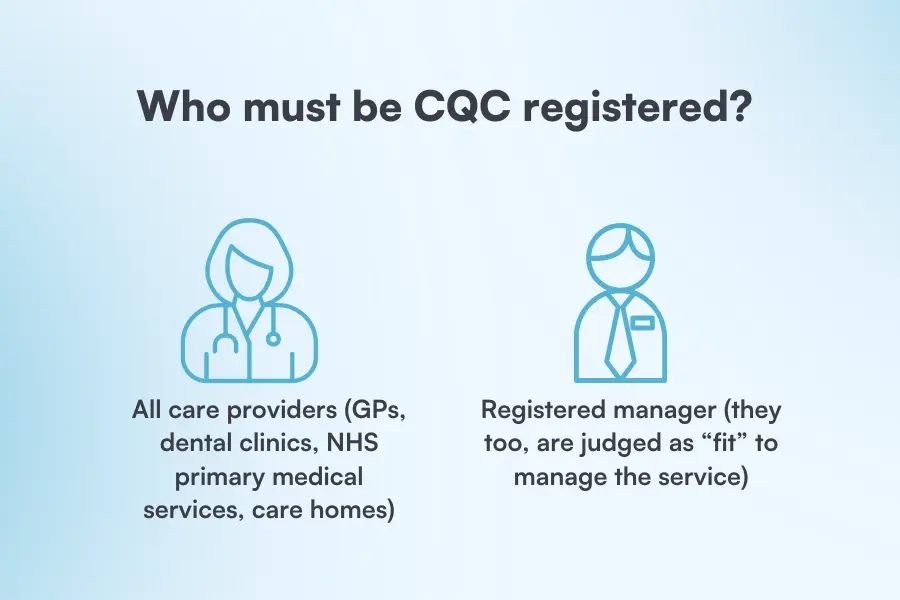
The two registrations are separate, and most services need both:
Registering with the CQC as an individual works differently. A sole provider who also runs the service day to day registers once, as a provider, with no separate manager application.
CQC defines personal care narrowly. The definition covers help with washing, dressing, eating, or using the toilet in someone’s own home. Agencies that only shop, clean, or keep company usually fall outside registration.
Starting a care agency follows the same route. Anyone setting up a care agency or a home care business registers as a provider first, then appoints a registered manager.
Pro tip: Confirm early whether your service needs both registrations. Most do, unless you are personally delivering and managing the service yourself.
CQC only accepts an application once your premises, staff, policies, and documents are ready, so preparation decides how fast registration moves.
Start the enhanced DBS check first. CQC says that check can usually take up to 60 days. No other published figure in the process is longer, so a late start here delays the whole application.
In practices we onboard, the document pack takes far longer to assemble than the application form takes to complete. Here is what to gather.
CQC also weighs governance heavily, so a written policy suite has to exist before you apply. Cover each of these areas:
Anyone working out how to start a care agency in the UK hits the same pack. The documents required for CQC registration do not change with the business model.
Services using controlled drugs need a Home Office license as well. Once the Home Office accepts a valid application, arranging a compliance visit can take up to 16 weeks, so that request goes in early too.
Applying for CQC registration happens online, through CQC’s provider portal. Downloadable forms cover the situations the portal does not handle.
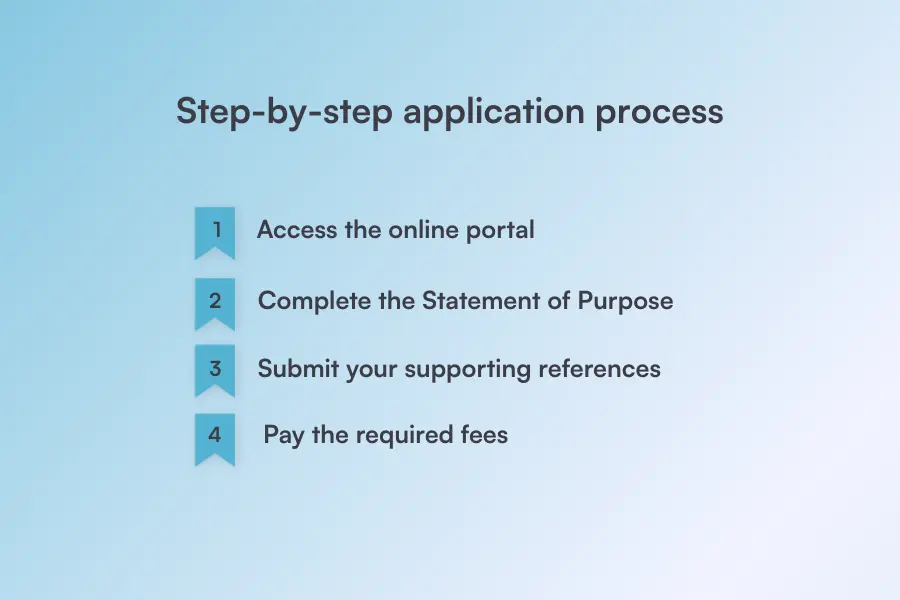
Register for a CQC provider portal account first. The portal saves progress, so the application does not have to be finished in one sitting.
The first screens ask for the basics of your organization:
Have the documents open before you start. Incomplete applications are one of the most common causes of delay, and CQC rejects them rather than holding them open.
The Statement of Purpose is your service description for CQC, setting out what care you provide, for whom, where, and with which staff.
Treat it as the business plan CQC reads first. The required sections are:
Your Statement of Purpose is what an inspector reads before a first visit. Vague wording here creates questions later, so name the activities precisely.
CQC supporting documents include professional references that verify the competence of key individuals, registered managers above all. Typical requirements are:
Complete references are what tell CQC your key personnel are fit and proper to run the service. Chase referees early, because a slow reply stalls the whole application.
CQC registration takes a few months from a complete application to a decision, with assessment activities scheduled in between.
Once the form is submitted, the process moves to assessment. CQC’s own guide to registration names three activities it may arrange:
One deadline sits inside this stage and catches people out. If you cannot agree a date for assessment activities within 28 days of being contacted, CQC may return the application or propose to refuse registration.
CQC publishes a fixed number for only two points in the whole process, and the timeline below shows where each one falls.
CQC sends its decision by email, and that email is what providers mean when they ask how to get a CQC registration certificate. Your entry on the CQC register goes live at the same time.
CQC registration carries no application fee. Annual fees follow once you are registered, running from around £313 (£309 for a diagnostic-only individual) to £193,390 by service type and size.
The band you land in depends on the type of service, the number of locations, and how many service users you support. The table below lists the fees for a single location.
A standard NHS GP practice is not billed by location. CQC charges £509 plus the registered patient list size divided by 1.7545.
Community social care uses a formula rather than a band. CQC charges £239 plus £54.305 for each service user, capped at £92,558 for a provider supporting 1,700 people or more.
The £193,390 ceiling applies to a hospital provider with more than 15 locations. All figures come from CQC’s published provider fees under the 2024/25 scheme, which stays unchanged for 2026/27.
CQC registration fees are invoiced annually, and CQC sends an invoice stating the exact fee before it falls due. Our breakdown of CQC registration cost works through which band applies to a specific service.
The five CQC requirements are that a service is safe, effective, caring, responsive, and well-led. Every registration decision and inspection tests those five.
CQC structured these five as key lines of enquiry until 2023. The single assessment framework replaced KLOEs with quality statements, but the five questions themselves did not change.
Requirements for CQC registration get abstract fast. The CQC Registration Readiness Map ties each question to a fundamental standard and to the record that proves it.
CQC publishes 14 fundamental standards in total, and the five key questions are how inspectors group them. Our full breakdown of CQC requirements goes standard by standard through what a provider has to prove.
CQC manager registration applies to whoever runs regulated activities day to day, and needs its own application, DBS check, and interview.
A CQC registered manager application must be submitted alongside the provider application. CQC cannot process a provider application without it.
CQC requirements for a registered manager turn on proven management experience rather than a single named qualification. Recent experience in a regulated service strengthens an application, and so does a qualification matched to the service type.
For a home care service, CQC names a Level 5 Diploma in Leadership and Management, or an equivalent, as evidence that helps. That diploma is the CQC registered manager course most applicants take, though CQC mandates no single course.
The CQC DBS for a registered manager differs from a standard employer check. The certificate must be an enhanced DBS check countersigned by CQC, issued within the past 12 months.
The manager application also asks for two personal records:
False or misleading information on the form carries a fine of up to £2,500, so account for every date.
The CQC interview comes after the application. Expect to be asked how you would handle a complaint, a safeguarding concern, a medication error, and a mental capacity assessment. CQC names those four areas in its guidance for manager applicants.
A CQC registered manager check runs through CQC’s public directory of care services. Each entry names the provider, the regulated activities, and the location. CQC publishes no separate CQC registered manager list, so that directory is where a manager’s status gets confirmed.
CQC registered manager salary sits outside CQC’s remit entirely. The regulator registers the person and sets no pay scale, so rates track service type, size, and region.
Service-level CQC registration and professional registration also run on separate tracks. A professional register is the public list a body such as the GMC or NMC maintains, and a CQC registration does not appear on it.
CQC’s own qualification checks look at management. The regulator judges whether the manager can run a service, and leaves clinical licensing to the professional bodies.
Registration creates a standing obligation. CQC expects notification whenever the service changes in a way that affects who is accountable or how care is delivered.
Our guide to the CQC inspection process covers what happens on the day and how ratings get decided.
Registration is granted on paperwork, and the same paperwork is what an inspector asks for later. Pabau, the practice management platform we build, keeps that evidence in one patient record instead of four filing systems.
Each line of the CQC Registration Readiness Map has a home in the system. The evidence then builds during the working day, rather than the week before a visit.
Pabau works as compliance management software alongside the day job, so the record a CQC inspector wants already exists. Every Pabau subscription includes every feature, so none of this sits behind a higher tier.

Pabau holds patient records, consent forms, staff training and DBS dates, incident logs, and patient feedback in one system. Your team can answer a CQC question on the day it is asked, without digging through folders.

The route to registration is slow in one place and quick in the others. Start the DBS check first, because 60 days of waiting cannot be compressed later.
Budget for the annual fee as a running cost rather than a one-off. A single-specialty independent service pays £1,743 a year at one location, and that invoice arrives every year.
Keep the CQC Registration Readiness Map after the certificate arrives. The same five questions decide the first inspection, and the evidence is easier to produce when it was never collected specially. Book a demo to see how Pabau keeps consent, training, and incident records inspection-ready from day one.

Working out which fee band applies? CQC registration cost in the UK walks through the annual fee for each service type and size.
Need the full list of standards? CQC requirements 2026 goes standard by standard through what a provider has to prove.
Preparing for your first visit? CQC inspection: How to prepare covers what happens on the day and how ratings get decided.
Unsure where CQC gets its powers? The Care Quality Commission and its role explains what the regulator does and which services it covers.
Setting up patient data handling? The GDPR checklist UK practices need lists the data protection steps a new service should have in place.
CQC publishes every registered provider in its Find care services directory on cqc.org.uk. Each entry shows the provider, its locations, regulated activities, and latest rating. Searching by name or postcode confirms whether a service holds a current registration.
The CQC application form lives inside the provider portal at cqc.org.uk, which is where most providers apply. Downloadable new provider and registered manager forms cover the situations the portal does not handle. Manager forms must be submitted with the provider application.
CQC requirements for a registered manager cover proven management experience, an enhanced DBS check countersigned by CQC, and a full work history. That history runs from age 16, and any break over four weeks needs an explanation. The DBS certificate must have been issued in the past 12 months. Qualifications should match the service type, such as a Level 5 Diploma for home care.
The interview tests how a manager would handle complaints, safeguarding concerns, medication errors, and mental capacity assessments. CQC also probes knowledge of the regulations and of the specific needs of your service users. Answers land best when tied to a situation you have managed yourself.
CQC’s general enquiries team answers questions about the forms, and its registration guidance covers each stage. Most CQC registration support comes down to document preparation, which a practice can handle itself. Keeping consent forms, training records, and incident logs in one system makes the evidence easier to assemble.
No. CQC registration covers the service, while HCPC registration covers the individual practitioner. HCPC registration is the license an individual holds with the Health and Care Professions Council. That body registers physiotherapists, paramedics, and other allied health professionals. A practice holds CQC registration while its clinicians hold their own with the HCPC, GMC, NMC, or GDC.