Facial skin treatment consent form template: Microneedling and phi-ion
A facial skin treatment consent form is the signed proof that a patient was scre...

2
Last Updated: Oct 21, 2026

Epilfree is a two-step activator-and-inhibitor toner system applied straight after waxing, not a single serum, to disable regrowth at the follicle.
Manufacturer guidance calls for at least 12 treatments, sometimes more, over a course of at least 12 months to track the natural 3-6 month hair growth cycle.
Contraindications screening and informed consent are essential before treatment to ensure client safety.
Pabau’s digital forms and automated aftercare messaging simplify Epilfree consultation workflows and client follow-up for beauty practices.
A two-page consent and medical-history declaration covering informed consent, treatment-history screening (waxing, laser/IPL, varicose veins, botox, chemical peels, microdermabrasion, and microneedling), and two free-text boxes for details – designed for estheticians and aesthetic practices administering Epilfree treatments.
Download templateEpilfree is a non-laser permanent hair reduction system used by estheticians and aesthetic practices worldwide.
After waxing lifts the hair from the root, the therapist applies a two-step activator and inhibitor toner to the freshly emptied follicle to disable future regrowth, offering an alternative to laser hair removal that suits all skin types.
Proper client screening, informed consent, and documented aftercare protect both the client and your practice. A consultation form is the backbone of that protection: it sets expectations on treatment frequency, screens for contraindications, and puts consent in writing before the first session.
Epilfree is a non-laser hair removal system that combines waxing with a two-step botanical toner application. During a standard session, a therapist first applies traditional waxing to remove hair from the desired area, leaving the follicle empty.
Immediately afterward, the therapist applies the Epilfree activator (Toner A), which opens the hair-shaft opening to roughly four times its normal size. A second inhibitor toner (Toner B) then goes onto that same freshly waxed, empty follicle, where it disables the dividing hair cell at the base of the follicle so it stops producing new growth.
Over successive treatments, this process gradually reduces hair density and eventually leads to permanent hair reduction. Unlike laser hair removal, Epilfree requires no special equipment, carries no risk of burns, and is suitable for all skin tones, including darker skin where laser treatments carry higher complication risks.
This makes Epilfree an ideal offering for practices expanding their hair removal services without the equipment or training costs that laser requires.
A standard Epilfree treatment session follows a structured protocol to ensure consistency, safety, and optimal results. Every session should be documented in the client record to track progress and identify any patterns of response or contraindication reactions.
Spacing often stretches out later in the course as regrowth slows, which is why a course of 12 or more treatments still spans at least 12 months rather than wrapping up in a few months of back-to-back visits.
An Epilfree consultation form serves three critical functions: it documents informed consent, screens for contraindications, and creates a medical-legal record of the client’s health status at the time of treatment. A comprehensive form protects both the client and your practice.
An effective Epilfree consultation form should cover these core sections:
What the template doesn’t include matters just as much. It has no client demographic fields, no dedicated allergy question, and no signature or date line. It also doesn’t spell out aftercare instructions itself; it only confirms that a separate Aftercare Card was given and explained to the client.
Pair it with your practice’s standard intake form.
The form becomes part of the client’s permanent record. Digital intake forms eliminate paper and ensure every client has signed and reviewed the same standardized document. A pre-built consultation template ensures consistency and speeds up new-client onboarding.
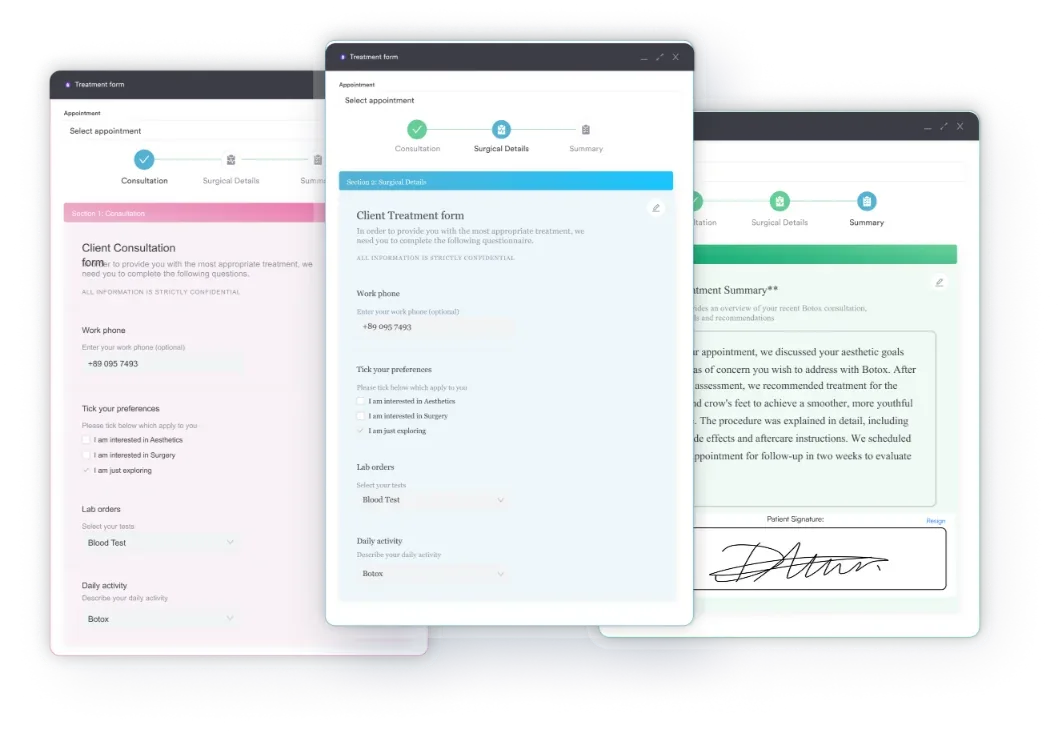
Before every Epilfree session, screen the client against absolute and relative contraindications. Absolute contraindications require deferral of treatment; relative contraindications require heightened assessment and possible modification of the treatment plan.
Always document the contraindications assessment in the client record. If a client reports a relative contraindication, note your clinical judgment and the decision to proceed (or defer) with signed acknowledgment of the modified risk.
Aftercare is as important as the treatment itself. The serum requires 6-12 hours to fully penetrate and work, and the client’s behavior during this window affects both efficacy and safety. Provide every client with a printed or digital aftercare sheet at the end of their session.
Many clients forget aftercare instructions.
Setting realistic client expectations around treatment frequency is crucial for satisfaction and retention. Hair grows in cycles, and the Epilfree toners are most effective when applied to a freshly waxed follicle in the active growth phase, known as anagen.
Not all hair sits in the same growth cycle at any given time, so multiple treatments are required to catch each hair as it cycles through this vulnerable phase.
Tracking session frequency and outcomes in the client record helps you identify whether a client’s progress matches expectations and when to recommend maintenance.
Many clients ask how Epilfree compares to laser hair removal. Understanding the differences helps you recommend the right treatment for each client and position both offerings in your practice.
Many practices offer both treatments. Epilfree attracts clients who prefer a natural, non-invasive approach or who cannot access laser due to skin type, and it pairs well with other non-invasive offerings.
For practices evaluating hair removal service expansion, Epilfree’s low equipment cost and broad suitability make it an attractive entry point before investing in laser technology.
Running a successful Epilfree program requires consistent tracking of client progress, adherence to session spacing, and reliable aftercare communication. Practice management software like Pabau automates these workflows and reduces the administrative burden on therapists.
Digital consultation forms eliminate paper, ensure every client completes the same contraindications screening, and create searchable records that therapists can pull up instantly at the start of each session.
That matters most for spa practice management software, where one therapist often runs several treatment types and needs a single record system rather than a handful of disconnected ones.
Session scheduling within Pabau lets you automatically space Epilfree appointments every two to three weeks across the full course. The software can flag when a client is overdue for their next treatment and send automated reminder messages via SMS or email, significantly improving attendance and course completion rates. R
Aftercare instructions can be sent automatically post-appointment, reducing the therapist’s need to hand out paper sheets at each session. Clients receive consistent, standardized aftercare guidance, and therapists have a record of when aftercare was communicated, which matters for liability if a client has an adverse reaction.
Tracking progress notes, such as hair density reduction, client satisfaction, and any skin reactions, within the client record helps therapists monitor long-term outcomes and adjust recommendations if a client isn’t progressing as expected.
Pairing that with broader daily records. Over time, this data also supports decisions about pricing, package structures, and marketing Epilfree to new clients.

Manage consultations, track multi-session treatment courses, and send automated aftercare, all from one platform.

Epilfree gives practices a real alternative to laser for clients who want gradual, non-invasive hair reduction or whose skin type rules laser out. Once the consultation and consent process is standardized, most of the risk in offering it comes down to keeping clients on schedule for a year or more, not the treatment itself.
Practices that treat the consultation form as a one-off compliance step tend to see clients drift off schedule and never finish the course. Practices that build it into a repeatable workflow, one every therapist follows the same way, see clients come back consistently until they hit the full 12 treatments and beyond into maintenance.
That consistency is what turns a single Epilfree booking into a year of repeat visits and referrals. Book a demo to see how Pabau keeps consultation, scheduling, and aftercare on track for every Epilfree client.

Ready to streamline your consultation process? Managing before-and-after photos helps document Epilfree results over multiple sessions and supports future marketing.
Want to improve client adherence to treatment schedules? The importance of consultations in aesthetic practice explores how thorough initial visits predict client satisfaction and course completion.
Considering electrolysis alongside Epilfree in your treatment menu? Electrolysis aftercare guide covers the recovery timeline for another popular non-laser hair removal option.
Offering microblading alongside your treatments? Microblading aftercare instructions template walks clients through the healing timeline with daily care steps and warning signs.
Epilfree is a non-laser hair reduction system applied right after waxing. An activator toner opens the hair-shaft opening, then an inhibitor toner disables the dividing cell at the base of the freshly emptied follicle, gradually reducing regrowth over a full treatment course.
Any discomfort comes from the waxing step itself, not the toners. The activator and inhibitor solutions are non-invasive, with no heat, light, or electrical energy involved, so most clients find it no more uncomfortable than a standard wax.
Yes, Epilfree works anywhere you would normally wax, including legs, underarms, the bikini area, face, arms, and back. Avoid areas with active skin conditions or open wounds, and adjust aftercare for sensitive zones like the face.
No. Like laser hair removal, Epilfree is an elective cosmetic treatment, so clients pay out of pocket rather than through insurance or a health plan.
Most sessions run 30-60 minutes depending on the treatment area: waxing takes 15-30 minutes and toner application another 10-15 minutes, with the rest for client education or paperwork. Small areas like the upper lip finish in 20-30 minutes.