Facial skin treatment consent form template: Microneedling and phi-ion
A facial skin treatment consent form is the signed proof that a patient was scre...

2
Last Updated: Oct 21, 2026

This fear hierarchy worksheet has clients name one core fear and list 10 related activities. Each gets ranked 1 (least fearful) to 10 (most fearful), with 5 as medium.
Five reflection questions follow the ranking. They prompt clients to name triggers, spot patterns, plan next steps, and line up support.
Fear hierarchies support evidence-based treatment for anxiety disorders, phobias, OCD, PTSD, and social anxiety. They give clinicians a structured sequence for confronting anxiety-provoking situations.
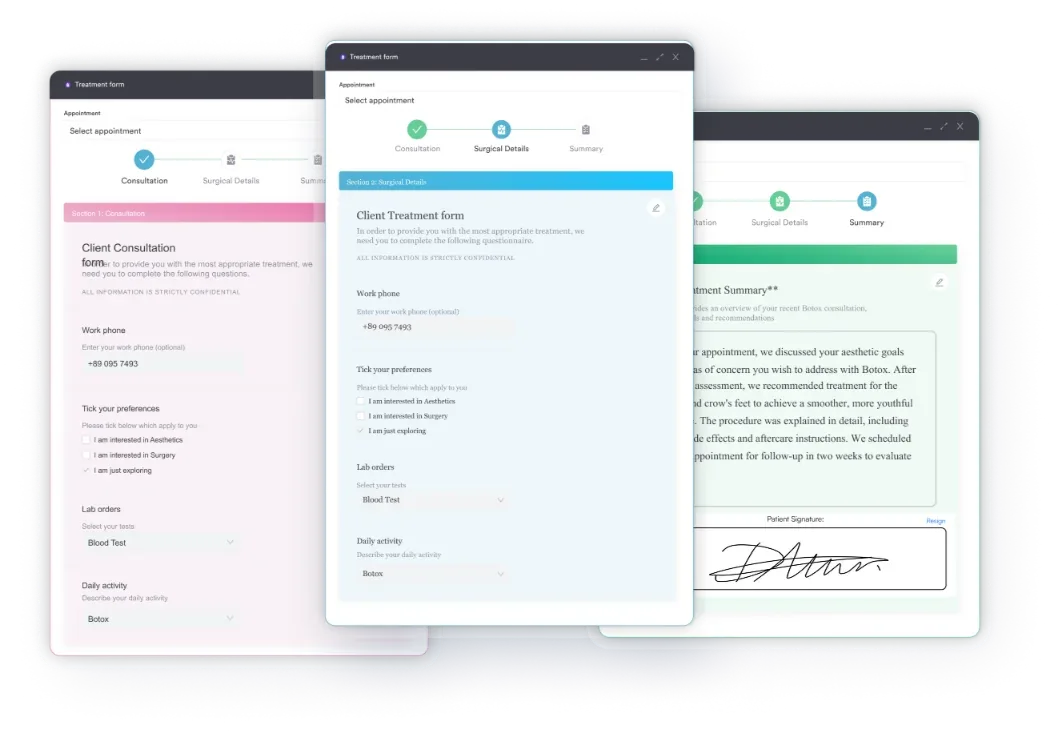
Practice management software like Pabau lets therapists share fear hierarchy worksheets digitally. It also tracks session-by-session progress and keeps exposure planning in one clinical record.
A ready-to-use clinical tool for naming one core fear and ranking 10 related activities from least to most fearful. It also includes five reflection questions, designed for therapists delivering exposure therapy across anxiety disorders, phobias, OCD, PTSD, and social anxiety.
Download templateA vague fear is hard to treat. “I’m anxious in social situations” gives you nothing to plan around. A ranked list of ten specific triggers does.
This fear hierarchy worksheet turns one core fear into ten concrete activities, ranked from least to most frightening. That gives you and your client a shared, clear order to work through in exposure therapy.
A fear hierarchy worksheet is a clinical assessment tool rooted in cognitive behavioral therapy, or CBT. It helps clinicians and clients work through feared situations in order.
This version has clients name one core fear and list 10 related activities. Each activity then gets ranked from 1, least fearful, to 10, most fearful. A rank of 5 marks medium difficulty.
Some clinicians anchor a fear hierarchy to the Subjective Units of Distress Scale, or SUDS. SUDS is a broader 0-100 client self-rating scale used across CBT. This worksheet instead uses a simpler 1-10 ranking. Clients can complete it on their own between sessions, without extra scoring rules to learn.
The fear hierarchy worksheet traces back to Joseph Wolpe’s systematic desensitization model from the 1950s. It remains the gold standard for planning exposure-based interventions today. Unlike a generic anxiety list, this worksheet respects the client’s pace and builds confidence step by step.
Once the concept is clear, building the hierarchy itself takes collaboration, specificity, and time. The process transforms vague anxiety (“I’m scared of public speaking”) into actionable exposure targets ranked by difficulty.
The ranking only needs three anchors. Rank the least fearful activity 1 and the most fearful 10. Treat 5 as the point where an activity feels genuinely hard but still doable. Everything else falls into place once a client compares each new situation against those three markers.
Before handing a client this worksheet, check that:
With that checklist covered, here’s a worked example for social anxiety. Notice how each activity is specific, the ranking reflects real differences in difficulty, and no step jumps too far ahead.
This progression is what makes a fear hierarchy worksheet work in practice. Each activity is concrete and measurable, and each one builds on the last success. Clients can see exactly what success looks like and track progress across sessions.
After ranking the 10 activities, the worksheet asks five open reflection questions. These move the client from simply ordering fears to understanding what drives them. They also clarify what preparing for each step looks like.
With the reflection questions answered, the hierarchy becomes a collaborative clinical document, not a handout you leave with a client. Use it to structure exposure-based therapy sessions and track progress across weeks or months.
The most critical factor is consistency. Incomplete or inconsistent exposures prolong treatment. Structured, consistent hierarchy work compresses the timeline to meaningful improvement.
Beyond social anxiety, fear hierarchy worksheets are evidence-based across multiple DSM-5 diagnoses. When a patient’s fear involves a major life decision rather than a situation they can approach in steps, a fear setting worksheet fits better. Here are the primary clinical populations:
OCD adaptations: In Exposure and Response Prevention, or ERP, your fear hierarchy worksheet must capture two things. It needs the obsessional trigger and the ritual the client will resist.
Touching a doorknob is the trigger, for example. Resisting the urge to wash hands for 10 minutes is the ritual to resist. Rank the combined activity 1-10 based on the difficulty of the exposure plus resisting the compulsion, not the exposure alone.
PTSD adaptations: Trauma-focused exposure hierarchies include imaginal exposure (revisiting the memory) and in-vivo exposure (returning to trauma-related locations or situations). A trauma-informed fear hierarchy worksheet needs three things: a safety plan, grounding techniques, and a note on supervision. Exposure work should only proceed under a trained clinician. Never recommend self-directed PTSD exposure.
Getting the clinical population right is only half the job. A fear hierarchy worksheet is only as good as how you implement it. These clinician tips maximize its impact:
Revisit the work often, and never rush it. That consistency turns exposure therapy from a good idea into lasting change for the client.
That change is easier to describe at case closure than to document. A Rokeach values survey ranked at intake and again a year later shows whether friendship, ambition or family security moved up the list.
Even with those mistakes avoided, many practices still track fear hierarchy rankings on paper. Others keep them in a folder, separate from the rest of a client’s chart. That split makes it hard to see whether a client is progressing up the hierarchy. It’s harder still to hand a clean summary to a supervising clinician or a referring provider.
Pabau keeps the completed worksheet, session notes, and reflection answers in the same digital record. Sharing a new ranking or updated reflection answers with a client takes a few minutes. Every version stays attached to that client’s chart, so the full history stays visible. A therapy practice management system that links each entry to the chart keeps therapy sessions organized across weeks of treatment.
That visibility matters most between sessions, when a clinician needs to check what a client actually completed for homework. It matters again at review points, when a supervisor wants to see progress at a glance. Pulling up the digital record beats digging through a folder of printed worksheets.

Share fear hierarchy worksheets digitally, and keep rankings and reflection answers in one clinical record. Automate follow-up reminders, all within your practice management platform.

A well-constructed fear hierarchy worksheet is one of the most powerful tools in exposure-based therapy. It transforms anxiety from an overwhelming, abstract threat into a series of manageable, ranked activities. Each one becomes a win for your client’s confidence.
Download this template and adapt it to your clinical population. Ranking fears systematically, one activity at a time, becomes the pathway to lasting relief.
Book a demo to see how Pabau helps you deliver structured exposure work at scale, tracking every client’s progress in one secure record.

Building an exposure plan for hoarding behaviors? Hoarding Rating Scale helps you gauge severity before you rank any exposure steps.
Need an easier first rung for social anxiety? Conversation Skills Worksheet breaks everyday exchanges into pieces a client can rehearse early.
Screening for anxiety tied to workplace performance? Impostor Syndrome Test flags the self-doubt that often complicates a client’s higher-ranked steps.
Wondering if attention issues are behind stalled homework? Executive Function Assessment screens for the planning and attention difficulties that can get in the way.
Need a simple way to log sessions? Coaching log template captures coaching goals, session notes, action items, and progress in one form.
No. Ten is a practical default for this worksheet, not a clinical rule. Clinicians often use eight to fifteen steps depending on how granular a fear feels. Add more rungs if two ranked activities jump too far apart in difficulty.
They’re the same tool under two names. “Fear ladder” is simply the term many clinicians use with clients instead of “fear hierarchy.” Both describe a ranked list of feared activities that guides graded exposure.
Clients can start listing fears on their own, but a therapist should guide the ranking and pacing of real exposures. This matters most for trauma-related or OCD cases. An overly ambitious first step can reinforce avoidance instead of reducing it.
The fear hierarchy is the ranked map of activities. Systematic desensitization is the technique that walks a client up that map, usually paired with relaxation training. Each exposure starts once anxiety from the last step has eased.
Ask them to break the top activities into smaller pieces. A fear that only produces extreme ratings usually hides several smaller, more specific triggers that deserve their own steps.