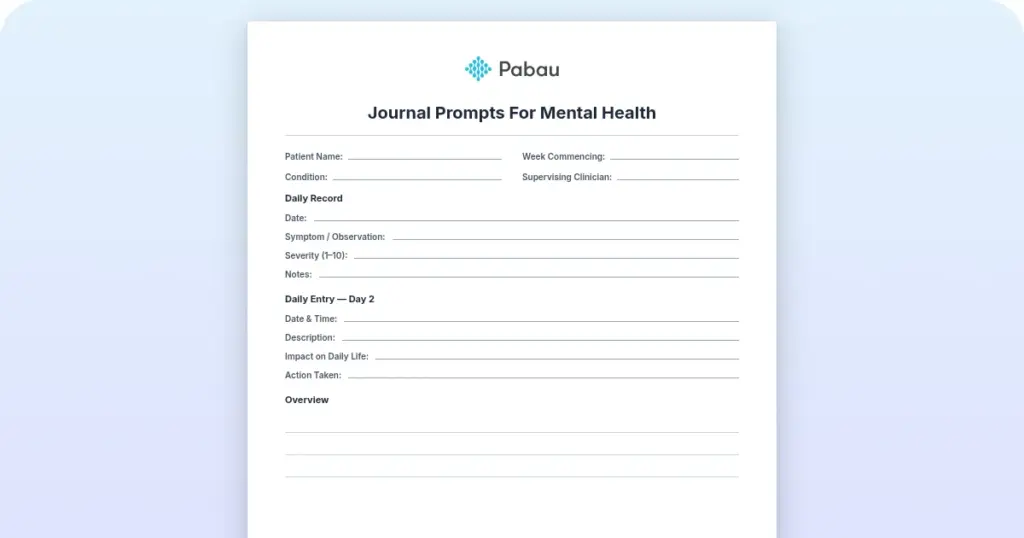
Journal prompts for mental health
Journal prompts for mental health are guided questions that help people process ...

2
Last Updated: Oct 13, 2026

A 5 minute gratitude journal is a structured daily practice using morning and evening prompts to cultivate appreciation and positive psychology, grounded in wellbeing science.
Regular gratitude journaling increases emotional resilience, reduces stress, and supports mental health outcomes documented in peer-reviewed positive psychology research.
Healthcare professionals using gratitude journaling report improved work-life balance, reduced burnout symptoms, and enhanced capacity for compassion with patients.
This free PDF template can be shared with new hires as part of staff onboarding materials.
A ready-to-use gratitude journal template with morning and evening prompts, daily affirmations, and weekly reflection sections designed for healthcare professionals and practice staff building a consistent gratitude practice.
Download templateGratitude journaling transforms how healthcare professionals experience their work and manage the emotional demands of clinical practice. This free 5 minute gratitude journal template, created by practice management software like Pabau, is designed specifically for practice staff.
Research from mental health practice settings shows that daily gratitude practices significantly improve staff retention, reduce compassion fatigue, and enhance patient relationships.
The 5 minute gratitude journal works by anchoring your attention to what’s working—even on difficult clinical days. Morning prompts frame your mindset before patient care begins. Evening reflection closes your day intentionally, helping you process emotional labor and recognize small wins. Together, they build a micro-habit that compounds into lasting psychological resilience.
A 5 minute gratitude journal is a structured daily practice that combines two brief journaling sessions—morning and evening—to cultivate deliberate appreciation for positive elements in your life and work.
The entire practice takes approximately 5 minutes total: 2-3 minutes for morning prompts and 2-3 minutes for evening reflection. Each session uses simple, guided prompts to anchor your thinking and reduce decision fatigue.
The framework is grounded in positive psychology, the scientific study of human flourishing. Research from leading institutions like the UC Berkeley Greater Good Science Center demonstrates that structured gratitude practice increases happiness, life satisfaction, and psychological resilience. For healthcare professionals, this translates into measurable improvements in job satisfaction, reduced burnout symptoms, and sustained clinical compassion.
This simplicity is the tool’s power. Unlike complex wellness interventions, a 5 minute gratitude journal integrates into any schedule and requires no additional resources or training to begin.
Daily gratitude journaling produces measurable psychological and occupational benefits, particularly for healthcare professionals navigating high-stress clinical environments.
These benefits accumulate over weeks and months of consistent practice, making gratitude journaling a low-cost, high-impact staff wellness intervention.
The morning session of your 5 minute gratitude journal sets your psychological frame for the entire clinical day. This brief ritual, ideally completed before patient care begins, anchors your attention to resources and intention rather than to potential problems or worries.
Complete this section with patient engagement in mind—this practice genuinely changes how you show up in clinical encounters.
Platforms differ widely in how they handle clinical worksheets; comparing Carepatron competitors shows the gaps quickly.
The evening session completes the daily gratitude cycle, helping you metabolize emotional labor and transition into personal time with closure and perspective.
Evening journaling, completed 30-60 minutes before bed, supports better sleep by settling the nervous system and promoting closure on work stress.
If you’re new to gratitude journaling, specific prompts help overcome decision fatigue and establish consistent practice. Our template includes pre-written prompts, but here are examples to guide your first week.
Your actual responses will be far more personal and clinically grounded than these templates—that personalization is where the psychological benefit lives.
Download the template and integrate it into your daily routine using these practical strategies for consistency and depth.
Consistency compounds; the first week feels effortful, but by week 3, most practitioners report that journaling feels natural and genuinely restorative.
Healthcare professionals face unique burnout pressures: emotional labor, moral distress, documentation overload, and the cumulative weight of others’ suffering. While systemic changes (staffing, workload, administrative burden) are essential, individual resilience practices provide immediate psychological support.
Gratitude journaling addresses burnout through three mechanisms. First, it counteracts the negativity bias hardwired into clinical brains (we’re trained to scan for problems). By deliberately anchoring to what worked, you rebuild psychological equilibrium.
Second, the practice creates a daily record of impact and meaning—when burnout whispers “nothing I do matters,” your journal proves otherwise. Third, evening reflection metabolizes emotional labor.
Clinicians implementing gratitude journaling alongside burnout prevention strategies report significantly lower emotional exhaustion scores within 4 weeks. Pair journaling with team wellness initiatives.
For practice leaders. A small investment in templates and space for practice yields measurable returns in staff retention and patient outcomes.
The 5 minute gratitude journal is one of the most evidence-backed, accessible, and cost-effective wellness interventions available to healthcare professionals. It requires no app, no training, and no budget—only deliberate attention and a few minutes daily.
Download your free template above, integrate it into your routine, and expect measurable shifts in stress, resilience, and job satisfaction within 4 weeks. For practice leaders, deploy the template as part of your staff automation for practices, wellness onboarding. The cumulative impact of consistent gratitude practice—across your entire team—is transformative.

Ready to support your team’s mental health systematically? Client portal features enable you to share wellness resources with patients and track their progress over time.
Structuring your psychiatric interviews? psychiatry interview structure guide This guide walks through the domains a psychiatry interview should cover for diagnosis and treatment planning.
Documenting disrupted speech in an exam? thought blocking symptoms and causes This article explains the causes, symptoms, and diagnosis of thought blocking.
A 5 minute gratitude journal is a structured daily practice with morning and evening prompts designed to cultivate appreciation and psychological resilience. The entire practice takes roughly 5 minutes: 2-3 minutes for morning gratitude and intention-setting, and 2-3 minutes for evening reflection on positive moments and learning.
Morning prompts typically include: (1) three things you’re grateful for, (2) one outcome that would make today great, and (3) a personal affirmation. These prime your nervous system for focus and resilience before patient care begins.
Yes, research from institutions like UC Berkeley Greater Good Science Center and peer-reviewed psychology journals consistently show that gratitude practice increases happiness, reduces stress, improves sleep, and builds psychological resilience. For healthcare professionals specifically, studies document reduced burnout and improved compassion within 4 weeks of consistent journaling.
Yes. Download the free 5 minute gratitude journal PDF template at the top of this article. It’s immediately ready to print or use digitally on any device with no email required.
Most practitioners notice measurable improvements in mood, stress, and sleep within 2-4 weeks of consistent daily practice. Full psychological benefits typically emerge within 8-12 weeks. The key is consistency, not perfection—even 5 minutes daily produces cumulative results.
Yes. Gratitude journaling is particularly effective for healthcare professionals because it counteracts negativity bias, creates a record of clinical impact, and metabolizes emotional labor from patient care. When paired with systemic wellness initiatives and healthcare professional burnout prevention, journaling significantly reduces burnout symptoms and improves retention.