EHR ROI: How to calculate and maximize your return
EHR ROI is the financial return a practice earns on its electronic health record...

Last Updated: Oct 15, 2026

Automated inventory management updates stock counts in real time, so you always know what’s on the shelf without manual counting.
It protects revenue by cutting waste from expired products and preventing stockouts that delay treatments.
Batch tracking, expiration alerts, and automatic reordering reduce the human errors that come with spreadsheets.
One system can manage inventory across multiple practice locations and transfer stock where demand is highest.
When choosing a system, prioritize one built for healthcare, with real-time data, integrations, and room to scale.
Nowadays, with the technology we have at hand, automating inventory management should be a default for any business.
But while other industries can get away with not having a product at their disposal from time to time, in healthcare, there’s no room for it, as the absence of a critical product can have dire consequences.
An Excel spreadsheet, unfortunately, is still the go-to tool for many healthcare professionals, but it falls short of the efficiency the healthcare industry demands.
The best way to meet these demands is by implementing a robust automated inventory management system, so let’s explore the key benefits you can gain from it.
The biggest shift automation brings is seeing your true inventory position at any moment, without counting a thing. Every time a product is received, used, or sold, the system updates the count on its own.
That live view means you can:
Instead of trusting a spreadsheet someone last touched three days ago, you and your team work from the same numbers in real time.
Implementing an automated practice inventory management system can be cost-effective, in more ways than one.
According to research, inventory record inaccuracy contributes to rising healthcare costs in the US
And where inventory management is carried out manually, more often than not, human errors can occur.
That’s why having an automated system enables accurate real-time stock count tracking and updates data as soon as products are received from suppliers, used by your staff, or purchased by clients, guaranteeing you’ll always be working with the right numbers.
Well-managed inventory levels will give your clients a sense of reassurance.
You might wonder how when they don’t even have access to your documentation and inventory and don’t know what’s happening behind the scenes of your practice.
But a simple shortage of a product when a client is in for treatment can be a crucial factor in deciding whether they will return for another treatment or what kind of review they’ll leave.
Failure to have essential products readily available, especially in the healthcare industry, can paint a picture of disorganization and a lack of professionalism. This may lead your clients to form a different impression of your practice, even if it excels in its core services and surpasses competitors.
That’s why, having always in stock what your clients need will take you one step closer to providing them with the best patient experience.
When the time comes to expand your business, the need for operational scalability becomes paramount.
Accommodating increased sales and managing larger volumes of inventory demands a higher level of precision and efficiency. Even if you opt to hire more staff, manual processes may still fail to meet the required levels of accuracy and efficiency.
This is where the integration of an automated inventory management system becomes invaluable. With such a system in place, you can seamlessly scale your operations to meet growing demands, ensuring that your business remains agile and well-prepared to thrive in a dynamic workplace.
The cherry on top? You won’t need to increase your staffing levels to manage your inventory needs effectively, as the system will do everything automatically.
As we mentioned, handling increased inventory becomes a breeze with an automated inventory management system.
But what happens when your inventory is scattered across various locations?
Pabau’s all-in-one solution eliminates this concern altogether.
Whether you run a single site or coordinate hospital inventory across several buildings, every location reports into one shared view.
Within Pabau, you can manage multiple practices from a single login, even if they’re in different locations, so your inventory stays in sync across every site.
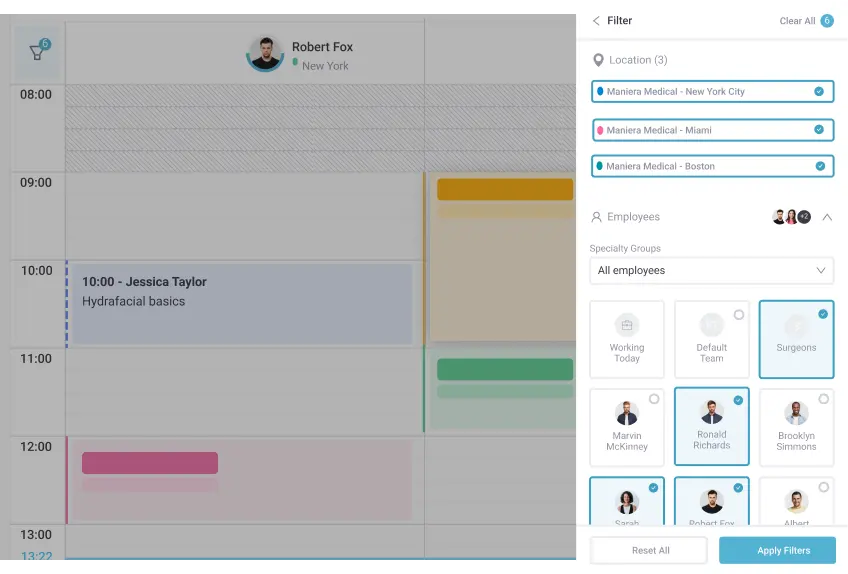
You can also ship products between practices when one location runs out of something a client needs urgently, which prevents lost sales and keeps clients happy.
Pabau’s system also tracks product sales trends across your practices, so if one location sees rising demand for an item while another has slower sales, you can redistribute stock to meet demand efficiently.
The traditional method of manually updating spreadsheets can be an arduous and time-consuming task.
That’s why an automated system in place eliminates the need for constant human intervention, resulting in a notably smoother and quicker inventory management process.
Also, a practice inventory management system significantly enhances efficiency by:
When you use Pabau’s automated inventory management system, your practice becomes paperless and your data is safely stored in the cloud.
The software will ensure that your data is not lost and it will give you the ability to access it from anywhere and on any device.
So even if you are not in your office, being paperless means you will still be able to track your inventory in real-time and make timely purchases, if needed.
Your team can handle this too. Give trusted staff permission to access the practice’s inventory, and they can make purchases on their own — even while you’re away from the practice — without needing to ask which products or suppliers to use.
Read our blog to find out why cloud software matters for your practice.
Set a par level (a minimum quantity) for every fast-moving item like injectables and anesthetic. An automated system reorders the moment stock drops below it, so you are never caught short mid-treatment.
Without automated inventory management, losing track of your supplies can hurt your practice, whatever its size — from a solo nurse practitioner’s private practice to a multi-location med spa group.
There’s a need to manage a diverse inventory that includes medical supplies, equipment, patient prescriptions, and wellness products, which brings with itself a fair share of challenges:
With all these challenges, a lack of efficient medical inventory management can throw a wrench into your practice’s daily operations. The best way to prevent this is through automation.
By using a practice inventory management tool, you can automate these processes and make your practice’s challenges disappear without breaking a sweat.
Automated inventory management simply means using specialized software to efficiently oversee and control your practice’s inventory. It’s as straightforward as that.
While this definition captures the core concept, it doesn’t fully convey the capabilities such a system brings to the table.
These invaluable features not only prevent you from needlessly restocking and overburdening your shelves but also safeguard against the accidental use of expired products on patients.
In a nutshell, automated practice inventory management isn’t just about tracking products; it’s about optimizing your practice’s operations and enhancing your decision-making process.
Equipment inventory in a medical facility is the tracked list of every reusable clinical asset the site owns, with its location, condition, and service schedule. It sits alongside consumables and pharmaceuticals as one of the three inventory types a practice manages.
It usually covers:
Tracking equipment apart from supplies keeps a device from being double-booked across rooms and stops maintenance lapsing mid-appointment.
Picture a busy day in your practice: patients in and out back-to-back, barely time for lunch, and an inventory check still waiting at the end of the day.
Because it’s a medical inventory check, the stakes are higher than in a typical stockroom — a missed item can delay a treatment or affect patient care.
Pabau takes that off your plate. It runs in real time, updating, tracking, and managing your practice’s inventory while you focus on your clients and your business. The same focus you gain there matters for clinical notes, which lose their detail when written after a full day of appointments.
Beyond tracking equipment and supplies, an all-in-one solution like Pabau also gives you:
With Pabau, the guesswork around your practice’s inventory disappears, which makes life easier for you and your staff. It’s user-friendly and requires minimal training, so your team gets value from it quickly.
Let’s break it down step by step.
Step 1: Creating categories
To kick things off, first and foremost you need to set categories for the products for a better organization. When creating a product category, you’ll need to input:
Step 2: Adding suppliers
The next thing to upload in the software to be able to make purchases through Pabau is to create suppliers and add their information.
Step 3: Setting up products
The software will allow you to enter all the products used in your practice and input all the necessary information about the products:
Once you set up your categories, suppliers, and products, making an inventory count is the next step you’ll need to take. With Pabau, you can perform an inventory count based on:
Check out how simple it is to perform an inventory count with Pabau.
And that’s it. Once your counts are complete, the software takes over.
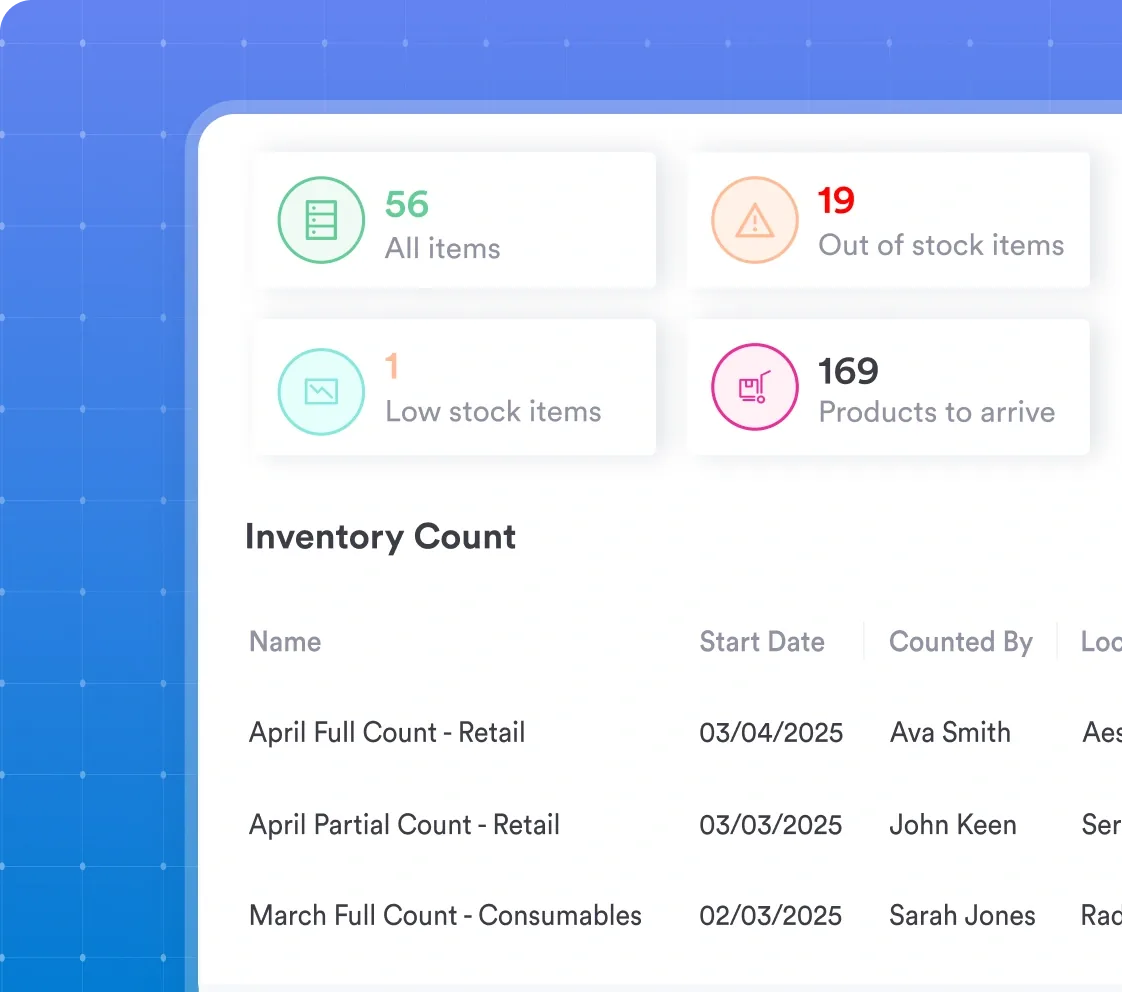
From this point onwards, it automatically manages restocking or deductions for products used during treatments or sold to your clients.
It will send you automatic reminders and alerts when you need to order more products and alert you if you have any slow-moving products.
You will be able to purchase the products through the system with only one click and even perform partial orders if necessary.
In the realm of automated inventory management systems, Pabau takes the spotlight. It not only offers all the essential features but goes the extra mile to simplify your practice’s inventory processes.
The top priority on your checklist when searching for an inventory management system is to ensure it’s purpose-designed for the healthcare industry. If your current platform falls short here, compare Semble alternatives with built-in stock control.
A medical stock management system has to do more than count boxes. Before you commit, check that it can:
The system also needs to be fast, accurate, and easy for your team to use, with the flexibility to automate order management from routine reorders through to larger purchasing decisions.
That holds regardless of specialty — whether you’re comparing the best plastic surgery software for a surgical practice or med spa scheduling software for a multi-room practice, the inventory engine underneath needs the same real-time data, integrations, and room to grow.
Pabau’s automated inventory management feature covers all of it: real-time visibility, lower costs, fewer inaccuracies, and coordination across multiple locations.
And reducing the admin work around inventory gives you more time back for your patients, your team, and yourself.
Before you commit to any system, run a two-week manual stock count and note every shortage and expired item you hit. That list becomes your demo checklist, so you can test each platform against the problems you actually have, not a generic feature grid.
Manual stock counts will always eat time you would rather spend with patients, and one missed reorder can cost you a booking. Automated inventory management takes both off your plate: real-time counts, expiry alerts, and reordering that happens before you run out.
Want to see it with your own product list? Book a demo, and we will show you how Pabau tracks stock, flags expiring batches, and reorders across every location, so you can get home in time for dinner.

Looking to cut down on documentation time? AI medical scribe tools ranks seven AI scribes for independent and mid-size practices, taking back the hour lost to notes.
Wondering how AI drafts clinical notes? AI clinical documentation explains how ambient AI drafts notes during the visit and the compliance rules practices cannot skip.
Comparing systems? Pabau’s inventory management software shows the reorder, tracking, and reporting features in action.
Manual tracking leans on spreadsheets and periodic counts, so the numbers drift the moment stock moves. An automated system updates every count as products are received, used, or sold, then flags low stock and expiring batches before they turn into a problem.
It tracks expiration dates and batch numbers and rotates products on a first-expired, first-out basis. The software flags items nearing their expiry while there’s still time to use them, and it stops you over-ordering slow movers that would sit on the shelf until they expire.
Yes. A cloud-based platform gives every site a shared view of stock, lets you move products between locations when one runs short, and compares usage trends so you can send supplies where demand is highest.