Alex Koch
Ethical consent form: free template and what to add
An ethical consent form is a written record that a patient or participant agreed...

2
Last Updated: Oct 26, 2026
Free PDF 5 pages, print-ready Clinician-reviewed
Alcohol use disorders (AUD) and hazardous drinking patterns are common in primary care and mental health settings, yet many practices lack a quick, validated screening method. The structured psychiatric evaluation template is one approach, but for a focused alcohol-specific screen, the AUDIT-C questionnaire is the gold standard. This brief guide walks you through administration, scoring, and clinical integration. Scores recorded at each session are only useful when they sit in one place, which is what psychology practice software does.
A ready-to-use, printable AUDIT-C questionnaire PDF covering alcohol consumption frequency, typical drinks consumed, and binge drinking frequency. It includes scoring instructions and interpretation guidance for primary care and mental health settings.
Upload this PDF, or any form you already use, and Pabau's AI Form rebuilds it with tick boxes, text fields and a signature. Attach it to the treatment once, and every patient gets it on time.
AI Form rebuilds the consent, history and aftercare forms you already use. You review each one, then publish.
Patients complete forms on their phone before they arrive, so the front desk stops retyping paper.
Every signed form is versioned and attached to the treatment record, ready when you need it.
Set how long a consent stays valid. Returning patients skip forms they have already signed.
Supports HIPAA and GDPR compliance AES-256 encryption 4.8 on G2 4.7 on Capterra Trusted by 4,000+ practices worldwide

The AUDIT-C questionnaire is a 3-item alcohol screening tool derived from the WHO’s full AUDIT and separately validated by VA researchers, used in primary care and mental health settings to identify hazardous or harmful drinking.
Scores range from 0-12; sex-specific positive thresholds are ≥3 for women and ≥4 for men, though guidelines vary, so always cite your source when interpreting results.
The AUDIT-C takes 2-3 minutes to administer and can be self-administered or clinician-led, making it practical for routine screening in busy practices.
Pabau’s digital forms and automated workflows allow you to embed AUDIT-C screening into your patient intake process, saving time and ensuring consistent documentation.
The AUDIT-C questionnaire is a 3-item, validated alcohol screening tool derived from the full 10-item Alcohol Use Disorders Identification Test (AUDIT), which was developed by the World Health Organization (WHO).
Also called the AUDIT-C test or AUDIT-C assessment, the abbreviated version was later created and validated by VA researchers (Bush et al., 1998) to quickly identify patients whose alcohol consumption is hazardous or harmful.
Unlike the full AUDIT, which takes 5-10 minutes, the AUDIT-C takes only 2-3 minutes to complete, making it ideal for time-constrained primary care, emergency departments, and mental health practices.
It screens three dimensions of alcohol use: drinking frequency, typical quantity, and binge drinking episodes. A positive screen prompts clinicians to consider the full AUDIT, brief intervention, or referral for further assessment.
The AUDIT-C is widely used in U.S. Veterans Affairs clinical practice, primary care settings, and HIV clinics. It has been validated across diverse patient populations and demonstrates high sensitivity and specificity for detecting AUD risk.
Each of the three questions uses a Likert scale (0-4 points per item) and addresses a distinct aspect of alcohol consumption. Here are the verbatim questions as they appear on the validated instrument:
These questions capture the three domains of alcohol use: frequency, quantity, and heavy episodic drinking. Patients may self-administer the questions or respond verbally during a clinician-led interview.
Scoring is straightforward: sum the points from all three questions to yield an AUDIT-C score ranging from 0 to 12. Each item contributes equally (0-4 points).
Record each answer and add them to obtain the total. No reversed scoring or weighting is required. It is a straightforward summation.
Score interpretation differs by sex. The most common positive-screen thresholds are ≥3 for women and ≥4 for men, though some clinical guidelines recommend ≥4 for all adults. Always cite the guideline source you are using in your practice policy to ensure consistency and defensibility.
Within the positive range, higher scores generally indicate greater risk, though the AUDIT-C itself does not define additional validated cutoffs beyond this single threshold.
A positive AUDIT-C screen does not constitute a diagnosis of AUD alone. Clinical correlation and further assessment, via the full 10-item AUDIT, structured interview, or specialist consultation, are required. The AUDIT-C is a screening tool, not a diagnostic instrument.
The AUDIT-C can be administered in two ways: as a self-report questionnaire completed by the patient, or as a clinician-administered interview. In busy primary care and mental health practices, digital intake forms streamline both approaches.
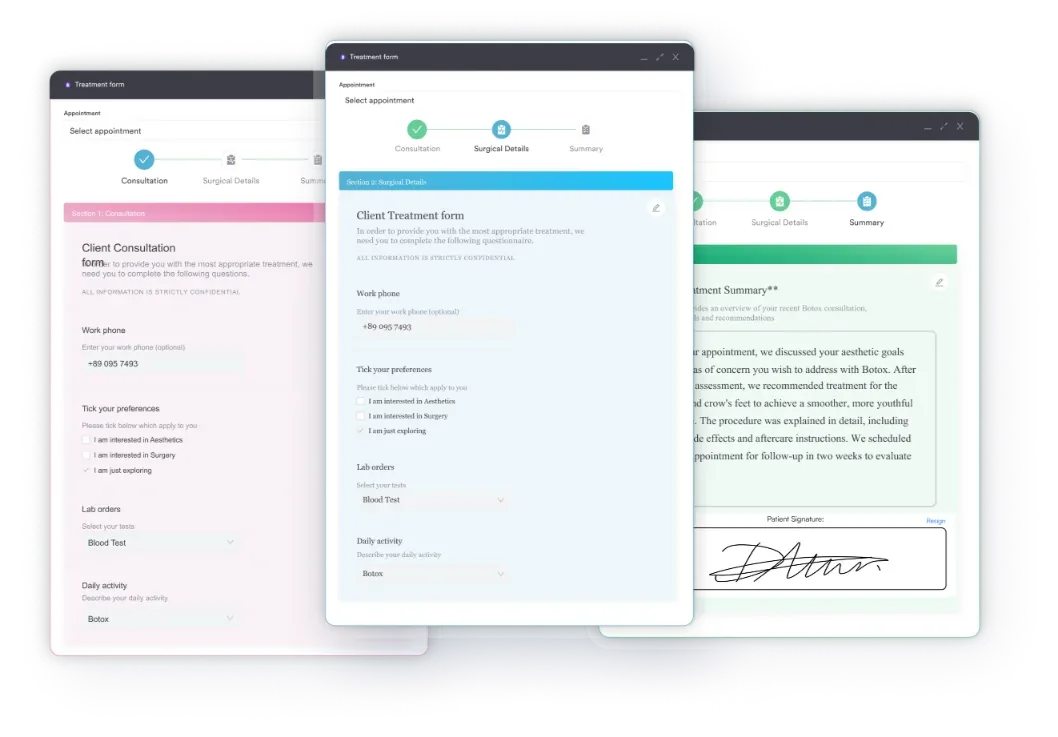
Self-administered approach: Provide the printable AUDIT-C form or fillable PDF to patients during intake. They complete it before or during the appointment, and you review the score. This works well in practices with online check-in or intake tablets.
Clinician-administered approach: Ask the three questions verbally during the history-taking phase of a consultation. Responses are recorded directly on the form or in the patient’s clinical record. This method allows you to clarify responses and observe nonverbal cues.
Both methods are validated. Choose based on your workflow and patient population. For automated clinical documentation, recording responses in a structured field allows your AI scribe to capture and transcribe them into your clinical note automatically.
The key difference is length and detail. The full 10-item AUDIT takes 5-10 minutes and assesses dependency and harmful use more thoroughly. The AUDIT-C is a faster screening gate: if scores are positive, you then administer the full AUDIT for deeper assessment.
Most primary care practices adopt this two-stage approach: AUDIT-C for universal screening at every visit or during intake, then full AUDIT for patients with positive screens. Practices that already use a psychological evaluation template for mental health intake can add AUDIT-C as a standard field within the same workflow.
The biggest operational challenge is remembering to administer AUDIT-C consistently. Embedding it into your patient records management system makes it routine. Here’s how:
Practices using mental health EMR software with intake-form builders can template the AUDIT-C and activate it for all new patients in seconds, removing manual work and keeping screening consistent and defensible.
The AUDIT-C has been extensively validated across primary care, veterans’ clinics, and HIV settings. According to Bradley et al. (2007), sensitivity and specificity vary by sex and the cutoff used:
The AUDIT-C is widely used in HIPAA-compliant screening workflows and supported by NIH Common Data Elements standardization, reflecting its clinical utility and regulatory acceptance.

Embed AUDIT-C into your intake forms, automate scoring, and keep results in one integrated patient record. Learn how Pabau helps practices deliver consistent, defensible screening.

Any time you administer a screening tool and store patient responses, you are handling protected health information (PHI). If your practice is HIPAA-covered or operates in the UK under GDPR, ensure your form, storage, and access controls meet regulatory standards. Screening results are part of the patient’s medical record and must be retained per your legal hold and record-retention policies.
Screening is also reimbursable in the US. There is no AUDIT-C CPT code specific to the tool itself, but alcohol misuse screening and brief counseling are billable under HCPCS codes G0442 and G0443, or CPT codes 99408 and 99409. Recording the AUDIT-C result against the encounter supports both patient care and reimbursement.
Storing screening data in your EHR (rather than on paper or unencrypted spreadsheets) ensures better audit trails and regulatory defensibility.
The AUDIT-C questionnaire is a proven, efficient alcohol screening tool that fits into primary care, mental health, and addiction medicine workflows. Its brevity, just 3 questions in 2-3 minutes, removes barriers to universal screening.
Use the downloadable PDF template above, and consider embedding the AUDIT-C into your digital comprehensive patient management system to automate scoring and keep results in one secure, auditable record.
For practices ready to move beyond manual forms and paper filing. The investment in a structured screening protocol pays off in earlier detection, better outcomes, and documented compliance.

Supporting a client’s daily recovery routine? Daily inventory worksheet guides clients through a daily emotional inventory to support relapse prevention.
Working with clients in a 12-step recovery program? 10 step inventory worksheet gives clients a structured way to take ongoing personal inventory during recovery.
Treating a client for codependency? 12-step codependency worksheet walks clients through a structured, step-by-step reflection process for working through codependency.
AUDIT-C stands for the Alcohol Use Disorders Identification Test – Consumption. It is the 3-item consumption-focused version of the full 10-item AUDIT (Alcohol Use Disorders Identification Test) developed by the World Health Organization.
A positive screen is typically ≥3 for women and ≥4 for men, though some guidelines recommend ≥4 for all adults. A positive screen indicates hazardous or harmful alcohol use and warrants further assessment, not a diagnosis of alcohol use disorder.
The AUDIT-C contains only the 3 consumption items from the full 10-item AUDIT and takes 2-3 minutes, making it ideal for universal screening. The full AUDIT adds 7 more items assessing dependence and harm, taking 5-10 minutes, and is used after a positive AUDIT-C screen.
Yes. The AUDIT-C has strong evidence for use in primary care settings, with sensitivity of about 73-86% and specificity of about 89-91% depending on sex and cutoff (Bradley et al., 2007). It is derived from the WHO’s AUDIT and widely used in U.S. Veterans Affairs and other healthcare systems.
Yes. A printable AUDIT-C questionnaire PDF is available above. You may also find free PDFs at auditscreen.org, which is maintained by the WHO AUDIT developers.
A positive score prompts further assessment via the full AUDIT, structured brief intervention (education about health risks, reduction strategies), or referral to an addiction specialist, depending on your practice protocols and the patient’s clinical context. Document your assessment and any counseling offered in the patient record.
Yes. The AUDIT-C is validated for both self-administration (paper or digital form) and clinician-administered interview. Self-administration is commonly used in primary care intake workflows and saves clinician time.
The AUDIT-C is most appropriate for adults. Validation in pregnant women, adolescents, and elderly patients is more limited. Consult population-specific guidance if you screen these groups. It is not recommended for patients with active severe alcohol withdrawal symptoms.
The AUDIT-C is designed for health care practitioners, but this brief screening tool can also be self-administered by patients or completed with trained non-clinical staff when clear instructions are provided. In many practices, patients fill it in during digital intake and a clinician reviews the score.