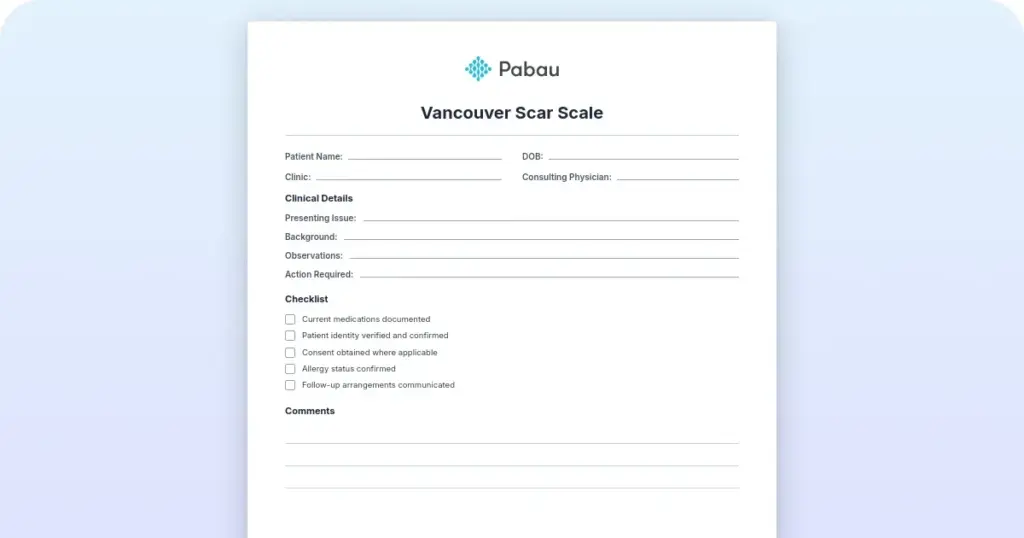
Vancouver scar scale template & scoring guide
Download your free Vancouver Scar Scale template A ready-to-use scoring form cov...

44
Last Updated: Sep 16, 2026

The Bayley Scales of Infant and Toddler Development is the standard tool for identifying developmental delays in young children.
Bayley-4 assesses children from 16 days to 42 months, while Bayley-3 covers 1 to 42 months.
The test measures cognition, language, motor skills, social-emotional development, and adaptive behavior. Composite scores use a mean of 100 and a standard deviation of 15.
Use corrected age for babies born before 37 weeks, until 24 to 36 months corrected age, or the scores will read as falsely delayed.
Pabau’s digital forms and patient portal help practices collect caregiver questionnaires, book follow-up assessments, and share progress reports with families.
A printable reference covering the five domains the Bayley Scales measure, from cognition and language through to adaptive behavior. Inside you get scoring guidelines, composite score interpretation ranges, and a corrected-age reminder for preterm infants.
Download templateThe Bayley Scales of Infant and Toddler Development is one of the most widely used standardized assessments in pediatric practice. Early intervention programs and developmental researchers lean on it just as heavily.
Clinicians use it to identify delays, plan treatment, and track progress. It also establishes eligibility for early intervention services under the Individuals with Disabilities Education Act, known as IDEA. This guide covers administration, scoring, and interpretation, including the corrected-age rule that decides whether a preterm score means anything at all. Recording measurements the same way each visit is what makes progress visible, and physical therapy EMR software enforces it.
The Bayley Scales of Infant and Toddler Development is a standardized, norm-referenced test of developmental functioning across five domains. The current edition, Bayley-4, assesses children from 16 days to 42 months of age.
The previous edition, Bayley-3, covers children aged 1 to 42 months. Both editions produce scaled scores and composite scores that clinicians use to identify delays, plan early intervention, and track progress over time.
Pearson Assessments publishes the test, which has been revised repeatedly since the original 1969 version. Each edition brings updated normative data that reflects current population demographics.
The assessment is grounded in developmental psychology, with extensive research behind its reliability and validity. That evidence base covers children born prematurely, children with developmental disorders, and children with known delays.
Screening tools such as the Ages and Stages Questionnaire work differently. A screen flags a possible concern in minutes, while the Bayley builds a detailed profile of strengths and weaknesses in every domain. That depth is what a comprehensive assessment of a young child calls for.
The same detail carries the documentation load in pediatric mental health records, NICU follow-up programs, and early intervention eligibility decisions. Diagnostic manuals and early intervention law both treat the Bayley as the clinical standard.
Administering the Bayley Scales takes training, careful protocol adherence, and a quiet testing space. Most sessions run 30 to 90 minutes, depending on the child’s age, cooperation, and the edition in use.
Bayley-4 administration is more streamlined than Bayley-3. Qualified examiners include psychologists, developmental pediatricians, occupational therapists, speech-language pathologists, and other licensed clinicians with formal Bayley training.
Scoring produces two types of standardized scores. Scaled scores (mean 10, standard deviation 3) describe performance on individual subtests. Composite scores (mean 100, standard deviation 15) combine related subscales into broader domain scores.
The Language Composite, for example, combines the receptive and expressive communication subscales. You convert raw scores against the age-stratified normative sample, using either the scoring software or the published tables.
For children born before 37 weeks gestation, use corrected age rather than chronological age. Corrected age is chronological age minus the number of weeks the child was born early, and it applies until roughly 24 to 36 months.
The adjustment exists because maturation tracks from the due date, not from an early birth date. Skip it in NICU follow-up and the scores come back artificially low, which labels a child delayed when development is on track.
Gathering caregiver input before the session saves time on the day. Digital intake forms let parents answer the adaptive behavior and social-emotional questions at home. There they can think properly about how their child behaves day to day.
The Bayley Scales serve a wide range of clinical populations and settings. Developmental pediatricians, pediatric psychologists, therapists, and neonatologists use it to screen for delays, confirm suspected delays, and measure treatment progress.
Early intervention coordinators rely on Bayley scores to determine Part C IDEA eligibility and to build individualized family service plans (IFSPs). Referrals tend to cluster around a few groups:
Those cases usually involve three or four disciplines at once, and everyone needs the same record of what the assessment found. Occupational therapy practice management tools keep scheduling and documentation in step across the team.
Researchers use the Bayley too, as an outcome measure for developmental studies. It also shows up in curriculum work for early intervention programs and in evaluations of whether a program is working.
Bayley-4 arrived in 2019 and moved several things on from Bayley-3 (2006). The biggest change is the age range. Bayley-4 starts at 16 days rather than 1 month, so newborns in high-risk follow-up can be assessed formally.
Administration is faster too, typically 30 to 45 minutes against Bayley-3’s 45 to 90. Normative data now reflects 2015-2018 US Census demographics, so scoring standards match today’s population.
The digital scoring platform also replaces most of Bayley-3’s manual conversion tables, which cuts scoring errors. Both editions cover the same five domains, but Bayley-4 reorganizes the subscales to read more clearly in early infancy.
Bayley results anchor early intervention planning. A composite score of 70 or below sits two or more standard deviations under the mean. That usually opens a Part C IDEA eligibility discussion and IFSP development.
Coordinators and clinicians then turn the domain profile into family-centered goals. A low motor composite points to milestone work, a low language composite to communication goals, and a low adaptive score to daily independence.
Therapists build their sessions from that profile. A behavioral intervention plan handles the social-emotional targets, while speech therapy worksheets carry the articulation and language work.
The results also decide what you share, and with whom. Secure progress reports keep parents current, and schools, therapy providers, and the pediatric medical home all need the same picture.
Serial administrations, usually every 6 to 12 months, show whether the intervention is working. Read score changes carefully, because measurement error and genuine progress can look alike on a first pass.
Documentation best practice: AI-assisted clinical notes capture what happened in the session, not only the numbers. Record how the child engaged, how they responded to each task, and how the scores connect to functional goals.
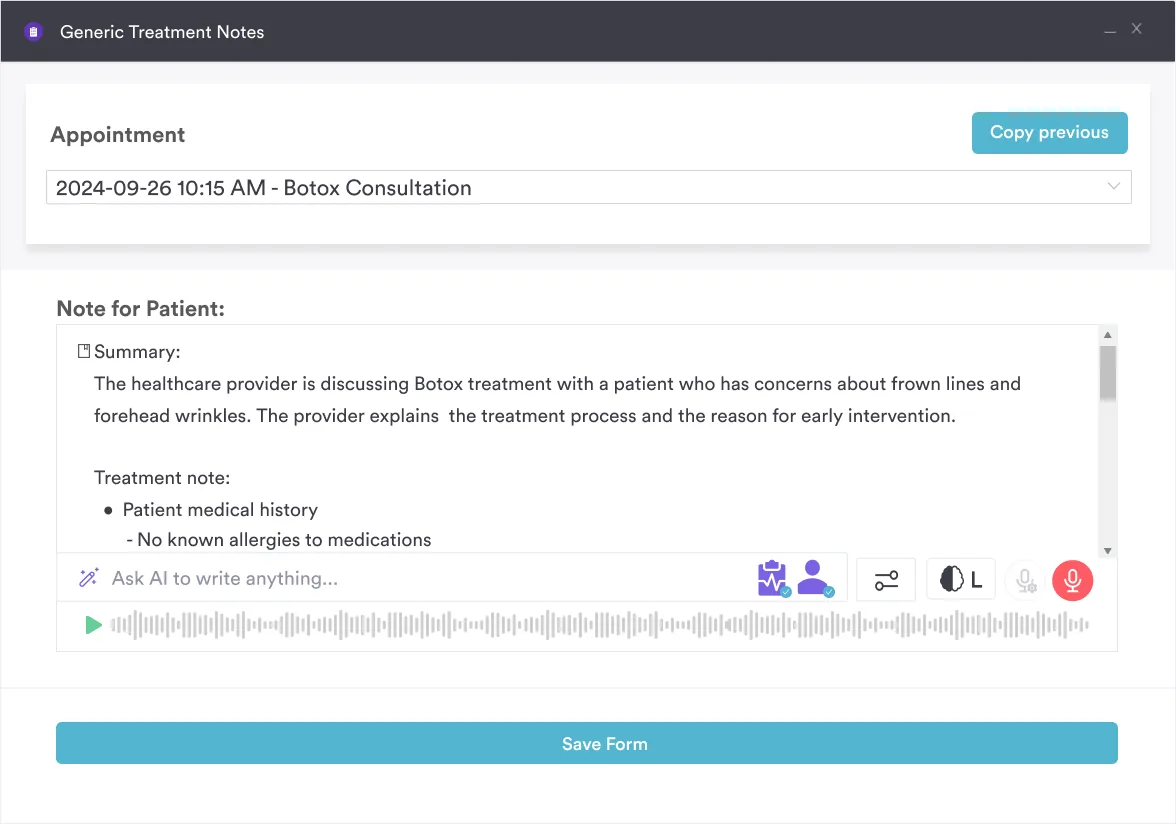
Capturing structured observations during the session gives the early intervention team more than a score sheet. The appointment is also a good moment to ask parents what they see at home and what they want to work on.
A busy assessment caseload usually runs on several disconnected systems. Scheduling sits in one place, caregiver questionnaires come back on paper, and progress reports go out as email attachments that nobody tracks afterwards.
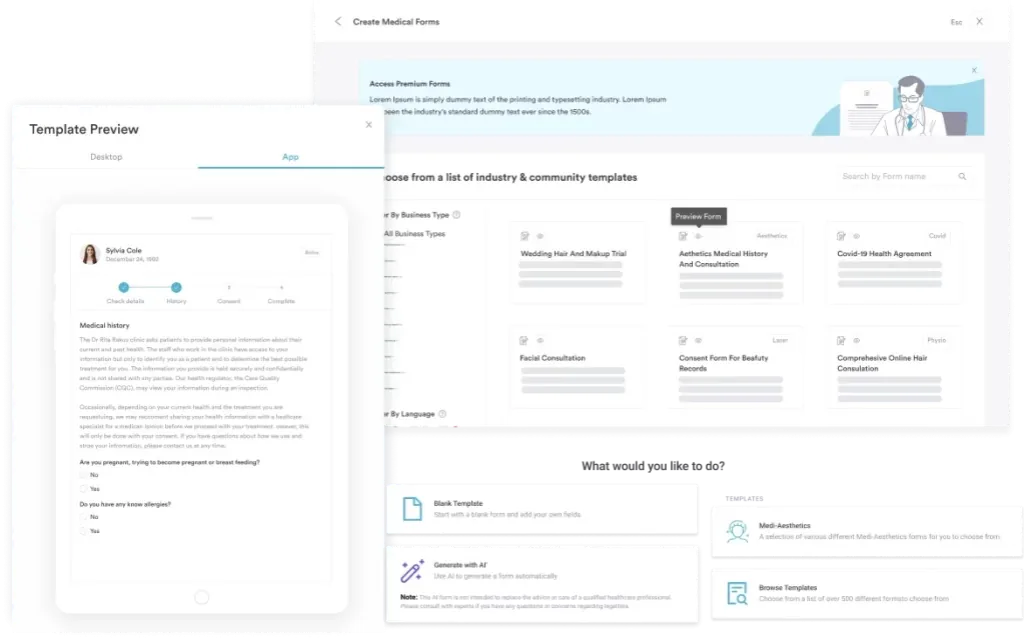
Practice management software like Pabau holds all of it against one client record. Caregiver forms arrive completed before the visit. Session notes attach to the same file, and automated follow-up messages send families their next steps without anyone chasing it.
Reminders and rebooking matter more here than in most specialties, because a missed follow-up pushes the next score back by months. Reducing no-shows keeps serial assessments on schedule and eligibility reviews on time.
Every Pabau subscription includes every feature, so a two-clinician early intervention team works with the same forms, portal, and reporting as a hospital follow-up program. Corrected age, consent, and referral records stay in one place when an audit asks for them.

Schedule assessments, document caregiver questionnaires, and share progress reports with secure access for families and referral partners.

The Bayley Scales give you a developmental profile no screening tool can match, and that depth is why the scores carry eligibility decisions. What they cost you is time, training, and attention to detail.
Corrected age is where most of that attention belongs. Get it wrong on a preterm infant and you can hand a family a delay the child never had. That paper follows the child for years.
Download the template above, keep it with your scoring materials, and make one person responsible for confirming corrected age before every session. Book a demo to see how Pabau handles caregiver forms, follow-up scheduling, and progress reports for developmental assessments.

Screening for subacromial impingement next? Yocum test guide shows how to load the subacromial space and read a positive shoulder pain result.
Following up on fine motor scores? Pinch grip test explains how to test grip strength and what the numbers mean.
Planning language activities after the assessment? Parts of the body worksheet supports early vocabulary work with young children.
Need a template to score gait speed? 10-meter walk test template turns a short walk into an objective gait speed score, with a downloadable scoring form.
The Bayley Scales of Infant Development identifies developmental delays, guides early intervention planning, and measures treatment progress. It also establishes Part C IDEA eligibility for infants and toddlers. Clinicians across pediatrics, psychology, occupational therapy, and speech-language pathology rely on the results for clinical decision-making.
Bayley-4 assesses children from 16 days to 42 months of age. That includes newborn screening in NICU settings, an expansion from Bayley-3, which began at 1 month.
Bayley scores include scaled scores (mean 10, SD 3) for individual subtests and composite scores (mean 100, SD 15) for each domain. Scores of 70 to 79 fall in the Borderline range, and anything below 70 indicates substantial delay. Scores of 80 to 89 are low average, which means you monitor development rather than refer immediately.
Corrected age is chronological age minus the number of weeks a baby was born early. Use it for children born before 37 weeks gestation, until roughly 24 to 36 months corrected age. Without the adjustment, normal development in a preterm infant reads as delay.
Bayley-4 starts at 16 days, while Bayley-3 started at 1 month. Administration runs 30 to 45 minutes rather than 45 to 90. Bayley-4 also carries updated 2015-2018 normative data and an easier digital scoring platform. Both editions assess the same five developmental domains.
Qualified examiners include psychologists, developmental pediatricians, occupational therapists, speech-language pathologists, and other licensed clinicians with formal Bayley training. Administration calls for a working knowledge of child development, standardized testing protocols, and clinical interpretation.
Re-administration frequency depends on clinical context. NICU follow-up programs typically test at 12 and 24 months corrected age. Early intervention programs may re-test every 6 to 12 months to measure progress. Intervals shorter than 6 months raise the risk of practice effects on scores.