Antipsychotic medication list
An antipsychotic medication list is a structured reference that organizes psychi...

2
Last Updated: Oct 13, 2026

Leaves on a Stream is an Acceptance and Commitment Therapy (ACT) exercise that teaches clients to observe thoughts without judging them.
Clients picture a flowing stream and set each thought on a passing leaf, which builds cognitive defusion for anxiety, rumination, and intrusive thoughts.
The free PDF is one page. It holds a single guided script of about five minutes, with paced pauses, a name and date field, and a notes box.
Session length comes from your pacing rather than from the file, so this page also covers short, full, and extended delivery.
Practice management software like Pabau keeps the exercise, the session note, and the follow-up message in one client record.
A one-page printable script for the Leaves on a Stream cognitive defusion exercise, written to read aloud in session. It runs about five minutes and marks fixed pauses of 10 to 20 seconds. A name and date field plus a notes box keep it ready for the client’s record.
Download templateLeaves on a Stream asks a client to picture a stream and set each thought on a passing leaf. The words you choose matter, and so does the silence you leave between them.
This page carries the full script to read aloud, shorter and longer ways to pace it, clinical indications, and debrief questions. The free PDF holds the core five-minute script for use in the room. Software for mental health practice management can then hold the note that follows in the client’s record.
The leaves on a stream script is a guided meditation text rooted in Acceptance and Commitment Therapy (ACT). Clients close their eyes and imagine sitting beside a gently flowing stream. Each time a thought, worry, memory, or sensation arises, they place it on a leaf and watch it float downstream. They do not try to change it, stop it, or chase it.
The exercise teaches cognitive defusion, which is the ability to step back from a difficult thought and see it as a passing mental event. A fused client says “I’m anxious.” A defused client says “I’m having the thought that I’m anxious.” That small change in wording carries a large change in how much the thought controls the next hour.
Cognitive defusion is one of six core processes in the ACT hexaflex model. It’s the process that makes ACT useful for anxiety, depression, rumination, and obsessive-compulsive patterns.
Rumination and intrusive thoughts lose their grip once a client sees that they do not have to fight them, suppress them, or believe them. Leaves on a Stream makes that shift immediate rather than theoretical.
Below is the complete leaves on a stream script. Read it aloud in session, or record it and play it back. Read slowly, and hold each pause for as long as the script marks.
“Find a comfortable position, sitting or lying down. You can keep your eyes open or gently close them, whichever feels right for you.
Take a moment to settle into your body. Notice the weight of your body supported by the chair or the floor. Feel your feet on the ground. Notice your breathing, without trying to change it.
[PAUSE 5 seconds]
Now, in your mind’s eye, imagine a forest clearing with a gentle stream flowing through it. The water moves slowly, unhurried. You are sitting on the bank of this stream, perhaps on soft grass or smooth stones. The air is calm. There is no rush, and nowhere to be.
[PAUSE 5 seconds]
As you sit here, you begin to notice leaves floating down the stream. Some are green, some are brown or gold. They drift past at their own pace. Some move quickly, some slowly. Each leaf is simply passing through.
[PAUSE 3 seconds]
Now, here is the practice. Each time a thought arises, and thoughts will arise, imagine placing that thought on a leaf. Do not fight it. Do not try to stop it. Just place it gently on a leaf and let the stream carry it away.
A worry about tomorrow? Place it on a leaf. A memory from the past? A leaf. A sensation in your body, a thought about this exercise, a feeling? All of it goes gently onto leaves.
[PAUSE 5 seconds]
Some leaves move quickly downstream. Some circle slowly. Some get caught for a moment and then float on. Your job is not to make them move faster or slower. Simply notice them, place them on the water, and let the stream do its work.
[PAUSE 5 seconds]
If you find yourself caught up in a thought, lost in it, forgetting the stream, that is completely natural. That is what minds do. When you notice it, simply pause and come back. Place that thought or feeling on a leaf too, then return to watching.
[PAUSE 5 seconds]
Continue sitting here, noticing the stream, placing thoughts on leaves. There is nowhere to go and nothing to accomplish. You are exactly where you need to be.
[PAUSE 10 seconds]
When you are ready, and that might be in a few moments or a few minutes, begin to bring your awareness back to your body. Notice your breath again. Feel the ground beneath you. Gently open your eyes and return to the room.”
For clients new to the exercise, or for sessions with little time left, use this condensed wording.
“Close your eyes and imagine sitting beside a gentle stream. Leaves float past on the water. Each time a thought appears, whether a worry, a memory, or a sensation, place it on a leaf and watch it drift away. No judgment, no struggle, just watching. Stay with it for a few minutes, and return to the stream whenever your mind wanders.
When you are ready, open your eyes.”
For deeper work, read the full script with longer pauses of 10 to 15 seconds. Add sensory detail as you go, such as the sound of the water, the temperature of the air, and the texture underfoot. Leave an extra minute of silence after the core practice before you guide the client back.
Length is a pacing decision rather than a different script. The same words stretch or compress depending on how long you hold each pause.
The download is a single printable page, built for use in the room rather than for reading beforehand. It contains four things.
The file does not hold separate short and extended documents, a delivery-guidance section, or debrief questions. Those all sit on this page instead. Print the PDF for the session, and use this page to prepare and to debrief.
Delivery rests on three things: the setting, your pacing, and your presence in the room. Here is how the exercise fits into standard therapy practice workflows.
The conversation afterward is where the learning consolidates. These prompts live on this page rather than in the PDF. Keep the page open during the debrief, or copy the ones you use most into your note template.
Defusion work suits any presentation where a client treats a thought as an instruction.
Contraindications: Hold this exercise back from clients in acute dissociation, active psychosis, or severe emotional dysregulation until grounding skills are in place. With trauma survivors, check that your digital intake forms record any history of dissociative episodes. Have a grounding protocol ready before you begin.
No two clients are identical, so adapt the wording to fit the person in front of you.
Record which adaptation you used and how the client responded. Over a handful of sessions, those notes show you which phrasing works with which client, and your delivery improves from evidence rather than memory.
Acceptance and Commitment Therapy starts from an unusual premise. The trouble lies less in the thoughts and feelings themselves, and more in a client’s relationship with them. Traditional cognitive behavioral approaches work to change or remove a negative thought, while ACT works to change how the client holds it.
Leaves on a Stream puts that shift into practice. Watching thoughts as leaves rather than commands builds the psychological flexibility ACT aims for. Research collected by the Association for Contextual Behavioral Science links defusion to less distress from unwanted thoughts. Peer-reviewed studies also report gains in quality of life.
The skill also transfers. A client notices a worry arriving and doesn’t get hooked by it, so work, relationships, and self-care continue while the anxiety talks. That is psychological flexibility in daily use, and a choice point worksheet tracks it between sessions.
Write the session up while it is fresh. Your psychotherapy progress notes should hold how the client responded, any emotional reaction, and the insight from the debrief. Read that against the baseline from their comprehensive assessment to see what has shifted.
Then set the exercise as homework. Ask the client to try it whenever they notice rumination or anxiety building.
They can read the printed script, play a recording, or simply recall the metaphor of the stream and the leaves. For a child with a school-based plan, write the skill into their behavioral intervention plan so everyone uses the same wording.
A short follow-up message a few days later lifts adherence more than any instruction given in the room. One question is enough: did you try it, and what did you notice?
In most practices the script sits in a folder on someone’s desktop. The session note lives in a separate system, and the follow-up never gets sent. Reconstructing what a client did last time then means opening three places at once.
Practice management software like Pabau keeps all of it in one client record. Digital intake and assessment forms capture the baseline and the safety history before you run a defusion exercise. Customizable session notes then let you log the pacing you used and how the client responded.
Pabau Scribe, our AI scribe, transcribes the debrief and structures the note around your treatment goals. You spend less of the evening writing up sessions, and the detail that usually gets lost stays on file.
Homework travels the same way. Share the script through the secure client portal, then let automated workflows send the check-in message and the short follow-up form a few days later. HIPAA-compliant software keeps every note and reply secure and audit-ready.
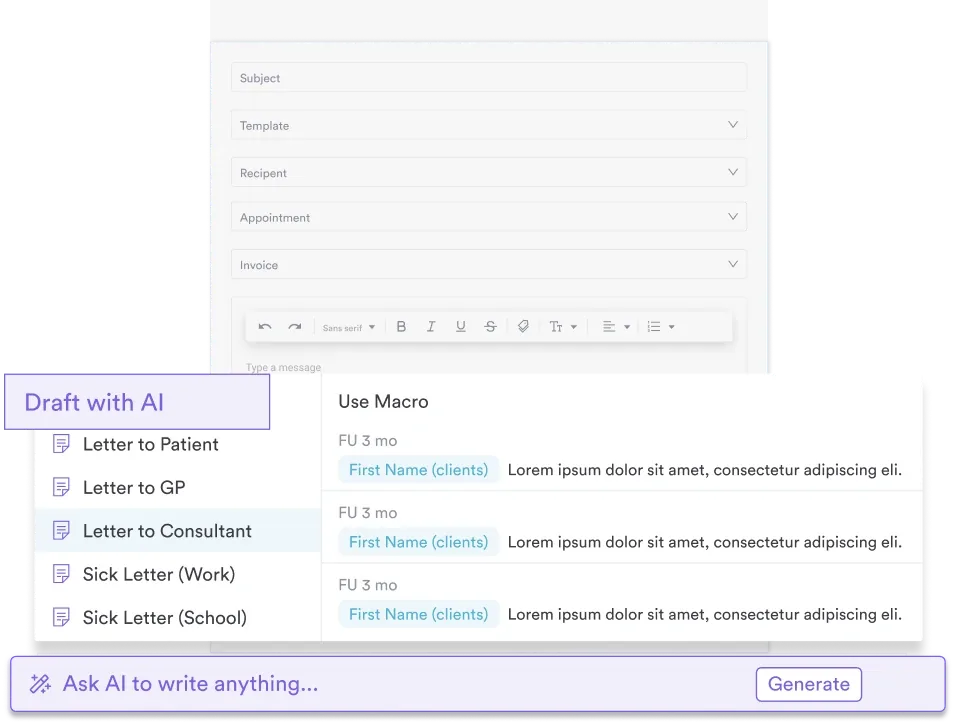

Pabau keeps intake forms, session notes, and follow-up messages in a single client record. Customizable note templates and Pabau Scribe, our AI scribe, capture how each client responded to the exercise you ran.

Leaves on a Stream is a small exercise with a long reach, and the delivery decides how far it travels. Slow pacing, honest framing, and a real debrief matter more than the exact wording you read out.
Print the PDF for the room and keep this page for preparation. Screen for dissociation first, start with the short pacing, and stretch the pauses only once the client is comfortable watching their own thoughts.
The exercise then compounds if the practice around it holds. Book a demo to see how Pabau stores the exercise, the session note, and the follow-up in one client record.

Want a mindfulness exercise clients do between sessions? Mindfulness walk worksheet turns a short walk into structured five-senses practice.
Building acceptance work around the same client? Acceptance and sources of strength worksheet pairs willingness with the resources a client already has.
Need a defusion tool for black-and-white thinking? All-or-nothing thinking worksheet helps clients catch an extreme thought and find the middle ground.
Revising the wider CBT toolkit? CBT cheat sheet sets out the distortions, techniques, and session structure on one page.
Writing the plan this exercise belongs to? Psychology treatment plan template links presenting problems to goals and measurable interventions.
Leaves on a Stream is a guided mindfulness meditation used in Acceptance and Commitment Therapy (ACT). It teaches clients to observe their thoughts without getting caught in them. Clients imagine sitting beside a stream and placing each thought on a leaf as it floats downstream. That builds cognitive defusion, which is the ability to see a thought as a passing mental event.
Yes. It is a core cognitive defusion exercise in Acceptance and Commitment Therapy. Defusion is one of the six processes in the ACT hexaflex model. Therapists across counseling, psychology, and psychiatry use it to build psychological flexibility.
Therapists use it for anxiety disorders, depression, rumination, obsessive-compulsive patterns, insomnia, trauma-related intrusive thoughts, and perfectionism. It fits anywhere a client is fused with a difficult thought. Hold it back in acute dissociation, active psychosis, or severe emotional dysregulation until grounding skills are in place.
Yes. Video delivery works well when the client is somewhere quiet and comfortable. Slow your pacing a little more than you would in the room. Check that they can close their eyes safely, so never run it while a client is driving. Some clients find vulnerable work easier from home.
Listen for a change in how the client talks about their thoughts. Naming a thought as a thought, rather than stating it as fact, is the shift you want. Watch for less struggle with intrusive thoughts, better sleep, or less rumination. Over several sessions, check that work, relationships, and self-care continue even when anxiety shows up.