CPT Code 62284: Injection procedure for myelography
CPT Code 62284: official descriptor and procedure overview The American Medical ...

Last Updated: Oct 19, 2026
V5268 is the HCPCS Level II code for an assistive listening device, telephone amplifier, any type. It covers inline, handset, and phone-only portable amplifiers that boost a caller's voice for a patient with documented hearing loss.
The code sits in the V5268-V5290 assistive hearing device group, separate from the wearable hearing aid codes. Traditional Medicare excludes it by statute, so payment depends on Medicaid, Medicare Advantage, or commercial plan rules.
Let Pabau's smart automation suggest the right codes, reduce claim denials, and keep your practice compliant—effortlessly.
Automate repetitive tasks and focus on what matters most—your patients.
Reduce coding errors and ensure compliance with the latest regulations.
Clean claims, fewer denials, and faster reimbursements.
Powerful insights and reporting to help your practice thrive.
HIPAA compliant SOC 2 certified GDPR-compliant Trusted by 4,000+ clinics worldwide

V5268 describes a telephone amplifier dispensed as an assistive listening device (ALD), not a conventional hearing aid.
Medicare Part B excludes hearing aid and ALD benefits by statute, while Medicaid coverage varies by state.
Claims need a written order, a current audiogram, and often a certificate of medical necessity before submission.
The device decides the code, so a wearable hearing aid billed as V5268 will deny whatever the payer.
HCPCS Code V5268 is the Level II code for an assistive listening device, telephone amplifier, any type. The amplifier boosts sound through a telephone handset or inline coupler during calls, rather than correcting hearing all day.
That distinction decides which payer rules apply and which documentation you need. If Level II coding is new to you, start with these medical billing fundamentals.
The AAPC HCPCS Level II code reference lists V5268 under the assistive hearing devices subsection, alongside other ALDs such as alerting devices and television amplifiers.
Descriptors can change in the annual update, so confirm the wording against the current CMS alpha-numeric HCPCS file. For the neighboring V-codes, browse our HCPCS code library.
V5268 is narrow in scope. It covers telephone amplifiers that boost the voice signal through a handset or inline coupler for a patient with documented hearing loss. The device must match the descriptor: any type of telephone amplifier classified as an ALD.
If the dispensed device corrects hearing all day rather than amplifying calls, V5268 is the wrong code. Submitting it for a conventional hearing aid is one of the leading denial triggers in this code range.
Billing V5268 follows a standard assistive device pathway in seven steps. Document each one before the claim goes out.
Every V5268 claim needs at least one ICD-10-CM diagnosis code that establishes medical necessity for a telephone amplifier. Payers match the diagnosis against their local coverage determination (LCD) or benefit policy. The H90 and H91 families cover the most commonly accepted diagnoses.
Bilateral sensorineural loss, H90.3, is the diagnosis most often paired with V5268. Individual payer LCDs may still restrict accepted codes to a subset of the H90/H91 range, so check the LCD before submitting. Some Medicaid managed care plans also require the audiogram to state the degree of loss (mild, moderate, severe, or profound).
Medicare Part B excludes hearing aids and most assistive listening devices from coverage under the Social Security Act. That exclusion applies to V5268, so traditional Medicare does not reimburse telephone amplifiers billed under this code.
Medicare Advantage (Part C) plans set their own supplemental benefits. Some cover ALDs as a hearing benefit, but this is plan-specific and changes from year to year.
Medicaid coverage varies significantly by state. Minnesota DHS, for example, covers hearing aid services, including HCPCS V-codes, for eligible Medicaid enrollees. Other states cover telephone amplifiers only for pediatric populations or not at all. Billing a state Medicaid program before confirming its hearing device policy is a reliable route to denial.
With audiology claims management software, you can build each payer’s coverage position into the billing workflow. A V5268 claim for a non-covering payer then gets flagged early. Staff can issue the Advance Beneficiary Notice (ABN) before dispensing rather than after the denial.
Prior authorization requirements for V5268 depend on the payer, so verify them claim by claim. Running insurance eligibility verification before each encounter surfaces PA requirements early enough to act on them.
PA approval does not guarantee reimbursement. If the dispensed device differs from the one in the PA request, the claim may still deny. Record the exact manufacturer and model in the PA submission and match them precisely on the claim.
Incomplete documentation is a common reason V5268 claims deny. Practices that meet medical billing compliance requirements assemble the file before submission, not after a denial forces an appeal. Every item below must be on file when the claim goes out.
Run a pre-submission checklist for every V5268 claim. Confirm the order is signed and the audiogram falls within the payer’s window. Check that the CMN is complete, the PA number is recorded, and proof of delivery is in the chart. One missing item can deny an otherwise clean claim.
The V52xx range includes dozens of codes for hearing aids, ALDs, and related hearing devices. Four codes cause the most confusion with V5268, so they are worth comparing directly.
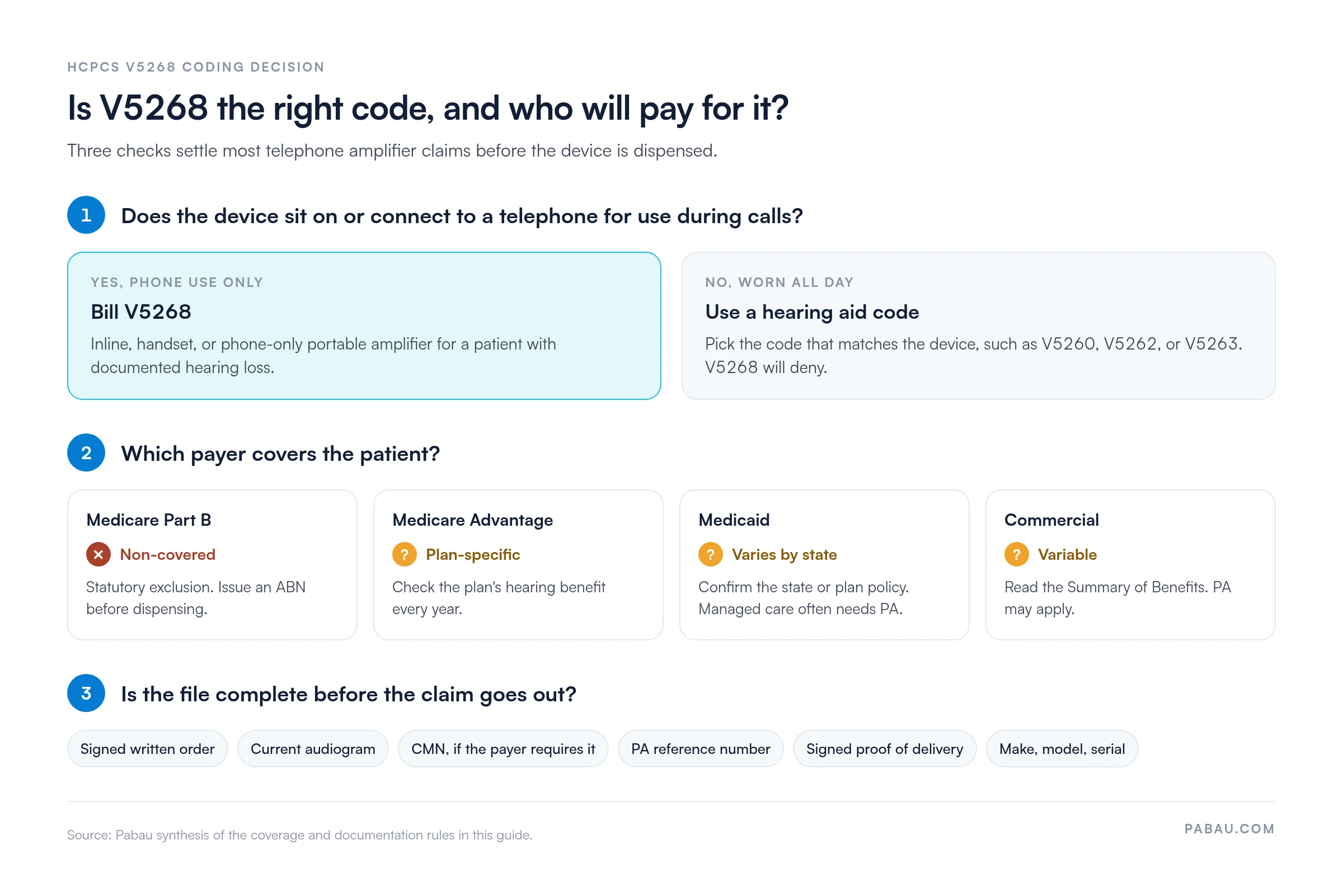
The deciding test is how the patient uses the device. If it sits on or connects to a telephone for calls, V5268 applies. If the patient wears it all day, bill the matching hearing aid code instead, such as V5262 for a single-ear disposable aid. The diagram below runs that test alongside the payer and documentation checks.
Most V5268 denials are preventable. Effective denial management starts with knowing which denial reasons recur for this code, then building prevention into the pre-submission workflow.
Because Medicare Part B does not cover V5268, the CMS Physician Fee Schedule lookup publishes no Medicare allowed amount for it. Reimbursement comes from state Medicaid fee schedules and commercial payer contracts.
Quote a V5268 rate only from the current year’s fee schedule, since CMS and state Medicaid rates change each fiscal year. The NLM HCPCS Level II API gives programmatic access to current HCPCS data, so your billing system can verify descriptor wording and code status.
Most V5268 denials start with a missing document or the wrong payer. In many audiology practices, the order sits in one system, the audiogram in another, and the delivery receipt in a paper folder. Someone then rebuilds the file by hand when a denial or an audit arrives.
Pabau keeps the patient record, signed forms, invoices, and claims in one place. The order, audiogram, CMN, and proof of delivery sit beside the V5268 claim. Staff can check the payer’s position before the device leaves the room. That means fewer appeals, and patients who know before dispensing whether they’ll pay out of pocket.

Pabau keeps claims, documentation, and payer rules in one place for hearing health practices. Less time goes to billing admin, and more goes to patients.

Treat V5268 as a device question first and a payer question second. Confirm that the device is a telephone amplifier, then confirm the payer covers it before the patient leaves with it. Those two checks prevent most of the denials this code attracts.
The trade-off is a few minutes of verification at dispensing against weeks of appeals afterward. For a Medicare Part B patient, that check is also what lets you issue the ABN on time. Book a demo to see how Pabau keeps the paperwork behind each hearing device claim in one place.

Need guidance on handling medical billing compliance? Navigating medical billing compliance requirements covers the key rules audiology and specialty practices need to follow.
Want to understand the broader billing process? Revenue cycle management fundamentals explains how HCPCS code billing fits into the end-to-end practice revenue cycle.
Billing a behind-the-ear digital pair? HCPCS Code V5261 covers binaural digital BTE hearing aids and how they differ from ALD codes.
Dispensing an accessory with no specific code? HCPCS Code V5267 explains when hearing aid and ALD supplies fall under the not otherwise specified code.
HCPCS Code V5268 covers a telephone amplifier supplied as an assistive listening device to a patient with documented hearing loss. It applies to inline and handset amplifiers designed for telephone use. Conventional wearable hearing aids are billed under separate V52xx codes.
No. Medicare Part B excludes hearing aids and most assistive listening devices by statute, so traditional Medicare does not reimburse V5268. Individual Medicare Advantage plans may cover telephone amplifiers as a supplemental hearing benefit, but this varies by plan. Providers should issue an Advance Beneficiary Notice before dispensing to Medicare Part B patients.
The most commonly accepted codes are H90.0 (bilateral conductive loss), H90.3 (bilateral sensorineural loss), H90.6 (bilateral mixed loss), and H91.10 (presbycusis). Their unilateral variants in the H90.1x and H90.4x subcategories are also common. The specific codes a payer accepts depend on its LCD, so confirm its accepted diagnosis list before submitting.
It depends on the payer. Medicare Part B does not require prior authorization because the benefit is excluded. Medicaid managed care plans and many commercial plans that cover hearing devices do require PA before dispensing. Verify PA requirements at the time of eligibility verification for each patient, before the device is provided.
V5268 covers a telephone amplifier used as an assistive listening device for telephone calls only. V5262 covers a disposable monaural hearing aid worn continuously for general hearing correction. The two codes describe fundamentally different devices: one is a telephone accessory, the other is a wearable hearing aid. Selecting the wrong code based on device type is one of the most common coding errors in this range.
The most common reasons are billing Medicare Part B, which excludes the benefit, and using V5268 for a hearing aid rather than a telephone amplifier. A missing or unsigned certificate of medical necessity, an unsupported ICD-10 code, and missing prior authorization also cause frequent denials. A pre-submission documentation checklist prevents most of these before they reach the payer.