CCSD Code S5535: Description, tariff, medical aid and claim requirements
CCSD Code S5535: Official description and procedure scope CCSD Code S5535 is a b...

Last Updated: Nov 20, 2026
V5270 is the HCPCS Level II code for an assistive listening device, television amplifier, any type. It reports a device that brings television sound to a listener with hearing loss.
CMS lists V5270 as non-covered by Medicare statute under section 1862(a)(7) of the Social Security Act, and Part B sets no fee for it. Caption decoders, telephone amplifiers and CROS hearing aids each carry their own codes.
Let Pabau's smart automation suggest the right codes, reduce claim denials, and keep your practice compliant—effortlessly.
Automate repetitive tasks and focus on what matters most—your patients.
Reduce coding errors and ensure compliance with the latest regulations.
Clean claims, fewer denials, and faster reimbursements.
Powerful insights and reporting to help your practice thrive.
HIPAA compliant SOC 2 certified GDPR-compliant Trusted by 4,000+ clinics worldwide

HCPCS Code V5270 reports an assistive listening device, television amplifier, any type. It is not a hearing aid code and not a CROS code.
CMS gives V5270 coverage code S, non-covered by Medicare statute, under section 1862(a)(7) of the Social Security Act.
Pricing indicator 00 means Part B sets no fee for V5270, so the patient owes the full charge unless another payer covers it.
A caption decoder is V5271, a TDD is V5272, and a binaural CROS hearing aid in an ITC/BTE pair is V5215.
Bill Medicare with GY only when a secondary payer needs the denial, and never append KX to V5270.
HCPCS Code V5270 is the Level II code for an assistive listening device, television amplifier, any type. It reports a device that brings television sound to a listener with hearing loss. The CMS HCPCS quarterly update file lists it as active, with coverage code S, non-covered by Medicare statute.
CMS added the code on January 1, 2002, and the descriptor has not changed since. The words “any type” mean the device’s technology does not change the code. The rest of the V5000-V5999 hearing services range sits in our library of HCPCS codes.
V5270 sits in a short run of assistive listening device codes. Each device type has its own code, so match the claim to what the patient takes home. The descriptors below come from the October 2026 HCPCS file.
Every code in that table carries coverage code S and pricing indicator 00 in the HCPCS file. Picking the wrong neighbor rarely changes what Medicare pays. It still misstates the device on the claim, and Medicaid or commercial payers that do cover these items pay by code. The guides to V5271, the caption decoder, and V5268, the telephone amplifier, cover the two closest neighbors.
Some code lists and claim templates describe V5270 as a binaural CROS hearing aid. That descriptor belongs to V5215, hearing aid, contralateral routing system, binaural, ITC/BTE. CMS made V5215 effective on January 1, 2019. A two-sided routing system built into eyeglass frames has its own code, V5230.
A CROS fitting billed as V5270 tells the payer the patient received a television amplifier.
Traditional Medicare does not pay for V5270. Section 1862(a)(7) of the Social Security Act bars Medicare payment for hearing aids and the exams that fit them. CMS cites that same statute against V5270 in the HCPCS file.
The Medicare Benefit Policy Manual, chapter 16, section 100 repeats the exclusion and points to 42 CFR 411.15(d). Cochlear implants and auditory brainstem implants are the exception, because Medicare pays for them as prosthetic devices. A television amplifier falls outside that exception.
A statutory exclusion changes the claim in four ways.
Check whether the patient has traditional Medicare or a Medicare Advantage plan before you quote a price. Traditional Medicare never pays for V5270, while some Advantage plans cover hearing devices as a supplemental benefit.
Non-covered by Medicare does not always mean self-pay. Check these routes before you quote the patient the full price.
Run insurance eligibility verification before the device leaves the office. A benefit check takes minutes, while a device delivered against a benefit that does not exist costs the full price. Each payer route ends in a different claim action, set out payer by payer here.
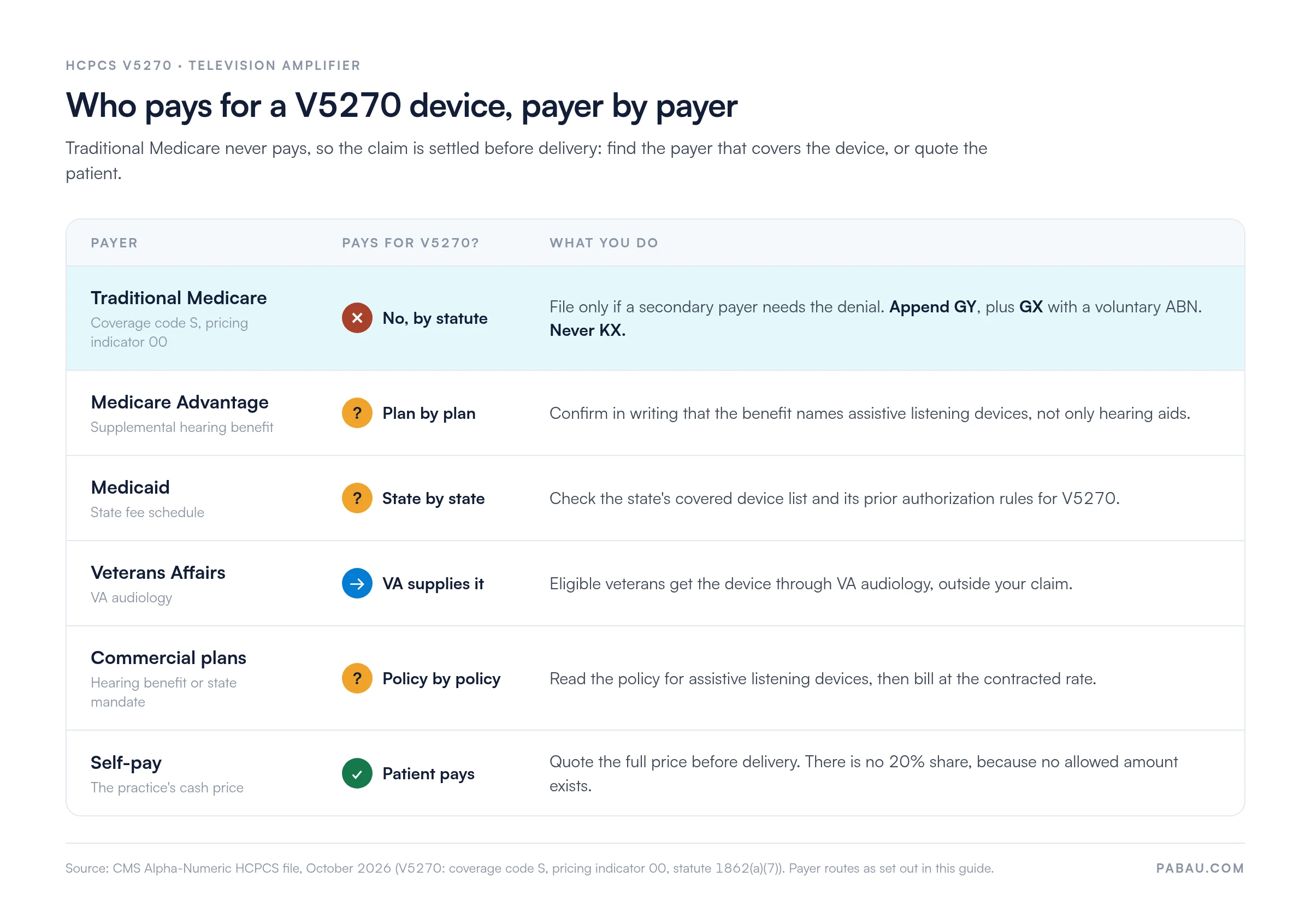
Traditional Medicare pays nothing for V5270 in 2026. Pricing indicator 00 means Part B does not price the code, so no Medicare allowed amount exists. Payment, where it exists, comes from the covering payer’s own rate.
Set a cash price from your acquisition cost and dispensing time. Quote it before delivery, so the patient never hears about a 20% share that does not exist.
On a statutorily excluded code, modifiers tell Medicare that you expect the denial and why you filed anyway. Two of them do almost all the work.
Medicaid and commercial payers set their own modifier rules for hearing devices. Follow the covering plan’s billing guide rather than the Medicare pattern above.
Medicare offers no documentation route to payment for V5270. The record still matters to the payers that may cover the device, and it protects the practice on a self-pay sale.
The workflow below assumes the patient wants the device and Medicare is somewhere in the picture. The aim is to settle who pays before delivery rather than after a denial.
Most V5270 errors come from one of two mistakes: the wrong device behind the code, or the belief that Medicare pays for it. Structured denial management catches both patterns before they repeat.
Audit the V5270 claim template once instead of fixing claims one by one. If the template still describes V5270 as a CROS hearing aid or carries KX, every claim built from it repeats the error.
A non-covered device creates front-desk work rather than claim work. Someone quotes a price, collects a signature, and takes the payment. Pabau, a practice management platform, keeps those steps on the patient’s record.
Pabau’s claims management software files the Medicare claim when a secondary payer needs the denial, and records what came back. Digital forms hold the ABN or written estimate and the delivery sign-off against the same patient.
Checkout invoices the device and records the payment at the counter. The V5270 balance is settled before it starts aging in accounts receivable.
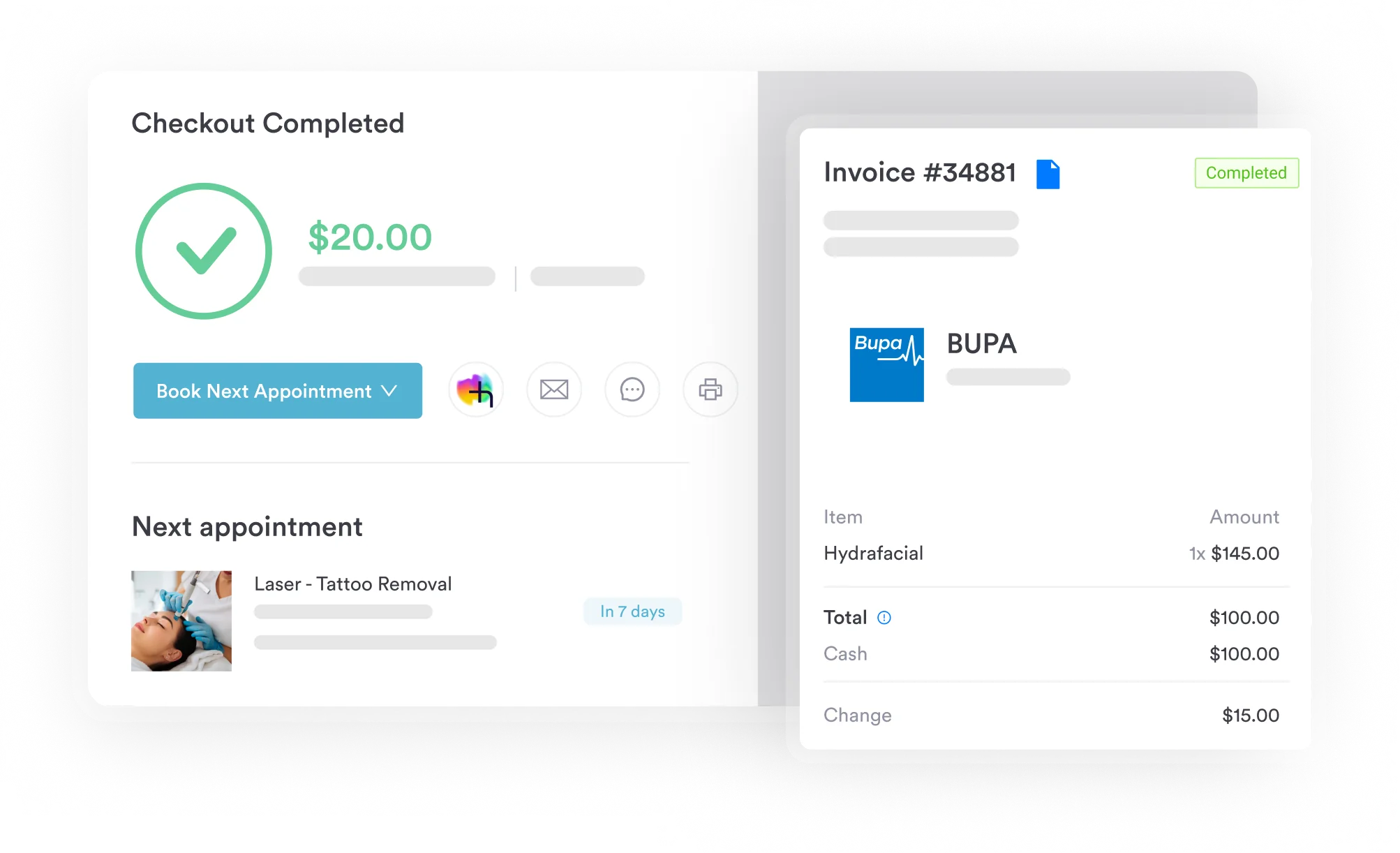

Pabau’s claims management, digital forms, and checkout keep the estimate, the signed notice, and the payment on one patient record. Your team quotes the price, collects it, and files a Medicare denial only when a secondary payer needs one.

V5270 reports a television amplifier, and traditional Medicare will not pay for it. The useful work happens before delivery: confirm the device, find the payer that covers it, and put the price in writing.
Get the code right as well. A television amplifier billed under a hearing aid code, or a CROS hearing aid billed as V5270, fails an audit whoever pays.
Book a demo to see how Pabau ties device charges to the estimate, the signed notice, and the payment behind them.

Billing a caption decoder instead? HCPCS code V5271 covers the television caption decoder, the closest neighbor to V5270.
Dispensing a telephone amplifier? HCPCS code V5268 explains the telephone amplifier code and how payers treat it.
Seeing recurring CARC codes on remittance advice? Denial codes in medical billing breaks down the most common CARC and RARC combinations and what each one means for resubmission.
Need to understand how claims flow through a clearinghouse? Medical claims clearinghouse guide explains how EDI claims move from practice to payer and where errors surface.
HCPCS Code V5270 covers an assistive listening device, television amplifier, any type. It reports a device that brings television sound to a listener with hearing loss. It does not describe a hearing aid or a CROS system.
No. V5270 is a television amplifier. The binaural CROS hearing aid in an ITC/BTE pair is V5215. The other binaural CROS pairs are V5211 and V5221, and monaural CROS devices are V5171 and V5181.
V5270 reports a television amplifier, which makes television sound easier for the listener to hear. V5271 reports a television caption decoder, which shows the dialogue as text. Bill the code that matches the device delivered.
No. CMS gives V5270 coverage code S, non-covered by Medicare statute, under section 1862(a)(7) of the Social Security Act. Part B sets no fee for it. Bill Medicare with GY only when a secondary payer needs the denial.
Medicare Advantage supplemental hearing benefits, state Medicaid programs, and commercial hearing benefits may cover it. Coverage varies by plan and by state, so verify the benefit before delivery. Otherwise the patient pays the full price.