CPT Code 62284: Injection procedure for myelography
CPT Code 62284: official descriptor and procedure overview The American Medical ...

Last Updated: Oct 19, 2026
V5262 is the HCPCS Level II code for hearing aid, disposable, any type, monaural. It covers one disposable hearing aid of any style, fitted to a single ear, and is billed as one unit per aid.
When both ears are fitted in the same encounter, the pair is billed under V5263 instead. Original Medicare excludes hearing aids by statute, so payment depends on Medicare Advantage, Medicaid, or commercial plan benefits.
Let Pabau's smart automation suggest the right codes, reduce claim denials, and keep your practice compliant—effortlessly.
Automate repetitive tasks and focus on what matters most—your patients.
Reduce coding errors and ensure compliance with the latest regulations.
Clean claims, fewer denials, and faster reimbursements.
Powerful insights and reporting to help your practice thrive.
HIPAA compliant SOC 2 certified GDPR-compliant Trusted by 4,000+ clinics worldwide

HCPCS Code V5262 covers one disposable hearing aid for a single ear, while V5263 covers both ears as a pair.
Original Medicare (Part B) excludes routine hearing aids by statute. Billing a Medicare patient for V5262 without a signed ABN on file exposes the practice to refund liability.
Most commercial payers and many state Medicaid programs require prior authorization and medical necessity documentation before reimbursing V5262.
Pabau’s claims management software helps audiology practices track hearing aid dispensing encounters, catch incomplete documentation, and reduce preventable denials.
HCPCS Code V5262 is a Level II supply code maintained by the Centers for Medicare & Medicaid Services (CMS). It describes one disposable hearing aid dispensed to a single ear. The full official descriptor is: Hearing aid, disposable, any type, monaural.
“Any type” means the code applies regardless of style. Completely-in-canal (CIC) disposable devices, behind-the-ear (BTE) disposable models, and extended-wear disposable aids such as the Lyric-style continuous-wear device all qualify. “Monaural” means one ear only. If both ears are fitted in the same encounter, the pair is billed under V5263 instead.
V-series codes are HCPCS Level II codes, not CPT. They are used by audiologists, hearing instrument specialists, and ENT practices dispensing hearing devices. Unlike CPT codes, V-series codes are not part of the AMA code set and do not carry physician work RVUs.
The table below summarizes the code’s core attributes as maintained in the CMS HCPCS Level II Alpha-Numeric file.
Verify current status against the annual CMS HCPCS release before submitting claims, as code descriptors and coverage policies are updated each January.
V5262 covers one ear, and V5263 covers both. The split sounds simple, yet it causes a large share of audiology coding errors. Billing V5263 when only one ear was fitted is one of the most common denial triggers in this code family.
A useful rule: document which ear or ears were fitted in the clinical note before selecting the code. The documentation drives the code selection, not the reverse.
V5262 sits within a broader family of HCPCS Level II codes for hearing devices and services. Knowing the adjacent codes prevents miscoding when the device type or service differs from what V5262 describes. A non-disposable aid fitted to one ear takes a different code, such as V5247 for a digitally programmable analog behind-the-ear device.
The same distinction applies to in-canal devices. A non-disposable analog aid fitted in one ear canal takes V5243 instead.
Three questions answered from the chart sort any dispensing encounter into the right V5 code, and the path below shows where each “no” leads.
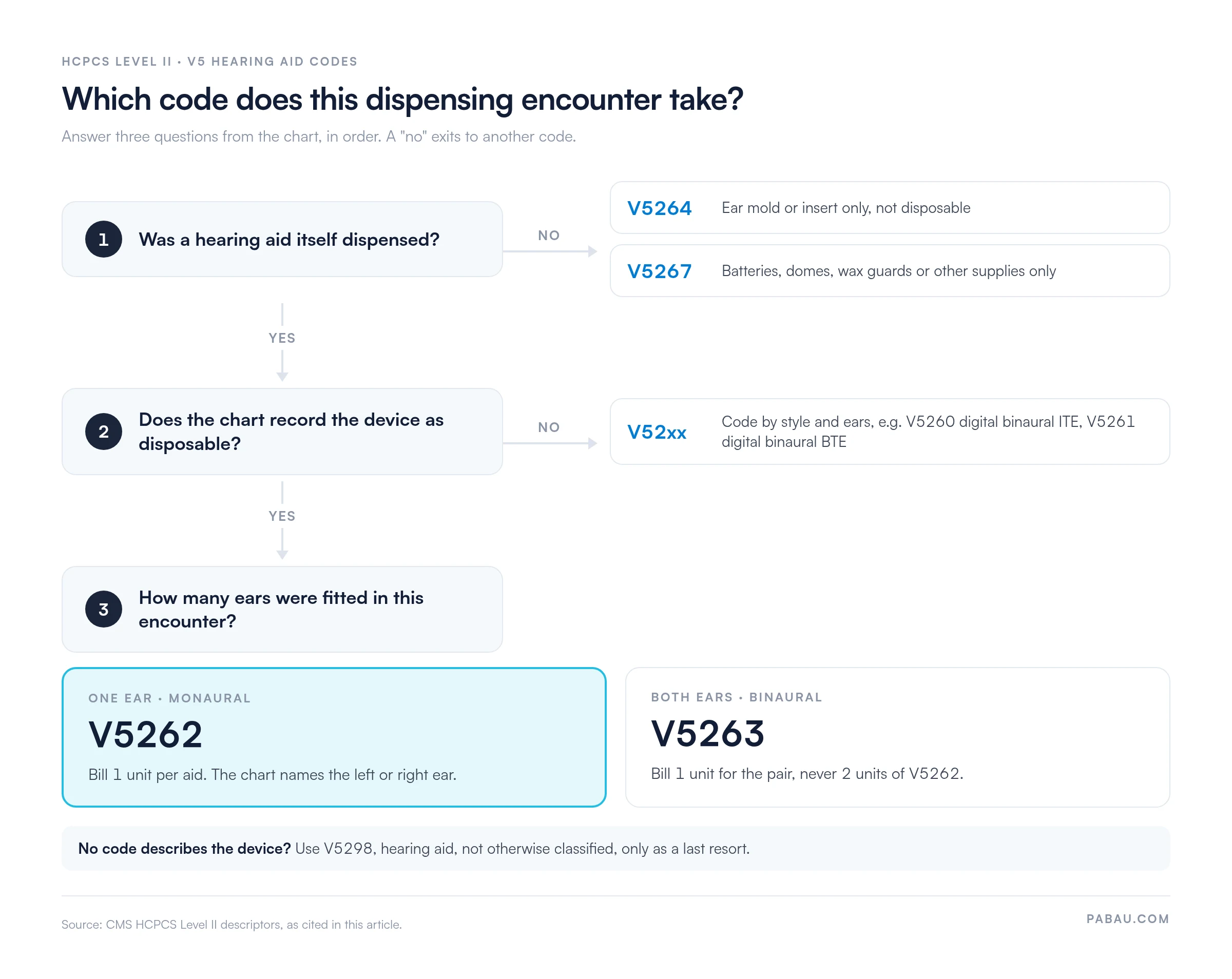
Document the device’s disposable classification in the dispensing note. Payers don’t assume a device is disposable. If the chart only reads ‘hearing aid dispensed’, the reviewer may default to a non-disposable code and deny V5262 as an incorrect code selection.
Original Medicare (Part B) does not cover routine hearing aids, including disposable hearing aids billed under HCPCS Code V5262. This is a statutory exclusion under Section 1862(a)(7) of the Social Security Act, which specifically excludes hearing aids and examinations for their prescription or fitting. CMS has not issued a Local Coverage Determination (LCD) that creates an exception for disposable aids.
Two practical implications follow from this exclusion:
Medicare Advantage (Part C) plans differ. Many Medicare Advantage plans include a hearing aid benefit not available under Original Medicare. Coverage, dollar limits, and device-type restrictions vary by plan. Verify the patient’s specific plan benefits before assuming coverage and obtain prior authorization if the plan requires it.
Coverage for disposable hearing aids under Medicaid varies significantly by state. Some state Medicaid programs cover disposable aids for pediatric beneficiaries (typically under age 21, under the EPSDT mandate) while providing no benefit for adults.
Others cover hearing aids for all age groups but impose device-type or quantity limits. A handful of states cover no hearing aids beyond cochlear implant-related items. Check your state Medicaid fee schedule and coverage policy before billing V5262 to a Medicaid patient.
Commercial payers generally cover hearing aids when a plan includes a hearing benefit, but most require prior authorization and medical necessity documentation for V5262. Reimbursement rates vary by payer contract and locality. Do not rely on a single fee schedule figure; verify the allowed amount through your payer-specific fee schedule or the payer’s provider portal before submitting.
Missing documentation drives many preventable V5262 denials from Medicaid and commercial payers alike. Every chart needs the following elements before submission, both for medical billing compliance and for audit readiness.
Style alone does not settle the code, since CIC appears in both disposable and non-disposable families. A digital CIC pair fitted to both ears is billed under V5258, so the dispensing note should state the disposable classification outright.
Billing software with a built-in documentation checklist flags an incomplete encounter before the claim leaves the practice. Without one, the missing element tends to surface weeks later as a denial.
Denials for HCPCS Code V5262 tend to follow six patterns, each with its own fix. Every rejection comes back on the remittance with a reason code, and our guide to claim denial codes explains how to read them.
Systematic denial management starts before claims leave the practice. Compare the reasons above against your monthly denial report. The pattern shows whether the problem is documentation, code selection, or payer policy, so you can fix it at the source.
A clean V5262 claim follows a predictable sequence. Skipping any step is where the process breaks down.
Build a pre-submission checklist specific to V5262. It confirms the payer benefit, any required PA, the dispensing date, the ear fitted, the disposable classification, and a unit count of 1. Running this checklist before claims leave the practice reduces first-pass denial rates without adding significant time to the billing workflow.
Prior authorization requirements for HCPCS Code V5262 depend entirely on the patient’s payer. There is no universal PA requirement, but many commercial plans and state Medicaid programs do require it before a disposable hearing aid is dispensed.
When a payer requires PA, the submission typically needs:
State Medicaid programs that cover V5262 for pediatric patients often require PA for every dispensing episode. Adult Medicaid benefits, where they exist, may carry extra quantity or frequency limits. Verify your state’s current policy through the state Medicaid fee schedule or provider bulletin.
Retroactive PA is possible with some payers when the practice can demonstrate clinical urgency or administrative error, but approval is not guaranteed. Prospective authorization is always the safer approach.
Use the AAPC HCPCS code reference or the PGM Billing HCPCS lookup tool to confirm current code status when preparing PA requests.
A denied V5262 claim usually traces back to the chart. The ABN sits in a paper file, the fitting note never names the ear, or the claim goes out as V5263 out of habit.
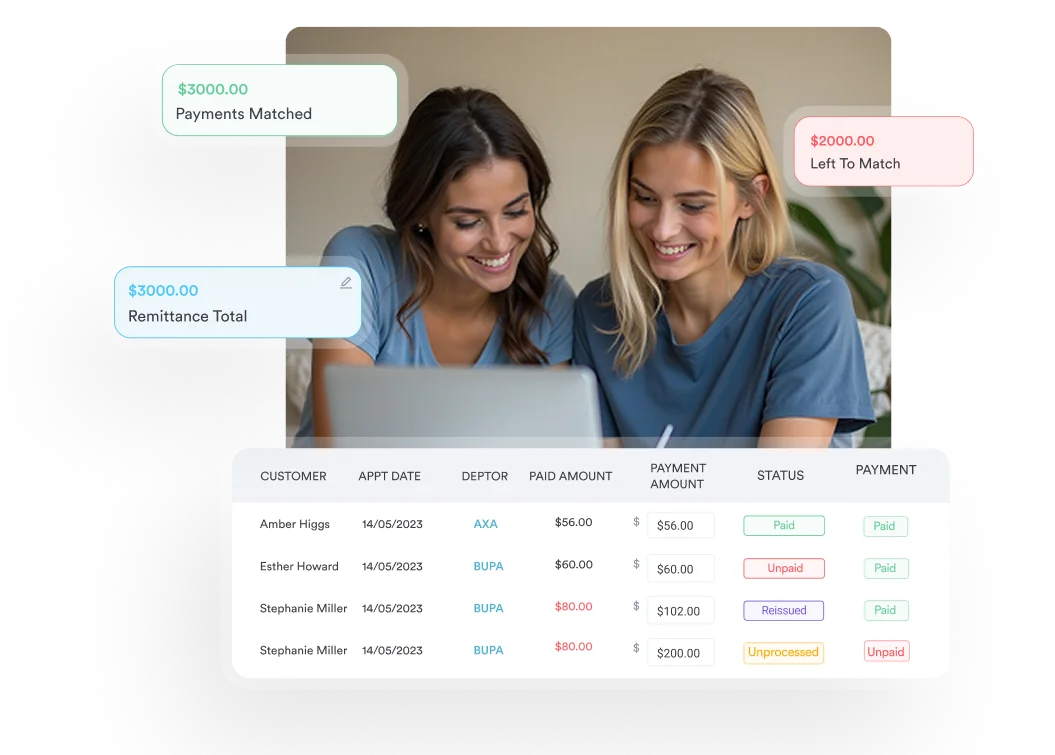
Pabau keeps those pieces in one patient record. The ABN is signed as a digital form before dispensing, and the fitting note records the ear and the device type. Its error-flagging claims management then raises the claim from that encounter and matches the payer remittance against it.
Your billing team resubmits fewer hearing aid claims and spends the recovered hours on new encounters. Short-paid claims are visible while they can still be corrected.

Pabau helps audiology practices track dispensing encounters, flag incomplete documentation before claims are submitted, and manage reimbursement workflows from a single platform.

V5262 billing comes down to two facts in the chart: the device is disposable, and one named ear was fitted. Once both are documented, the choice between V5262 and V5263 makes itself.
The trade-off is time at the front of the visit. Checking benefits, securing prior authorization, and getting an ABN signed takes longer than dispensing first. It still costs far less than appealing a denial or refunding a Medicare patient.
Book a demo to see how Pabau ties the fitting note, the ABN, and the claim together for your audiology practice.

New to HCPCS billing? What is medical billing walks through the core concepts audiology billing staff need before tackling Level II code submissions.
Dealing with recurring claim rejections? Denial management in healthcare covers systematic strategies for reducing first-pass denial rates across device and supply codes.
Want a cleaner claims submission process? Submitting clean claims outlines the documentation and formatting standards that reduce payer rejections before they start.
Dispensing batteries or domes on their own? HCPCS Code V5267 covers hearing aid supplies and accessories billed without the device.
Fitting an earmold separately? HCPCS Code V5264 explains how to bill a non-disposable ear mold or insert.
HCPCS Code V5262 covers one disposable hearing aid dispensed to a single ear (monaural), of any style including CIC, BTE, open-fit, and extended-wear disposable devices. It does not cover non-disposable aids, accessories, earmolds, or binaural fittings.
V5262 covers a monaural (single-ear) disposable hearing aid. V5263 covers a binaural (both-ear) disposable hearing aid pair. Bill V5262 when one ear is fitted and V5263 when both ears are fitted in the same encounter. Billing V5263 for a monaural fitting is one of the most common denial triggers in this code family.
No. Original Medicare (Part B) excludes routine hearing aids by statute, including disposable aids billed under V5262. Medicare Advantage plans may cover hearing aids depending on the individual plan’s benefit structure. Always verify coverage before dispensing and obtain a signed ABN before billing a Medicare patient for V5262.
Prior authorization requirements vary by payer. Many commercial plans and state Medicaid programs require PA before a disposable hearing aid is dispensed. Original Medicare does not cover V5262 at all, so PA is not applicable there. Always verify the patient’s specific payer policy before dispensing.
Bill 1 unit. HCPCS Code V5262 represents one hearing aid for one ear. Billing 2 units for a single monaural fitting will generate a unit-mismatch denial. If both ears are fitted, use V5263 (1 unit for the pair) rather than 2 units of V5262.
The most common reasons are Original Medicare’s statutory exclusion of hearing aids, missing prior authorization, and V5263 billed for a one-ear fitting. Thin medical necessity documentation, a mismatched dispensing date, and 2 units billed for a single aid round out the list.