HCPCS Code Q4175: Billing, coverage, and documentation guide
HCPCS Code Q4175: Code Description and Product Identity HCPCS Code Q4175 is the ...

Last Updated: Nov 20, 2026
V5269 is the HCPCS Level II code for assistive listening device, alerting, any type. It covers a signaler that alerts a person with hearing loss to a sound they may miss. Typical examples are doorbell, telephone, smoke alarm and baby-cry alerts that flash a light, vibrate or sound louder.
The code sits in the V5268-V5290 assistive hearing device range and is not a hearing aid code. Traditional Medicare Part B treats it as a statutorily excluded hearing item, so any coverage comes from Medicaid, Medicare Advantage or commercial plans.
Let Pabau's smart automation suggest the right codes, reduce claim denials, and keep your practice compliant—effortlessly.
Automate repetitive tasks and focus on what matters most—your patients.
Reduce coding errors and ensure compliance with the latest regulations.
Clean claims, fewer denials, and faster reimbursements.
Powerful insights and reporting to help your practice thrive.
HIPAA compliant SOC 2 certified GDPR-compliant Trusted by 4,000+ clinics worldwide

HCPCS code V5269 describes an assistive listening device, alerting, any type, such as a doorbell, smoke alarm or baby-cry signaler.
V5269 is not a hearing aid code. A digital, binaural, in-the-ear hearing aid is billed on V5260.
Traditional Medicare excludes V5269 by statute, so bill it with modifier GY when the patient or a secondary payer needs a formal denial.
Medicaid, Medicare Advantage and commercial coverage varies by plan, so confirm the benefit and any prior authorization before dispensing.
Billing software such as Pabau keeps the order, hearing evaluation and delivery receipt on the patient record, so V5269 claims go out complete.
HCPCS code V5269 is the Level II code for an assistive listening device, alerting, any type. CMS lists it in its quarterly HCPCS release files with the short descriptor “Alerting device, any type.” The code has been in effect since January 1, 2002, and sits in the V5268-V5290 assistive hearing device range.
An alerting device tells a person with hearing loss that a sound has happened. It turns a doorbell, telephone, smoke alarm, alarm clock or crying baby into a flashing light, a vibration or a louder tone. “Any type” means the code covers every alerting format, not one specific product.
V5269 covers the alerting device itself, supplied to a patient with documented hearing loss. Common formats include strobe lights, bed shakers, vibrating wrist receivers and extra-loud alarm sounders. A home system that links several sound sources to one receiver also fits the “any type” descriptor, though payers set their own rules on units.
The descriptor covers the device, not the visit. Bill any evaluation or training appointment separately, under the CPT code that matches the service.
Excluded from V5269: The list below covers the coding mismatches that most often send a claim back.
Every code from V5268 to V5274 opens with “Assistive listening device,” so coders have to match the function, not the family name. V5269 is also confused with V5260, a hearing aid code, because the two numbers sit close together. The table maps the codes most often mixed up with V5269.
Read the order and the device spec sheet before you pick the code. When the device’s main job is to signal that a sound happened, V5269 is the match. For a device outside the V5268-V5274 run, search the full list of HCPCS Level II codes.
Traditional Medicare does not pay for V5269. The CMS HCPCS file gives the code coverage code S, non-covered by Medicare statute, and cites Section 1862(a)(7) of the Social Security Act. That section bars Part A and Part B payment for hearing aids and their exams. The Medicare Benefit Policy Manual, chapter 16 sets out the exclusion in full.
Check the benefit before you dispense. A pre-service insurance eligibility verification that names the hearing device benefit stops most non-covered denials before they happen. The chart sets out where each payer stands and the step to take before dispensing.
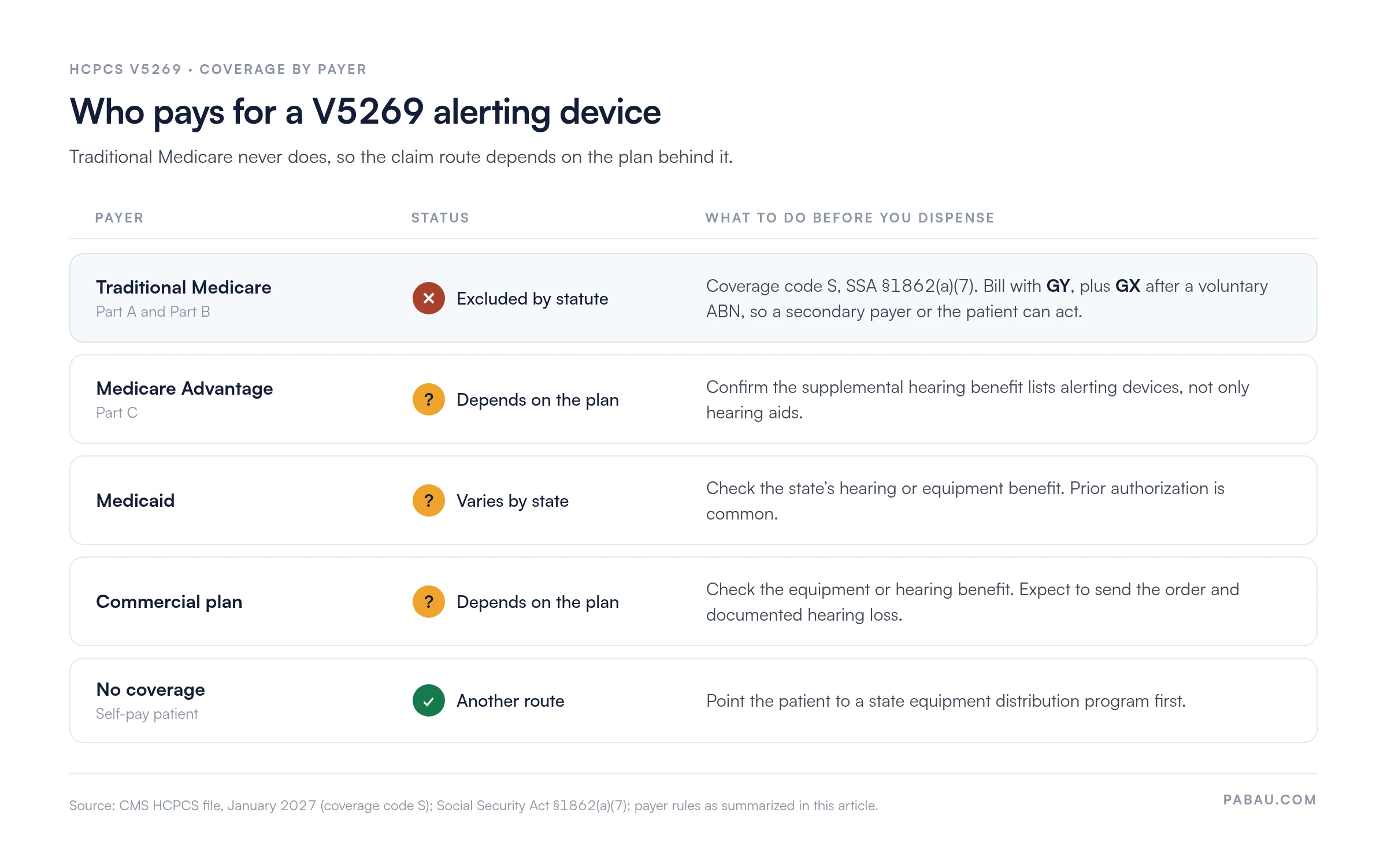
Payers that cover V5269 want proof of two facts. The patient has hearing loss, and the device alerts them to a sound they would otherwise miss, such as a smoke alarm. Keep each of the following in the record before the claim goes out.
For compliance, keep the full claim file for the retention period your state and payers set. Audit requests usually ask for the order and the hearing evaluation first, so file them where billers can find them fast.
Most technical rejections on V5269 come from three errors: the wrong code family, the wrong unit count or a missing coverage modifier. The modifiers below cover the common payer scenarios.
V5269 denials cluster around five root causes. Each one has a prevention step you can build into intake.
Track V5269 denials by CARC code in your denial management workflow. CARC 96 (non-covered charge) points to a payer that excludes the item, CARC 197 to a missing authorization and CARC 4 to a modifier problem.
Most V5269 denials start before anyone builds the claim, when a plan type goes unchecked or an order never reaches the file. The fix is a check that runs at booking, before a biller ever opens the claim.
In Pabau, insurer details, the signed order and the audiogram sit on the same patient record. Its claims management software checks required fields before a claim goes out and tracks each claim through adjudication.
The result is fewer V5269 claims coming back for a missing GY modifier or an absent delivery receipt. Your billers spend less time rebuilding claims and more time on the ones that pay.

Pabau keeps orders, hearing evaluations and payer details on one patient record. Claims checks flag missing fields and modifiers, so V5269 claims go out clean the first time.

V5269 is a narrow code with one job: an alerting device for a patient who can’t hear the doorbell, the phone or the smoke alarm. Most errors come from treating it as a hearing aid code or sending it to a payer that excludes it by law.
Before you dispense, confirm the device’s function, the patient’s plan and any authorization that plan requires. On traditional Medicare, bill with GY so the patient or a secondary payer can act on the denial. To see how Pabau keeps orders, hearing evaluations and claims together, book a demo.

Need a clean-claim checklist for DMEPOS submissions? What is a clean claim in medical billing covers the field-by-field requirements that keep HCPCS claims from rejecting on edit.
Struggling with remittance codes after a denial? Understanding electronic remittance advice (ERA) explains how to read CARC and RARC codes on your 835 transaction so you can resolve V5269 denials faster.
Looking for a broader denial reduction strategy? Denial management in healthcare outlines the workflow steps that cut first-pass denial rates across claim types.
HCPCS code V5269 is the Level II code for an assistive listening device, alerting, any type. It covers devices that signal a doorbell, phone, smoke alarm or crying baby with light, vibration or a louder tone.
No. V5269 covers alerting devices only. A digital, binaural, in-the-ear hearing aid is billed on V5260, and other hearing aid styles have their own V-codes.
Traditional Medicare does not. The CMS HCPCS file marks V5269 as non-covered by statute under Section 1862(a)(7) of the Social Security Act. A Medicare Advantage plan may cover it as a supplemental benefit, so check the plan.
On a traditional Medicare claim, add GY to show the item is statutorily excluded, plus GX if you issued a voluntary ABN. LT and RT don’t apply, because an alerting device isn’t ear-specific.
Doorbell and knock signalers, telephone ring signalers, smoke and carbon monoxide alarm alerts, baby-cry monitors and vibrating alarm clocks. Each one turns a sound into a light, a vibration or a louder tone.
Yes. V5269 has been in effect since January 1, 2002, and remains an active code. Check the current CMS HCPCS quarterly file before billing, since CMS updates the code set every year.
Many states run equipment distribution programs for residents with hearing loss, and many of them supply alerting and signaling devices. Vocational rehabilitation services may also fund a device the patient needs for work.