Pabau Engage inbox

Pabau Engage is here: every patient conversation in one inbox.

Learn more
Book a demo Book a demo
☰
HCPCS Code

HCPCS code V5261 – Digital binaural behind-the-ear hearing aid


Code Definition

V5261 is the HCPCS Level II code for a hearing aid, digital, binaural, BTE. It describes a matched pair of digital behind-the-ear aids fitted to both ears in one dispense.

The code covers the devices only. Audiology CPT codes report the fitting, and the binaural dispensing fee is reported with V5160. The nearest neighbors are V5257, the digital monaural BTE aid, and V5253, the digitally programmable binaural BTE pair.

Code range
V2020-V5364 Vision, hearing and speech-language pathology services
Category
V5008-V5364 Hearing services
Code range
V5120-V5267 Hearing aids
Billable
No
Code also known as
BTE hearing aid, bilateral hearing aids, binaural BTE, behind the ear hearing device
Save time. Improve accuracy. Get paid faster.
Automate coding with Pabau

Let Pabau's smart automation suggest the right codes, reduce claim denials, and keep your practice compliant—effortlessly.

  • AI-powered code suggestions
  • Real-time compliance checks
  • Faster claims, fewer denials
Why practices choose Pabau
Save hours every week

Automate repetitive tasks and focus on what matters most—your patients.

Improve accuracy

Reduce coding errors and ensure compliance with the latest regulations.

Get paid faster

Clean claims, fewer denials, and faster reimbursements.

Grow with confidence

Powerful insights and reporting to help your practice thrive.

HIPAA compliant SOC 2 certified GDPR-compliant Trusted by 4,000+ clinics worldwide

Key takeaways

Key takeaways

HCPCS code V5261 describes a digital, binaural, behind-the-ear hearing aid. It covers a matched pair of BTE devices fitted to both ears in one dispense.

The monaural counterpart is V5257. Bill V5257 with an LT or RT modifier when only one digital BTE aid is dispensed.

Traditional Medicare Part B excludes hearing aids under SSA §1862(a)(7), so most V5261 claims go to Medicaid, Medicare Advantage, or commercial plans.

Missing prior authorization, the wrong style or laterality code, and absent proof of delivery cause most preventable V5261 denials.

Pabau, the billing and practice software we build, keeps the audiogram, authorization, and both serial numbers on the record the claim is built from.

HCPCS code V5261: Definition and official descriptor

HCPCS code V5261 covers a digital, binaural, behind-the-ear hearing aid. It is a Level II code maintained by the Centers for Medicare & Medicaid Services (CMS). The official long descriptor is Hearing aid, digital, binaural, BTE, and the code sits in the V5120-V5267 hearing aid range.

Each word in the descriptor limits what the code can report:

  • Digital: The aid processes sound digitally. Conventional analog and digitally programmable analog aids have their own codes, so the manufacturer’s spec sheet decides the code.
  • Binaural: Two aids are dispensed together, one for each ear, and billed as a pair on one line. If only one aid is dispensed, V5261 is the wrong code.
  • BTE (behind the ear): The body of the device sits behind the outer ear, with a tube or receiver wire running into the canal. In-the-ear, in-the-canal, and completely-in-canal aids each have separate digital codes.

The table below summarizes the attributes a device must meet to be reported with V5261.

Attribute V5261 requirement
Code system HCPCS Level II (CMS-maintained)
Code range V5120-V5267 hearing aids, within V5008-V5364 hearing services
Technology Digital
Fitting Binaural (one aid per ear, billed as a pair)
Style BTE (behind the ear)
Medicare Part B Not covered (statutory exclusion)
Not included Dispensing fee, earmolds, batteries, fitting services, cochlear implants, and bone-anchored devices

What V5261 covers, and what it excludes

V5261 reports the devices themselves, meaning the two hearing aids delivered to the patient. Several related items sit outside the code and are reported separately.

  • Dispensing fee: The binaural dispensing fee is reported with V5160. The monaural fee, V5241, applies only when a single aid is dispensed.
  • Fitting services: The audiogram, hearing aid evaluation, and fitting appointment are professional services. They are reported with audiology CPT codes, not with V5261.
  • Earmolds and supplies: A non-disposable earmold or insert is V5264, and a disposable one is V5265. Batteries fall under V5266, and other accessories under V5267.
  • Receiver-in-canal (RIC) aids: RIC devices have no style code of their own. Most payers treat them as BTE aids, but confirm that with the payer before coding.
  • Implanted devices: Cochlear implants and bone-anchored hearing devices are not hearing aids for this code. They are reported with L-codes such as L8614 and L8690.

V5261 vs adjacent hearing aid HCPCS codes: How to choose correctly

The digital hearing aid codes form a grid of four styles and two fittings. Picking the wrong cell is the most common miscoding error on V5261, so check style and laterality together.

Style Digital, monaural (one ear) Digital, binaural (both ears)
CIC (completely in canal) V5254 V5258
ITC (in the canal) V5255 V5259
ITE (in the ear) V5256 V5260
BTE (behind the ear) V5257 V5261 (this code)

The V5257 vs V5261 confusion point: Both codes describe digital BTE aids. V5257 is monaural and V5261 is binaural. Sometimes the audiologist fits one ear now and the second ear later. Bill each aid on its own date with V5257 and an LT or RT modifier.

Using V5261 for a single aid overstates the claim. Billing V5257 twice for a same-day pair is accepted by some payers, but others expect the binaural code instead. The choice also changes the dispensing fee and modifier lines, as the chart below shows.
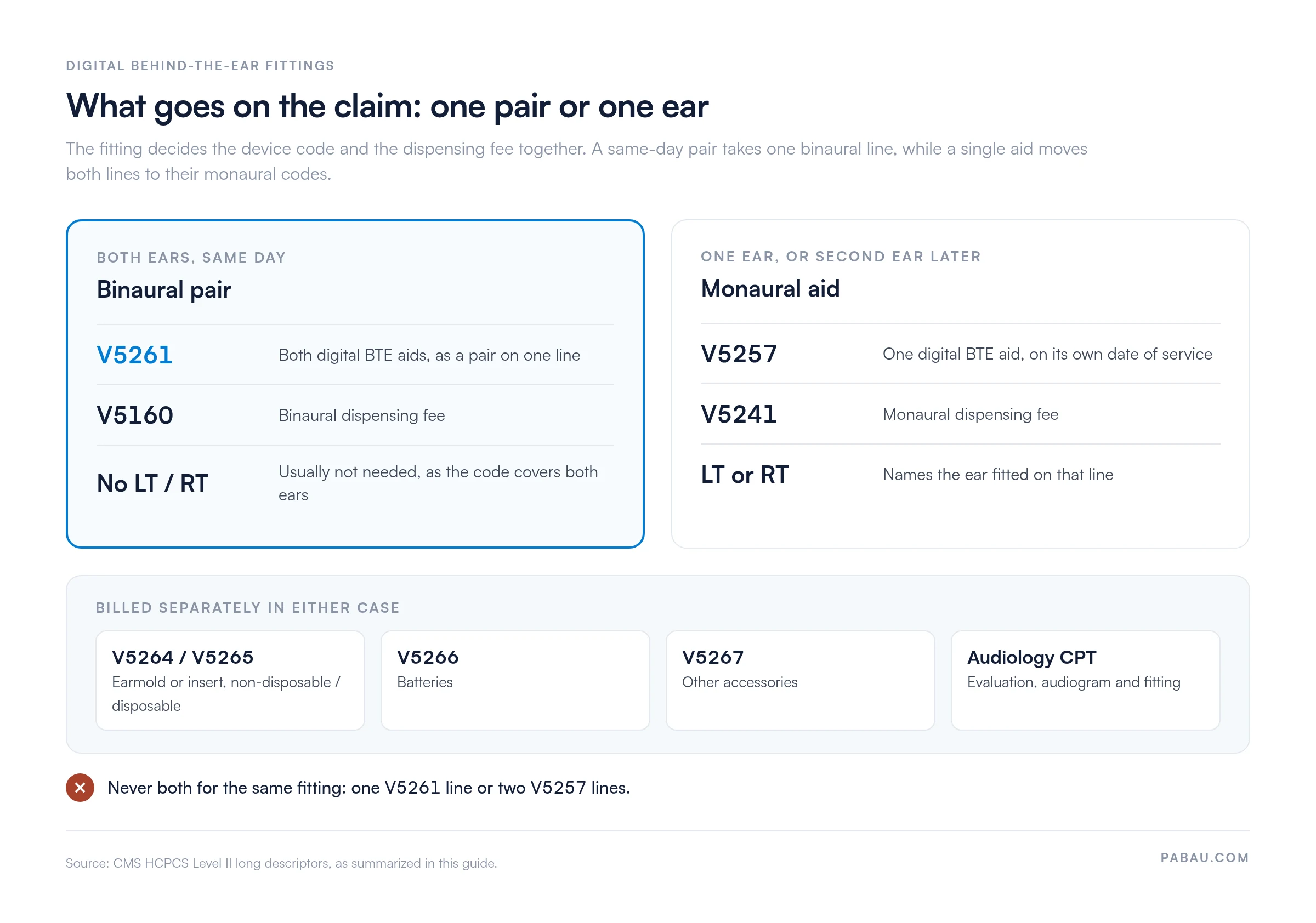
Claim lines for a digital behind-the-ear fitting.
A same-day pair takes V5261 and the V5160 fee, while a single aid takes V5257, V5241, and an LT or RT modifier. Codes follow the CMS HCPCS Level II descriptors.

Two other neighbors need checking at the same time. V5260 is the digital binaural ITE pair, so it is a style error on a BTE fitting, not a monaural option. V5253 is the binaural BTE pair for digitally programmable analog aids.

The codes after V5261 are not style or laterality variants. V5262 and V5263 report disposable hearing aids of any type, monaural and binaural. V5264 and V5265 report earmolds or inserts, non-disposable and disposable.

Modifiers used with V5261

V5261 already describes a pair, so laterality modifiers are usually not needed on the binaural line. A few modifiers still apply in specific claim scenarios.

Modifier When used Risk if incorrect
GY Billing traditional Medicare for a statutorily excluded item, usually to get a denial a secondary payer needs Without GY, the claim may not return the clean denial a secondary payer asks for
LT / RT Used on the monaural code (V5257) when billing a single digital BTE aid; not standard on binaural V5261 Adding LT or RT to a binaural code may trigger a payer edit that needs manual review
NU / UE Some Medicaid programs ask for a purchase modifier: NU for new equipment, UE for used equipment Omitting it where the payer requires it causes a denial, so check the payer’s billing guide

An Advance Beneficiary Notice (ABN) is not required for a statutorily excluded item like a hearing aid. Many practices still give patients a voluntary written notice, so the cost conversation is documented before the fitting.

Documentation requirements for billing V5261

Incomplete documentation is the most common denial trigger after missing prior authorization. The following records usually need to be on file before you submit a V5261 claim.

  • Audiometric evaluation: A current audiogram, often dated within 6 to 12 months of dispensing, showing hearing loss that meets the payer’s medical necessity threshold. It should carry the audiologist’s signature and credentials.
  • Recommendation for bilateral fitting: A written recommendation or order for binaural BTE amplification. It ties the audiogram findings in both ears to the device type you dispensed.
  • Device invoice: An itemized invoice showing the manufacturer, model, and serial numbers for both aids. Some Medicaid programs reimburse against invoice cost, so they check it against their allowable amount.
  • Proof of delivery (POD): A signed, dated receipt confirming the patient received both hearing aids. Many state Medicaid programs treat the delivery date as the date of service.
  • Prior authorization number: Where the payer requires authorization, the number goes in the designated field on the claim. A missing number usually means a denial and a slower appeal.
  • Examination notes: Some payers require proof that a licensed audiologist or physician examined the patient in person before the fitting. Telehealth-only evaluations may not satisfy every state Medicaid policy.

The claim also needs a diagnosis that supports a bilateral fitting. Use the ICD-10 codes for bilateral conductive, sensorineural, or mixed hearing loss in the H90 category, and make sure the audiogram supports them.

Pro Tip

Build a V5261 documentation checklist into intake, before the fitting appointment rather than after it. Collecting the audiogram, device invoice, and authorization number before the patient leaves removes the most common post-submission correction requests.

Which payers cover V5261 and what are their requirements?

Payer policy for V5261 varies widely. Knowing each payer’s position before you order the devices prevents claims that can never be paid.

Payer Coverage position Key requirement
Medicare Part B Statutorily excluded under Section 1862(a)(7) of the Social Security Act No reimbursement; bill the patient or a secondary payer, using GY where a Medicare denial is needed
Medicare Advantage Coverage varies by plan; many plans include a supplemental hearing benefit Verify the plan benefit, prior authorization, and network rules before dispensing
Medicaid (state programs) Covered in many states, with Washington HCA and Minnesota DHS among those publishing hearing aid billing guides Prior authorization, an audiometric evaluation, and proof of delivery are common requirements
Blue Cross Blue Shield Covered under some commercial plans, depending on the member’s benefit Prior authorization is common, and some plans limit the benefit by age
Other commercial plans Coverage and authorization rules vary by plan and employer contract Verify eligibility and benefit details before the appointment

Medicare Advantage is where a Medicare patient is most likely to have hearing aid coverage. Each plan designs its own benefit, so check it before telling a patient they have no coverage. Running insurance eligibility verification at booking catches this early.

Reimbursement rates and allowable amounts for V5261

No single national allowable applies to V5261. Reimbursement is set at the payer level, and three mechanisms decide what a practice is paid.

  • State Medicaid fee schedules: Each covering state sets its own maximum allowable for V5261. Some pay a fixed amount, and others pay invoice cost plus a dispensing fee. Check the current schedule on the state’s provider portal.
  • Medicare Advantage contracted rates: Plans negotiate rates with contracted audiology providers or hearing aid networks. Out-of-network fittings often carry lower payment or higher patient cost-sharing.
  • Commercial contracted rates: Blue Cross Blue Shield and other commercial payers set rates through provider contracts, which are not public. Out-of-network claims usually pay the plan’s out-of-network allowance.

Traditional Medicare publishes no payment rate for V5261, because the code sits outside the Medicare benefit. Your payer contracts, the state Medicaid schedule, and the remittance on paid claims are your only benchmarks.

Common claim denial reasons for V5261 and how to avoid them

Most V5261 denials are preventable. The table below maps each common denial to its root cause and the step that prevents it. A structured denial management process helps you spot which one your practice hits most.

Denial reason Root cause Prevention
Non-covered service Claim sent to traditional Medicare Part B, which excludes hearing aids Bill the patient or secondary coverage; append GY if a Medicare denial is needed first
Missing prior authorization Authorization not obtained before dispensing on a plan that requires it Check the requirement at eligibility verification and record the number before the fitting
Wrong code selected V5261 used for a monaural fitting, or a non-BTE or non-digital pair billed as V5261 Confirm style, technology, and laterality at fitting; use V5257 with LT or RT for one digital BTE aid
No proof of delivery Claim sent before the patient signed the POD, or the POD has no date Collect a signed, dated POD at the dispensing appointment
Frequency limitation Replacement claim sent before the payer’s minimum interval has passed Record the last dispensing date and check the payer’s limit before booking a replacement
Duplicate billing A binaural claim plus monaural lines submitted for the same pair Use either one V5261 line or two V5257 lines, never both for the same fitting

Frequency and replacement limitations

Payer limits on hearing aid replacement vary widely. State Medicaid programs commonly allow replacement every three to five years, and each program publishes its own interval.

Early replacement needs documented medical necessity. Accepted reasons usually include loss, damage beyond repair, or a significant change in hearing thresholds. An appeal that cites the audiogram and the payer’s own early-replacement criteria beats a generic medical necessity statement.

How to submit a V5261 claim: Step-by-step

A clean V5261 claim follows the same workflow from eligibility check to payment posting. Claims management software that tracks each step flags a missing audiogram or delivery receipt before the claim goes out.
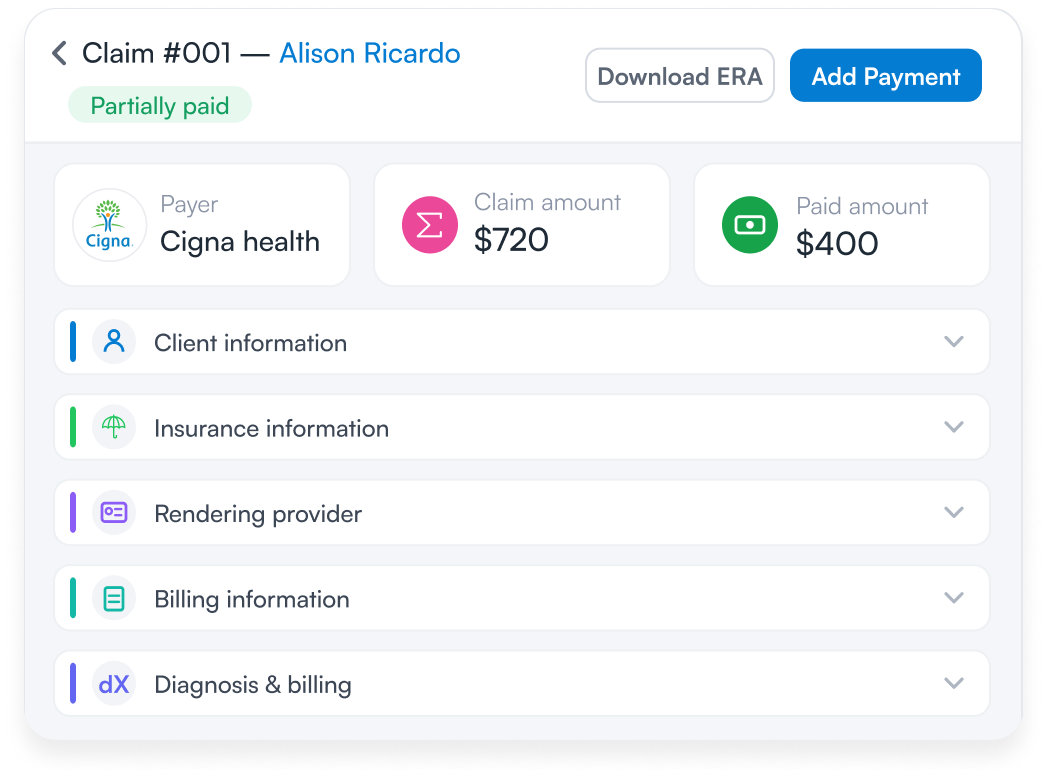
Pabau claim detail screen showing payer Cigna Health
Pabau’s claim screen puts the billed and allowed amounts side by side, so you can see whether a V5261 pair was paid in full.
  1. Confirm coverage and benefit: Run eligibility verification before the appointment. Confirm the hearing aid benefit, any benefit limit, and the patient’s cost share, and flag Medicare Advantage plans for a separate check.
  2. Obtain prior authorization: Where the payer requires it, send the audiogram and proposed device model before the fitting. Record the authorization number and approval date in the patient record.
  3. Document the evaluation: The audiologist records the audiogram results, the degree and configuration of loss in each ear, and the rationale for bilateral BTE amplification.
  4. Dispense and collect proof of delivery: Record the manufacturer, model, and serial number for each aid. Have the patient sign and date the POD at the appointment.
  5. Select the code and modifiers: Confirm both aids are digital BTE devices fitted as a pair, then enter V5261. Add V5160 for the binaural dispensing fee and any payer-required modifier.
  6. Attach supporting documents: Depending on the payer, attach the audiogram, the recommendation, the invoice, and the signed POD. Otherwise keep them ready in the record for audit.
  7. Submit and track: Watch the remittance closely. A non-covered denial from a Medicaid plan may mean the patient’s plan excludes hearing aids, so call provider relations before you rebill. A complete superbill keeps every required field filled before submission.

How Pabau keeps V5261 claims moving

A binaural claim doubles the paperwork. Two serial numbers, two ears on the audiogram, one authorization, and one delivery receipt all have to agree before the claim goes out.

In most audiology practices those records live in different places, so a mismatch only shows up when the denial arrives.

Pabau holds the patient record and the claim in one system. The audiogram, the order, the fitting note, and both device serial numbers attach to the same file the claim is built from. Your biller can see the file is complete before V5261 leaves the practice.

Remittances post back against the code they paid. That gives you a running view of what each payer allows for V5261, and which plans deny it most often.

Manage audiology claims without the manual follow-up

Pabau’s claims management tools help audiology practices track prior authorization status, attach documentation, and submit HCPCS V-series claims cleanly the first time.

Pabau claims management dashboard

Conclusion

V5261 fails for reasons that are settled before the claim is built. The payer decides whether hearing aids are covered, and the fitting decides whether the code is right.

The cheapest fix is to code at device selection. When the audiologist confirms a digital BTE pair, V5261 is right, and a single aid moves the claim to V5257 with LT or RT. Verify the benefit and the authorization at that same moment.

Make that check a hard step in your scheduling workflow, and most V5261 denials never happen. Book a demo to see how Pabau tracks hearing aid claims from the fitting through to the posted payment.

Continue your research

Continue your research

Need to understand how claims move from submission to payment? Medical billing fundamentals walks through the complete revenue cycle from code selection through ERA posting.

Looking for a clean claim checklist for audiology and hearing services? Medical billing compliance outlines the documentation and process standards that keep HCPCS claims audit-ready.

Frequently asked questions

What does HCPCS code V5261 cover?

HCPCS code V5261 covers a hearing aid, digital, binaural, BTE. That means a matched pair of digital behind-the-ear aids fitted to both ears in one dispense. It is a Level II code in the V5120-V5267 hearing aid range.

Is HCPCS V5261 covered by Medicare?

No. Traditional Medicare Part B excludes hearing aids under Section 1862(a)(7) of the Social Security Act. Many Medicare Advantage plans include a hearing benefit, but coverage varies by plan and needs separate verification.

What is the difference between V5261 and V5257?

Both codes describe digital behind-the-ear hearing aids. V5257 is monaural, one aid for one ear, while V5261 is binaural, a pair for both ears. If only one digital BTE aid is dispensed, bill V5257 with an LT or RT modifier.

What documentation is required to bill V5261?

You typically need a current audiogram, a written recommendation for bilateral BTE amplification, and an itemized invoice with both serial numbers. Add a signed proof of delivery and the prior authorization number where the payer requires one.

Why would a V5261 claim be denied?

Common reasons are the Medicare Part B exclusion, missing prior authorization, and using V5261 for a monaural fitting. Unsigned proof of delivery, frequency limits, and duplicate billing also cause denials. Each is preventable with a pre-fitting checklist.

Which payers reimburse HCPCS code V5261?

State Medicaid programs with a hearing aid benefit, such as Washington and Minnesota, reimburse V5261. Many commercial plans, including some Blue Cross Blue Shield plans, cover it with prior authorization. Medicare Advantage varies by plan, and traditional Part B does not pay.
×