HCPCS Code Q4175: Billing, coverage, and documentation guide
HCPCS Code Q4175: Code Description and Product Identity HCPCS Code Q4175 is the ...

Last Updated: Nov 20, 2026
V5272 is the HCPCS Level II code for assistive listening device, TDD. It covers one telecommunications device for the deaf, a text telephone that lets a patient with documented hearing loss type and read phone conversations.
The code sits in the V5268-V5290 assistive hearing device range. It excludes hearing aids, telephone amplifiers, and captioned telephones, and traditional Medicare Part B treats it as a statutorily excluded hearing device.
Let Pabau's smart automation suggest the right codes, reduce claim denials, and keep your practice compliant—effortlessly.
Automate repetitive tasks and focus on what matters most—your patients.
Reduce coding errors and ensure compliance with the latest regulations.
Clean claims, fewer denials, and faster reimbursements.
Powerful insights and reporting to help your practice thrive.
HIPAA compliant SOC 2 certified GDPR-compliant Trusted by 4,000+ clinics worldwide

HCPCS code V5272 covers one TDD, a text telephone that lets a patient who is deaf or hard of hearing type and read phone calls.
Traditional Medicare Part B excludes hearing devices under Section 1862(a)(7), so V5272 coverage depends on Medicare Advantage, Medicaid, or commercial benefits.
V5272 is not a hearing aid code. Billing it for an amplified phone, a caption decoder, or a captioned telephone is a coding error that payer edits flag.
Pabau, a practice management platform, keeps the order and hearing evaluation on the patient record and validates each V5272 claim before it goes out.
HCPCS code V5272 is the HCPCS Level II code for an assistive listening device, TDD. The Centers for Medicare & Medicaid Services (CMS) publishes that descriptor in its quarterly HCPCS code file. TDD stands for telecommunications device for the deaf, a text telephone that is also called a TTY. AAPC lists the code in the V5268-V5290 assistive hearing devices range.
A TDD is a keyboard with a text display that connects to a telephone line. Two TDD users type to each other directly. A TDD user reaches a hearing caller through a telecommunications relay service, whose operator voices the typed text and types the replies. The device serves patients whose hearing loss rules out voice calls, even with amplification.
Confirm the current descriptor against the latest CMS HCPCS release, since descriptors can change in annual code cycles.
V5272 covers a single TDD unit supplied to a patient with documented hearing loss and a qualifying order. The code describes the device itself. It does not bundle the hearing evaluation, the time spent teaching the patient to use the device, or a telephone service plan.
A captioned telephone is not a TDD. The patient speaks normally and reads a relay service’s captions of the other caller’s words. A payer that covers one may point you to V5274, the not otherwise specified code, so check its policy first. Never bill V5272 for it, because the descriptor names a TDD only.
Neighboring codes in the V5268-V5290 range describe similar devices, so match the exact device to the exact code. A telephone device is the most common mix-up, because V5268 also covers a phone accessory. A signaler that flashes when the phone rings bills as V5269. The table below maps the codes most often confused with HCPCS code V5272.
If the device lets the patient type and read a phone conversation, the code is V5272. If it makes a voice call louder, it is V5268. Television devices go to V5270 or V5271. The guide below runs the same test, then follows a V5272 claim to the payer.
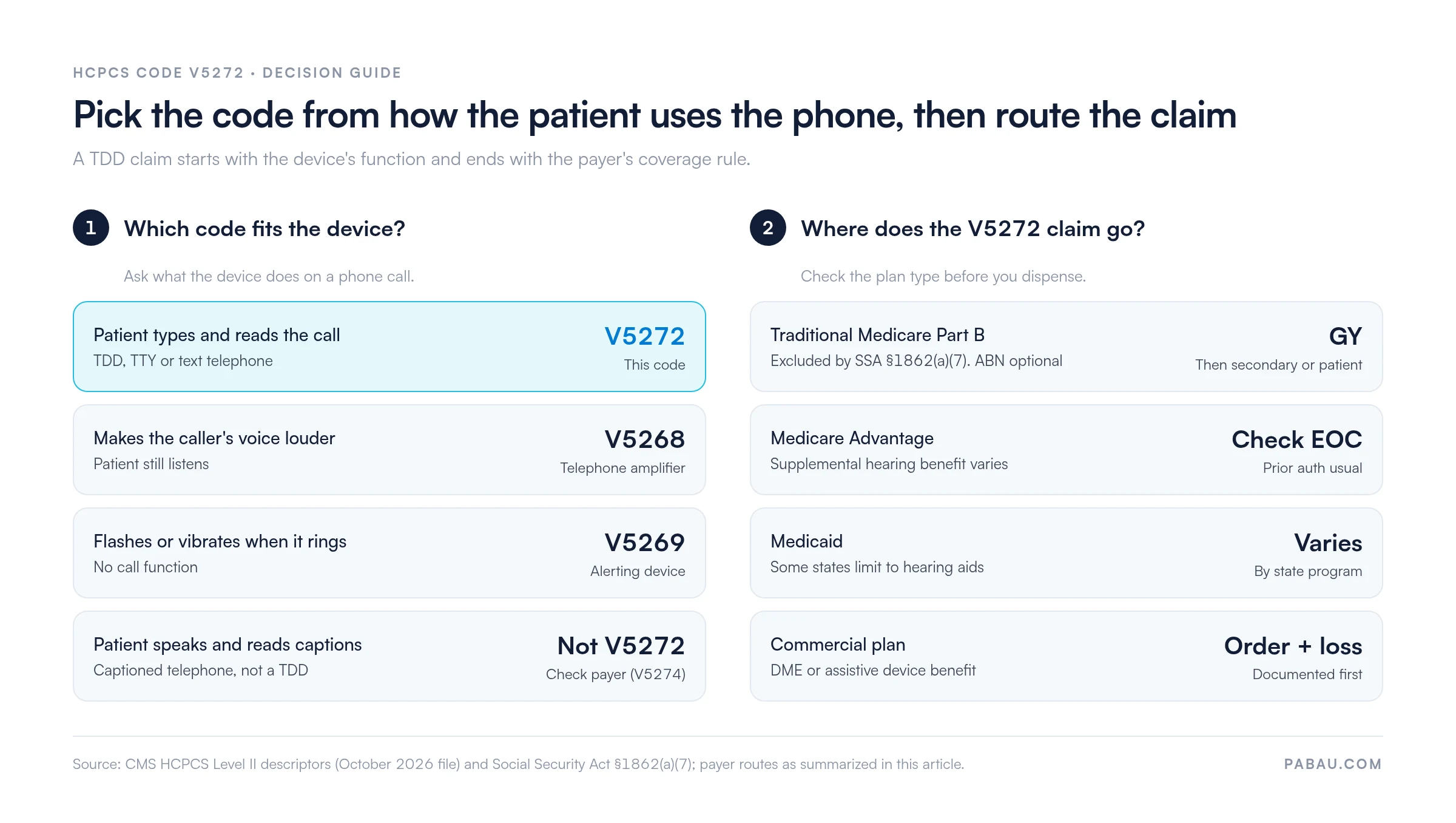
Use the AAPC HCPCS code lookup to verify current descriptors before each claim cycle.
Traditional Medicare Part B does not cover hearing aids or assistive hearing devices. Section 1862(a)(7) of the Social Security Act makes hearing aids a statutory exclusion, and a TDD falls into the same non-covered category. A V5272 claim sent to traditional Medicare will deny as a non-covered benefit, whatever the medical necessity documentation shows.
Insurance is not the only route for this device. Most states run a telecommunications equipment distribution program that supplies TDDs to eligible residents with hearing loss, often at no cost. Checking that option at intake can spare the patient a claim that was always likely to deny.
Prior authorization for V5272 depends entirely on the payer. Traditional Medicare doesn’t require it for a non-covered item, because the claim will simply deny. Medicare Advantage plans that cover the device usually require authorization before dispensing.
Commercial insurers typically want three documents before they issue an authorization number. Those are a signed order, hearing evaluation results, and a statement of why voice calls aren’t workable for this patient. Confirm current requirements through each payer’s provider portal, since they can change between plan years.
Payers that cover V5272 ask for the same core file. Every item below should sit in the patient chart before the claim goes out.
The functional need statement carries the most weight on a V5272 review. A payer reviewer sees hearing loss on the chart and asks why an amplified phone wouldn’t do. One sentence from the ordering provider that answers the question settles it.
Once the file is complete, Pabau’s claims management software checks each claim for missing or invalid details before it leaves the practice.
The ICD-10-CM code on a V5272 claim has to support the need for a text telephone specifically. A code that shows severe or profound loss makes the strongest case, because it explains why amplification alone falls short. These codes are the ones most often paired with V5272 claims.
Claim construction for HCPCS code V5272 follows a simple pattern. Most avoidable rejections come from a wrong unit count, a missing coverage modifier, or a service date that doesn’t match delivery. Submitting a clean claim from the start avoids the rework cycle that eats into billing staff time.
Bill one unit per TDD dispensed. A TDD is a single device, not a paired item, so RT and LT modifiers don’t apply. A replacement goes on a new claim with one unit, and the record should document why the original device needed replacing.
GY alone is the norm on a traditional Medicare V5272 claim. The other two modifiers apply only in the advance beneficiary notice (ABN) situations below.
For Medicare Advantage or commercial claims where the TDD is a covered benefit, no coverage-status modifier is usually needed. Confirm each payer’s modifier rules in its billing manual before submission.
Report V5272 on the CMS-1500 claim form or its electronic equivalent, the 837P transaction. Enter the code in Box 24D and one unit in Box 24G. Point Box 24E to the hearing loss diagnosis listed in Box 21. The date of service is the delivery date, and it must match the signed delivery receipt.
Traditional Medicare does not pay for V5272, so no Medicare fee schedule amount applies to the device. Reimbursement comes from Medicare Advantage plans, state Medicaid programs, and commercial insurers, each of which sets its own allowable amount. Use the CMS Physician Fee Schedule search to look up rates for any associated audiology service codes.
State Medicaid programs that cover assistive listening devices publish their rates on their provider portals. Commercial allowables are set by contract. Rates reset each year, so re-check them at the start of every plan year.
V5272 denials cluster around a predictable set of root causes. Knowing them lets billing staff build a pre-submission checklist that stops most denials before they happen. Systematic denial management also tracks patterns over time, so recurring issues with one payer get escalated rather than fixed one claim at a time.
Start by identifying the denial reason from the Explanation of Benefits or the 835 remittance before taking any action. Acting on the wrong reason wastes the appeal slot. A working knowledge of medical billing denial codes helps billing staff triage from the remittance rather than from memory.
Before you dispense a TDD, ask whether the patient has tried an amplified phone and what happened. Record the answer in the chart. That single line answers the question most V5272 medical necessity reviewers ask, and it keeps the claim off the V5268 path.
A clean V5272 claim needs five things in place before it leaves the practice. Those are the right code, the right coverage modifier, a specific diagnosis, a matched delivery date, and a complete documentation file. Many audiology teams still check them by hand across a billing system, a paper order, and a scanned evaluation.
Pabau brings that check into one system. Insurer details live on the patient record, next to the signed order and the hearing evaluation. Claims go to Claim.MD from inside Pabau, after a check for missing or invalid details. A rejected claim is flagged as Needs action, with the reason shown.
The result is fewer V5272 claims bouncing back for a missing GY modifier or an unsigned delivery receipt. Your billers spend less time rebuilding claims and more time on the ones that need a judgment call.

Pabau tracks prior auth status, records HCPCS codes, and flags rejected claims as Needs action and shows the reason. Your billers spend less time chasing paperwork.

V5272 is a narrow code: one device, one clear purpose, and a payer landscape where traditional Medicare denies by statute. That makes two checks at intake worth more than any appeal later. Confirm the patient’s plan type, and confirm that a TDD, not an amplified phone, is the device the patient needs.
For traditional Medicare, bill with GY, or point the patient to the state equipment program. For other plans, secure authorization and a functional need statement first. Pabau’s medical billing workflow keeps the order, the evaluation, and the claim in one place. To see how it handles HCPCS device codes, book a demo.

Need a framework for reducing claim rejections across your practice? Medical billing compliance covers the documentation and workflow standards that keep audiology and healthcare supply claims clean from submission.
Want to understand how payer eligibility checks prevent V5272 coverage surprises? Insurance eligibility verification explains how real-time eligibility queries surface hearing benefit details before a device is dispensed.
Looking for a plain-English explanation of the full billing cycle? Revenue cycle management explained covers each stage from patient intake through claim payment and how to identify where supply code revenue leaks most often occur.
Dispensing a device for a cochlear implant user? HCPCS code V5273 covers the assistive listening device that pairs with an implant processor.
Billing a TV amplifier rather than a phone device? HCPCS code V5270 sets out the descriptor and coverage for television amplifiers.
HCPCS code V5272 is the Level II code for an assistive listening device, TDD. A TDD, or telecommunications device for the deaf, is a text telephone that lets a patient type and read phone conversations. CMS maintains the code in the V5268-V5290 assistive hearing device range.
No. V5272 describes a TDD, which is a text telephone, not a hearing aid. Hearing aids bill under their own V5 hearing aid codes, and billing V5272 for one is a coding error.
No. Traditional Medicare Part B excludes hearing devices under Section 1862(a)(7), so V5272 is not payable under original Medicare. Some Medicare Advantage plans cover assistive listening devices as a supplemental benefit, so check the individual plan.
V5272 covers a TDD, where the patient types and reads the conversation. V5268 covers a telephone amplifier, which makes the caller louder so the patient can still listen. Match the code to how the patient uses the phone.
No. A TDD is a single device, not a paired item, so side modifiers don’t apply. Bill one unit per device. On traditional Medicare, GY alone is the norm, and GA applies only when you issued an optional ABN.
The most common reasons are a non-covered benefit under traditional Medicare, a missing prior authorization, and medical necessity not established. A wrong code for the device and a missing proof of delivery follow. The 835 remittance codes show which one applies.