CPT Code 98981: RTM Treatment Management Billing Guide
CPT code 98981: Definition and official descriptor CPT code 98981 is an add-on c...

Last Updated: Nov 9, 2026
V5050 is the HCPCS Level II code for a hearing aid, monaural, in the ear. It reports one in-the-ear (ITE) hearing aid fitted to a single ear, where no digital or programmable ITE code applies.
Two errors cause most rework on this code. Some billers confuse V5050 with V5060, its behind-the-ear equivalent. Others send the claim to traditional Medicare, which excludes hearing aids under Social Security Act §1862(a)(7).
Let Pabau's smart automation suggest the right codes, reduce claim denials, and keep your practice compliant—effortlessly.
Automate repetitive tasks and focus on what matters most—your patients.
Reduce coding errors and ensure compliance with the latest regulations.
Clean claims, fewer denials, and faster reimbursements.
Powerful insights and reporting to help your practice thrive.
HIPAA compliant SOC 2 certified GDPR-compliant Trusted by 4,000+ clinics worldwide

HCPCS Code V5050 reports one in-the-ear (ITE) hearing aid for a single ear. Behind-the-ear, binaural, body-worn and digital aids each have their own V-code.
Traditional Medicare Part B does not cover hearing aids. V5050 is excluded under Social Security Act §1862(a)(7) and has no Medicare fee schedule rate.
Billing a BTE aid as V5050 and dispensing without a required prior authorization are the two leading causes of V5050 denials.
Pabau, the practice management platform we build, records the prior authorization on the patient’s case and warns when one is missing.
HCPCS Code V5050 is the Level II code for a hearing aid, monaural, in the ear. It reports one in-the-ear (ITE) aid fitted to a single ear, where no digital or programmable ITE code applies.
It sits in the V5000 series, which covers hearing aids, hearing-related supplies and audiology services. The quick-reference table below captures the essential code facts.
V5050 does not cover digital or digitally programmable aids, which have their own HCPCS codes. It does not cover binaural fittings either, which take the binaural codes. According to CMS’s HCPCS overview, the V-series codes are updated annually and published in the CMS Alpha-Numeric HCPCS file.
The descriptor “monaural, in the ear” sets two hard boundaries. The device sits inside the ear canal or concha bowl, and only one ear is billed per unit. Crossing either boundary is a miscoding.
The V5050 vs V5060 distinction trips up practices regularly. Both are monaural aids, and the split depends entirely on where the device sits. A BTE aid billed as V5050 will be denied for wrong code on audit. The table below covers the codes most often confused with V5050.
For the in-the-ear and behind-the-ear aids, the right code comes down to three questions, set out in the grid below.
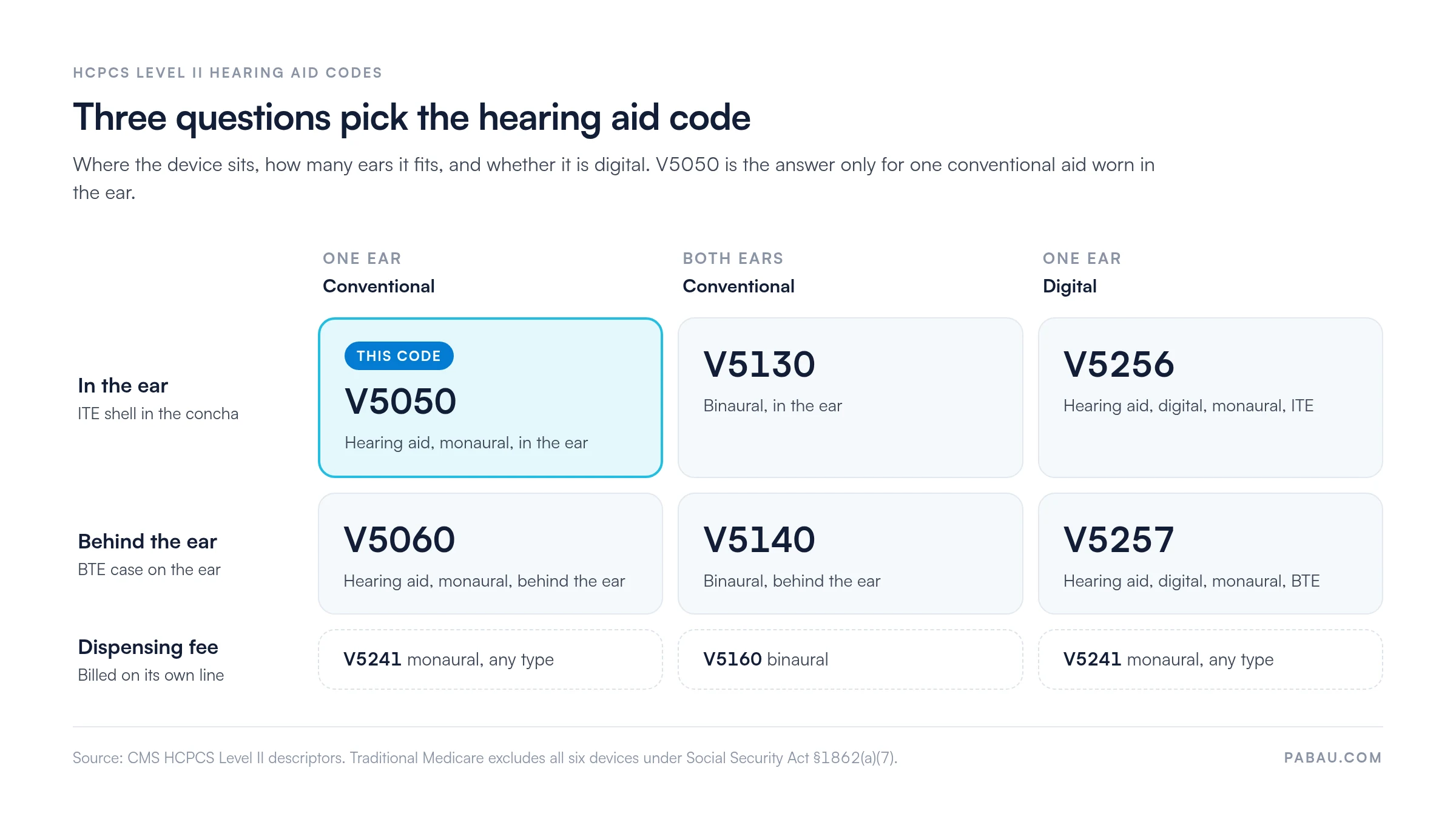
When the aid is digital or programmable, the code moves off V5050. A digital ITE aid takes V5256, and a digitally programmable analog ITE aid takes V5246. Confirm the technology from the manufacturer’s specification sheet before coding, because payers that cover hearing aids may price the three codes differently.
Traditional Medicare Part B does not cover hearing aids. This exclusion is established by Social Security Act §1862(a)(7), which explicitly lists hearing aids as a non-covered benefit. Because V5050 describes a hearing aid device, Medicare Part B will not reimburse it, and CMS publishes no fee schedule allowable for the code.
Coverage varies significantly across other payer types. The table below outlines the typical position by plan type. Always verify with the specific plan before claiming.
Payer coverage policies change with plan year. Verify patient benefits before every V5050 fitting, not just at initial patient registration. Good insurance eligibility verification at the point of service prevents the most avoidable denials on this code.
Documentation requirements for HCPCS Code V5050 vary by payer and plan policy. The list below reflects common payer expectations. Treat it as a checklist, not a guarantee of coverage.
Solid medical billing compliance practice means retaining all of the above in the patient record for the payer’s audit lookback period. That period typically runs three to seven years, depending on payer type.
Run a documentation checklist at the point of dispensing, before the patient leaves the practice. Chasing a signed delivery confirmation or serial number after the patient has gone home adds days to your billing cycle. Items still missing at audit time become findings.
A clean V5050 claim moves through six steps. Each step feeds the next, so a skipped step creates rework further down the line.
Understanding clean claim submission standards matters for V5050, because a single missing field generates a technical denial. A wrong taxonomy code for the rendering provider, for example, can delay payment by weeks.
Most V5050 denials are preventable. The table below maps the most frequent denial patterns to their root cause and corrective action. The CARC numbers follow the standard set, and our guide to medical billing denial codes defines each one.
Effective denial management in healthcare for hearing device codes starts at the front desk. Building payer-specific PA and eligibility checks into the dispensing workflow stops the top two denial categories before a claim is submitted.
CMS does not publish a Medicare fee schedule allowable for V5050. Hearing aids are excluded under Social Security Act §1862(a)(7). The code therefore carries no Physician Fee Schedule rate and no DMEPOS competitive bidding price under traditional Medicare.
For payers that do cover V5050, reimbursement rates are plan-specific and not available in a single public schedule. Here is where to find them.
Never fabricate or reproduce reimbursement figures from unofficial sources. Use the CMS Physician Fee Schedule search to confirm there is no Medicare rate for V5050.
Work directly with each payer for contracted allowables. The AAPC HCPCS code lookup shows descriptor and status information, which confirms the code is active before billing.
V5050 is the device code, and it represents the hearing aid itself. Fitting and dispensing the aid is billed separately with V5241 (dispensing fee, monaural hearing aid, any type). A binaural fitting takes V5160 instead, and V5090 covers an unspecified hearing aid. How the device and fee codes interact depends on the payer’s bundling edits.
Many commercial payers and some Medicaid plans allow V5050 and V5241 on the same claim, treating the device and the fitting as two reimbursable services. In this model, V5050 covers the hardware cost and V5241 covers the audiologist’s time and professional dispensing service.
Some payers apply a bundling edit that collapses V5241 into V5050, treating the fitting fee as part of the device allowable. Submitting both codes together then results in one being denied as unbundled. The remittance will typically show CARC 97, which means the payment is included in the allowance for another service.
Check the payer’s policy or fee schedule notes before billing both codes together. Where bundling edits apply, bill V5050 only and account for the fitting service within the device allowable.
Payer editing logic changes with plan updates, so recheck it each year. A superbill that separates device and service lines lets your practice switch billing patterns by payer without rebuilding the encounter record.
Create a payer-specific cheat sheet for V5050 that records each plan’s PA requirement, diagnosis code rules, frequency limitation and bundling edit status. Update it at the start of each contract year. One page per payer stops the same denial from recurring all year.
V5050 rework usually starts before the claim exists. A BTE aid gets keyed as ITE, a prior authorization goes unrecorded, or the benefit check is months old. Each one surfaces as a denial weeks later.
Pabau, the practice management platform we build, keeps the fitting record and the claim in one system. The prior authorization code, dates and sessions sit on the patient’s case, and Pabau warns when one is missing.
Its claims management software sends CMS-1500 claims through the Claim.MD clearinghouse, checks eligibility and posts ERA remittances to the patient record.
The billing team sees an eligibility response or a rejection the day it comes back. A coding fix then happens while the fitting is still fresh, so the corrected claim goes out the same week.

Pabau tracks prior authorizations on the patient case and submits claims through Claim.MD, with eligibility checks and ERA posting. See how it handles hearing aid billing from fitting to remittance.

V5050 rewards a short check at the fitting appointment. Confirm the aid sits in the ear, fits one ear and is neither digital nor programmable, and the code is settled. Then confirm the payer covers hearing aids at all, because traditional Medicare never will.
The trade-off is a few minutes at the front desk against weeks on appeals. A benefit check and a recorded prior authorization cost little, while a rebilled V5050 claim waits for payment all over again. Book a demo to see how Pabau keeps hearing aid claims, authorizations and remittances on one patient record.

Need a full picture of how claims move through your practice? Medical billing fundamentals explains the end-to-end revenue cycle from patient registration to payment posting.
Seeing recurring claim rejections across payer types? Medical claims clearinghouse guide covers how clearinghouse edits catch errors before claims reach the payer.
Fitting a digital in-the-ear aid instead? HCPCS code V5256 covers the digital monaural ITE aid and how to bill it.
Fitting both ears? HCPCS code V5130 explains how to bill a binaural in-the-ear fitting.
HCPCS Code V5050 is the Level II billing code for a hearing aid, monaural, in the ear. It applies to full-shell, half-shell and low-profile ITE hearing aids fitted to a single ear. Audiologists and DME suppliers use it to report this device to covered payers.
No. Traditional Medicare Part B excludes hearing aids under Social Security Act §1862(a)(7), so V5050 is a non-covered benefit with no published fee schedule rate. Medicare Advantage plans may cover hearing aids at plan-specific rates, and Medicaid coverage varies by state.
V5050 covers a monaural in-the-ear (ITE) hearing aid, and V5060 covers a monaural behind-the-ear (BTE) hearing aid. Both are for single-ear fittings, but the device style decides the code. Billing V5060 for an ITE device, or the reverse, is a miscoding that generates a denial on audit.
It depends on the payer and plan year. Many Medicare Advantage, Medicaid managed care and commercial plans require PA before the device is dispensed. A claim submitted without required PA is hard to overturn on appeal, so check PA requirements during the eligibility check.
Sometimes. Many commercial and Medicaid plans allow V5050 (device) and V5241 (monaural dispensing fee) on the same claim as separate services. Some payers apply bundling edits that fold the fitting fee into the device allowable. Check the payer’s policy or fee schedule notes before billing both codes together, to avoid CARC 97 denials.
The required ICD-10 diagnosis code varies by payer policy. Common pairings include H91.90 (unspecified hearing loss, unspecified ear), H91.10 (presbycusis, unspecified ear) and the laterality-specific variants. Check the plan’s coverage criteria for acceptable codes rather than applying a single code universally.
Frequency limitations vary by payer. Many commercial and Medicaid plans allow one covered hearing aid per ear every three to five years, and some apply an annual benefit cap. Verify the plan’s frequency limitation at the eligibility check, and document medical necessity if early replacement is required.