ICD-10 Code Z86.73: Personal history of TIA
ICD-10 Code Z86.73: Definition, descriptor, and code hierarchy ICD-10 Code Z86.7...

Last Updated: Nov 20, 2026
Billable Code Specific Code
Y72.1 is the billable ICD-10-CM code for therapeutic (nonsurgical) and rehabilitative otorhinolaryngological devices associated with adverse incidents. It records that an ENT device used to treat or restore function, such as a hearing aid, broke down or malfunctioned and harmed the patient.
The code sits in Chapter 20, in the block Medical devices associated with adverse incidents in diagnostic and therapeutic use (Y70-Y82), under category Y72. It's an external cause code, so it always follows the code for the injury or condition the device caused.
Let Pabau's smart automation suggest the right codes, reduce claim denials, and keep your practice compliant—effortlessly.
Automate repetitive tasks and focus on what matters most—your patients.
Reduce coding errors and ensure compliance with the latest regulations.
Clean claims, fewer denials, and faster reimbursements.
Powerful insights and reporting to help your practice thrive.
HIPAA compliant SOC 2 certified GDPR-compliant Trusted by 4,000+ clinics worldwide

ICD-10 code Y72.1 reports a therapeutic or rehabilitative ENT device, such as a hearing aid, that broke down or malfunctioned and harmed the patient.
It’s an external cause code, so it always follows the code for the injury or condition and is never listed first.
A device that worked as designed but still caused a later complication codes to Y83-Y84, not Y72.1.
Reporting Y72.1 isn’t nationally mandatory, so check whether your state or payer requires external cause codes.
Pabau records the device details and attestation in the patient record, so the practice can pair and sequence codes correctly.
ICD-10 code Y72.1 is the billable ICD-10-CM code for Therapeutic (nonsurgical) and rehabilitative otorhinolaryngological devices associated with adverse incidents. The code and that exact wording appear in CMS’s FY 2027 ICD-10-CM files, which cover encounters from October 1, 2026, to September 30, 2027.
In plain terms, it tells the payer that an ENT device meant to treat or restore function broke down and harmed the patient. A hearing aid is the classic example. Y72.1 explains how the injury happened, and a separate code describes the injury itself.
Two tests decide whether Y72.1 fits. First, the device has to have broken down or malfunctioned. The Y70-Y82 block includes “breakdown or malfunction of medical devices (during use) (after implantation) (ongoing use).” Its Excludes2 note sends later complications from a device that didn’t fail to Y83-Y84.
Second, the device’s job has to be treatment or rehabilitation without surgery. In the Alphabetic Index of External Causes, the path runs Incident, adverse, device, otorhinolaryngological, then therapeutic or rehabilitative. Both end at Y72.1.
When the device is diagnostic, such as an audiometer or tympanometer, use Y72.0 instead. When it’s an implant or prosthesis, Y72.2 applies. The flow below puts both tests and every Y72 subcode on one page.
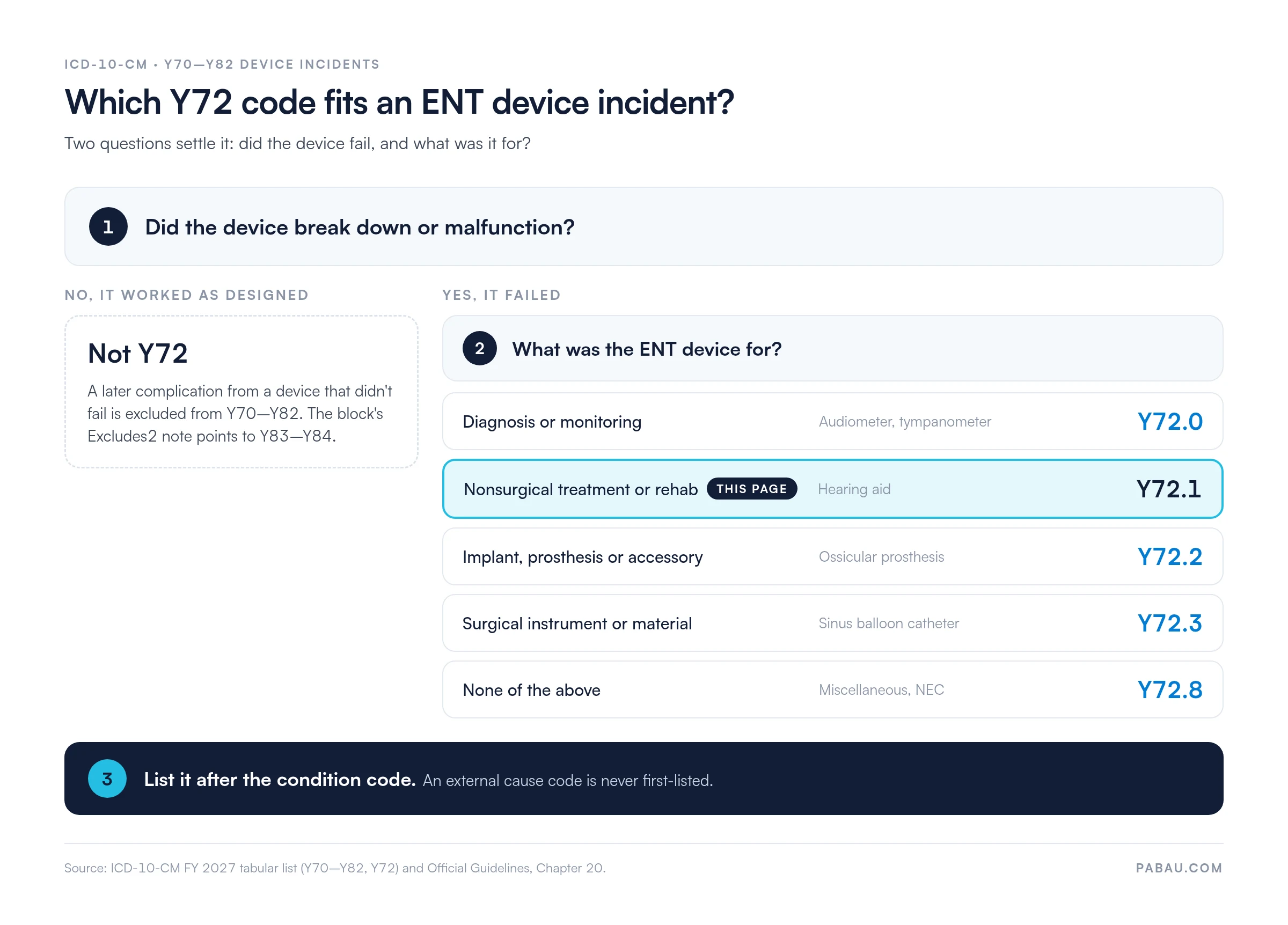
Most coding errors here come from the wrong subcode or the wrong chapter. Check the device’s job and what happened to it against this table before you submit.
A fitting or adjustment visit with no harm codes to Z46.1 on its own. Check each subcode against the CDC/NCHS ICD-10-CM web tool for the current fiscal year, since the tabular list updates every October 1.
The ICD-10-CM Official Guidelines settle the order in Chapter 20. An external cause code can never be a principal or first-listed diagnosis. Y72.1 explains the cause, and a separate code explains the result.
A patient’s behind-the-ear hearing aid develops a feedback fault and blasts a loud squeal into the right ear. The audiologist documents the fault, tests hearing and records a temporary threshold shift from the noise.
Line one of the claim is H83.3X1, noise effects on right inner ear. Y72.1 follows it. If your payer or state wants place of occurrence, a Y92 code goes on this first visit only. At follow-up, H83.3X1 and Y72.1 repeat, but the Y92 code doesn’t.
The record has to support both codes before the claim goes out. Good medical billing compliance starts in the chart, not on the claim form. Capture the device details at the visit, rather than rebuilding them from memory a week later.
Y72.1 doesn’t drive payment on its own. It has no RVU value and isn’t tied to a procedure. Its job is to record how the injury happened, for quality reporting, device-safety tracking and any payer that asks for it.
Practices billing US payers electronically can send claims through Claim.MD from Pabau, the practice management platform we build. That route also runs eligibility checks and posts remittances. Pabau’s claims management software lets the practice build the claim with the primary condition code listed first.
Run a quarterly audit of claims carrying Y72.x codes. Check that a condition code sits first on every Y72.1 claim, that the device type matches the subcode and that the record documents the fault. Fixing an order error before adjudication costs far less than working the denial.
Most of these denials are preventable. Effective denial management in healthcare starts with knowing why the claim failed. When one does come back, check the remittance code against the top 20 CARC codes before you rework it.
Each fix below is part of meeting clean claim requirements for external cause codes.
Hearing aids are FDA-regulated devices, so an incident can raise a reporting question alongside the coding one. Mandatory reports under 21 CFR Part 803 fall on manufacturers, importers and user facilities such as hospitals. A physician’s office isn’t a user facility under that rule, but anyone can file a voluntary report through FDA’s MedWatch program.
For each scenario, check the record for a device fault first. Then code the condition, and add Y72.1 only when a fault is documented.
Cochlear implants need a closer look. Coders often assign the external processor to Y72.1 and the implanted receiver to Y72.2. Confirm against the current tabular list and payer policy before you code the incident.
In many audiology and ENT practices, the device details sit in a free-text note while the claim gets built somewhere else. When the coder can’t find the fault or the provider’s cause-and-effect note, the claim stalls or goes out unsupported.
Pabau records the device details and attestation in the patient record, so the practice can pair and sequence codes correctly. Custom forms prompt for the device, the fault and the outcome during the visit. The claim then pre-fills from that record, and your coder checks the order before sending.
The result is one record your coder works from, so Y72.1 claims go out with their support attached.

Pabau records the device details and attestation in the patient record, so the practice can pair and sequence codes correctly. Claims then pre-fill from that record before they reach the payer.

Y72.1 is a small code with two traps. Confirm the device failed before you reach for it, and keep it behind the condition code every time.
If you change one habit, make it documenting the fault at the visit. With the device, the fault and the provider’s note in the chart, the code choice and its order are easy to defend.
Pabau records the device details and attestation in the patient record, so the practice can pair and sequence codes correctly. Book a demo to see how it supports ENT and audiology billing.

Need a full overview of denial prevention for device-related claims? Denial management in healthcare covers the workflow for identifying, correcting and appealing rejected claims.
Sending ICD-10 claims through a clearinghouse? Claim.MD clearinghouse guide explains how 837P claims route through Pabau’s US clearinghouse integration.
Want the wider context for external cause codes? Revenue cycle management guide places supplementary ICD-10 codes within the broader RCM process.
No. Y72.1 is a complete, billable code at four characters. The seventh character for initial, subsequent or sequela belongs on the injury code it follows, where that code takes one.
Not nationally. The Official Guidelines require external cause codes only under a state-based mandate or a payer’s rules. Without either, reporting is voluntary but encouraged.
Use Z46.1, encounter for fitting and adjustment of hearing aid. Y72.1 needs an adverse incident, so a routine fitting doesn’t carry it.
Only when the breakage harmed the patient. A broken aid that caused no injury or condition gives Y72.1 no harm to explain, so it stays off the claim.
No. It carries no RVU value and isn’t tied to a procedure. Payment follows the condition code and the services billed.
Yes. It’s in the FY 2027 ICD-10-CM code set, which covers encounters from October 1, 2026, to September 30, 2027. Its descriptor didn’t change in the FY 2027 update.