CPT code 93503: Swan-Ganz catheter billing and modifiers
CPT code 93503: Official descriptor and procedure overview In the AMA CPT code s...

Last Updated: Oct 23, 2026
V5060 is the HCPCS Level II code for hearing aid, monaural, behind the ear.
Medicare Part B never pays it. That exclusion is written into statute, and it drives most V5060 denials. The rest come from inside the code range itself, where V5070 and V5080 describe glasses rather than the binaural aid many billers expect.
Let Pabau's smart automation suggest the right codes, reduce claim denials, and keep your practice compliant—effortlessly.
Automate repetitive tasks and focus on what matters most—your patients.
Reduce coding errors and ensure compliance with the latest regulations.
Clean claims, fewer denials, and faster reimbursements.
Powerful insights and reporting to help your practice thrive.
HIPAA compliant SOC 2 certified GDPR-compliant Trusted by 4,000+ clinics worldwide

V5060 bills one behind-the-ear hearing aid fitted to a single ear.
Medicare Part B never covers hearing aids, so V5060 goes to Medicaid, Medicare Advantage, or a private insurer.
V5070 and V5080 describe glasses, not binaural aids, so a bilateral fitting bills as V5140.
Payers expect an audiogram, a signed prescription, and often a certificate of medical necessity before they pay.
Practice management software like Pabau ties the audiogram and consent to the claim, so the file is ready at submission.
HCPCS Code V5060 describes a hearing aid, monaural, behind the ear. It sits in the HCPCS Level II code set maintained by the Centers for Medicare and Medicaid Services (CMS).
Monaural means the device fits one ear. Behind the ear (BTE) means the processing unit rests above and behind the auricle. A tube or receiver carries the sound into the ear canal.
V5060 is a supply or device code, not a procedure code. Audiologists, hearing aid dispensers, and licensed hearing instrument specialists use it when billing a single BTE device. Claims management software that supports HCPCS Level II matters here, because the hearing aid V-codes do not map to CPT.
Medicare does not cover V5060, so no CMS national fee schedule rate applies. Medicaid programs and private payers set the rate instead, payer by payer. Rates vary widely by state, plan type, and contracted status.
Fee schedule aggregator data puts private payer allowables for a monaural BTE aid between roughly $500 and $3,000 per device. Treat those as indicative. Contracted rates differ by insurer and geographic market, so verify yours against the payer contract.
The CMS Physician Fee Schedule covers any companion codes that appear on the same claim as V5060. For the code record itself, the AAPC HCPCS lookup is a widely used free reference.
Run an eligibility check for every payer on the claim before you dispense the aid. Confirm that a hearing aid benefit exists and whether the payer wants prior authorization. Check whether the hearing aid evaluation code V5010 has to sit on the same claim. Doing all of this before the patient leaves the office removes the most common reason for a V5060 denial.
Medicare Part B excludes hearing aids under 42 U.S.C. Section 1395y(a)(7). The exclusion is absolute under traditional Medicare. No HCPCS code, V5060 included, can be billed to Part B for a hearing aid device.
Submitting V5060 to Part B produces a denial regardless of the patient’s diagnosis or degree of hearing loss. No modifier and no volume of documentation changes that outcome.
Medicare Advantage (Part C) is a different matter. Some plans add a supplemental hearing benefit that covers behind-the-ear aids. Coverage is plan-specific, so confirm the benefit, any dollar maximum, and whether in-network dispensing is required. When a plan does cover V5060, the claim goes to the plan directly rather than to traditional Medicare.
Medicaid hearing aid benefits are optional for states, so coverage for V5060 depends on where the patient is enrolled. California (Medi-Cal) and Minnesota both cover hearing aids for Medicaid beneficiaries. Each sets its own fee schedule rates, quantity limits, and prior authorization requirements.
Other states offer no hearing aid benefit at all. Verify coverage with the specific state Medicaid program before the device is ordered.
Private insurers handle V5060 through individual plan designs. Many employer-sponsored plans now include a hearing aid benefit, usually capped annually or over a lifetime at $500 to $2,000 per ear. Coverage often depends on a documented degree of hearing loss, confirmed by an audiogram.
Sharing audiological records with an insurer puts patient data under HIPAA into scope. Route prior authorization requests through a compliant channel rather than plain email.
Most V5060 errors come from skipping a step early. They then surface as a denial weeks after the device was dispensed. The sequence below keeps the steps in order.
Audiological records, audiograms, and prior authorization correspondence all count as protected health information. That puts HIPAA compliance across the whole billing trail, not just the clinical note.
Thin documentation is the leading cause of V5060 post-payment audits and recoupment. Payers expect a complete record at the time of submission. One missing item can trigger a documentation request or a denial on review. An appeal filed after the timely filing window is denied on timeliness alone, whatever the coding showed.
Structured digital intake forms built around audiology workflows capture every required field the same way each time. The checklist below is what payers look for.
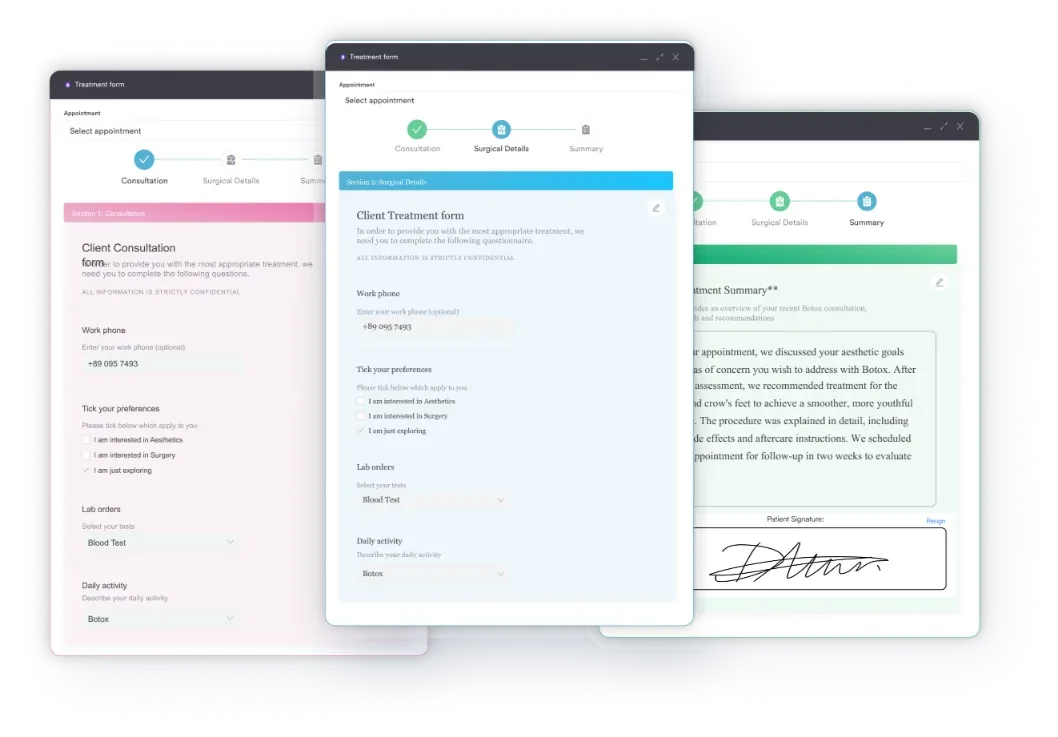
Good practice management software ties each document to the patient chart and the claim it supports, so nothing gets missed.
V5060 sits inside a family of hearing aid codes, and picking the wrong one is a common audiology billing error. The table below covers V5030 through V5080, so you can match the code to the device you dispensed. Verify the descriptions against the CMS annual HCPCS release before you submit.
The range crosses into eyewear. V5070 and V5080 describe glasses-mounted aids. HCPCS code V5080 is the bone conduction version, which vibrates the bone behind the ear instead of sending sound into the ear canal.
None of those six codes covers a bilateral fitting. Binaural behind-the-ear aids bill as V5140, which sits above this range in the V5100-V5160 block. V5000 sits below the range and is deleted, so a claim still carrying it is refiled as V5060 for a single behind-the-ear aid.
V5060 must be paired with an ICD-10-CM diagnosis code that establishes medical necessity. The diagnosis documents the type and degree of hearing loss behind the prescription. The codes below are the ones most often linked to a hearing aid claim.
Check current descriptions against the CDC ICD-10-CM tool before submitting, since descriptions and validity change each year. An EHR for private practice that maps diagnoses to HCPCS device codes cuts down crosswalk errors.
Six mistakes account for most V5060 denials. Each one costs less to catch before submission than to appeal afterward.
Practices on integrated platforms report fewer claim errors, because the documentation checklist and the claim form read from the same data.
When a V5060 claim is denied as a non-covered service, check for a Medicare Advantage plan before you write off the balance. A supplemental hearing benefit may cover it. Call the plan’s provider line rather than the standard Medicare number. Medicare Advantage plans are run by private insurers and have their own authorization and billing pathways. Plenty of resubmitted V5060 claims get paid after that one check.
In most audiology practices the audiogram lives in one system, the signed prescription sits in a folder, and the claim is raised somewhere else. When a payer asks for proof of medical necessity, someone has to go and find all three.
Practice management software like Pabau keeps them in one place. The audiogram, the consent, the prescription, and the dispensing note all attach to the patient record the claim is built from. Coverage notes and prior authorization references sit on that same record.
So the biller can see what the payer agreed to before the device goes out, and answer a documentation request the same week it arrives. For a solo audiologist.

Pabau ties the audiogram, the consent, and the dispensing note to the patient record your V5060 claim is built from. Your billers can answer a payer request without hunting through three systems.

The decision that settles a V5060 claim happens before the device leaves the office. Once the aid is fitted, the practice owns whatever the payer refuses to pay. Verifying the benefit and collecting the audiogram first is what turns V5060 into a paid line.
The other half is code discipline. V5060 is monaural and stays monaural. A bilateral fitting is V5140, and a glasses-mounted aid is V5070 or V5080. A quantity of two on a V5060 line is a denial waiting to happen.
Book a demo to see how Pabau keeps audiology documentation and hearing aid claims on one record, so fewer V5060 submissions come back.

Coding the related induced abortion procedure? CPT code 01966 guide CPT code 01966 covers anesthesia for an induced abortion, distinguishing it from spontaneous or missed abortion coding.
Billing anesthesia for a nerve block instead? CPT code 01992 guide CPT code 01992 covers anesthesia for a nerve block or injection performed in the prone position.
Billing a body-worn aid instead? V5030 covers the air conduction body-worn device and the documentation that goes with it.
Fitting both ears? V5160 explains the binaural dispensing fee that usually accompanies a bilateral claim.
Billing the fitting appointment separately? V5011 covers fitting, orientation, and checking of the hearing aid after it is dispensed.
HCPCS Code V5060 is an HCPCS Level II supply code used to bill a monaural (single-ear) behind-the-ear (BTE) hearing aid. Audiologists and hearing aid dispensers submit it when a BTE device is provided for one ear only.
No. Medicare Part B does not cover hearing aids under any HCPCS code, including V5060, because of a statutory exclusion. Some Medicare Advantage (Part C) plans offer a supplemental hearing benefit that may cover V5060. Verify directly with the plan before dispensing.
V5060 describes a monaural behind-the-ear (BTE) hearing aid. V5050 describes a monaural in-the-ear (ITE) hearing aid. Both fit one ear only. The difference is the physical style of the device, so use the code that matches what you dispensed.
Payers expect a current audiogram plus a hearing aid prescription signed by a licensed audiologist or physician. They also want fitting and dispensing notes that record the device serial number. Many Medicaid programs add a certificate of medical necessity. Keep any prior authorization approval number on file.
The five codes paired with V5060 most often are H90.0, H90.3, H90.6, H91.10, and H91.90. They cover bilateral conductive, sensorineural, and mixed hearing loss, plus presbycusis and unspecified loss. Code to the highest level of specificity the audiogram supports.
Medicaid hearing aid coverage varies by state because it is an optional benefit. States including California and Minnesota cover hearing aids for eligible beneficiaries, each with their own prior authorization rules and fee schedule rates. Contact the specific state Medicaid program to confirm coverage before dispensing.
All six codes in this range describe monaural aids. V5030 and V5040 are body worn, air conduction and bone conduction in that order. V5050 sits in the ear and V5060 behind it. V5070 and V5080 are glasses-mounted, air and bone conduction. The binaural behind-the-ear code is V5140, which sits outside this range.