Pabau Engage inbox

Pabau Engage is here: every patient conversation in one inbox.

Learn more
Book a demo Book a demo
☰
HCPCS Code

HCPCS code V5256 – Digital monaural ITE hearing aid


Code Definition

HCPCS code V5256 is the Level II code for a hearing aid that is digital, monaural and in-the-ear (ITE). It covers one custom ITE device for a single ear, built to fill the outer bowl in a full-shell or half-shell style.

The code turns on three details: digital processing, one ear and the ITE shell. Change any one and the claim needs a different code. Coders most often slip on one ear versus two, and on ITE, ITC and CIC styles, which all sit in the ear. Once those are settled, the audiogram and the prior authorization decide whether the claim pays.

Level
Level II
Category
V — Vision, hearing and speech-language pathology services
Code range
V5000-V5999 Hearing services
Billable
No
Code also known as
in-the-ear hearing aid, digital ITE hearing aid, single-ear ITE aid
Save time. Improve accuracy. Get paid faster.
Automate coding with Pabau

Let Pabau's smart automation suggest the right codes, reduce claim denials, and keep your practice compliant—effortlessly.

  • AI-powered code suggestions
  • Real-time compliance checks
  • Faster claims, fewer denials
Why practices choose Pabau
Save hours every week

Automate repetitive tasks and focus on what matters most—your patients.

Improve accuracy

Reduce coding errors and ensure compliance with the latest regulations.

Get paid faster

Clean claims, fewer denials, and faster reimbursements.

Grow with confidence

Powerful insights and reporting to help your practice thrive.

HIPAA compliant SOC 2 certified GDPR-compliant Trusted by 4,000+ clinics worldwide

Key takeaways

Key takeaways

HCPCS code V5256 bills one digital in-the-ear (ITE) hearing aid fitted to a single ear.

A binaural ITE fitting is billed as V5260, never as two units of V5256.

ITC, CIC and BTE aids each have their own codes, so the fitting style on the order decides the claim.

Traditional Medicare excludes hearing aids, so most V5256 claims go to Medicaid, Medicare Advantage or commercial plans.

Fitting, dispensing, batteries, repairs and any ear mold are billed on their own lines when the payer allows it.

HCPCS code V5256 covers one digital ITE hearing aid

HCPCS code V5256 is the supply code for a hearing aid that is digital, monaural and in-the-ear (ITE). All three must be true at once. An ITE aid is custom-built from an ear impression and fills the outer bowl of the ear, in a full-shell or half-shell style.

Fit the same device to both ears and the code moves to V5260. Dispense a smaller in-the-canal or completely-in-canal aid, or a behind-the-ear aid, and a different code applies again.

AttributeWhat V5256 requiresCoding note
Processing type
DigitalOther aid types, such as analog or programmable-analog aids, use different V-codes in V5030-V5253.
Ears fitted
Monaural (one ear only)Both ears take V5260, the binaural ITE code.
Style
In-the-ear (ITE), full shell or half shellITC is V5255, CIC is V5254 and BTE is V5257.
Code type
HCPCS Level II supply codeNot a CPT procedure code. Submit it on the CMS-1500 or 837P.

V5256 sits in the hearing services range of the CMS HCPCS Level II code set. CMS updates that file every year. For the wider code family, start from our HCPCS code guide.

What V5256 pays for, and what goes on its own line

V5256 pays for the device. The services around it, from the V5010 hearing aid assessment to the fitting, are coded separately. Payers decide which of them they cover.

Included in V5256
The digital monaural ITE hearing aid
Excluded, bill separately
Assessment for a hearing aid (V5010)
Hearing aid fitting/orientation/checking (V5011)
Dispensing fee, monaural hearing aid (V5241)
Ear mold/insert, not disposable, any type (V5264)
Batteries (V5266) and other supplies or accessories (V5267)
Repair or modification (V5014)
Binaural ITE fitting (use V5260 instead)
Other styles: CIC (V5254), ITC (V5255) and BTE (V5257)

An ITE shell is molded to the ear, so most ITE fittings need no separate ear mold. If one is dispensed, it is a V5264 item in its own right. Payer policy may allow it, or the dispensing fee, to be bundled into the device payment. Check the state Medicaid provider manual or the plan contract before you split the lines.

Style and ear count decide between V5256 and its neighbors

Five codes cause most of the mix-ups. Two questions sort them: how many ears were fitted, and where the device sits. Run them in that order, as the chart below does.
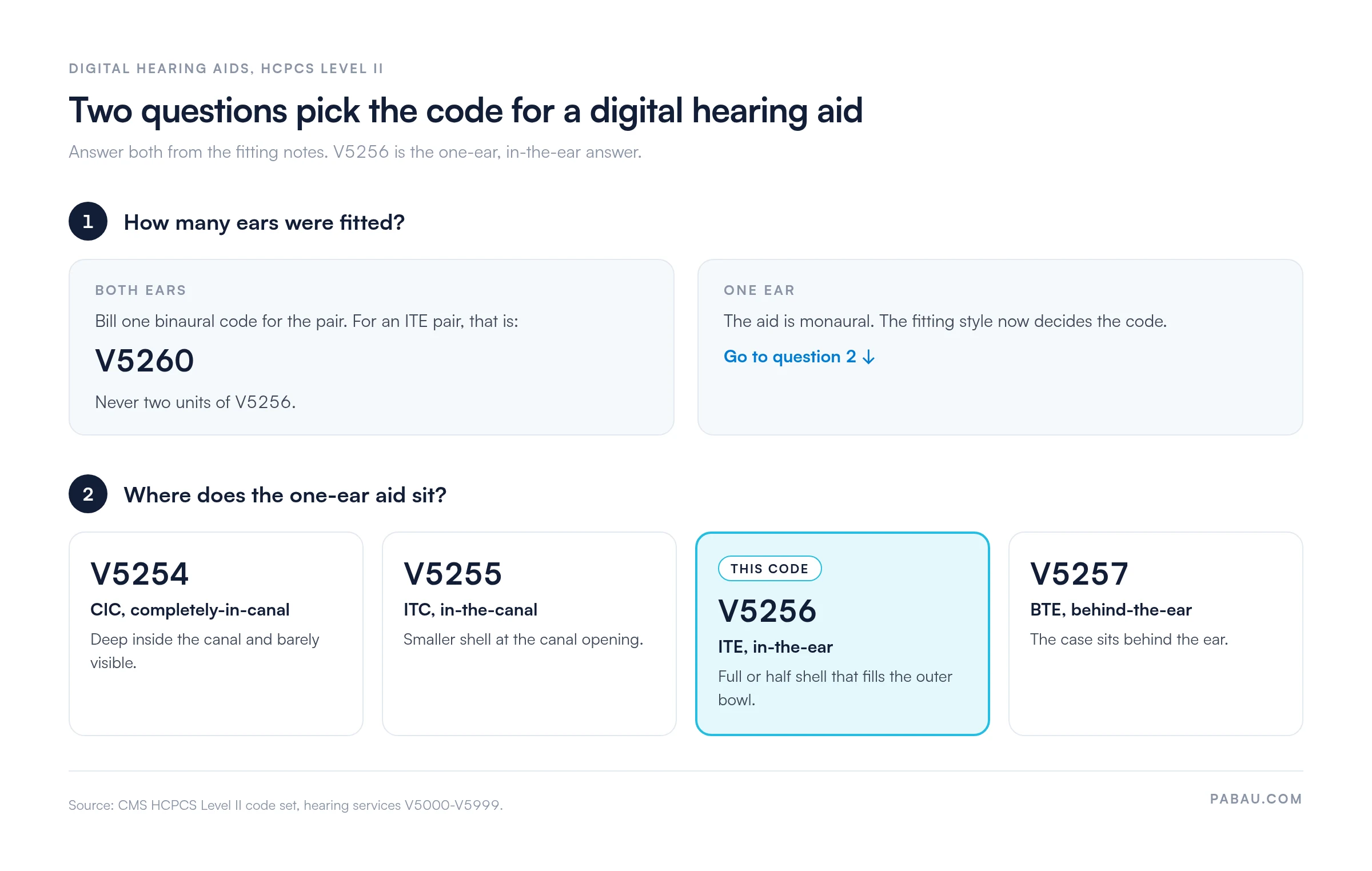
Decision chart for digital hearing aid codes
Settle the ear count first, because a second ear moves the claim off V5256 whatever the style. Codes are from the CMS HCPCS Level II code set.
CodeDescriptorEarsStyleHow it differs from V5256
V5254
Hearing aid, digital, monaural, CICOne earCompletely-in-canalSits deep inside the canal and is barely visible.
V5255
Hearing aid, digital, monaural, ITCOne earIn-the-canalSmaller shell at the canal opening, leaving most of the outer bowl clear.
V5256THIS CODE
Hearing aid, digital, monaural, ITEOne earIn-the-earThis code. A full-shell or half-shell device fills the outer bowl.
V5257
Hearing aid, digital, monaural, BTEOne earBehind-the-earThe case sits behind the ear, so it is a different style code.
V5260
Hearing aid, digital, binaural, ITEBoth earsIn-the-earThe binaural version of V5256, billed as one line for the pair.

The costliest slip is billing V5256 twice for a pair. That reads as a duplicate and denies, while V5260 covers both aids on one line. The style slip is quieter. A half-shell ITE and a large ITC can look alike, so code from the manufacturer’s style on the order. For the behind-the-ear version, see HCPCS code V5257.

Documentation that holds up when a V5256 claim is audited

Medicaid plans audit hearing aid claims closely. Gather these records before the fitting, not after a denial.

  1. Audiometric evaluation: A current audiogram that meets the payer’s hearing-loss criteria. Many plans want it within 12 months of dispensing. Record the tester’s credentials.
  2. Order or prescription: A written order from the physician or audiologist that names the ITE style and the ear. Some payers require a physician signature.
  3. Medical necessity note: Why this patient needs amplification in one ear, and why an ITE suits them. “Patient has hearing loss” is too thin for most Medicaid plans.
  4. Fitting notes: The style dispensed (ITE, full or half shell), the ear fitted and the dispensing date. This note locks in the code.
  5. Device details: Make, model and serial number, so the payer can match the item to the billed code.
  6. Diagnosis code: The most specific ICD-10-CM code the audiogram supports, covered in the next section.
  7. Prior authorization: The approval number, where the payer requires one. Without it, the claim denies regardless of the rest.

Diagnosis codes that pair cleanly with V5256

The diagnosis must match the type of hearing loss and, where it can, the ear fitted. A laterality mismatch is a common denial trigger.

ICD-10-CM codeDescriptionPairing note
H90.41Sensorineural hearing loss, unilateral, right ear, with unrestricted hearing on the contralateral sideDirect match for a right-ear ITE fitting.
H90.42Sensorineural hearing loss, unilateral, left ear, with unrestricted hearing on the contralateral sideDirect match for a left-ear ITE fitting.
H90.11Conductive hearing loss, unilateral, right ear, with unrestricted hearing on the contralateral sideAccepted by many plans when the audiogram supports it.
H90.3Sensorineural hearing loss, bilateralValid when only one ear is aided. Document why the second ear is not.
H91.90Unspecified hearing loss, unspecified earUse only when type and ear are unknown. Some payers reject it.

Pro Tip

Some state Medicaid programs publish an accepted-diagnosis list for hearing aid claims. Check the state Medicaid provider manual or billing guide before you submit, because the list can differ from what other payers accept.

Who pays for V5256 depends on the plan

Traditional Medicare excludes hearing aids under Section 1862(a)(7) of the Social Security Act. So V5256 is not payable under Part B. Some Medicare Advantage plans add a hearing aid benefit, so read the plan’s Evidence of Coverage.

A quick insurance eligibility check before dispensing saves an unpaid device.

Payer typeCoveragePrior authorizationNotes
Traditional Medicare (Part B)
Not covered
N/AStatutory exclusion, so the patient pays unless another plan covers it.
Medicare Advantage (Part C)Plan-specificOften yesCheck the plan benefit and your network status.
Medicaid (state-based)Varies by stateCommonly requiredSome states cover children only. Check the state manual.
Commercial insurerPlan-specificOften yesSelf-funded employer plans may carve hearing out entirely.

There is no Medicare fee for V5256, so check each payer

Because of the statutory exclusion, CMS publishes no national Medicare allowance for V5256. Each payer sets its own rate.

  • Medicaid: Search the state Medicaid portal for its hearing aid or DME fee schedule. States update these on their own timetable.
  • Commercial plans: The rate is set by your contract. Ask your payer contact, or read the allowed amount on a recent remittance.
  • Medicare Advantage: Each plan sets its own benefit and rate. Request the schedule from the plan directly.

Pro Tip

Never bill V5256 at last year’s Medicaid rate. Confirm the current year’s schedule before billing.

A worked example: Billing one ITE aid for the right ear

Here is how a clean V5256 claim comes together, using a typical Medicaid patient.

  1. Confirm coverage first. The plan covers adult hearing aids with prior authorization, and allows one device every few years. You request approval.
  2. Test and document. The audiogram shows sensorineural loss in the right ear and normal hearing on the left. That supports H90.41.
  3. Get the order. The audiologist orders a digital full-shell ITE aid for the right ear.
  4. Fit and record. Fitting notes name the style, the right ear and the serial number.
  5. Code the lines. V5256 for the device, plus V5011 and V5241 if the plan pays them separately. No V5264, because the shell needs no ear mold.
  6. Submit and track. Send the CMS-1500 or 837P with the authorization number, then watch the status until it pays.

If the patient returns for a left-ear aid in the same episode, stop and check with the payer. Some plans then expect the binaural code, V5260.

Common V5256 mistakes and how to fix them

Most V5256 denials trace back to a handful of causes. Good denial management starts by sorting the reason before you touch the claim.

MistakeRoot causeFix
Missing or expired authorization
Approval not obtained, or the dispensing date fell outside it
Get approval before dispensing and put the number on the claim.
Two units of V5256 for a pair
Binaural fitting coded as two monaural aids
Bill V5260 once for both ears.
ITC, CIC or BTE style coded as V5256
Code picked from habit, not the fitting notes
Use V5255, V5254 or V5257 to match the style dispensed.
Missing or old audiogram
Test not attached, or outside the payer’s window
Attach a current audiogram with its date and tester credentials.
Diagnosis mismatch
The diagnosis names the wrong ear or loss type
Code the ear fitted, such as H90.41 or H90.42.
Supplier not enrolled
The payer does not recognize the provider as a hearing aid supplier
Confirm enrollment with the payer before you resubmit.

Before you submit: A quick V5256 checklist

  • The fitting notes say ITE, full or half shell.
  • One ear was fitted, and the notes name it.
  • The diagnosis code matches that ear and the loss type.
  • The audiogram is current and attached.
  • The prior authorization number is on the claim.
  • Fitting, dispensing fee and any ear mold sit on their own lines, where the payer allows it.
  • The rate matches this year’s payer schedule.

How Pabau keeps V5256 claims complete before they go out

Hearing aid claims usually stall on a missing authorization number or an out-of-date audiogram. Pabau, the practice management software we build, pulls the claim together from the patient record.

The HCPCS and ICD-10 codes on the visit pre-fill the CMS-1500, and its code library lets you look up V5256 or V5260.
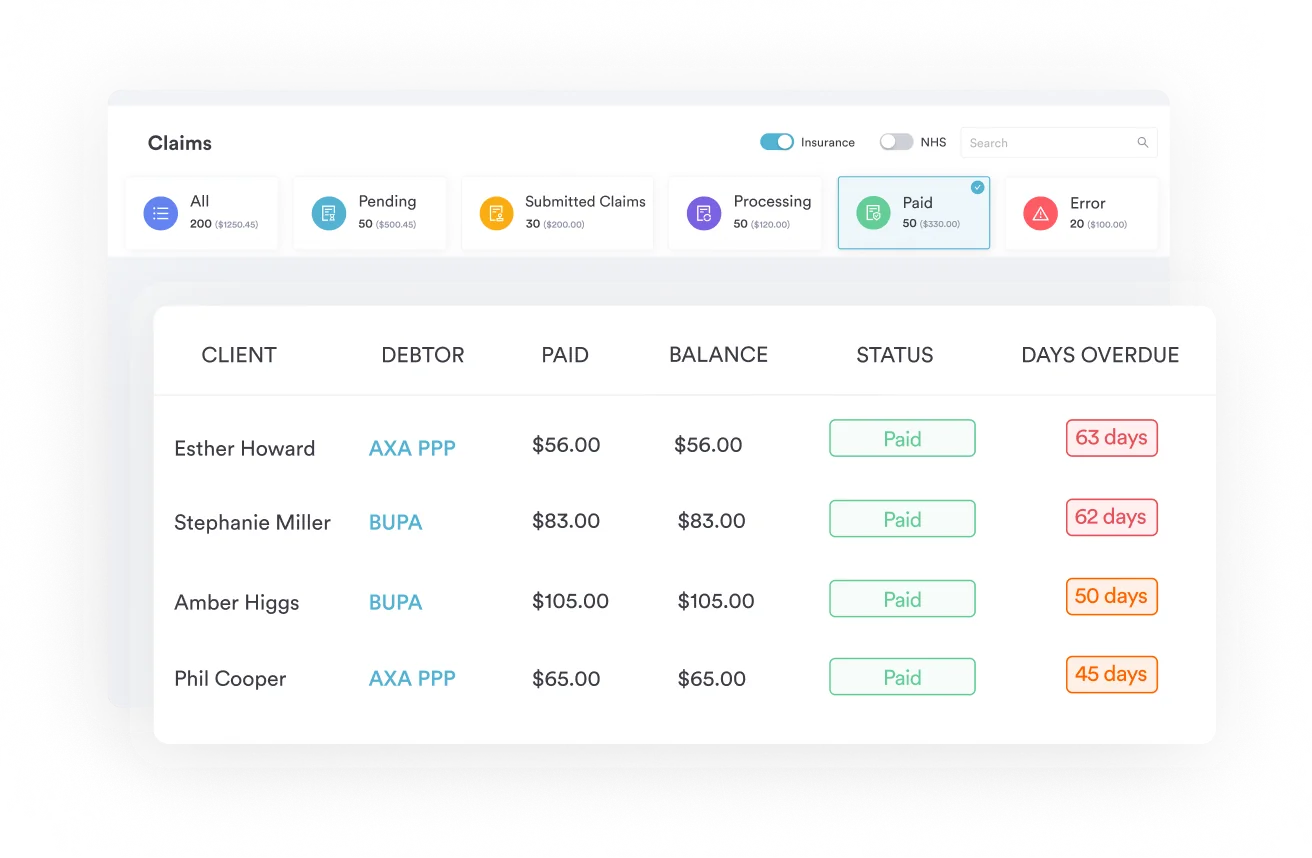
Pabau claims screen tracking an insurance claim from submission to payment
Pabau’s claim tracking shows where each hearing aid claim sits, so your team can chase a stalled V5256 claim before it turns into a denial.

Before a claim can be sent, Pabau’s claims management checks that required fields, such as the authorization code, are filled in. For US practices, it runs eligibility checks, tracks claim status and posts remittances. Your team sees a missing authorization before the payer does.

Send complete hearing aid claims the first time

Pabau pre-fills claims from the patient record and checks required fields, like authorization numbers, before a V5256 claim is sent.

Pabau claims management dashboard

Conclusion

Code V5256 from the fitting notes, not from memory. Confirm the ITE style and the single ear, and the code choice takes care of itself. Then put your effort into the authorization and the audiogram, because that is where these claims usually stall.

If one detail changes, the code changes with it. A second ear means V5260, and a different style means a different code. Book a demo to see how Pabau helps audiology practices send complete hearing aid claims the first time.

Continue your research

Continue your research

Billing the behind-the-ear version? HCPCS code V5257 covers the digital monaural BTE hearing aid and how it differs from in-the-ear styles.

Fitting BTE aids in both ears? HCPCS code V5261 covers the binaural BTE code, the two-ear counterpart of V5257.

Struggling with repeat rejections? Denial management in healthcare shows how to sort, appeal and prevent payer denials.

Want claims that pay on first submission? What makes a clean claim lists the fields and records that decide whether a claim pays first time.

New to the billing cycle? What is medical billing walks through the revenue cycle from visit to payment.

Frequently asked questions

What does ITE mean in HCPCS code V5256?

ITE stands for in-the-ear. The aid is custom-built from an ear impression and fills the outer bowl of the ear, as a full shell or half shell.

What is the difference between V5255 and V5256?

Both are digital monaural aids. V5255 is in-the-canal (ITC), a smaller shell at the canal opening. V5256 is in-the-ear (ITE), which fills more of the outer ear.

What is the binaural code for an ITE hearing aid?

V5260 is the digital binaural ITE code. Bill it once for a pair, rather than two units of V5256.

Do you need RT or LT modifiers with V5256?

Some Medicaid plans ask for RT or LT to show which ear was fitted. Others do not. Check the payer’s billing guide, and keep the ear in your fitting notes either way.

How often can a patient get a new V5256 hearing aid?

Payers set their own replacement limits. Many Medicaid and commercial plans allow one aid every few years, unless the hearing loss changes or the device is lost.

Does V5256 cover a rechargeable ITE aid?

Yes, if it is digital, monaural and in-the-ear. The power source does not change the code.
×