CCSD Code D1010: Radical mastoidectomy including meatoplasty
CCSD Code D1010: Definition and clinical scope CCSD Code D1010 is the UK private...

Last Updated: Nov 25, 2026
V5246 is the HCPCS Level II code for a digitally programmable analog hearing aid in an in-the-ear (ITE) style, fitted to one ear. It covers the device only, billed one unit per ear, with the dispensing fee and fitting services on their own lines.
Most V5246 errors come from its neighbors in the same family. V5244 is the completely-in-canal (CIC) version, V5245 the in-the-canal (ITC) version and V5247 the behind-the-ear (BTE) version. A matched pair fitted together falls under the binaural codes V5250-V5253 instead.
Let Pabau's smart automation suggest the right codes, reduce claim denials, and keep your practice compliant—effortlessly.
Automate repetitive tasks and focus on what matters most—your patients.
Reduce coding errors and ensure compliance with the latest regulations.
Clean claims, fewer denials, and faster reimbursements.
Powerful insights and reporting to help your practice thrive.
HIPAA compliant SOC 2 certified GDPR-compliant Trusted by 4,000+ clinics worldwide

V5246 is one digitally programmable analog hearing aid in an in-the-ear (ITE) shell, fitted to one ear and billed per ear.
Style decides the neighbor: V5244 is the CIC version, V5245 the ITC version and V5247 the BTE version of the same aid.
A matched pair belongs under the binaural programmable codes V5250 to V5253, so check the payer’s rules before billing two V5246 lines.
The dispensing fee goes on its own line as V5241 for one ear or V5160 for both, never inside the device charge.
Original Medicare excludes hearing aids by statute, so V5246 is paid through Medicare Advantage, Medicaid or commercial hearing benefits.
HCPCS code V5246 reports a single digitally programmable analog hearing aid in an in-the-ear (ITE) style, fitted to one ear. The full descriptor in the CMS HCPCS quarterly update files reads “Hearing aid, digitally programmable analog, monaural, ITE (in the ear).” One device, one ear, one unit on the claim line.
That single word, monaural, is where most trouble starts. Older reference sheets and some practice templates still describe V5246 as a binaural pair. Bill it that way and the claim fails on the descriptor before anyone looks at medical necessity.
Read the descriptor as three filters. The device has to pass all three before V5246 is the right answer.
The manufacturer’s spec sheet settles the first and third filters. If it says fully digital, the aid is V5256 instead. The audiogram and the order settle the second. Keep all three in the chart, because a reviewer will check them in that order.
The programmable analog family is V5244-V5247 (monaural) and V5250-V5253 (binaural), split by style. V5248 and V5249 sit between them but are conventional analog binaural aids.
Routing systems for one-sided hearing loss bill outside this family, such as V5230 for a two-sided system in glasses. The grid below puts each style and ear count on its own code.
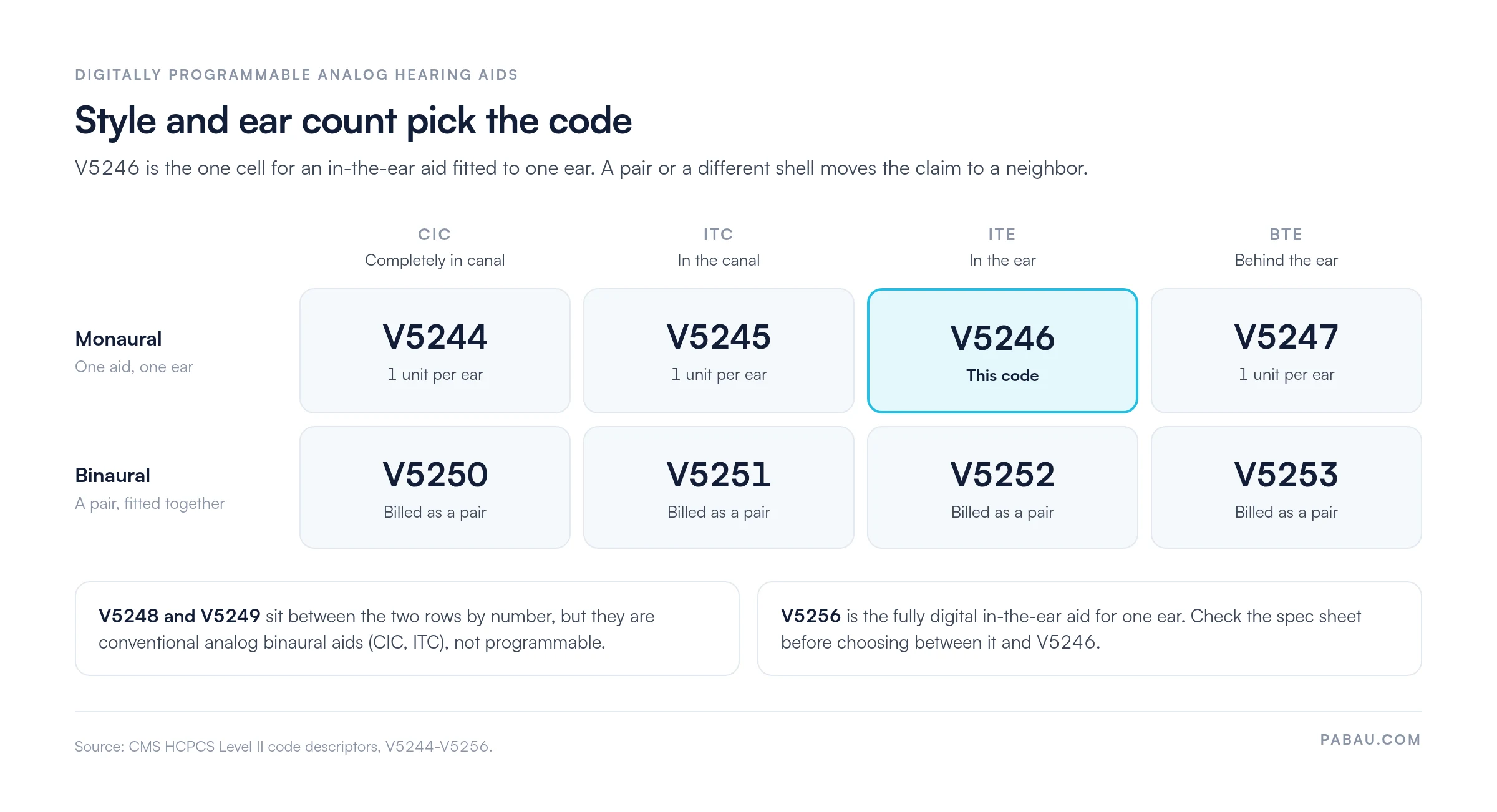
Two mix-ups come up again and again. The first is V5244, which looks like the ITE code but is the CIC version. The second is V5242, which some fee sheets list as a dispensing fee. It is an analog monaural CIC hearing aid, so a V5242 line beside V5246 bills a second device.
V5246 pays for the aid itself. The visits around it, the fee for dispensing and the supplies that follow all have codes of their own.
When no specific code fits a device, the catch-all is V5298, hearing aid, not otherwise classified. Use it only when that is true. V5090 is not a device code at all, since it reports a dispensing fee for an unspecified hearing aid. For any other V code, start from our HCPCS reference for billers.
A typical encounter produces three or four claim lines. Here is the order they are usually built in, with the code each one carries.
Watch the CPT side. On January 1, 2026, CPT 92590-92595 were replaced by a new set of hearing device service codes. Before then, 92590 was the monaural hearing aid exam and 92591 the binaural one. Dates of service from 2026 onward take the new codes, while the V codes did not change.
Some payers, including some Medicaid programs, want an RT or LT modifier on a monaural aid. It shows which ear was fitted and stops a second V5246 for the other ear from looking like a duplicate. Check the state manual before you assume.
Original Medicare does not pay for V5246. Section 1862(a)(7) of the Social Security Act excludes hearing aids and the exams for them. The Medicare Benefit Policy Manual, Chapter 16, §100 repeats that exclusion, as does 42 CFR 411.15(d).
The exclusion sits in the benefit itself, so stronger documentation or an appeal won’t change the outcome. Payment has to come from another source.
Ask for an advance beneficiary notice or a signed financial agreement when the patient is on Original Medicare only. They will pay out of pocket, and the paperwork should say so before the aid is ordered.
Run through this list before the claim leaves the practice. Each line maps to a denial that is easier to prevent than to appeal.
Most denials for this code repeat the same few errors. The table pairs each one with its fix, and logging them in your denial management workflow shows which ones keep coming back.
Picture a Medicaid patient with moderate loss in the right ear and near-normal hearing on the left. The audiologist fits one digitally programmable analog ITE aid to the right ear.
The claim carries V5246 with RT, one unit, and V5241 for the dispensing fee. The 2026 selection and fitting CPT codes go on their own lines. Prior authorization and the serial number sit on the claim and in the chart.
A year later, the left ear declines and needs an aid too. That second fitting is a new monaural claim, V5246 with LT. Had both ears been fitted on day one, the pair would have gone under V5252 with the V5160 binaural dispensing fee.
Most V5246 problems start before the claim is built. The authorization sits in an email, the device details live in a supplier invoice, and the code is typed from memory.
Pabau, a practice management platform with claims management built in, keeps those pieces on the patient’s case. It tracks the prior authorization code, dates and approved sessions, and warns you when an authorization code is missing. Claims fill from the record, and US claims go out through Claim.MD with eligibility checks and remittance posting.
The result is fewer claims bounced for a missing approval, and less time spent matching paperwork after the patient has gone home. A sound clean claim process starts there.

Pabau tracks prior authorization codes on each patient case and warns you when one is missing. Hearing aid claims then go out complete the first time.

V5246 is a narrow code, and that is its value. One programmable analog ITE aid, one ear, one unit. When the claim matches those three facts, the rest is payer routing.
If you fix one habit, make it checking laterality before the code is chosen. A pair belongs under V5252, and the dispensing fee belongs under V5241 or V5160, never V5242.
Book a demo to see how Pabau keeps authorizations and device details on the claim for your hearing care practice.

Need a broader framework for managing payer denials? Denial management in healthcare covers root-cause analysis and appeal workflows across code sets.
Building a clean-claim process from scratch? Clean claim submission outlines what decides whether a claim clears the clearinghouse on the first pass.
Looking for billing compliance guidance? Medical billing compliance covers documentation standards and audit readiness for busy billing teams.
Fitting an in-the-canal shell instead? HCPCS code V5245 covers the ITC version of the same programmable analog aid.
Dispensing a behind-the-ear model? HCPCS code V5247 is the BTE code in this monaural family.
An ITE aid fills the outer bowl of the ear, while an ITC aid sits mostly inside the ear canal. ITE shells are larger, so they suit wider loss ranges and easier handling. In this family, ITE is V5246 and ITC is V5245.
They are uncommon now, since most aids dispensed today are fully digital. Check the manufacturer’s spec sheet before coding. A fully digital ITE aid for one ear is V5256, not V5246.
It depends on the state. Many programs allow one aid per ear every few years, with earlier replacement only when hearing changes or the aid can’t be repaired. The state’s provider manual sets the limit.
No. V5246 describes a custom in-the-ear aid that is programmed and fitted for the patient. Over-the-counter aids are bought without a fitting, and most insurers don’t reimburse them under hearing aid V codes.
Bill the replacement as a new V5246 with the ear modifier, plus a dispensing fee if the payer allows one. Payers often ask for proof of the loss and a new prior authorization, so check their replacement policy first.