HCPCS Code E0272: Foam rubber mattress billing guide
HCPCS Code E0272: official descriptor and code overview HCPCS Code E0272 is the ...

Last Updated: Nov 6, 2026
V2530 is the HCPCS Level II code for contact lens, scleral, gas impermeable, per lens (for contact lens modification, see 92325). It bills one rigid scleral lens made from a material that blocks oxygen, historically PMMA. A pair of lenses goes on two claim lines, one per eye.
Few practices dispense it today, since modern scleral lenses are gas permeable and bill under V2531. Medicare covers V2530 for aphakia, but treats a scleral lens for keratoconus as an excluded refractive lens. The fitting is billed separately, usually with CPT 92313.
Let Pabau's smart automation suggest the right codes, reduce claim denials, and keep your practice compliant—effortlessly.
Automate repetitive tasks and focus on what matters most—your patients.
Reduce coding errors and ensure compliance with the latest regulations.
Clean claims, fewer denials, and faster reimbursements.
Powerful insights and reporting to help your practice thrive.
HIPAA compliant SOC 2 certified GDPR-compliant Trusted by 4,000+ clinics worldwide

HCPCS code V2530 bills one rigid scleral contact lens made from a gas impermeable material, such as PMMA. Each eye gets its own claim line.
V2530 and V2531 describe the same scleral design and differ only by gas permeability, so check the material on the lab order before you code.
Medicare covers contact lenses for aphakia, but treats a scleral lens for keratoconus or other irregular corneas as an excluded refractive lens.
Bill the fitting separately with CPT 92313, and send any lens modification to CPT 92325, as the descriptor directs.
Billing software such as Pabau pre-fills the CMS-1500 from the patient record and flags missing required fields before the claim goes out.
HCPCS code V2530 is the CMS code for “contact lens, scleral, gas impermeable, per lens.” The full descriptor adds a note: for contact lens modification, see CPT 92325. It sits in the V2500-V2599 contact lens range of the HCPCS Level II code set, which CMS maintains.
Three conditions define the code. The lens has a scleral design, its material blocks oxygen, and one unit equals one lens. In practice that means a hard scleral lens, historically made from PMMA (polymethyl methacrylate).
A scleral lens is a large-diameter rigid lens. It vaults over the cornea and rests on the white of the eye, with a fluid reservoir underneath. That design gives a smooth optical surface over a cornea that a soft lens can’t correct well.
Gas impermeable sclerals were the first scleral lenses in wide use. Because PMMA lets almost no oxygen through, modern scleral fittings moved to gas permeable materials. V2530 is now uncommon, but it still applies when the lab order shows an impermeable material.
Billed under V2530:
Billed with other codes:
V2530 and V2531 describe the same scleral lens design. They differ on one attribute, the oxygen permeability of the material. Because most scleral lenses dispensed today are gas permeable, the usual error is V2530 billed for a gas permeable lens.
When in doubt, ask the lab for the order before you code. The Dk value, the material’s oxygen permeability rating, settles which code applies. The diagnosis then settles who pays, as the chart below shows.
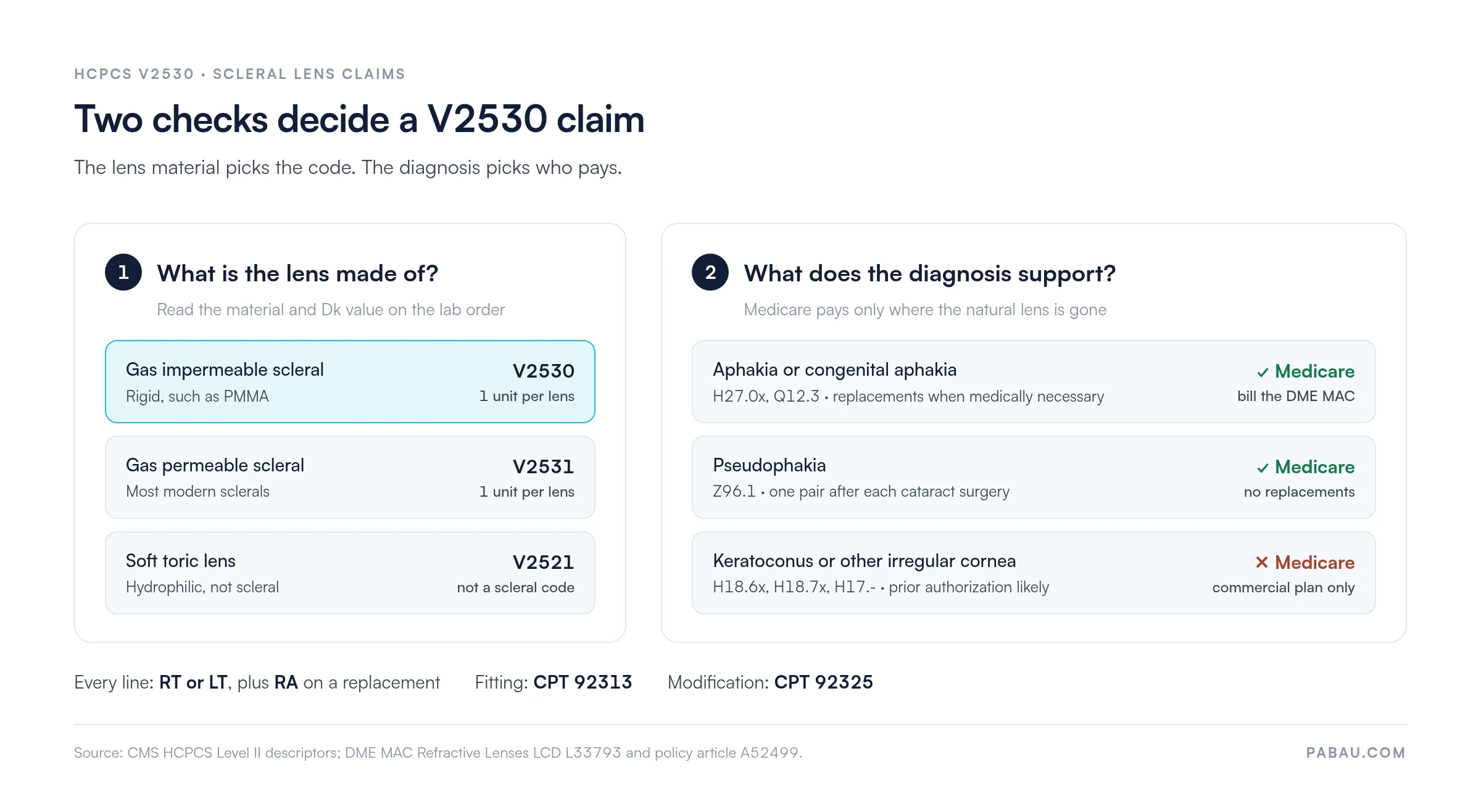
Every V2530 claim needs an ICD-10-CM diagnosis code that shows medical necessity. Which codes work depends on the payer. Medicare pays for contact lenses only after the natural lens is gone, while commercial plans usually cover irregular corneas.
Accepted diagnosis lists vary by plan, so check each payer’s medical policy before you submit. The CDC ICD-10-CM coding tool confirms a code is current and valid.
Section 1862(a)(7) of the Social Security Act excludes eyeglasses and contact lenses from Medicare coverage. The exception is a lens that replaces the natural lens of the eye. The DME MAC Refractive Lenses LCD (L33793) and its policy article (A52499) apply that rule to the V2500-series codes.
Under that policy article, covered diagnoses are limited to aphakia, congenital aphakia and pseudophakia. For an aphakic patient with no intraocular lens, the LCD also covers replacement lenses when they are medically necessary.
For a pseudophakic patient, coverage is one pair of glasses or contact lenses after each cataract surgery, and replacements are not covered.
Keratoconus and other irregular corneas fall outside that benefit. A scleral lens prescribed for them is an excluded refractive lens under Medicare, whatever the material. The narrow exception is a scleral cover shell (V2627), which is a prosthetic item and not a V2530 lens.
The policy article also requires the RT or LT modifier on every lens code. A Medicare claim for V2530 goes to the DME MAC, not the Part B carrier.
Commercial payers write their own medical-necessity criteria, and many cover scleral lenses for irregular corneas. Most ask for proof that glasses or soft lenses failed first. Coverage is never automatic, so verify each plan’s current policy before the lens is ordered.
Many commercial plans, Medicare Advantage plans and Medicaid managed care plans require prior authorization for a scleral lens. Traditional Medicare has no prior authorization step for the aphakia benefit.
A standard request for V2530 usually includes:
Send the request before you dispense, since retroactive authorization is hard to get. Check the patient’s benefits at the same time, with a routine for verifying insurance eligibility before each fitting appointment.
V2530 is billed per lens, so one unit equals one lens. A patient fitted in both eyes gets two claim lines, one with RT and one with LT. A pair billed as two units on one line is a frequent rejection.
Worked example: A patient with bilateral aphakia receives gas impermeable scleral lenses on the same day. The Medicare claim carries two lines:
Use the dispensing date, not the fitting date, as the date of service for the lens.
The fitting is a separate service. For a scleral lens, that’s CPT 92313, the corneoscleral lens fitting code. An initial keratoconus fitting may use CPT 92072 instead.
A later adjustment to the lens is modification, which the V2530 descriptor sends to CPT 92325. Some payers bundle the fitting into the lens, while others pay both. Check the contract before you bill them on the same date.
A gas impermeable scleral lens is an unusual order today, so payers may look closely at the record. Medical billing compliance on a V2530 claim means the file is complete before the claim goes out.
Run through this checklist before you submit:
Keep this documentation for at least seven years, or longer where a payer or state requires it. A clean claim starts at dispensing, while the paperwork is still easy to fix.
Before each batch goes out, check every V2530 line against the lab order. Confirm the material is gas impermeable, the line carries RT or LT, and the diagnosis fits the payer. That short check catches the most common rejections before they reach a rework queue.
V2530 denials cluster around a handful of causes. Each one traces back to a field on the claim or a document missing from the file.
For a wider reference, our guide to denial codes in medical billing covers the full list of claim adjustment reason codes (CARCs).
Eye care coders need to tell V2530 apart from the codes around it. Picking the wrong neighbor changes the allowed amount and the paperwork the payer expects.
Medicare pays for V2530 as a prosthetic supply, so the billing entity needs active DMEPOS supplier enrollment. Optometrists and ophthalmologists who dispense lenses themselves usually enroll as suppliers. The alternative is to route the lens through a separately enrolled optical supplier.
DMEPOS enrollment for Medicare includes:
Medicare publishes DMEPOS rates in the CMS DMEPOS fee schedule. Rates vary by state and change every January 1, so a fixed dollar figure here would date quickly. Scleral lenses are purchased items, so the allowed amount is a one-time fee for each lens.
Commercial allowed amounts are set per contract. Check your contracted rate for V2530 in each payer’s fee schedule before you dispense.
Verify DMEPOS enrollment status every quarter, not only at setup. A lapsed enrollment or bond stays invisible until lens claims start coming back with a supplier eligibility denial.
Many eye care teams still build lens claims by hand. They retype the diagnosis, lens details and authorization number from the chart, and each retype risks a missing field.
Pabau’s claims tools pre-fill the CMS-1500 straight from the patient record. Its code lookup libraries help your coders find the HCPCS and ICD-10 codes they need. Before a claim goes out, Pabau checks required fields, such as the prior authorization number.
In the US, Pabau sends claims, runs eligibility checks and posts electronic remittance advice (ERA) through Claim.MD. Your team gets cleaner claims management, with each lens line tracked from submission to payment.
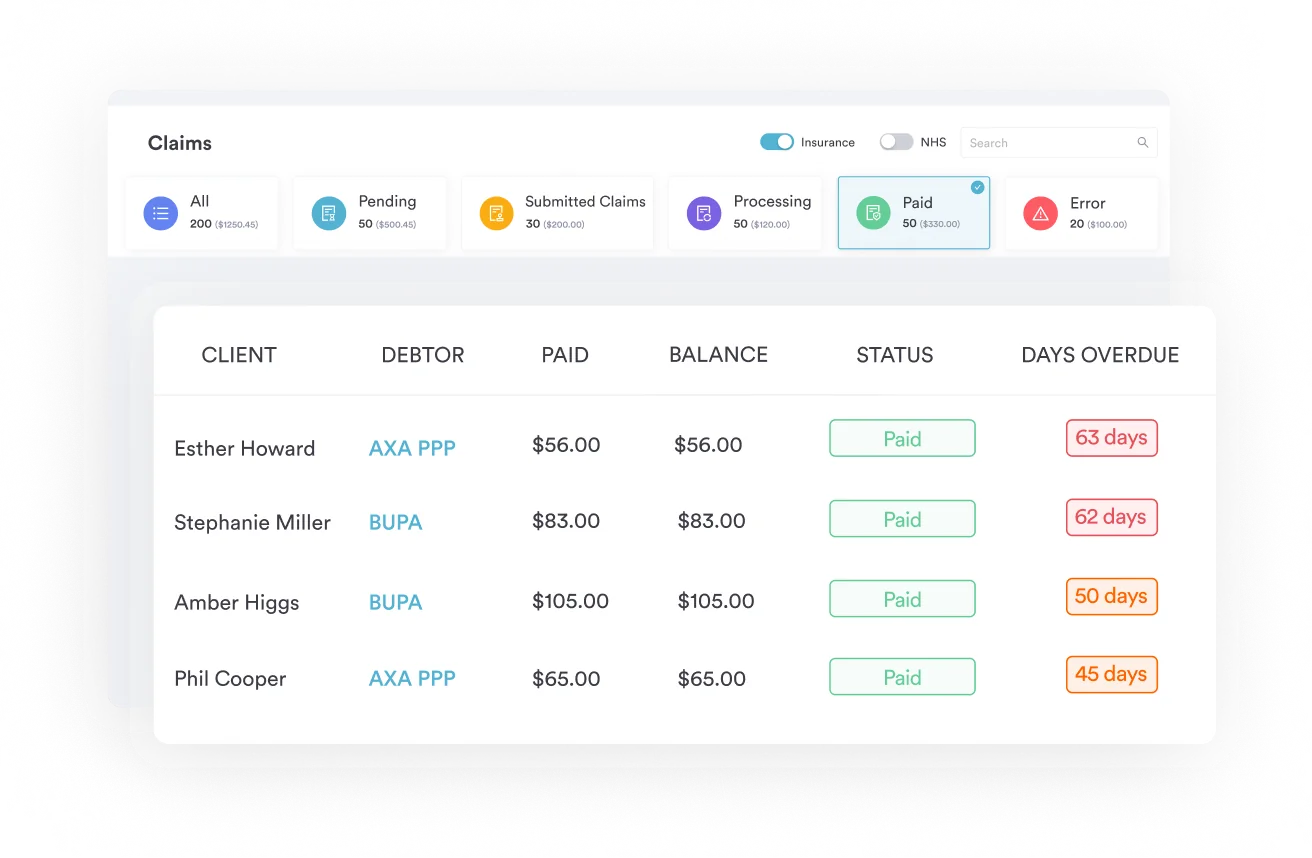

Pabau pre-fills the CMS-1500 from the patient record and checks required fields, such as laterality modifiers and authorization numbers, before a claim is sent. US claims, eligibility checks and remittances run through Claim.MD.

V2530 is a narrow code for an uncommon lens. Before you use it, read the material on the lab order. Most scleral lenses today are gas permeable and belong under V2531, so V2530 should be the exception on your claims.
Then match the payer to the diagnosis. Medicare pays for an aphakic eye and excludes keratoconus, so an irregular-cornea claim depends on commercial authorization. Settle that before the lens is ordered, and the practice won’t absorb the cost of a custom lens.
Book a demo to see how Pabau pre-fills and checks your scleral lens claims before they reach the payer.

Managing denials across multiple payers? Denial management in healthcare covers systematic workflows for reducing rejection rates.
V2530 bills one rigid scleral contact lens made from a gas impermeable material, such as PMMA. Practices use it for aphakia and irregular corneas, such as keratoconus, when the lab order shows an impermeable material.
Both codes describe a scleral contact lens billed per lens. V2530 is for a gas impermeable material, and V2531 is for a gas permeable one. Most modern scleral lenses are gas permeable, so check the Dk value on the lab order.
No. V2530 is a rigid scleral lens. A soft toric or prism ballast lens is billed with V2521, one of the hydrophilic contact lens codes.
Medicare covers contact lenses, including V2530, for aphakia and congenital aphakia. For pseudophakia, it covers one pair of glasses or contact lenses after each cataract surgery. A scleral lens for keratoconus is an excluded refractive lens under Medicare.
No. The V2530 descriptor sends contact lens modification to CPT 92325. Bill the modification as its own service, and keep V2530 for the lens itself.
Bill one unit per lens, on its own line with RT or LT. A pair is two lines. Replacement limits depend on the payer, and Medicare covers replacements for aphakic patients when they are medically necessary.