HCPCS code V2599: Other type contact lens billing guide
What is HCPCS code V2599? HCPCS code V2599 is the Level II supply code for a con...

Last Updated: Oct 20, 2026
92072 is the CPT code for fitting of contact lens for management of keratoconus, initial fitting. It pays for the professional fitting of both eyes, whatever lens type is used, and excludes the lens itself.
Most denials on this code trace back to two mistakes. One is billing it for a follow-up fitting visit, since it covers only the initial encounter. The other is pairing it with the wrong ICD-10 code.
Let Pabau's smart automation suggest the right codes, reduce claim denials, and keep your practice compliant—effortlessly.
Automate repetitive tasks and focus on what matters most—your patients.
Reduce coding errors and ensure compliance with the latest regulations.
Clean claims, fewer denials, and faster reimbursements.
Powerful insights and reporting to help your practice thrive.
HIPAA compliant SOC 2 certified GDPR-compliant Trusted by 4,000+ clinics worldwide

CPT Code 92072 covers the initial fitting only, so subsequent fitting visits are billed with E&M codes instead.
Valid ICD-10 pairings are H18.601 through H18.629, and the unspecified-eye codes such as H18.609 raise denial risk with many payers.
92072 is a bilateral code, so a fitting of both eyes is billed once, with no -50 modifier and no second line.
The physical contact lens supply is billed separately using HCPCS V-codes and is not included in 92072.
Practice management software like Pabau flags ICD-10 mismatches and modifier errors before claims leave the practice.
According to the American Medical Association’s CPT code set, CPT Code 92072 is described as: Fitting of contact lens for management of keratoconus, initial fitting.
The AMA CPT Editorial Panel maintains this descriptor. The code pays for the professional fitting service once for both eyes, whichever lens type the patient needs.
Three elements define what 92072 covers in a single encounter.
Four services sit outside 92072 and need their own codes or no charge at all:
92071 and 92072 sit side by side in the CPT code set, and swapping one for the other is a classic keratoconus miscoding error. According to the AAPC CPT code reference and the American Academy of Ophthalmology’s Savvy Coder guidance, the two codes separate by diagnosis, not lens type.
A keratoconus patient fitted with an RGP lens must be billed under 92072 paired with an H18.6 code. Billing 92071 instead, even with the same lens type, misrepresents the diagnosis, and payers can flag it on audit.
The same goes for 92310, the routine contact lens fitting code. Refer to a current procedure-to-diagnosis crosswalk tool to verify ICD-10 pairing before submitting.
Lens design does not change the code here. A scleral lens fitted for keratoconus still bills as 92072, while a corneoscleral fitting outside keratoconus takes CPT 92313.
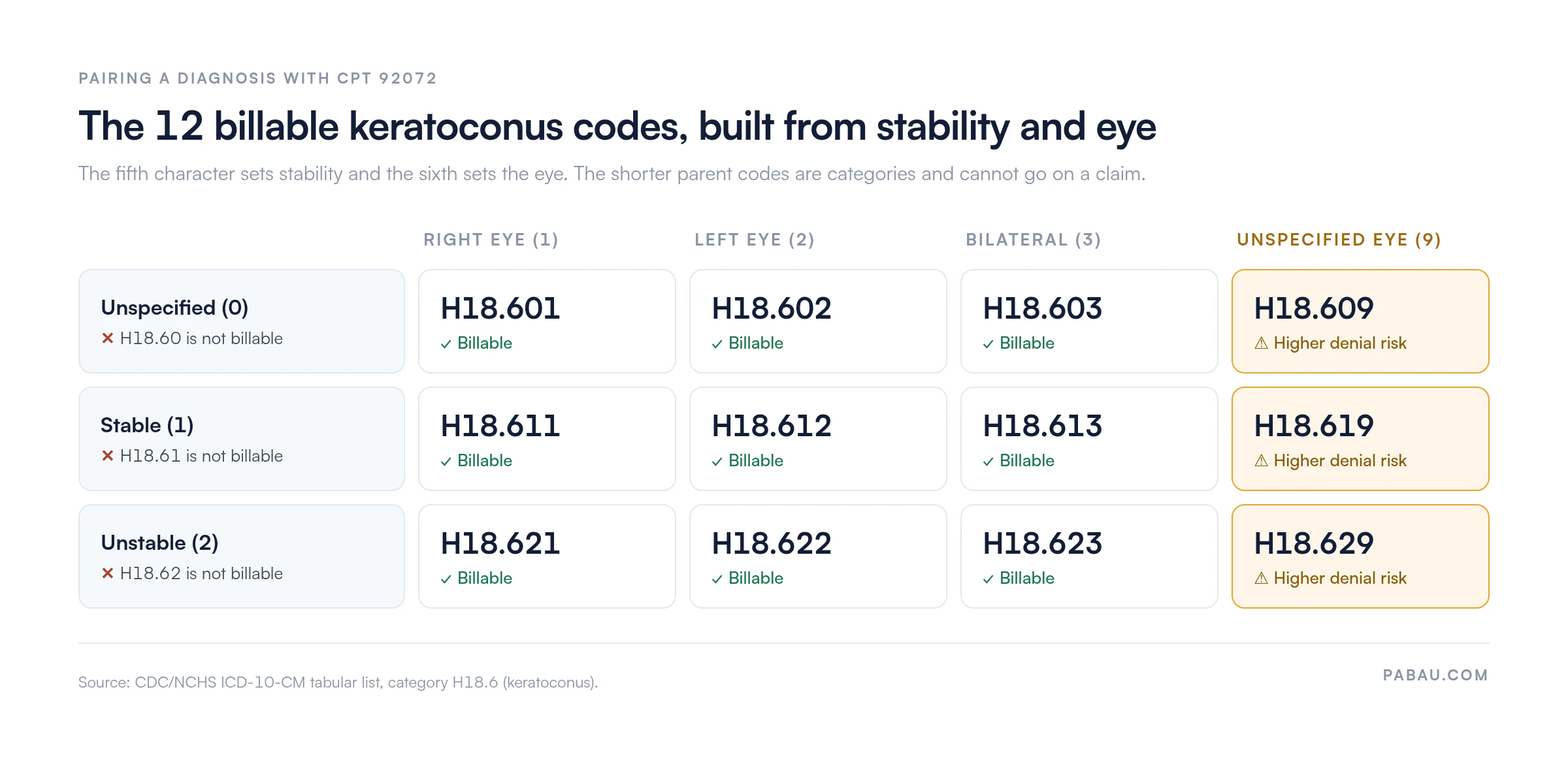
Keratoconus claims under CPT Code 92072 require a billable H18.6 diagnosis code. Payers increasingly expect the sub-code that names the eye. Submitting H18.609 (keratoconus, unspecified, unspecified eye) raises denial risk when the chart documents the treated eye. Per the CDC/NCHS ICD-10-CM tool, the valid codes are:
Code to the highest level of specificity the documentation supports. If the fitting note names the right or left eye, use the laterality-specific sub-code. H18.609 belongs on a claim only when the record does not say which eye was treated.
The table covers the codes you will reach for most, but the full set follows one pattern. After H18.6, the fifth character records stability (0 unspecified, 1 stable, 2 unstable). The sixth records the eye (1 right, 2 left, 3 bilateral, 9 unspecified). That gives 12 billable codes, laid out below.
Every element below must appear in the clinical note for the fitting visit. Payers audit these fields during retrospective review. A note that describes the lens trial without the supporting clinical data will not survive appeal.
Many practices build a keratoconus fitting template into their encounter notes. The template prompts for each required field while the patient is still in the chair, so nobody has to reconstruct the note during an appeal.
CPT Code 92072 is a bilateral code, so one line pays for fitting both eyes. Modifier choice therefore turns mostly on whether a separate evaluation and management (E&M) service was billed on the same date.
Modifiers -E1 through -E4 (eyelid designations) do not apply to contact lens fitting. Neither does -GN, which marks services under an outpatient speech-language pathology plan of care. Physical therapy services carry -GP instead. A bilateral fitting billed on two lines, or with -50, is the modifier error most likely to trigger a duplicate-claim denial.
Medicare physician fee schedule reimbursement for CPT Code 92072 is calculated from its assigned relative value units (RVUs) multiplied by the annual conversion factor.
According to the CMS Physician Fee Schedule lookup tool, practices should confirm current-year rates by searching code 92072 and selecting their MAC and geographic area.
The 2026 conversion factor and locality-adjusted rates are available through that tool. With the component RVU values in hand, you can calculate your non-facility reimbursement.
Commercial payers set their own contracted rates, which typically range above Medicare’s allowable. The lens supply (HCPCS V-codes such as V2530 for scleral lenses) is billed separately, under its own coverage and fee schedule rules. When you review collection rates for keratoconus patients, reconcile 92072 payments against both the Medicare allowable and your contracted commercial rates.
Each January, pull your MAC’s updated fee schedule from the CMS Physician Fee Schedule lookup tool before your first 92072 claim. Compare it against the fee table in your practice management system. A 2025 fee loaded against a 2026 submission creates underpayment that compounds across every keratoconus fitting for the year.
Medicare Part B covers CPT Code 92072 when the fitting is medically necessary. That means standard spectacles or soft contact lenses cannot adequately correct the patient’s keratoconus. Each Medicare Administrative Contractor (MAC) sets the detailed criteria in a Local Coverage Determination (LCD).
Find your MAC’s LCD by searching for “keratoconus contact lens” on the CMS coverage database before you build a documentation template.
The spectacle attempt behind that necessity statement carries its own code. A monofocal fitting is billed as CPT 92340, which puts the earlier correction attempt in the claim history.
Medicare does not reimburse the physical lens supply under the fitting code. The lens is billed separately with the appropriate HCPCS V-code, under its own coverage and documentation rules. Checking insurance eligibility at scheduling tells you whether the plan needs prior authorization before the fitting.
Commercial payers vary widely on prior authorization. Some want corneal topography results and documented corrected visual acuity with a standard lens before they approve the fitting. Others issue blanket authorizations for all H18.6 diagnoses, so verify each payer before the appointment.
Medicaid coverage for 92072 varies by state. Many state Medicaid programs cover specialty contact lens fitting for keratoconus as a medically necessary service. Age limits, prior authorization requirements, and annual fitting allowances differ from state to state. Check your state’s Medicaid fee schedule and LCD equivalents before billing.
CPT Code 92072 generates a predictable set of denial reasons, and most are preventable with a documentation review before the claim goes out.
If you submit 92072 claims electronically, a clearinghouse such as Claim.MD can validate ICD-10 pairing and flag modifier inconsistencies before the claim reaches the payer. When a rejection does come back, look up the medical billing denial codes on the remittance, so the appeal answers the reason the payer gave.
Run a quarterly audit of your 92072 claims. Pull every encounter coded 92072 in the past 90 days and confirm each one is the patient’s first keratoconus fitting on record. Review and correct any repeat claim before the payer’s retrospective audit window closes.
Yes, CPT Code 92072 may be billed alongside a comprehensive ophthalmological or optometric exam on the same date of service. That’s 92004 for new patients and 92014 for established patients. The exam must be a separately identifiable, medically necessary service, documented beyond the fitting itself.
The key requirements for same-day billing are:
A preventable 92072 denial usually starts in the fitting note or on the claim line. The note lacks its medical necessity statement, or the modifier is wrong. Practice management software like Pabau keeps both on the same encounter. Its claims management software attaches the ICD-10 diagnosis codes to each encounter record and flags missing modifiers.
Fitting documentation is stored against the patient record too, so it’s ready the day an auditor asks for it.
For US payers, Pabau’s integration with the Claim.MD clearinghouse checks eligibility before the fitting appointment, so your team knows the patient’s coverage status in advance. The superbill workflow exports encounter data in CMS-1500 format, pre-filled with the procedure and diagnosis codes captured at the point of care. That means fewer manual data-entry errors and a shorter billing cycle for specialty lens encounters.

Pabau’s claims management software validates ICD-10 code pairing, flags missing modifiers, and stores documentation against each encounter. Give your billing team a pre-submission review layer that catches keratoconus coding errors at the point of care.

A clean 92072 claim comes down to three questions you can answer before it goes out. Is this the initial keratoconus fitting? Does the note prove medical necessity with topography findings? Does the diagnosis code name the eye?
Answer all three and most of the denial reasons above never come up. The trade-off is a few extra minutes at the fitting visit, because a complete note takes longer than a lens order. That time costs far less than an appeal.
Book a demo to see how Pabau checks the diagnosis, modifiers and fitting note on every 92072 claim before it reaches the payer.

Need to understand how denials are managed systematically? Denial management in healthcare walks through the end-to-end process of tracking, appealing, and preventing claim rejections.
Fitting a routine contact lens instead? CPT code 92310 explains the routine corneal lens fitting code, and why it never goes on a keratoconus claim.
Want to verify patient coverage before the fitting visit? Insurance eligibility verification explains how to confirm benefit status and prior authorization requirements upfront.
Billing the lens supply as well? HCPCS code V2513 explains how to report an extended-wear gas permeable lens alongside the fitting.
CPT Code 92072 covers the initial fitting of a contact lens for keratoconus management. That includes trial lens selection, over-refraction, and the fitting evaluation performed during the first encounter. It does not include the physical lens supply (billed with HCPCS V-codes), subsequent fitting visits, or a separately billed refraction.
CPT 92071 is for fitting a therapeutic contact lens for ocular surface disease, such as keratitis or dry eye. CPT 92072 is specifically for the initial fitting of a contact lens for keratoconus management. The diagnosis separates them: H18.6x (keratoconus) drives 92072, while other corneal surface diagnoses drive 92071. Using 92071 on a keratoconus patient is a coding error.
Medicare Part B may cover CPT Code 92072 when the fitting is medically necessary and standard spectacles or soft lenses cannot provide adequate correction. Coverage is conditional on the criteria in your MAC’s Local Coverage Determination (LCD). Medicare does not cover the physical lens separately under this code; the lens supply requires a separate HCPCS V-code claim.
92072 is a bilateral code billed once per fitting, so it needs no -RT, -LT or -50 modifier to cover both eyes. The laterality-specific ICD-10 sub-code names the eye. Modifier -25 applies to any same-day E&M code (92004 or 92014), not to 92072 itself.
The usual causes are billing 92072 for a follow-up visit, when it is initial-only, and using an unspecified-eye code such as H18.609. Missing medical necessity documentation also triggers denials. So do billing a bilateral fitting twice and submitting a same-day E&M without modifier -25. A plan exclusion for contact lens fitting is the denial reason least recoverable on appeal.
Yes, provided the eye exam represents a separately identifiable, significant service beyond the fitting evaluation itself. Apply modifier -25 to the E&M code (92004 or 92014) and document the two services distinctly in the clinical note. Confirm the payer’s bundling edit policy before submitting, since some payers deny the combination regardless of modifier.