ICD-10 code Y83.0: Surgical operation with whole organ transplant
ICD-10 code Y83.0 names the transplant as the cause, not the problem ICD-10 code...

Last Updated: Nov 19, 2026
Billable Code Specific Code
Z97.3 is the billable ICD-10-CM code for presence of spectacles and contact lenses. It records that a patient wears glasses or contact lenses, and it describes a status rather than a disease.
Report it as an additional code after the condition or encounter that brought the patient in, such as myopia, keratoconus or a lens fitting (Z46.0). Don't confuse it with Z96.1, which records an implanted intraocular lens, or Z97.4, the external hearing aid. Z97.3 is valid for FY2027 claims.
Let Pabau's smart automation suggest the right codes, reduce claim denials, and keep your practice compliant—effortlessly.
Automate repetitive tasks and focus on what matters most—your patients.
Reduce coding errors and ensure compliance with the latest regulations.
Clean claims, fewer denials, and faster reimbursements.
Powerful insights and reporting to help your practice thrive.
HIPAA compliant SOC 2 certified GDPR-compliant Trusted by 4,000+ clinics worldwide

Z97.3 is a billable FY2027 ICD-10-CM code for presence of spectacles and contact lenses, in category Z97 of Chapter 21.
Report Z97.3 as an additional code, after the eye condition or encounter that brought the patient in.
Z97.3 covers both spectacles and contact lenses, and Z97.4 is the external hearing aid, so never use Z97.4 for lens status.
Leave Z97.3 off a claim coded H18.82-, because that code already says the corneal disorder is due to a contact lens.
Pabau, a practice management platform, pre-fills the claim from the patient record, checks required fields and submits it through Claim.MD.
ICD-10 code Z97.3 is the billable ICD-10-CM code for presence of spectacles and contact lenses. The descriptor is current in CMS’s FY2027 ICD-10-CM files, which apply to encounters from October 1, 2026 to September 30, 2027. It sits in category Z97, Presence of other devices, in Chapter 21.
The code records a status, not a disease. It tells the payer the patient wears glasses or contact lenses, which explains the lens work on the same claim. It never explains the visit by itself.
Z97.3 documents the presence of spectacles and contact lenses. That includes single-vision and progressive glasses, and soft, rigid gas-permeable, extended-wear and scleral lenses. It applies whether the patient corrects one eye or both.
Contact lens visits are where coders reach for it most. Typical scenarios:
When the lens causes trouble, the active condition takes the lead. Z97.3 then plays a supporting role, or drops off the claim when it adds no information.
One pairing is redundant. The FY2027 Official Guidelines say a status code shouldn’t join a diagnosis code that already carries the same information. H18.82x already names the contact lens, so Z97.3 adds nothing beside it.
Category Z97 covers assistive or corrective devices that aren’t implants or grafts. Read the whole block once and the Z97.3 versus Z97.4 mix-up stops.
Spectacle wearers are coded to Z97.3 too, so no separate glasses code exists in this block. The CDC/NCHS ICD-10-CM browser shows each descriptor for the year you’re billing.
Z97.3 goes after the principal diagnosis on the claim. Per the ICD-10-CM Official Guidelines published by CMS, status codes give context that affects care. The principal diagnosis has to reflect why the patient came in.
Build the claim in this order:
The reason for the visit decides what goes first, and whether Z97.3 belongs at all. The guide below sorts the four situations coders meet most.
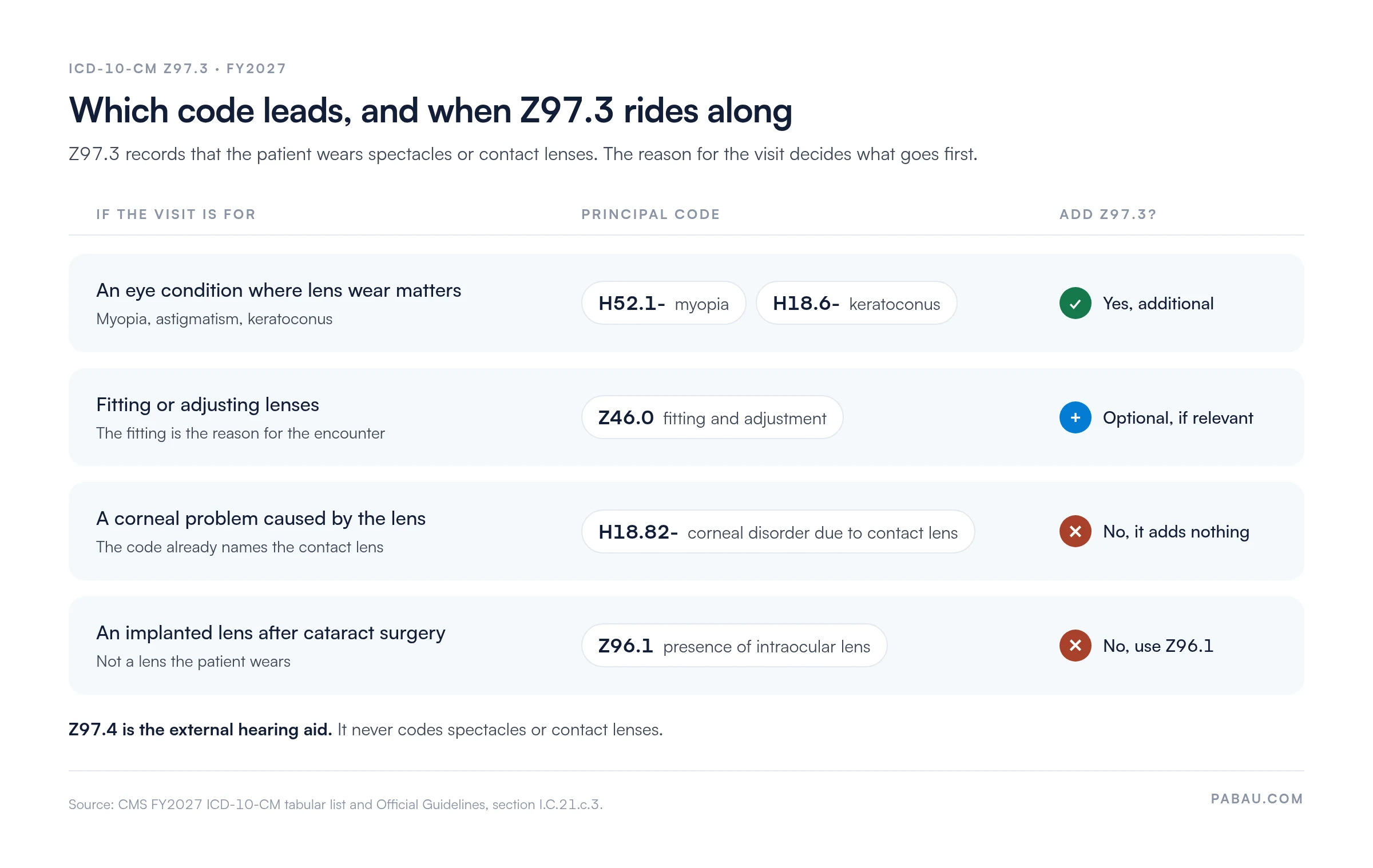
For the initial keratoconus fitting itself, CPT has a dedicated code, 92072. Z97 also carries an Excludes2 note for fitting codes (Z44-Z46), so Z46.0 and Z97.3 may appear on the same claim.
Check CPT descriptors against the AAPC Codify ICD-10-CM reference and the current AMA CPT manual. Procedure code assignments can change with annual updates.
A search for “contact lens” in most EHRs returns several codes at once. Here’s when each one is the right pick instead.
Search ‘contact lens’ in your EHR’s ICD-10 lookup before you pick Z97.3. Many systems list Z46.0, H18.82x and Z97.3 together. Save the common Z97.3 pairings as favorites so busy sessions don’t end in the wrong click.
The chart must support Z97.3 before it reaches a claim. The note needs to show that the patient wears glasses or contact lenses, and that lens status matters to this visit. A note that says only “refractive error” doesn’t support it.
Capture these details at the visit rather than rebuilding them after a denial. An intake form with lens history fields saves the chart hunt later.
A Z97.3 claim moves from the visit note to code selection, then to benefit routing and the clearinghouse. Each handoff is a chance for one of these errors to slip through.
Z97.3 doesn’t trigger payment on its own. It supports the billable services on the same claim, and how payers treat it depends on the plan type.
Medicare: Medicare doesn’t cover routine refractions, eyeglasses or contact lenses, except after cataract surgery that implants an IOL. Z97.3 shows up on Medicare claims when lens wear accompanies a medically necessary service, such as keratoconus monitoring. The Local Coverage Determination for that service decides coverage, so check the Medicare Coverage Database.
Commercial insurers: most plans cover contact lens exams under vision benefits rather than medical benefits. When a corneal condition sends the exam to the medical plan, Z97.3 follows the active diagnosis. A claim with only Z97.3 and no condition code is usually denied for medical necessity.
Medicaid: coverage varies by state. Some programs cover medically indicated lenses for keratoconus, aphakia or anisometropia, while others cover glasses only. Verify the state Medicaid program’s coverage policy before you submit. Solid medical billing workflows help staff route each lens claim to the right benefit from the start.
Most Z97.3 denials come from one of two errors. The code lands first on the claim, or the note doesn’t support the lens status.
Read each rejection against the payer’s denial codes to find which row it matches. Effective denial management workflows then fix the template or intake step that let the error through.
Pull your contact lens claims from the last 90 days. Filter for Z97.3 in position one, or Z97.3 with no condition code. Fix the template or intake form behind each hit before the next billing cycle.
In many optometry practices, the coder rekeys the diagnosis from the chart into a separate billing tool. That handoff is where Z97.3 slips into first position or the condition code goes missing.
Pabau’s claims management software pre-fills the claim from the patient record, so the diagnoses on file seed the claim. Its ICD-10-CM and CPT lookup libraries cover more than 20,000 codes. Before the claim can be sent, Pabau checks that required fields like membership numbers are complete.
In the US, claims go out through Claim.MD, with real-time eligibility checks before the visit and ERA remittances after it. Your team spots denial patterns from the remittance data instead of a stack of paper EOBs. That makes submitting a clean claim the routine outcome rather than a lucky one.

Pabau pre-fills each claim from the patient record, checks required fields before you send, and submits US claims through Claim.MD with eligibility checks and ERA. Book a demo to see it in your optometry or ophthalmology practice.

Z97.3 is one of the easier codes to get right once you treat it as context. Lead with the reason the patient came in, then add Z97.3 only when the lead code doesn’t already mention lenses.
The payoff is fewer medical-necessity denials on lens exams, and audits that pass on the first read. The trade-off is a minute more at intake to record lens type and schedule. That minute is cheaper than an appeal.
Book a demo to see how Pabau builds each contact lens claim from the patient record, so your team stops rekeying codes.

Struggling with claim denial patterns across your practice? Understanding denial management in healthcare covers the core workflows for tracking, appealing and preventing repeat denials.
Want to know what makes a claim pay the first time? Submitting a clean claim explains the data elements payers check before they process a claim.
Billing the glasses side of the visit? CPT code 92340: Fitting of monofocal spectacles covers the spectacle-fitting code that often travels with Z97.3.
Coding the lens itself? HCPCS code V2510: Gas permeable contact lens explains how the lens supply is billed per lens.
Yes. Z97.3 covers spectacles as well as contact lenses, so glasses wearers take the same code. Report it as an additional diagnosis when the glasses matter to the visit.
No. Payers expect the condition or encounter code first, such as myopia or a lens fitting. A claim led by Z97.3, or carrying it alone, is usually denied.
Use Z01.00 when the exam finds nothing abnormal, and Z01.01 when it does. Code the abnormal finding as well when you use Z01.01.
Yes. Medicare Part B covers one pair of glasses or one set of contact lenses after each cataract surgery that implants an IOL. Code the implant status with Z96.1.
Yes. Z97.3 is a billable code in the FY2027 ICD-10-CM code set, which applies to encounters from October 1, 2026 to September 30, 2027.